

Quick Summary
This blog explains how Google Ads helped a jewelry brand move beyond simply generating website traffic and focus on reaching customers with genuine buying intent. It covers the role of Search and Shopping campaigns, Performance Max, product-feed optimization, remarketing, conversion-rate optimization, and ROAS tracking in turning clicks into measurable sales. The key lesson is that successful jewelry advertising is not about reaching the largest audience, but about connecting the right products with the right customers at the right stage of their buying journey.
The article also emphasizes that Google Ads works best as part of a broader digital marketing strategy involving SEO, Meta Ads, content, and marketplace optimization. Continuous campaign optimization, accurate tracking, strong product pages, and performance-focused budgeting can help jewelry brands build a more profitable and sustainable eCommerce strategy.
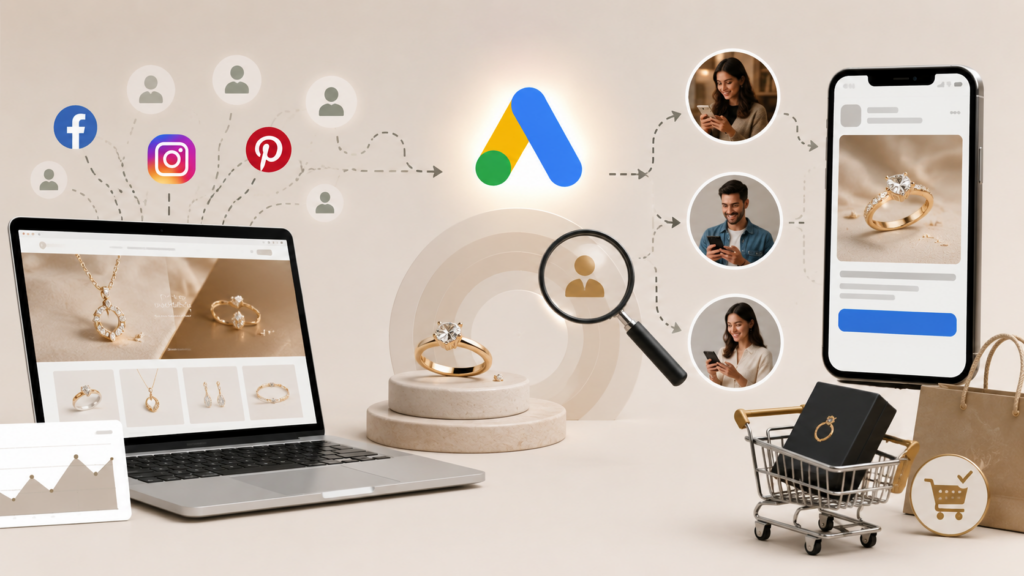 Running a jewelry brand online can feel exciting at first. You have beautiful products, carefully selected designs, attractive photographs, and a website that looks professional. You may even have visitors coming in every day. Yet, there comes a frustrating moment when you look at your sales and wonder, “Where are the actual buyers?”
That was exactly the challenge I faced with my jewelry brand.
People were visiting my website, browsing rings, necklaces, earrings, bracelets, and other pieces, but getting those visitors to actually purchase was a different story. Social media brought attention, but attention did not always translate into transactions. Organic search was useful, but building strong rankings takes time. I needed a way to reach people who were already looking for jewelry and were closer to making a buying decision.
That is where Google Ads changed the way I thought about digital marketing.
Instead of simply trying to put my jewelry in front of as many people as possible, the goal became much more practical: reach the right people at the right moment with the right product.
Google Ads Changed the Meaning of “Traffic” for My Brand
Before using paid search strategically, I used to think that more website visitors automatically meant more sales. It sounds logical, but online retail does not work that way.
Someone searching for “jewelry ideas” may simply be looking for inspiration. Another person searching for “gold earrings for women” could be comparing products. But someone searching for a specific product, style, material, or shopping option may already have a strong purchase intention.
Google Ads allowed my brand to appear when customers were actively searching for products like mine.
That difference was important.
Rather than waiting for potential customers to discover my brand, I could meet them during the moment when they were already expressing interest. For a jewelry business, where customers often compare designs, prices, quality, styles, and delivery options before purchasing, that timing can make a significant difference.
The campaign was no longer simply about clicks. It became about understanding why someone was searching and what they were likely to do next.
The Biggest Shift Was Targeting Buying Intent
Jewelry is an emotional purchase, but it is also a highly considered purchase.
A customer may spend several minutes comparing similar necklaces or revisit the same ring multiple times before ordering. This means advertising has to do more than create awareness. It needs to support the customer’s buying journey.
Google Search campaigns helped put the brand in front of people using relevant commercial search terms. Shopping campaigns added another layer by allowing customers to discover products visually while comparing options.
This was especially useful because jewelry is naturally visual. Customers want to see the product before they click. They want an immediate impression of the design, finish, style, and price.
That is why product-level advertising became such an important part of the strategy.
Google Shopping Put My Products in Front of Shoppers
One of the most useful changes was focusing on Google Shopping rather than relying only on traditional search advertisements.
When someone is searching for jewelry, seeing an actual product image alongside its name and price can be much more persuasive than a text-only advertisement. It gives the customer a reason to investigate before they even reach the website.
But simply uploading products to Google is not enough.
Product titles, descriptions, images, product attributes, identifiers, and feed information all influence how effectively products can participate in Shopping campaigns. Poorly structured product information can make it harder for the right shoppers to discover the right products.
For my brand, this meant looking at the product feed as part of the advertising strategy rather than treating it as a technical afterthought.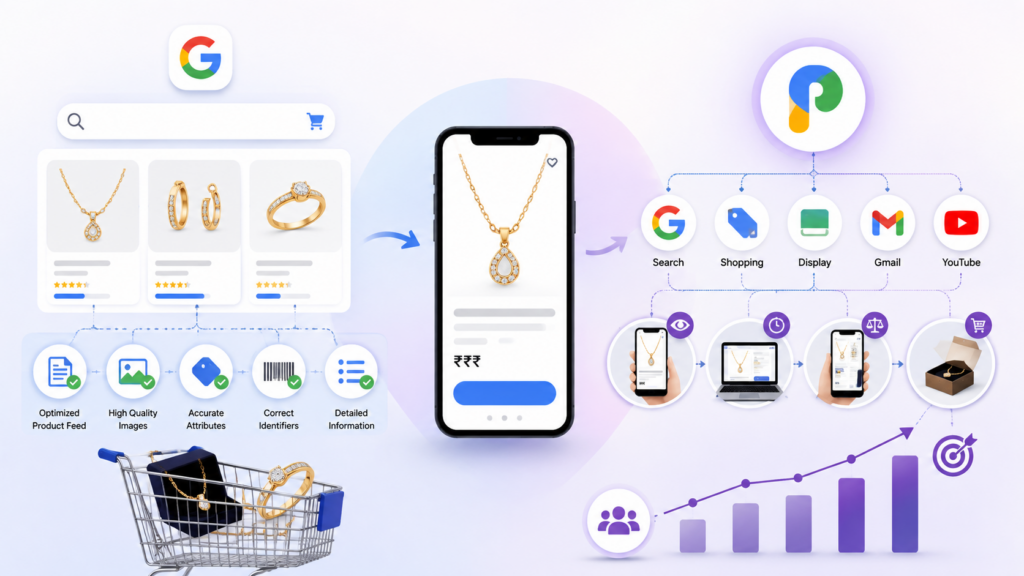
Performance Max Helped Connect Different Customer Touchpoints
Another part of the strategy was Performance Max.
Customers rarely follow a perfectly straight path from search to purchase. Someone might see a product today, visit the website tomorrow, compare another brand later, and finally make a purchase several days afterward.
Performance Max can help advertisers reach customers across multiple Google properties through one campaign structure, including Search, Shopping, Display, Gmail, and YouTube.
For a jewelry brand, that broader reach can be valuable because customers often need multiple interactions before feeling confident enough to buy.
The important lesson for me was not to view Performance Max simply as an automatic advertising solution. The campaign still needs the right products, conversion signals, creative assets, product information, budgets, and performance goals behind it.
Automation works best when the strategy feeding it is strong.
Remarketing Helped Bring Interested Shoppers Back
One of the most overlooked realities of online jewelry shopping is that not everyone purchases during the first visit.
A customer might add a bracelet to the cart and leave. Someone else might look at several engagement rings but want to think about the decision. Another shopper might browse earrings during lunch and plan to return later.
Without remarketing, those potential customers can disappear.
Remarketing helped my brand reconnect with people who had already demonstrated interest. Instead of showing completely new audiences the same message, advertising could be used to re-engage people who had already visited product pages or interacted with the store.
That made the advertising journey feel more connected.
A first interaction could introduce the product. A later interaction could remind the customer about it. Eventually, the customer could return when they were ready to purchase.
For high-consideration products such as jewelry, that continued presence can be particularly useful.
Not Every Click Was a Good Click
One of the biggest lessons I learned was that traffic alone is not a success metric.
Imagine receiving thousands of clicks but very few purchases. On paper, the campaign looks busy. In reality, the advertising budget may be disappearing without generating enough revenue.
That is why keyword research, search-term analysis, bidding, audience targeting, conversion tracking, and budget allocation became so important.
The focus shifted from “How many people clicked?” to questions such as “Which searches produced sales?”, “Which products generated revenue?”, “Which campaigns attracted valuable customers?” and “Where are we spending money without getting enough return?”
That mindset completely changed the way I evaluated advertising.
Conversion Optimization Made the Advertising Work Harder
Getting someone to the website is only half the job.
If the product page is confusing, the checkout process is complicated, shipping information is difficult to find, or customers do not immediately understand the value of the product, even an excellent advertisement can struggle to produce a sale.
This is where conversion rate optimization becomes important.
The advertising strategy needs to connect with the website experience. The message a customer sees in an advertisement should make sense when they arrive on the landing page. Product photography should be clear. Important information should be easy to find. Trust signals should be visible. The checkout experience should not create unnecessary friction.
For my jewelry brand, this was a valuable realization: Google Ads could bring the customer to my virtual storefront, but the storefront still had to convince them to buy.
Tracking ROAS Made the Numbers More Meaningful
Before taking performance marketing seriously, advertising numbers could sometimes feel overwhelming.
Clicks. Impressions. Cost per click. Conversion rate. Revenue. Cost per acquisition. So many figures can make it difficult to understand what is actually happening.
ROAS helped simplify the bigger question: how much revenue is the advertising generating compared with what is being spent?
This became particularly important for jewelry because different products can have very different margins, prices, and purchasing patterns. A campaign producing lots of inexpensive orders is not necessarily better than one producing fewer but more valuable purchases.
Complete Gurus positions its performance marketing approach around measurable outcomes such as ROAS, cost per lead, cost per sale, and revenue rather than vanity metrics. Its website states that the agency manages more than $3 million in annual ad spend and works with B2B, eCommerce, and D2C brands.
That performance-oriented approach is particularly relevant when the real objective is not simply to advertise a jewelry brand, but to grow it profitably.

Google Ads Was Only One Part of the Bigger Strategy
Another thing I learned is that paid advertising does not have to operate alone.
Google Ads can capture existing demand, while SEO can help build long-term organic visibility. Meta Ads can help introduce products to new audiences and support retargeting. Content can answer customer questions and strengthen trust. Marketplace optimization can help brands selling through platforms such as Amazon, Flipkart, Etsy, or Walmart.
Complete Gurus offers services across Google Ads, Meta Ads, SEO, Answer Engine Optimization, Generative Engine Optimization, and third-party marketplace management. Its site also specifically lists Google Ads for Jewelry and Jewelry Marketing among its services.
For a growing jewelry business, this broader approach matters because customers do not always discover products in the same place.
Someone may find a brand through Google, follow it on Instagram, read a blog post, compare products on a marketplace, and finally purchase through the website.
A strong digital strategy should be able to support that journey.
What Made the Strategy Feel Different
The biggest difference was that advertising stopped feeling like gambling with a budget.
Every campaign had a reason behind it.
Product selection was connected to performance. Keywords were connected to customer intent. Landing pages were connected to advertisements. Remarketing was connected to previous behavior. Budgets were connected to results.
Complete Gurus describes its Google Ads approach as covering campaign strategy, setup, copywriting, bid management, ongoing optimization, and performance reporting. For eCommerce businesses, its services include Shopping campaigns, Performance Max, product-feed optimization, remarketing, and RLSA.
That kind of end-to-end management is important for jewelry brands because advertising is rarely a “set it and forget it” activity.
Customer behavior changes. Products change. Competition changes. Seasonal demand changes. What works during a festive shopping period may not perform the same way during an ordinary month.
Continuous optimization gives the campaign room to adapt.
The Real Success Was Reaching Customers Who Actually Wanted Jewelry
Looking back, the most important outcome was not simply getting more impressions or clicks.
It was reaching people who had a genuine reason to consider buying.
That distinction matters for any jewelry business owner who has ever felt disappointed after spending money on advertising without seeing enough sales. You do not necessarily need everyone to know about your brand. You need the right potential customers to discover it, understand the product, trust the business, and have an easy path toward purchase.
Google Ads gave my jewelry brand the opportunity to participate in those high-intent moments.
It helped turn search behavior into a meaningful opportunity.
Suggested Reading: How Instagram Marketing Increased My Jewelry Sales
Conclusion
Growing an online jewelry brand is not just about having beautiful products. It is about making sure those products appear in front of customers when they are ready to explore, compare, and eventually buy. Google Ads helped me understand that effective advertising is less about chasing the biggest audience and more about connecting with the right audience.
From Search and Shopping campaigns to Performance Max, product-feed optimization, remarketing, conversion optimization, and performance tracking, each part can contribute to a more focused customer journey. When these elements work together, advertising becomes more than a source of website traffic. It becomes a structured way to find genuine buyers and build sustainable eCommerce growth.
For jewelry brands that want a performance-focused approach rather than advertising based on guesswork, Complete Gurus offers Google Ads management alongside Meta Ads, SEO, AEO, GEO, eCommerce performance marketing, and marketplace services. Its dedicated Google Ads approach for eCommerce and jewelry brands makes it worth considering for businesses looking to turn paid search into measurable revenue and reach customers who are genuinely ready to buy.

Ashutosh Mishra is an AI Visibility & Performance Marketing Expert with 14+ years of experience helping businesses grow through AI Visibility (AEO/GEO), Google Ads, Meta Ads, and SEO. He partners with founders and business leaders to build data-driven growth strategies that increase visibility, improve marketing performance, and help businesses get discovered, trusted, and recommended in the age of AI.