
Quick Summary
SEO takes time, so it’s hard to know if your money is going to the right place. Rankings are only one part of the picture. To judge your SEO properly, look at organic traffic, keyword visibility, leads, sales and how people behave on your site. This guide explains what to track, what to ask your SEO team, and how long you should wait before expecting results.
Why Is SEO So Hard to Measure?
SEO doesn’t work like a switch. You can’t turn it on and see results the next morning.
Let’s say you do everything right. You publish a few helpful articles. You fix slow pages and broken links. You clean up your site structure and get a few good backlinks. And still, your traffic looks the same for weeks.
That doesn’t mean it’s not working. Search engines need time to crawl your pages, understand the changes and decide where you belong. On top of that, your competitors aren’t sitting still. They’re also writing content and going after the same keywords.
Because of this delay, many business owners get nervous after two or three months. Some stop too early. Others keep paying without knowing if anything is improving.
The fix is simple. Don’t judge SEO by a single number. Look at a few of the right ones together.
Are Higher Rankings Enough to Prove SEO Is Working?
No, not on their own.
Moving from page three to page one is a good sign, and it’s worth celebrating. But rankings only tell you where you appear. They don’t tell you who is clicking or what they do next.
Here’s an example. Imagine you rank number one for a keyword that gets very few searches, or one that attracts people who will never buy from you. That ranking looks nice in a report, but it does nothing for your business.
Now imagine you rank number four for a keyword that real buyers search for every day. That ranking could bring you far more enquiries than the first one.
So instead of asking only, “What position am I ranking at?”, ask this too: “Are the right people finding my website through Google?”
That one question changes how you look at SEO.
Which SEO Metrics Should You Track?
You don’t need to track fifty things. A handful of numbers will tell you most of what you need to know.
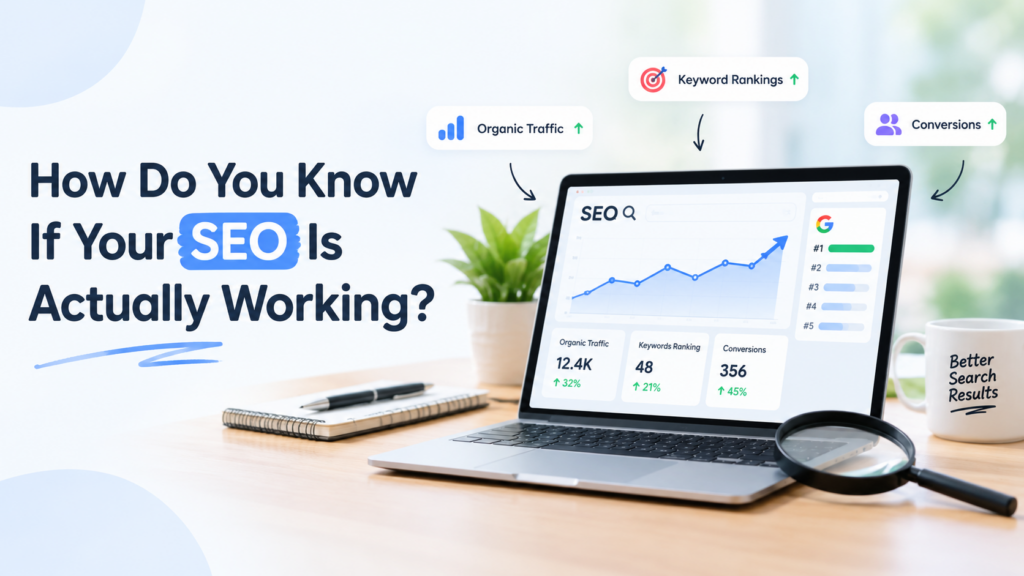
1. Organic Traffic
Organic traffic is the number of people who come to your site from unpaid search results.
If this number grows steadily over a few months, it’s usually a good sign. It means more people are finding you through Google.
But don’t just look at the total. Look at where the visitors are going. Are they landing on your service pages and blog posts, or on pages that don’t matter? A big jump in visitors means little if none of them are interested in what you sell.
2. Keyword Visibility
Keyword rankings are still useful. You just need to track them in a smart way.
Don’t try to track hundreds of random keywords. Pick the ones that match your products, your services and your customers. For example, a local dentist should care about “dentist near me” far more than “history of teeth whitening.”
Also look at the bigger picture. Is your site slowly showing up for more related searches? That’s a healthy sign, even if your main keyword hasn’t moved yet.
3. Impressions and Clicks
Google Search Console is a free tool, and it shows you how often your pages appear in search results (impressions) and how often people click on them.
Here’s how to read it:
- Impressions up, clicks low: People see your pages but don’t click. Your page titles and descriptions may need to be more interesting.
- Impressions and clicks both up: Your visibility is improving. Keep going.
- Impressions down: Something may be wrong. Check for technical problems or new competitors.
4. Engagement
Once people reach your site, what do they do? Do they read your pages, visit other pages, or leave right away?
Look at how long people stay, how many pages they view and where they drop off. If visitors keep leaving quickly, the problem may not be your SEO. It might be your page content, your design or your speed.
5. Conversions
This is the most important one. A conversion is when a visitor does something valuable, like filling out a form, calling you or buying a product.
If your traffic is growing but nobody is contacting you, something needs to change. It could be your offer, your page layout or your call-to-action.
Does SEO Need to Generate Leads?
For most businesses, yes. This is the real test.
Traffic is nice to see on a chart. But a business needs customers, not just visitors. Good SEO should bring the right people to the right pages, and some of them should turn into leads or sales.
Depending on your business, that could look like:
- Contact form submissions
- Phone calls
- Product purchases
- Demo requests
- Consultation bookings
- Newsletter signups
- Quote requests
That’s why your SEO report should connect search results with real business results. If it only shows traffic and rankings, you’re only seeing half the story.
What Are Common Signs That SEO Is Working?
Not sure if you’re on the right track? Here are some signs to look for.
- Your impressions are slowly going up in Google Search Console.
- You’re showing up for more keywords than before.
- More visitors are landing on your important pages.
- You’re getting more calls, form fills or enquiries from search.
- Your pages are getting indexed faster.
- Your bounce rate is going down or your engagement is improving.
You don’t need all of these at once. But if you see a few of them moving in the right direction over several months, your SEO is probably working.
What Are Warning Signs That SEO Isn’t Working?
Some things should make you stop and ask questions.
- Your traffic has been flat or falling for six months or more.
- Your rankings go up, but leads don’t.
- Your agency sends reports full of numbers but never explains them.
- Nobody can tell you what was actually changed on your site.
- You’re being promised guaranteed rankings.
- The reports focus only on keywords that are easy to rank for but don’t matter to your business.
None of these automatically means SEO is a bad idea. But they do mean you should ask for clear answers.
Should You Hire an SEO Agency?
It depends on your situation.
If your website is small and simple, you may be able to handle SEO yourself. This works best when someone on your team has the time to learn it and stay consistent.
But if you have a large website, an online store, a competitive industry or several locations, an agency can save you a lot of time and trouble. SEO has many moving parts, including technical fixes, content, links and tracking. A good team knows how to handle all of them together.
When you start comparing providers, checking directories and lists of the Best SEO Companies is a good way to begin. It gives you names to research and a quick idea of who is out there.
But a list should only be your starting point. Before you choose anyone, look at their past work, how they communicate, how they report, how they plan their strategy and how well they understand your industry. Talk to them. See if they listen to you or just push a package.
What Should You Ask an SEO Company Before Hiring Them?
Don’t decide based on big promises like “page one in 30 days” or “thousands of backlinks.”
Ask simple, practical questions instead:
- What will you change on my website?
- How will you choose my target keywords?
- How will you measure success?
- What will your monthly reports include?
- How will you fix technical SEO problems?
- What kind of content will you create for me?
- How will you track leads and conversions?
- How often will you update me?
- Can you explain your strategy in plain language?
- What will you need from my team?
Pay attention to how they answer. A good agency explains things clearly and gives honest answers, even when the answer is “it depends.” If someone avoids your questions or hides behind technical words, that tells you something too.
What Does a Good SEO Report Look Like?
A good SEO report is easy to read. You should be able to see what changed, what got better, what didn’t work and what happens next, without needing a dictionary.
A solid report usually includes:
Organic traffic: How many people came from search, and how this compares to last month.
Keyword performance: Which important keywords went up or down.
Top landing pages: Which pages are bringing in the most organic visitors.
Conversions: How many of those visitors became leads or customers.
Technical issues: Any problems that could hurt crawling, indexing or user experience.
Work completed: What the team actually did this month.
Next steps: What they plan to work on next.
A report full of charts and numbers with no explanation isn’t helpful. The point of a report is to help you make decisions, not to look impressive.
How Long Should You Give SEO?
There’s no single answer that fits every website.
A brand new site in a crowded industry may need a lot more time than an older site with strong authority and good content. A local business with little competition may see movement faster than a national online store.
As a rough guide, many businesses start seeing early signs in a few months. Later, those signs can turn into real results like more clicks, more enquiries and more sales. But this is only a rough guide, not a promise.
What you should look for is steady progress. First, impressions and keyword visibility usually improve. Then clicks go up. After that, you start seeing more enquiries and conversions. If you see this pattern forming, be patient.
Common Mistakes Business Owners Make With SEO
A few mistakes come up again and again.
Checking rankings every day. Rankings move up and down all the time. Looking at them daily will only stress you out. Check monthly trends instead.
Giving up too early. SEO is slow. Stopping after two months usually means you leave right before things start to work.
Focusing only on traffic. More visitors don’t help if they never become customers.
Ignoring the website itself. If your pages load slowly, look confusing or don’t explain your offer well, SEO can only do so much.
Believing guarantees. Nobody can truly guarantee a number one ranking on Google. Be careful with anyone who does.
Final Thoughts
SEO works best when you treat it as a long-term marketing effort, not a quick trick.
Rankings do matter, but they’re only one piece. The real value comes from bringing in the right visitors, answering their questions, giving them a better website experience and turning that visibility into real business results.
If you’re thinking about hiring an SEO agency, take your time. Compare a few options and ask lots of questions. Look for proof, not promises. A good SEO strategy should be easy to understand, easy to measure and closely tied to what your business wants to achieve.
And if you’re already doing SEO, check your numbers regularly, ask your team questions and focus on progress over perfection. That’s usually how good results are built.

Ashutosh Mishra is an AI Visibility & Performance Marketing Expert with 14+ years of experience helping businesses grow through AI Visibility (AEO/GEO), Google Ads, Meta Ads, and SEO. He partners with founders and business leaders to build data-driven growth strategies that increase visibility, improve marketing performance, and help businesses get discovered, trusted, and recommended in the age of AI.