
Quick Summary
If you sell a USMLE, NCLEX, MCAT, COMLEX, NEET or PANCE prep course, you probably already get traffic from Google. The harder question is why so few of those visitors become paying students. The answer is rarely “more traffic.” Medical test prep buyers are stressed, cautious and comparison-minded, and they take weeks to decide. They search in stages, and each stage needs a different page, a different message and a different follow-up.
This article walks through how to turn that search traffic into seats filled. It covers reading intent behind the keywords, structuring campaigns by exam, building landing pages that earn trust, using organic content to pull in students early, nurturing leads around exam calendars, and measuring cost per enrollment instead of clicks. It also touches on the newer reality of students asking AI tools for course recommendations. Everything here is written for someone who needs results and wants to know what to change on Monday morning.
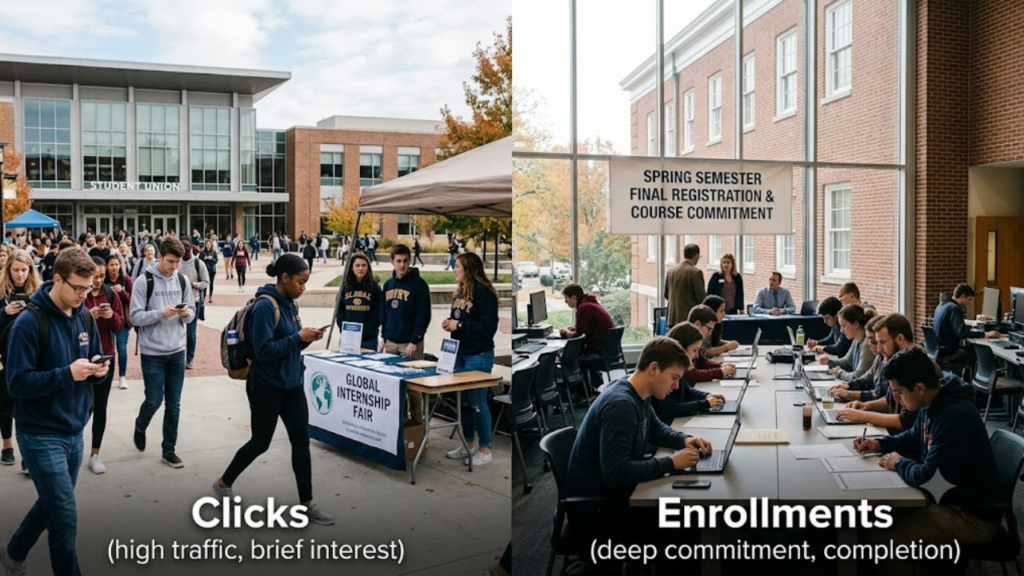
Why Clicks and Enrollments Are Two Very Different Things
Picture a second-year medical student at eleven at night. She has a Step 1 date on the calendar, a shaky practice score, and about nine browser tabs open. She isn’t ready to buy yet. She is reading, comparing and quietly panicking, and the course she finally pays for will be the one that made her feel most understood during that messy research stretch.
That is the buyer you are trying to reach, and she behaves nothing like someone shopping for a pair of sneakers. Test prep is a high-stakes purchase. A wrong choice can cost her money, time she doesn’t have, and possibly a score that shapes her residency options. So she checks pass rates, reads reviews, watches free sample lectures, and asks friends in her cohort before she ever touches an enrollment form.
Most prep companies still measure success the way an online store would. They look at sessions, click-through rate and cost per click, then wonder why the numbers look healthy while the enrollment dashboard stays flat. The gap exists because a click only tells you someone showed up. It says nothing about whether they were ready to buy, whether your page answered their real question, or whether anyone followed up when they left to think it over.
Once you accept that the purchase is slow, emotional and peer-influenced, the whole strategy shifts. You stop trying to squeeze a sale out of the first visit. You start designing a path that meets the student where she is, keeps you in her field of view, and makes enrolling feel like the obvious next step when she finally decides. Everything else in this article builds on that idea.
Learn to Read What Students Are Really Typing
Two students can type nearly identical searches and be in completely different places. Someone who searches “USMLE Step 1 syllabus” is gathering information. They might be a first-year student who won’t buy for months, or someone who simply wants a free outline. Someone who searches “best USMLE Step 1 course” has moved into comparison mode. They are weighing options and are far closer to a decision. If both visitors land on the same page and see the same offer, you will under-serve one and probably annoy the other.
This is where keyword intent earns its keep. Buying signals tend to hide in the modifiers: words like best, review, compare, price, discount, online, live, guarantee and trial. Information-seeking searches usually carry words like syllabus, format, how many questions, passing score or study schedule. Neither type is bad. They simply deserve different treatment, and a smart budget leans toward the first group while using the second group to build relationships at lower cost.
It also helps to think about where in the prep journey a student is. Someone early in their program is researching what the exam even looks like. Someone three months out is hunting for a structured plan. Someone retaking an exam after a disappointing result is searching with urgency and some embarrassment, and wants a course that feels like a real fix rather than a repeat of what failed before. The same exam name can sit behind all three searches, yet the emotional temperature differs wildly.
Complete Gurus builds this kind of targeting into its work for medical test prep companies, reaching students by exam type, program year, geography and intent signals so budget goes toward people close to enrolling rather than broad, unqualified traffic. Whether you handle this in-house or with a partner, the habit to adopt is simple. Before you spend on any keyword, ask yourself what this person is trying to do right now, and whether you have a page that helps them do it.
Structure Your Campaigns Around Exams, Not Around “Medical Prep”
One of the quietest budget drains in this industry is the single giant campaign labeled something like “Medical Exams.” It feels tidy. In practice it blends audiences that have almost nothing in common. A nursing graduate preparing for the NCLEX is a different person from a pre-med student sitting for the MCAT, who is different again from a resident preparing for a later USMLE step or a student in an osteopathic program facing COMLEX. They search with different vocabulary, worry about different things, and respond to different proof.
When you split campaigns by exam, several useful things happen at once. Your ad copy can speak the language of that specific test, mentioning the right step, format or scoring concerns. Your budget can follow performance, so a strong NCLEX season doesn’t get starved because MCAT clicks are expensive that month. Your reporting becomes honest, because you can finally see which exam is actually producing students and which is just producing curiosity.
Within each exam, a second layer of separation pays off. Keep the high-intent searches in their own group, with ads that push toward a trial, a consultation or enrollment. Give the research-stage searches their own treatment, with ads pointing to a useful guide or a free sample resource. Add a retargeting layer for people who visited but didn’t convert, because in this market the second and third exposures usually do the persuading.
Geography matters as well. Exam timelines, licensing paths and student expectations differ across regions, and a message that lands in one market can feel off in another. Letting budgets shift toward the exam categories, locations and creatives that are actually converting is the practical heart of performance marketing for this niche. It means your spend follows evidence rather than habit, and it prevents the slow bleed that comes from funding everything equally because nobody had time to look.
Make the Landing Page Carry the Weight
You can run flawless campaigns and still lose the student on the page they land on. Landing pages are where most of the leakage happens, and they are usually the cheapest thing to fix.
Start with the first screen. A stressed student scanning on a phone wants to know three things in a few seconds: is this for my exam, does it work, and what do I do next. If your headline talks about “comprehensive learning solutions” instead of naming the exam and the outcome, you have already made her work too hard. Name the test. State plainly what the student gets. Make the next step obvious and low-risk.
Low-risk is the key phrase. Because the purchase is expensive and the stakes are personal, asking for full enrollment on the first visit is like proposing on a first date. Free trial lectures, sample question banks, and a short diagnostic can all act as stepping stones. They let the student feel the quality of your teaching before committing, and they give you a legitimate reason to capture contact details. A student who has watched twenty minutes of your instructor explain a tricky concept is far warmer than one who read a feature list.
Proof carries enormous weight here, so use it with care. Score-improvement stories, student testimonials and clear explanations of what your guarantee covers all help, but vague claims backfire. If you promise a score guarantee, spell out the conditions in plain language. Students are smart and skeptical, and hidden fine print destroys trust faster than having no guarantee at all. Show real instructors with real credentials. Show how the course is structured week by week. Be upfront about price, or at least about how pricing works, since price sensitivity is a major factor in this market and evasiveness tends to push people toward competitors who are more direct.
Finally, think about the thing nobody enjoys doing, which is removing friction. Shorten forms. Make sure the page loads quickly on a mediocre connection. Let students book a call with a counselor if they want a human answer. Each small obstacle you remove is a few more students who make it to the finish line.
Let Organic Search Do the Slow, Steady Work
Paid ads are wonderful for speed, but they stop the moment you stop paying. Organic search works differently. It builds quietly and compounds, and for a business whose buyers research for weeks, it is one of the most reliable ways to be present during that entire stretch.
The idea is to show up for exam-specific searches before the student is anywhere near ready to buy. Think of searches like “NCLEX prep course,” “best MCAT tutor” or “NEET online coaching,” along with the many informational queries that surround them. When your site answers those questions well, a student meets you early and associates your brand with real help. By the time she is ready to pay, you are already familiar.
That means building genuine authority content rather than thin pages stuffed with keywords. Score-improvement guides, study schedules, explanations of how an exam is structured, breakdowns of common mistakes and free practice material all earn trust. Student success stories do too, particularly when they describe the starting point and the struggle honestly rather than just announcing a high score. Content like this serves two jobs at once. It ranks for the research-stage searches, and it gives your paid campaigns and email follow-ups something valuable to point toward.
Technical foundations matter too. A fast site, clean structure, sensible internal links between exam pages and guides, and properly organized content help search engines understand what you offer and for whom. Many prep companies publish good content on a site that is slow or confusing to crawl, then wonder why it never ranks. If your content is strong, it deserves a technical base that lets it be found.
Be patient with this channel, but not passive. Organic results take months rather than weeks, which is why it pairs so well with paid search. Ads cover the urgent, high-intent moments today, while content quietly builds the audience that makes tomorrow’s enrollments cheaper.
Win the Comparison Phase on YouTube and in Student Communities
Here is something many prep businesses underestimate: a large share of the real decision happens away from Google’s results page. Students watch videos, scroll exam forums, read comment threads and ask friends. Your job is to be useful in those places so that when they circle back to search for your name, they already half-trust you.
YouTube deserves special attention because it fits how students study. Free lectures, concept walk-throughs and exam-day tips let prospective students sample your teaching at no cost, and those same videos can be turned into advertising. A student who watched part of a lecture can later be shown an offer for the full course, which moves them from “just watching” to “enrolled” with a gentle nudge rather than a hard sell. That progression, from free value to remarketing to a clear offer, is one of the most dependable patterns in this niche.
Social presence supports the same goal. Instagram, YouTube and exam-specific communities are places to share study tips, score wins and instructor personality. The point is not to chase viral reach. It is to stay quietly visible while students plan their prep timeline, so that your name is familiar when the budget conversation happens.
Reviews and word of mouth deserve their own mention. Because students ask peers before buying, a trail of honest feedback across review platforms and communities does real work for you. Encourage satisfied students to share their experience, respond thoughtfully to critical comments, and avoid anything that looks manufactured. A single candid, balanced review often persuades more than a dozen glowing ones that sound the same.
Nurture Leads Around the Exam Calendar
Suppose your landing page works and a student downloads a sample question bank. What happens next decides whether that lead becomes revenue. For many companies, the answer is “nothing much,” and that is where enrollments quietly vanish.
Test prep decisions unfold across weeks, and they are tied tightly to dates. Exam registration windows, application deadlines and the simple arithmetic of “how many weeks do I have left” all shape when a student feels ready to act. A follow-up sequence that ignores this calendar feels generic. One that acknowledges it feels helpful.
Good nurturing mirrors the student’s mindset. Right after the first sign-up, deliver what you promised and add a little more. A day or two later, share something that tackles a common worry for that specific exam. As time passes, introduce a success story, a clear explanation of how your course is structured, and an invitation to talk with a counselor. As an important date approaches, a respectful note about timing can nudge someone who has been circling. The tone should be that of a knowledgeable friend, not a pushy salesperson, because students can sense desperation immediately.
Email and automation tools make this scalable, but the human layer still matters. Your counseling or sales team should receive leads that are already warm and labeled by exam and stage, so their first conversation starts from understanding rather than from scratch. A student who gets a thoughtful call from someone who knows she is retaking the NCLEX in six weeks feels looked after. That feeling closes more enrollments than any discount.
Retargeting completes the loop. Many students will leave your site without taking action, and that is normal. Showing them a fitting reminder across search and social over the following weeks keeps your course in mind during the exact period when they are deciding.
Measure Seats, Not Sessions
If you take only one habit from this article, make it this: judge your marketing by enrollments and what each one costs you. Impressions, clicks and even raw lead counts are useful signals along the way, but none of them pays an instructor’s salary.
Start by tracking cost per enrollment by exam and by channel. You may discover that one exam produces students at half the cost of another, or that a modest YouTube campaign feeds your paid search results more than anyone realized. Add lifetime student value to the picture, because a student who buys a single-exam course differs from one who returns for later steps or recommends you to a classmate. Marketing spend tied to seats filled, rather than vanity metrics, tells you where to lean in and where to pull back.
Funnel drop-off deserves equal attention. Where do students disappear: between the ad and the page, between the page and the form, between the form and the first follow-up, or between the counseling call and the payment? Each leak has a different fix, and you cannot know which one to repair without seeing the whole path. Reporting that shows enrollments, cost per lead and drop-off points, along with clear recommendations, turns a pile of numbers into decisions.
Make sure your tracking is honest before you trust it. Connect your ads, your forms and your enrollment records so you can follow a student from first click to payment. Many businesses discover that some of their “best” campaigns bring cheap leads who never buy, while some “expensive” ones bring the students who actually enroll. You can only see that when the data connects, and once you can, your budget decisions get much calmer and much smarter.
Review your numbers on a steady rhythm, ideally weekly. Frequent, plain-language reporting keeps small problems from growing into expensive ones and lets you shift budget while a promising trend is still fresh.

Prepare for Students Who Ask AI Instead of Google
There is a newer wrinkle worth planning for. A growing number of students now ask AI assistants and AI-powered search summaries questions like “which USMLE course is best for someone retaking Step 1?” The answers they receive shape their shortlist before they ever click a traditional result.
This means your content needs to be easy for machines to understand and trust, in addition to being persuasive to humans. Clear answers to real student questions, well-organized pages, consistent information about your courses, and structured data that explains what you offer all help AI systems describe your business accurately. If your pricing, exam coverage or guarantee terms are murky or contradictory across your site, an AI summary may get them wrong or skip you altogether.
You don’t need to abandon what works. The fundamentals of useful, honest, well-organized content serve both traditional search and AI-driven discovery. The practical step is to review your key pages and ask whether a stranger, or a machine, could quickly work out which exams you cover, who your course is for, what it costs or how pricing works, and why students trust you. Where the answer is no, tighten the page.
Answer-focused and AI-visibility work is a growing part of what agencies offer, and it is worth discussing with whoever manages your search presence. Treat it as an extension of good fundamentals rather than a separate trick, and you will be better placed as student behavior keeps shifting.
Suggested Reading: Is ChatGPT Advertising Worth the Cost in 2026?
Conclusion
Turning Google traffic into medical test prep enrollments comes down to respecting how your students actually buy. They research slowly, compare carefully, lean on peers and decide only when they feel understood. So read the intent behind each search, build campaigns around individual exams, give every visitor a landing page that lowers risk and proves quality, and keep showing up through organic content, video and community presence. Follow up around the dates that drive their decisions, measure success in seats and cost per enrollment, and make sure your information is clear enough for both people and AI tools to trust. None of this is flashy, but together these habits turn curious browsers into enrolled students.
If you would rather not piece all of this together alone, Complete Gurus is a digital marketing agency that builds SEO, Google Ads, YouTube, Meta and lead-generation strategies specifically for medical test prep companies, covering exams like USMLE, NCLEX, MCAT, NEET, PANCE and COMLEX. With 13+ years of experience, over $3 million in ad spend managed annually, weekly transparent reporting and a 90-day ROAS guarantee, the team focuses on enrollments and cost per student rather than vanity numbers. You can explore their services or ask for a free audit at https://completegurus.com/.

Ashutosh Mishra is an AI Visibility & Performance Marketing Expert with 14+ years of experience helping businesses grow through AI Visibility (AEO/GEO), Google Ads, Meta Ads, and SEO. He partners with founders and business leaders to build data-driven growth strategies that increase visibility, improve marketing performance, and help businesses get discovered, trusted, and recommended in the age of AI.