
Quick Summary
If you have noticed that people no longer scroll through ten blue links before making a decision, you are not imagining it. Customers now ask Google a question and get a written answer at the top of the page. They open ChatGPT, Gemini or Perplexity and ask, in plain language, which company they should hire or which product they should buy. Whoever gets named in that answer wins the attention, and often the sale. Everyone else is invisible, even if they rank on page one.
The good news is that visibility in this new landscape is not a mystery. It comes down to being clear about who you are, being consistent everywhere you appear online, publishing content that genuinely answers real questions, and giving machines clean signals they can trust. This guide walks you through how that works in practice: how AI tools choose which brands to mention, how to audit where you stand, how to build content and technical foundations that get you cited, and how paid media still fits into the picture. Read it like a conversation with a friend who has spent years in the trenches, because that is the spirit in which it is written.
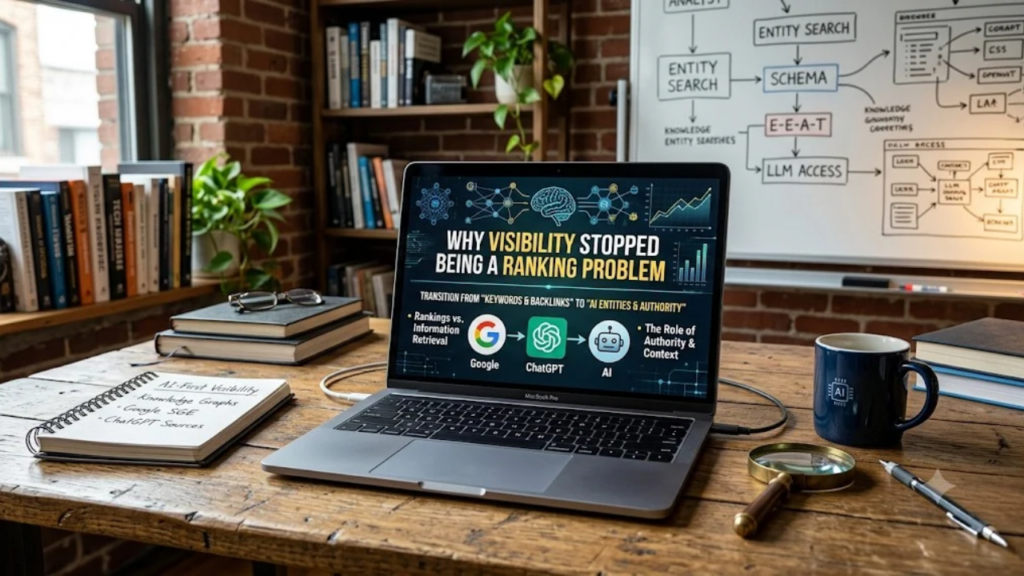
Why Visibility Stopped Being a Ranking Problem
For about two decades, brand visibility meant one thing: climb the search results. You picked keywords, wrote pages, built links and waited. If you reached the top three positions, the phone rang. It was a game with clear rules, and most businesses learned to play it reasonably well.
Then the interface changed. Today a person might type a long, messy question into Google and receive a summarized answer before they see a single website. Someone else might skip Google altogether and ask an AI assistant to compare three agencies, recommend a project management tool or explain which running shoes suit flat feet. In both cases the customer is handed a short list, sometimes just one name, and moves on. The old idea of fighting for position number four has quietly lost its meaning, because position number four is now buried beneath an answer box nobody asked you to compete for.
This is the shift that catches business owners off guard. You can have decent rankings, steady traffic and a nicely designed website, and still discover that AI tools never mention you when a potential customer asks about your category. That is not a failure of effort. It is a mismatch between the way you built your visibility and the way people now look for answers.
Think of it as moving from a phone book to a conversation. A phone book lists everyone alphabetically and lets the reader decide. A conversation involves a trusted advisor who says, “You should talk to these people.” Your goal is to become the name that advisor reaches for. That requires a different kind of work, one that blends classic search optimisation with what the industry now calls answer engine optimisation and generative engine optimisation. The labels sound technical, but the idea underneath is very human: be the most clear, credible and useful answer to a real question.
How Google, ChatGPT and Perplexity Decide Who Gets Mentioned
Before you change anything, it helps to understand what is happening behind the curtain. Nobody outside these companies knows every detail of how their systems weigh information, and anyone who claims certainty is selling something. But the broad behaviour is well observed, and it follows a few consistent patterns.
AI assistants build answers from two places. One is what they absorbed during training, a vast snapshot of text from across the web. The other, increasingly, is live retrieval, where the tool searches the web in real time, reads the pages it finds and stitches a response together. Perplexity leans heavily on this second approach and shows its citations openly. ChatGPT and Gemini blend both, depending on the question and the settings. Google’s AI Overviews pull from pages already in its index, favouring those that answer the question directly and come from sources it considers reliable.
What do these systems reward? Clarity, for one. A page that states plainly what a company does, who it serves and where it operates is far easier to summarise than one wrapped in vague slogans. Consistency is another. If your name, services and descriptions match across your website, your social profiles, review platforms and directories, the system gains confidence that you are a real, stable entity. Contradictions, on the other hand, create doubt, and doubt means you get left out.
Then there is corroboration. AI tools are cautious by design. They like claims that appear in more than one trustworthy place. A brand that is talked about by customers, reviewed on independent platforms and mentioned in industry publications looks safer to cite than one that only talks about itself on its own site. This is why reputation work and visibility work have become so tightly intertwined.
Finally, there is usefulness. A page that actually resolves the question, with specifics, examples and a human voice, is more likely to be quoted than a thin page stuffed with keywords. The machines are getting better at telling the difference, and so are your customers.
Start With an Honest Look at Where You Stand Today
Most businesses skip this step because it can be uncomfortable. They jump straight into publishing more content and hoping for the best. A better approach is to sit down and ask the assistants themselves how they see you.
Open ChatGPT, Gemini and Perplexity and ask the kinds of questions your customers would ask. Not “what is Brand X” but the questions that come before someone knows your name. Which company is best for a particular problem in your city? How do I choose between two types of solution? What should I look for when hiring someone in your field? Watch which brands appear, how they are described and whether you are anywhere in the answer. Do the same in Google and read the AI Overview, if one appears, with the same critical eye.
The results are often humbling and always useful. You may find that AI tools describe your company with outdated information, confuse you with a competitor or skip you entirely. You may notice that a rival with a weaker product gets mentioned constantly because their content is clearer or their presence across the web is stronger. You might even discover that the tools attribute your best ideas to someone else.
Write down what you find, in plain notes, without judgment. You are building a baseline, a picture of your current reputation in the machine’s eyes. This is exactly the thinking behind a proper AI search visibility audit, which looks at where and how your brand appears across assistants and search features, what is missing and what is being said incorrectly. At Complete Gurus, this audit is offered free, precisely because so many brands have no idea what AI tools currently say about them until someone shows them.
Once you have that picture, the rest of the work becomes much more focused. You are no longer guessing. You are fixing specific gaps.
Make Your Brand a Clear Entity, Not Just a Website
Here is a concept worth sitting with. Search engines and AI systems do not only read pages; they try to understand things. A company, a founder, a product, a location, a service category. These are called entities, and the clearer and better connected your entity is, the more confidently a machine can talk about you.
Imagine your brand as a person being introduced at a dinner party. If the host says, “This is Maria, she runs a dental clinic in Austin and has been practising for fifteen years,” everyone instantly understands who she is and when to bring her up in conversation. If the host mumbles, “This is Maria, she does stuff with teeth maybe,” nobody remembers her. Your website and online profiles are the host. They need to introduce you with precision.
Start with the basics on your own site. Your homepage and about page should say, in simple words, what you do, for whom, where and how long you have been doing it. Avoid clever phrases that sound impressive but explain nothing. If you have thirteen years of experience, say so. If you serve clients in several countries, name them. Specifics build trust with people and give machines something concrete to latch onto.
Next, make sure the same story is told everywhere. Your business name, address, phone number, descriptions and service lists should match across Google Business Profile, LinkedIn, industry directories, review platforms and social channels. Small inconsistencies, like an old address or a different spelling of your brand, scatter your identity into fragments.
Then add structured data, sometimes called schema markup, to your pages. This is a bit of code that tells search engines explicitly what each page is about: an organisation, a service, a product, a review, a person. It does not change what visitors see, but it hands machines a labelled map instead of making them guess. Clean schema setup, paired with entity optimisation, is one of those unglamorous tasks that quietly makes everything else work better, and it is a core part of the AI search optimisation work Complete Gurus handles for its clients.
Write Content That Answers the Way People Actually Ask
Content is still the engine of visibility, but the style that wins has shifted. For years, writers were trained to sprinkle keywords and pad articles to hit a word count. AI systems tend to ignore that padding. What they pick up is content that gives a direct, trustworthy answer, then supports it with depth.
A useful habit is to open important pages with the answer itself. If your article is about how long a project takes, say how long it takes in the first couple of sentences, then spend the rest of the page explaining the nuance. This mirrors how people want to read and gives both Google and AI tools a clean passage to lift. Think of it as writing the summary first and the story second.
Questions deserve special attention. People type and speak real questions, with all their awkward phrasing. Mine your customer emails, sales calls, support tickets and social comments for the exact words people use. Then build pages that respond to those questions in a natural voice. A sentence like “Most small businesses see their first meaningful results within a few months, though it depends on competition and budget” does more good than a paragraph of jargon.
Be specific wherever you can. Concrete numbers, real examples, named scenarios and honest trade-offs make content feel lived-in. Generic advice is everywhere and AI tools can generate it in seconds, so there is little reason for them to cite it. What they cannot generate is your own experience: the client story, the lesson from a failed campaign, the way your process differs from the standard approach. That is the material worth publishing.
Depth matters too, but depth does not mean length for its own sake. Build clusters of related pages that cover a topic from several angles, linked together sensibly, so that your site becomes a recognised source on a subject rather than a collection of random posts. This is where professional content and answer engine optimisation support earns its keep. Complete Gurus pairs blog writing and content strategy with AEO, so that articles are written to be read by humans and understood by machines at the same time.
Fix the Technical Foundations Quietly Holding You Back
You can write the most helpful page in your industry and still lose if machines cannot reach or understand it. Technical health is not exciting, but it is the floor everything else stands on.
Start with crawlability. Make sure important pages can be found and read by search bots, and that you have not accidentally blocked them through settings left over from a website redesign. Check that your site loads quickly on mobile, because a slow page is a frustrating page, and both people and algorithms notice. Tidy up broken links, duplicate pages and confusing redirects that dilute your authority.
Pay attention to how your content is rendered. If critical information only appears after heavy scripts run, some crawlers and AI retrieval tools may never see it. Plain, well-structured HTML with clear headings, short paragraphs and descriptive titles tends to travel much further than something clever but fragile.
It is also worth deciding deliberately which AI crawlers you welcome. Many businesses block everything out of caution and later wonder why assistants never mention them. If your goal is visibility, you will usually want reputable AI and search bots to be able to read your public content. That is a business decision, and it should be made on purpose rather than by accident.
If your store lives on a particular platform, the details change. A Shopify shop, a WordPress site, a BigCommerce catalogue and a Magento build each have their own quirks around structure, speed and markup. Platform-specific technical SEO exists for exactly this reason, and it saves a great deal of trial and error when someone who has handled your platform many times sets it up properly from the start.
Earning a Place Inside Google’s AI Overviews
Google’s AI Overviews deserve their own attention because they sit at the top of the most-used search engine on earth. When one appears, it summarises an answer and links to a handful of sources. Being one of those sources can bring visibility even when clicks are fewer than they used to be, because your brand name appears in front of the reader at a moment of high interest.
There is no switch to flip for this. What you can do is make your pages the kind Google is comfortable quoting. That means a clear, direct answer near the top, honest supporting detail below it, a trustworthy author or brand behind the page, and solid technical health. It also means covering the follow-up questions a reader is likely to have, because AI Overviews often draw from pages that anticipate the next question rather than only the first.
Formatting helps more than most people expect. Short sections with plain headings, comparisons laid out in clear sentences, and definitions that stand on their own give Google tidy passages to extract. You do not need to write like a robot. You just need to write like someone who respects the reader’s time.
Keep your expectations realistic as well. Overviews change, vary by query and are not guaranteed for any page. The aim is not to chase a feature but to build the kind of authority that makes you a natural candidate. Dedicated optimisation for AI Overviews and broader AI search visibility focuses on exactly that: understanding which of your topics trigger summaries, how competitors are being cited and where your content can be sharpened to compete.
Getting Named by ChatGPT, Gemini and Perplexity
Each assistant behaves a little differently, and that is worth knowing even if you do not tune for each one separately. ChatGPT tends to favour well-established sources and clear explanations, and its recommendations can reflect a mix of training knowledge and live browsing. Gemini is closely tied to Google’s own ecosystem, so strong Google presence, business profiles and structured information carry weight. Perplexity is the most transparent of the three, showing its sources prominently, which makes it a handy testing ground to see who is being cited for your topics and why.
What unites them is the hunger for corroborated, reputable information. Your own website is only one voice. Reviews on independent platforms, mentions in industry articles, interviews, case studies, community discussions and consistent profiles all feed the picture these tools assemble. A brand that is discussed in several credible places is far easier for an assistant to recommend with confidence.
This means that part of your visibility strategy happens outside your website. Encourage satisfied customers to leave detailed, honest reviews. Contribute expert commentary to publications your audience reads. Publish original findings, case studies or data that others will want to reference. Keep your profiles on professional networks active and accurate. Each of these is a small vote of confidence, and AI systems are good at counting votes.
Phrasing matters as well. When you describe your services, use the same language your customers use. If people ask for a “Google Ads expert for a Shopify store” and your site only says “paid acquisition solutions,” the connection is weaker than it needs to be. Plain, specific wording bridges the gap between your offer and the questions people type into assistants. Specialised work on ChatGPT, Gemini and Perplexity optimisation is built around closing that gap, one platform at a time.
Local, Marketplace and Product Visibility
Not every brand is a global software company. If you serve a particular city, run a clinic, manage a home service business or sell through marketplaces, your visibility battleground looks different, and the AI era has not erased it.
For local businesses, a complete and active Google Business Profile remains the single most valuable asset. Accurate hours, services, photos, genuine reviews with thoughtful replies and consistent details across directories all shape whether you appear in local results and AI-generated summaries about nearby options. When someone asks an assistant for the best provider in their area, local trust signals do much of the deciding. Local SEO is not a relic; it is the foundation that AI recommendations about places are built on.
For sellers on Amazon and other marketplaces, the product listing is the visibility. Titles, bullet details, enhanced brand content and brand store pages influence both on-platform search and the increasingly conversational shopping experiences emerging elsewhere. Retail giants are already experimenting with AI-driven product discovery, which means the quality and clarity of your product information matters more each month. Rich, accurate, well-structured listings give shopping assistants the facts they need to recommend you.
The common thread is that detail wins. The more precisely you describe what you offer, who it is for and why it is good, in every place a machine might look, the more likely you are to be matched with someone who needs it.
Paid Media Still Has a Seat at the Table
It would be convenient if organic visibility alone could carry a brand, but nobody who has run a business believes that. Earning authority takes time, and in the meantime you still need customers. Paid advertising is the part of the mix that lets you show up today while the longer-term work compounds.
Google Ads remains one of the most reliable ways to capture people who are actively searching with intent, whether through Search, Shopping or Performance Max. Meta Ads on Facebook and Instagram help you reach people before they search, introducing your brand to audiences who match your best customers and then following up with those who showed interest. Together they create repeated exposure, which has a quiet but real effect on how often people search for your brand by name later. And branded searches, in turn, strengthen the signals that Google and AI tools use to judge how well known you are.
There is also a new frontier opening up. Advertising inside AI assistants, including ChatGPT, is emerging as a channel that brands are beginning to explore. It is early, and the formats will keep changing, but businesses that learn how it works while competition is thin often gain a useful head start.
The smartest approach treats paid and organic as partners rather than rivals. Insights from ad campaigns reveal which messages, offers and phrases resonate most, and that knowledge can sharpen your content. Meanwhile, strong organic pages improve landing experiences and lower the cost of conversions. When the two teams talk to each other, both perform better.

Measuring Progress When the Old Metrics Fall Short
One of the more frustrating parts of this shift is that traditional analytics do not tell the whole story. A person might see your brand in an AI answer, think about it for a week, then search your name directly and convert. In your dashboard that looks like a direct visit, and the AI mention that planted the seed goes unrecorded.
So measurement needs a wider lens. Keep tracking rankings, organic traffic and conversions, because they still matter. Add regular checks of how assistants talk about you, using the same set of customer questions each month so you can compare like with like. Watch whether your brand appears more often, whether descriptions are accurate and whether you are being cited alongside the competitors you care about.
Pay attention to branded search volume and direct traffic trends, which often rise as visibility grows even when attribution is murky. Look at the quality of leads and the questions prospects ask on calls. If more people say they “saw you mentioned” or “asked an AI about it,” that is a signal worth celebrating, even if it cannot be neatly charted.
And be patient. Visibility in AI search is built through accumulated trust, not overnight tricks. Brands that treat it as a steady, long-term discipline, reviewing, improving and repeating, tend to pull ahead of those hunting for shortcuts. Transparent reporting in plain language, rather than a wall of vanity numbers, makes that journey far easier to follow.
Suggested Reading: How Short-Form Video Advertising Helps eCommerce Brands Increase Sales
Conclusion
Improving brand visibility across Google, ChatGPT and AI search is not about gaming a system. It is about becoming the kind of business a thoughtful advisor would genuinely recommend: clearly described, consistently presented, backed by real proof and willing to give straight answers to real questions. When you build that foundation, you stop depending on any single platform’s mood, because the qualities that earn a mention today are the same ones that will earn trust tomorrow, whichever new interface arrives.
Start small if you need to. Ask the assistants how they describe you. Tidy up your profiles. Rewrite one key page so it answers a customer’s question in the first two sentences. Add the structured data your site is missing. Collect the reviews you have earned. Each step moves you closer to being the name people hear when they ask.
If you would rather not do all of this alone, Complete Gurus is a performance marketing and AI visibility agency with more than thirteen years of experience across Google Ads, Meta Ads, SEO, answer engine optimisation, generative engine optimisation and third-party store management. The team helps B2B, eCommerce and D2C brands get found on Google and named by AI assistants, with services that include ChatGPT, Gemini and Perplexity optimisation, Google AI Overviews optimisation, schema and entity setup, content strategy, local and technical SEO, and paid campaigns backed by transparent weekly reporting. You can begin with a free AI search visibility audit to see exactly where your brand stands today. Visit https://completegurus.com/ to get started.

Ashutosh Mishra is an AI Visibility & Performance Marketing Expert with 14+ years of experience helping businesses grow through AI Visibility (AEO/GEO), Google Ads, Meta Ads, and SEO. He partners with founders and business leaders to build data-driven growth strategies that increase visibility, improve marketing performance, and help businesses get discovered, trusted, and recommended in the age of AI.