
Summary
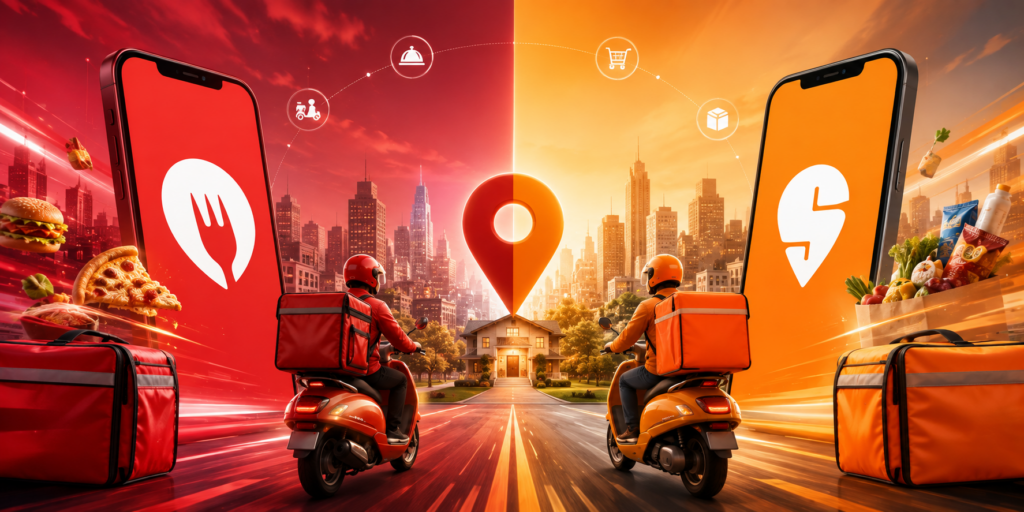
This case study explores how Zomato and Swiggy grew from food-ordering apps into two of India’s largest digital convenience ecosystems. It explains how both companies use strong branding, digital marketing, social media, personalized offers, customer data, AI, technology, delivery networks, restaurant partnerships, memberships, advertising, and quick commerce to attract customers and increase repeat orders. The study also compares their marketing strategies, app experiences, customer acquisition and retention methods, AI capabilities, business models, revenue sources, and overall growth.
The analysis shows that Zomato has built stronger brand recall through its relatable marketing, humor, and highly recognizable social-media campaigns, while Swiggy has created a broad convenience ecosystem through food delivery, Instamart, and Swiggy One. Zomato/Eternal currently has a slight overall advantage because of its strong brand positioning, Blinkit’s quick-commerce growth, and improving profitability. However, Swiggy remains a strong competitor with rapid growth and major long-term potential. The case study also highlights important lessons for startups, restaurants, e-commerce brands, and marketers on using data, AI, customer experience, and multiple revenue streams to build sustainable business growth.
Introduction: The Rise of India’s Food Delivery Economy
India’s food delivery industry has changed the way people discover, order, and experience food. What was once limited to calling a nearby restaurant has become a digital ecosystem where customers can compare restaurants, explore menus, read reviews, use personalized offers, track deliveries in real time, and receive food at their doorstep within minutes.
The growth of smartphones, affordable internet, digital payments, urban lifestyles, and app-based convenience created the right environment for food delivery platforms to scale. However, technology alone did not build this market. Companies such as Zomato and Swiggy turned food ordering into a habit by combining strong branding, customer-focused app experiences, large restaurant networks, delivery technology, data-driven marketing, and continuous innovation.
Today, food delivery is no longer only about ordering lunch or dinner. Customers use these platforms to discover new restaurants, order during office hours, plan family meals, access special offers, and solve everyday convenience needs. Both companies have also expanded beyond their original food delivery models and built broader digital ecosystems.
Zomato’s official platform states that it serves customers across more than 800 cities, works with over 300,000 restaurants, and has delivered more than 3 billion orders. Swiggy has also built a large multi-category convenience network, with food, grocery, dining-out, and other services available through its platform.
The rise of these companies shows how a digital platform can influence consumer behavior, create new customer habits, and transform a traditional industry through marketing, technology, data, and operational scale.
How Food Delivery Changed Consumer Behavior in India
Before food delivery apps became widely popular, customers usually depended on nearby restaurants, printed menus, phone calls, or personal visits. Restaurant discovery was often based on location, word of mouth, or local familiarity. The customer experience was limited, and comparing multiple restaurants was not always easy.
Food delivery apps changed this process by placing thousands of restaurants on a single digital platform. Customers could search by cuisine, dish, price, rating, delivery time, dietary preference, or location. This made food discovery faster and gave users more control over their choices.
Several major changes followed.
Convenience Became a Daily Expectation
Customers no longer had to travel to a restaurant or make multiple phone calls. A few taps could complete the entire ordering process. The app handled restaurant discovery, menu browsing, payment, order updates, and delivery tracking.
This convenience gradually changed food delivery from an occasional service into a regular part of urban life. People began ordering food during workdays, late evenings, weekends, celebrations, and even for small personal needs.
More Choice Increased Customer Expectations
Food delivery platforms gave customers access to local restaurants, national chains, cloud kitchens, cafes, bakeries, and specialty food brands through one interface.
As choice increased, customer expectations also changed. Users began comparing:
- Food prices
- Delivery fees
- Restaurant ratings
- Estimated delivery time
- Discounts and offers
- Membership benefits
- Packaging quality
- Customer reviews
The customer was no longer choosing only a restaurant. The customer was evaluating the complete digital experience.
Digital Payments Made Ordering Faster
The growth of UPI, digital wallets, cards, and other online payment methods reduced friction during checkout. Customers could place orders without handling cash, while restaurants and platforms could process transactions more efficiently.
Easy digital payments also supported repeat ordering because customers could save payment methods and complete future purchases quickly.
Food Discovery Became Personalized
Zomato and Swiggy use customer activity and behavioral signals to make food discovery more relevant. The apps can present restaurants, cuisines, dishes, and offers based on factors such as location, previous orders, browsing behavior, time of day, and current demand.
For example, a customer who frequently orders biryani may see more biryani restaurants or related offers. A user ordering breakfast in the morning may receive different recommendations from someone browsing late at night.
This personalization reduces decision-making time and can improve the chances of conversion.
Speed Became Part of the Product
Earlier, customers mainly evaluated food based on taste, quality, and price. App-based delivery added another important factor: speed.
Estimated delivery times, live order tracking, delivery updates, and real-time notifications made speed a visible part of the customer experience. The platform was no longer only selling access to food; it was selling convenience and time savings.
Customers Became More Comfortable Trying New Brands
Food delivery apps reduced the effort required to discover unfamiliar restaurants. Ratings, reviews, menus, photos, offers, and search filters gave customers more confidence to try new food brands.
This helped smaller restaurants and cloud kitchens reach customers beyond their immediate neighborhoods.
Research on food delivery app behavior has also highlighted the importance of restaurant variety and user-friendly app design. A broad restaurant selection can improve customer satisfaction, while an easy-to-use interface can encourage continued usage and repeat orders.
Discounts Created New Ordering Habits
First-order offers, free-delivery campaigns, coupon codes, bank partnerships, and membership benefits encouraged customers to order more frequently.
Discounts helped platforms attract new users, but they also changed customer expectations. Many users began comparing offers between apps before placing an order. Over time, both companies had to balance promotional growth with profitability and long-term customer retention.
Food Delivery Became Part of a Larger Convenience Economy
The growth of food delivery also prepared customers to use apps for groceries, household essentials, dining reservations, and other services.
This shift helped Zomato and Swiggy expand their business models. The companies moved from solving one problemfood deliveryto building broader convenience ecosystems around customer demand.
Why Zomato and Swiggy Became Market Leaders
Zomato and Swiggy became market leaders because they did more than build food-ordering apps. They created large networks that connected customers, restaurants, delivery partners, advertisers, and technology systems.
Their success came from a combination of strong execution across several areas.
1. Early Market Entry and Strong Brand Recognition
Zomato entered the restaurant discovery space before online food delivery became a mainstream habit in India. Its early focus on restaurant information, menus, ratings, and reviews helped it build brand awareness.
Swiggy entered with a stronger focus on delivery operations and convenience. It built a large delivery network and positioned itself around reliable, fast, and accessible service.
Over time, both brands became familiar names in India’s digital economy.
2. Large Restaurant Networks
A food delivery platform becomes more useful when customers have more choices. Zomato and Swiggy invested heavily in onboarding restaurants across major cities and expanding into new locations.
Large restaurant networks create a strong growth cycle:
More restaurants → More customer choice → More orders → More value for restaurants → More restaurant partnerships
This network effect made it harder for smaller competitors to match their scale.
3. Strong Delivery Infrastructure
Food delivery is not only a marketing business. It is also a complex logistics business.
Both companies built large delivery networks and developed systems to manage:
- Order allocation
- Delivery partner availability
- Restaurant preparation time
- Customer location
- Traffic conditions
- Peak-hour demand
- Estimated delivery time
The ability to coordinate these moving parts at scale became a major competitive advantage.
4. Easy-to-Use Mobile Apps
The app became the main customer touchpoint. Zomato and Swiggy continuously improved search, restaurant discovery, menus, recommendations, payments, order tracking, and customer support.
A simple app experience can increase conversion and repeat usage. If customers can quickly find food, understand the total cost, complete payment, and track delivery, they are more likely to return.
5. Strong Marketing and Brand Building
Both companies invested in digital campaigns, social media, push notifications, brand partnerships, outdoor advertising, seasonal promotions, and customer engagement.
Zomato became especially known for humorous, timely, and culturally relevant marketing. Swiggy built a strong identity around convenience, speed, and solving everyday customer needs.
Their marketing did not only promote discounts. It helped create memorable brand personalities.
6. Data-Driven Customer Experiences
Every search, click, order, review, and interaction can provide useful information. Both platforms use data to understand customer preferences and improve recommendations, offers, delivery estimates, and operational planning.
Data helps the platforms answer questions such as:
- What does a customer usually order?
- Which restaurants are popular in a specific area?
- What food is in demand at a particular time?
- Which customers may respond to a specific offer?
- Where is delivery demand likely to increase?
This allows the companies to make customer experiences more relevant and operations more efficient.
7. Expansion Beyond Food Delivery
Both companies recognized that long-term growth could not depend only on restaurant delivery.
Zomato expanded into quick commerce through Blinkit and added other consumer-facing businesses under its broader ecosystem. Swiggy expanded through Instamart, Dineout, and additional convenience services.
This diversification created more opportunities for customer engagement and revenue growth.
8. Continuous Investment in Technology
Technology supports almost every part of the businessfrom restaurant discovery and personalized recommendations to delivery allocation and customer support.
AI, machine learning, automation, and data analytics can help platforms improve:
- Search relevance
- Food recommendations
- Delivery-time estimates
- Demand forecasting
- Customer segmentation
- Offer personalization
- Fraud and risk detection
- Operational efficiency
These capabilities are important because even small improvements can have a large impact when millions of customer interactions take place across the platform.
From Restaurant Discovery to Complete Convenience Platforms
The growth of Zomato and Swiggy can be understood as a journey through several stages.
Stage 1: Restaurant Discovery
The original value was helping customers find restaurants and access useful information such as menus, ratings, reviews, locations, and cuisines.
Zomato built its early identity around this model. Restaurant discovery helped the company understand local food markets and build relationships with restaurants before food delivery became its main growth engine.
Stage 2: Online Food Ordering
The next stage was enabling customers to place orders through the platform.
This created a direct digital connection between customers and restaurants. The platform could now influence the complete journeyfrom discovery to purchase.
Stage 3: Managed Delivery
Building or coordinating delivery networks gave the platforms more control over the customer experience.
Delivery speed, order tracking, customer communication, and service quality became important parts of the brand.
Stage 4: Personalized Food Experiences
As the customer base grew, data became more valuable. The platforms could recommend restaurants and dishes based on individual preferences and local demand.
The app experience became increasingly personalized rather than showing the same information to every user.
Stage 5: Membership and Customer Retention
Programs such as Zomato Gold and Swiggy One encouraged customers to order more frequently by offering benefits such as reduced delivery costs, special discounts, or partner offers.
Membership programs also helped build long-term customer relationships.
Stage 6: Advertising and Restaurant Growth
Restaurants began using the platforms not only to receive orders but also to improve visibility.
Sponsored listings, promotional campaigns, and in-app advertising created additional revenue opportunities for the platforms while helping restaurant partners reach more customers.
Stage 7: Quick Commerce and Everyday Convenience
The rise of quick commerce expanded the meaning of convenience.
Customers could use the same ecosystem to order groceries, household products, snacks, and other essentials. Zomato’s Blinkit and Swiggy’s Instamart became important growth engines beyond traditional food delivery.
Stage 8: Multi-Service Consumer Ecosystems
Today, both companies are moving toward broader convenience models.
The goal is not only to help customers order food. The larger opportunity is to become a frequently used digital platform for food, grocery, dining, local discovery, and other everyday needs.
This evolution is important from a marketing perspective. A customer who uses multiple services within one ecosystem may interact with the brand more often, generate more data, and become more valuable over time.
What This Case Study Will Analyze
This case study will examine how Zomato and Swiggy built large food delivery businesses by combining marketing, technology, data, customer experience, and operational scale.
The analysis will cover:
Marketing Strategy
The case study will compare how both companies use brand positioning, social media, content, campaigns, digital marketing, and customer communication to build awareness and engagement.
Online and Offline Advertising
It will examine performance marketing, app-based promotions, sponsored campaigns, outdoor advertising, partnerships, and other methods used to reach customers.
App Experience and Customer Journey
The study will analyze how users move from restaurant discovery to checkout, payment, order tracking, and delivery.
Customer Acquisition and Retention
It will explore discounts, referral programs, memberships, personalized offers, push notifications, and other strategies used to attract and retain customers.
AI, Data, and Technology
The case study will examine how AI, machine learning, and data can support personalization, search, recommendations, demand forecasting, delivery optimization, and operational efficiency.
Business and Growth Performance
The analysis will compare important business indicators such as order growth, food delivery value, revenue, customer growth, quick-commerce performance, and profitability.
Advertising and Restaurant Ecosystems
It will explore how Zomato and Swiggy create value for restaurant partners and generate additional revenue through advertising and promotional services.
Quick-Commerce Expansion
Blinkit and Instamart will be analyzed as important parts of the companies’ future growth strategies.
Final Competitive Analysis
The case study will evaluate which company performs better across major areas, including:
- Brand marketing
- Customer acquisition
- Customer retention
- App experience
- AI and personalization
- Food delivery growth
- Quick-commerce growth
- Revenue generation
- Profitability
- Long-term strategic position
The purpose is not to select a winner based on one number. Zomato and Swiggy operate across multiple business segments, and each company may lead in different areas. The final analysis will therefore compare performance using relevant business and marketing metrics.
Zomato vs Swiggy: Company Overview
Zomato and Swiggy are India’s two leading food delivery platforms, but their growth journeys began from different starting points.
Zomato started as a restaurant discovery platform. Its early business focused on helping customers find restaurants, view menus, check ratings, and read reviews. It later expanded into online ordering and food delivery.
Swiggy began with a stronger delivery-first model. Its early strategy focused on building a reliable delivery network and making restaurant food more accessible through a dedicated app.
Over time, both companies expanded beyond their original models. They now operate broader ecosystems that include food delivery, customer memberships, restaurant services, advertising, quick commerce, and other convenience-focused offerings.
Zomato’s Journey from Restaurant Discovery to Food Delivery
Zomato was founded in 2008 under the name Foodiebay. The original idea was simple: make restaurant menus easier to access online.
At the time, customers often had limited information about restaurants. Zomato helped organize menus, restaurant details, ratings, reviews, and location information in one place.
The company later changed its name to Zomato and expanded into more cities and international markets.
Its early restaurant-discovery model created several advantages:
- Strong restaurant relationships
- Large restaurant information databases
- Brand recognition among customers
- Better understanding of local food markets
- A large audience interested in restaurant discovery
As online food ordering became more popular, Zomato expanded into food delivery. This allowed the company to move from providing information to becoming part of the complete customer transaction.
The platform could now support the full journey:
Restaurant Discovery → Menu Browsing → Order Placement → Payment → Delivery → Customer Feedback
This shift created more opportunities for revenue and customer engagement.
Zomato later expanded its ecosystem through businesses such as:
- Food delivery
- Zomato Gold
- Blinkit
- Hyperpure
- District
The company’s broader strategy is based on building consumer services around food, convenience, and local experiences.
Zomato’s official website reports more than 300,000 restaurant partners, operations across 800+ cities, and over 3 billion orders delivered.
The company’s food delivery business has remained an important growth engine. In Q4 FY2026, food delivery NOV growth was reported at 18.8% year over year, while the broader consumer ecosystem continued to benefit from strong quick-commerce growth.
Swiggy’s Journey from Food Delivery to a Multi-Service Platform
Swiggy was founded in 2014 in Bengaluru.
Unlike Zomato, Swiggy entered the market with a stronger focus on solving the delivery problem. The company built its own delivery network and worked to create a reliable ordering and fulfillment experience.
Its early value proposition focused on convenience:
Choose food → Place an order → Track delivery → Receive food at home
Swiggy’s delivery-first approach helped it build strong operational capabilities. The company invested in delivery partner networks, technology, logistics, customer support, and restaurant partnerships.
As its customer base expanded, Swiggy moved beyond food delivery and developed a broader convenience platform.
Its major growth areas include:
- Swiggy Food
- Swiggy Instamart
- Swiggy One
- Swiggy Dineout
- Restaurant and advertising services
The company’s strategy is based on increasing the number of customer needs solved through one ecosystem.
For example, a customer may use Swiggy to order lunch, purchase groceries through Instamart, access dining offers through Dineout, and receive membership benefits through Swiggy One.
This multi-service approach can increase customer engagement and create opportunities for cross-selling.
Swiggy’s food delivery business continued to show strong growth in FY2026. In Q4 FY2026, food delivery GOV increased 22.6% year over year to approximately ₹9,005 crore, according to the company’s shareholder communication.
Swiggy’s latest reported Q1 FY2027 results also showed continued growth across food delivery and quick commerce, with consolidated revenue increasing 37% year over year and the company’s net loss narrowing compared with the same quarter in the previous year.
Key Business Segments of Zomato
Zomato has expanded from a restaurant-discovery company into a broader consumer ecosystem.
1. Food Delivery
Food delivery remains one of Zomato’s most important businesses.
Customers can:
- Discover restaurants
- Search for dishes
- Compare ratings and reviews
- View menus
- Place orders
- Make digital payments
- Track deliveries
- Access offers and membership benefits
The food delivery platform also creates value for restaurant partners by providing customer reach, order volume, advertising opportunities, and digital visibility.
2. Blinkit
Blinkit is Zomato’s quick-commerce business.
It focuses on fast delivery of products such as:
- Groceries
- Fresh food
- Snacks
- Beverages
- Household essentials
- Personal-care products
- Electronics and other convenience items
Blinkit has become an important part of Zomato’s broader growth strategy because it increases customer interaction beyond meal ordering.
3. Zomato Gold
Zomato Gold is the company’s membership and loyalty program.
It is designed to encourage repeat usage by offering selected benefits, which may include delivery-related savings, special offers, or partner benefits.
Membership programs can improve retention by giving customers a reason to use the platform more frequently.
4. Hyperpure
Hyperpure is Zomato’s business-to-business supply platform.
It supports restaurants by providing products such as:
- Fresh ingredients
- Food supplies
- Kitchen essentials
- Other restaurant-related products
This business expands Zomato’s relationship with restaurant partners beyond customer orders.
5. District
District is part of Zomato’s broader move into local experiences and going-out services.
It supports activities such as dining and entertainment discovery, helping the company expand beyond food delivery into additional consumer experiences.
6. Restaurant Advertising and Promotional Services
Restaurants can use paid visibility and promotional tools to reach more customers.
Advertising can create a new revenue stream for the platform while helping restaurant partners improve discovery and order potential.
Key Business Segments of Swiggy
Swiggy has developed into a multi-service convenience platform.
1. Swiggy Food
Swiggy Food is the company’s core food delivery business.
Customers can:
- Search for restaurants
- Browse menus
- Discover dishes
- Use filters
- Apply offers
- Make payments
- Track orders
- Contact customer support
Food delivery remains a major source of customer engagement and business value.
2. Swiggy Instamart
Instamart is Swiggy’s quick-commerce business.
It provides fast delivery of:
- Groceries
- Fruits and vegetables
- Dairy products
- Snacks
- Household products
- Personal-care products
- Everyday essentials
Instamart is an important strategic business because it increases order frequency and allows Swiggy to serve customer needs beyond restaurant food.
3. Swiggy One
Swiggy One is the company’s membership program.
It is designed to provide benefits across eligible services and encourage customers to remain active within the Swiggy ecosystem.
The multi-service model can make membership more valuable because customers may use benefits across food delivery, quick commerce, and other offerings.
4. Swiggy Dineout
Swiggy Dineout focuses on dining-out experiences and restaurant offers.
Customers can discover restaurants, access selected offers, and engage with restaurants beyond home delivery.
Swiggy reported more than 48,000 active restaurant partners on Dineout in Q3 FY2026, with the business growing at more than 30% year over year at that time.
5. Restaurant Advertising and Promotional Services
Swiggy provides restaurants and brands with opportunities to improve visibility and reach customers through the platform.
Advertising tools may support:
- Sponsored placement
- Promotional campaigns
- Customer targeting
- Brand visibility
- In-app discovery
6. Additional Convenience Services
Swiggy has explored additional services to increase the number of customer needs served through its platform.
The broader strategy is to become a frequently used convenience app rather than depending only on food delivery.
Their Current Position in India’s Food Delivery Market
Zomato and Swiggy remain the two dominant platforms in India’s organized online food delivery market.
Their market position is supported by:
- Large customer bases
- Extensive restaurant networks
- Strong brand awareness
- Large delivery ecosystems
- High app usage
- Significant marketing investment
- Strong technology capabilities
- Expansion into quick commerce
Zomato has historically held a larger share of India’s food delivery market, while Swiggy has remained its closest major competitor. A Reuters report published in late 2024 cited Zomato at approximately 58% market share and Swiggy at approximately 34%, based on the market data referenced in the report.
However, market share should not be treated as the only measure of success. Both companies are expanding into multiple business areas, and their performance can vary by metric.
For example:
- Zomato may lead in one food delivery measure.
- Swiggy may show stronger growth in another period.
- Blinkit and Instamart may perform differently in quick commerce.
- Revenue growth and profitability may not move at the same rate.
- Customer growth does not always mean higher profit.
Therefore, this case study will compare the companies using multiple indicators rather than relying on one market-share number.
Zomato vs Swiggy: Quick Business Comparison
| Area | Zomato | Swiggy |
| Founded | 2008 as Foodiebay; later renamed Zomato | 2014 |
| Original Business Focus | Restaurant discovery, menus, ratings, and reviews | Food delivery and delivery logistics |
| Core Business | Food delivery and a broader convenience ecosystem | Food delivery and a multi-service convenience platform |
| Food Delivery | Major business with a large restaurant and customer network | Major business supported by a large delivery and restaurant ecosystem |
| Quick Commerce | Blinkit | Instamart |
| Membership Program | Zomato Gold | Swiggy One |
| Dining and Going-Out Services | District and related going-out offerings | Swiggy Dineout |
| Restaurant Advertising | Sponsored visibility, promotions, and advertising opportunities | Sponsored visibility, promotions, and advertising opportunities |
| B2B Restaurant Support | Hyperpure supplies and services | Restaurant-focused services and platform tools |
| Primary Brand Strength | Strong brand recall, restaurant discovery, and culturally relevant marketing | Convenience, delivery execution, and multi-service integration |
| Major Growth Strategy | Expand the consumer ecosystem through food delivery, quick commerce, going-out services, and restaurant support | Increase customer engagement through food delivery, quick commerce, memberships, dining, and broader convenience services |
| Technology Focus | Personalization, search, recommendations, delivery efficiency, and data-driven growth | Personalization, delivery optimization, demand forecasting, and multi-service convenience |
| Long-Term Opportunity | Build a broader consumer ecosystem around food, commerce, and local experiences | Become a high-frequency convenience platform serving multiple everyday needs |
Understanding the Indian Food Delivery Market
India’s online food delivery market has grown from a convenience service used mainly in large cities into an important part of the country’s digital economy. Food ordering apps are now used by students, working professionals, families, young consumers, and small businesses across many cities.
The market has expanded because food delivery platforms solve several customer problems at the same time. They provide restaurant discovery, menu access, online payments, personalized recommendations, delivery tracking, customer support, and doorstep convenience through one app.
Zomato and Swiggy played a major role in building this market. However, the industry is now entering a new phase. The focus is gradually shifting from rapid customer acquisition toward higher order frequency, better customer experience, improved delivery efficiency, stronger retention, and sustainable profitability.
The market also has significant room to grow. Online food delivery represented only around 11% of India’s total food-services market in 2026, compared with approximately 3% in 2018. This shows that online ordering has expanded rapidly but still represents only a part of India’s overall food-services economy.
How Large Is India’s Online Food Delivery Market?
The size of India’s online food delivery market depends on how the market is measured. Some reports calculate the value of food ordered through platforms, while others measure platform revenue or include a broader set of food-related services.
According to Statista’s market forecast, India’s online food delivery market is projected to generate approximately US$61.76 billion in revenue in 2026, with an expected annual growth rate of around 9.7% between 2026 and 2031.
Another market estimate valued India’s online food delivery market at approximately US$55.58 billion in 2025 and projected a compound annual growth rate of 22.18% from 2026 to 2034.
These estimates should not be treated as directly interchangeable because research firms may use different definitions and calculation methods. However, both forecasts point in the same direction: India’s online food delivery market is expected to continue growing over the long term.
The growth opportunity is supported by several factors:
- A large and growing urban population
- Increasing smartphone usage
- Affordable mobile internet
- High adoption of UPI and digital payments
- More working professionals with limited time
- Greater acceptance of online services
- Expansion into Tier 2 and Tier 3 cities
- Increasing restaurant participation
- Growth in cloud kitchens and digital-first food brands
Zomato’s scale shows how large the platform economy has become. The company reports more than 300,000 restaurant partners, operations across 800+ cities, and over 3 billion orders delivered.
However, the industry’s future is not only about adding new users. Increasing order frequency and improving the experience for existing users are becoming equally important.
A customer who orders once a month and a customer who orders several times each week create very different long-term business value. This is why both Zomato and Swiggy focus heavily on personalized recommendations, memberships, offers, delivery speed, and customer retention.
Key Growth Drivers
India’s food delivery market is growing because multiple economic, technological, and behavioral changes are happening at the same time.
1. Urbanization and Busy Lifestyles
Urban consumers often have limited time to cook, travel to restaurants, or wait for traditional delivery services.
Long work hours, traffic, smaller households, and changing lifestyles have increased demand for convenient food options.
Food delivery apps make it possible to order meals during:
- Office hours
- Late evenings
- Weekends
- Family gatherings
- Festivals
- Social events
- Travel
- Unexpected situations
The value is not only the food. The platform also saves time and reduces effort.
2. Growth of Working Professionals
India’s growing workforce has created a large customer base for food delivery.
Many professionals use food delivery because it offers flexibility. They can order meals at home, in the office, during meetings, or while traveling within a city.
Lunch and dinner ordering are important demand periods, but breakfast, snacks, beverages, and late-night food have also become valuable categories.
3. Expansion into Tier 2 and Tier 3 Cities
Food delivery was initially concentrated in major metropolitan areas. Over time, Zomato and Swiggy expanded into smaller cities.
This expansion created new growth opportunities because many customers outside large metros had limited access to organized online food ordering.
Tier 2 and Tier 3 markets may have different customer preferences. Local restaurants, regional cuisines, affordable meals, and value-focused offers can play a larger role.
As these cities become more digitally connected, food delivery platforms can reach new customers and restaurant partners.
4. Growth of Cloud Kitchens
Cloud kitchens operate mainly for delivery rather than traditional dine-in service.
They can reduce the cost of maintaining large customer-facing spaces and focus on online orders.
Food delivery platforms help cloud kitchens reach customers through:
- Search results
- Restaurant listings
- Sponsored placements
- Personalized recommendations
- Offers and promotions
This has increased the number and variety of food brands available online.
5. Better Delivery Technology
Technology has improved the ability to manage large numbers of orders.
Platforms can use data and algorithms to support:
- Delivery partner allocation
- Route planning
- Estimated delivery times
- Demand forecasting
- Restaurant preparation coordination
- Customer notifications
Better delivery systems can improve customer satisfaction and reduce operational inefficiencies.
6. Growth of Digital Payments
UPI has made online payments faster and easier for many Indian consumers.
Customers can complete orders without entering card details repeatedly or handling cash.
Digital payments also support:
- Faster checkout
- Easier refunds
- Promotional offers
- Bank partnerships
- Customer loyalty programs
A smooth payment experience can reduce order abandonment and encourage repeat purchases.
7. Strong Restaurant Participation
Restaurants use Zomato and Swiggy to reach customers beyond their physical locations.
For many restaurants, the platforms provide:
- Digital visibility
- Access to new customers
- Delivery support
- Marketing tools
- Promotional opportunities
- Customer reviews
- Order analytics
The platforms create a digital marketplace where restaurants can compete for customer attention.
8. Growth of Quick Commerce
Quick commerce has increased customer expectations around speed and convenience.
Customers who become used to receiving groceries and everyday products quickly may also expect faster food delivery.
This creates opportunities for Zomato and Swiggy to serve more customer needs through Blinkit and Instamart.
Changing Customer Expectations
Customer expectations have changed significantly since online food delivery became popular.
Earlier, customers mainly wanted a restaurant to deliver food. Today, they expect a complete digital experience.
Faster Delivery
Speed has become an important part of the product.
Customers often compare restaurants based on:
- Estimated delivery time
- Delivery reliability
- Order tracking
- Delivery fees
A long or uncertain delivery time can influence the final purchase decision.
More Choice
Customers expect access to:
- Local restaurants
- National chains
- Regional cuisines
- International food
- Healthy meals
- Budget-friendly options
- Premium restaurants
- Late-night food
The quality of restaurant discovery can influence how long customers remain active on an app.
Personalized Recommendations
Customers increasingly expect apps to understand their preferences.
Relevant recommendations may be based on:
- Previous orders
- Favorite cuisines
- Location
- Time of day
- Budget
- Popular local restaurants
- Current offers
Personalization can reduce decision fatigue and make ordering faster.
Transparent Pricing
Customers want to understand the total cost before paying.
They may compare:
- Food prices
- Delivery charges
- Platform fees
- Taxes
- Packaging charges
- Discounts
Pricing transparency is important because unexpected charges can reduce customer trust.
Better Value
Customers are becoming more value-conscious.
A good customer experience is not always about the lowest price. Customers may also consider:
- Food quality
- Delivery speed
- Membership benefits
- Restaurant reliability
- Customer support
- Overall convenience
The future of food delivery is likely to be shaped by a combination of experience, speed, and value.
Reliable Customer Support
Customers expect quick support when:
- An item is missing
- The order is delayed
- The food is damaged
- The wrong order is delivered
- A payment issue occurs
Support quality can affect whether a customer continues using the platform.
The Rise of Convenience-First Consumers
A convenience-first consumer values time, accessibility, speed, and ease of use.
For these customers, food delivery is not always a luxury. It can be a practical solution for managing daily routines.
Convenience-first behavior is visible in several ways:
- Ordering meals instead of cooking after work
- Using subscriptions to reduce delivery costs
- Choosing restaurants based on delivery time
- Ordering groceries through quick-commerce apps
- Using personalized recommendations instead of searching manually
- Paying through UPI for faster checkout
- Reordering favorite meals with minimal effort
The customer journey has become shorter:
Open App → View Recommendations → Select Food → Pay → Track Order → Receive Delivery
This simple flow encourages repeat usage.
Convenience also creates opportunities for cross-selling.
A customer may:
- Order lunch through Zomato or Swiggy
- Use Blinkit or Instamart later for groceries
- Use a membership benefit
- Discover a restaurant through a dining service
This increases the customer’s interaction with the ecosystem.
The Role of Smartphones and Digital Payments
Smartphones are the foundation of India’s app-based food delivery economy.
The smartphone brings several services together:
- Restaurant discovery
- Menu browsing
- Customer reviews
- Food ordering
- Digital payments
- Live order tracking
- Customer support
- Promotional notifications
Food delivery apps are designed for frequent and fast interactions. Customers can place an order within minutes without visiting a restaurant website or making a phone call.
Digital payments further improve the experience.
UPI has made mobile transactions easier for customers and businesses. It allows users to pay directly through bank accounts and complete purchases quickly.
Digital payments also support marketing strategies such as:
- Bank offers
- Cashback campaigns
- Payment partnerships
- Membership discounts
- Personalized coupons
The combination of smartphones and digital payments has reduced friction across the customer journey.
Major Market Challenges
India’s food delivery market has strong growth potential, but it also faces major challenges.
1. High Customer Acquisition Costs
Attracting new customers can be expensive.
Platforms may spend money on:
- Digital advertising
- Discounts
- Free-delivery offers
- Referral programs
- Brand campaigns
- Promotional partnerships
The challenge is to convert new users into long-term customers without depending on continuous discounts.
2. Pressure to Maintain Affordable Prices
Customers are sensitive to price changes.
Higher delivery fees, platform fees, taxes, and restaurant prices can reduce order frequency.
Platforms must balance revenue growth with customer affordability.
3. Restaurant Commission Concerns
Some restaurant owners have raised concerns about commissions, promotional costs, and platform dependence.
Recent reporting has highlighted restaurant concerns that commissions and related charges can significantly affect margins, with some restaurant groups claiming rates can reach around 30% in certain situations.
The exact commercial terms can vary based on contracts, services, city, order volume, and promotional arrangements.
The long-term challenge is to create a model that supports platform growth while remaining sustainable for restaurant partners.
4. Delivery Costs
Food delivery requires large operational networks.
Costs may include:
- Delivery partner incentives
- Insurance and support
- Technology infrastructure
- Customer service
- Peak-hour demand management
Delivery costs can increase when platforms expand into new locations or compete aggressively for speed.
5. Profitability Pressure
High order growth does not always produce high profits.
Platforms may need to invest heavily in:
- Marketing
- Technology
- Delivery operations
- Customer offers
- Quick-commerce infrastructure
The challenge is to improve unit economics while maintaining growth.
6. Customer Loyalty Is Not Guaranteed
Many customers use more than one app.
They may compare:
- Discounts
- Delivery time
- Membership benefits
- Restaurant availability
- Final order cost
This makes customer retention important.
7. Delivery Partner Availability
Food delivery depends on a large and active delivery network.
Demand can increase during:
- Lunch hours
- Dinner hours
- Weekends
- Festivals
- Rain
- Major events
Platforms must maintain enough delivery capacity without creating unnecessary operational costs.
8. Data Privacy and Trust
Food delivery platforms collect information related to:
- Location
- Orders
- Food preferences
- Payment activity
- App behavior
As personalization increases, responsible data management becomes more important.
9. Increasing Competition
Zomato and Swiggy remain the largest food delivery platforms, but competition is expanding.
New entrants, restaurant-led ordering systems, quick-commerce companies, and large digital platforms may increase pressure on the market.
Competition Beyond Zomato and Swiggy
Although Zomato and Swiggy dominate India’s organized food delivery market, they are not the only companies influencing customer behavior.
Magicpin
Magicpin operates in local commerce and food delivery and has expanded its presence through restaurant partnerships and value-focused offers.
Its strategy focuses on:
- Local discovery
- Discounts
- Restaurant partnerships
- Value-driven customer acquisition
ONDC
The Open Network for Digital Commerce is designed to create a more open digital commerce ecosystem.
Instead of one platform controlling the entire customer journey, ONDC aims to allow different buyers, sellers, and service providers to connect through a shared network.
Its long-term impact could include:
- More competition
- Greater choice
- Lower dependence on large platforms
- New opportunities for restaurants
However, building customer awareness and a consistent user experience remains important.
Restaurant-Owned Ordering Platforms
Some restaurants are investing in direct ordering through:
- Their own websites
- Mobile apps
- Loyalty programs
Direct ordering may help restaurants build stronger customer relationships and reduce dependence on third-party platforms.
Quick-Commerce Companies
Quick-commerce companies are changing consumer expectations around speed.
Although quick commerce does not directly replace restaurant food delivery, it competes for:
- Customer attention
- App usage
- Household spending
- Delivery capacity
Blinkit, Instamart, Zepto, BigBasket, Amazon, and other companies are competing in the broader convenience economy.
Large E-Commerce Platforms
Large e-commerce companies may also enter or expand food-related services.
Recent reporting indicates that Flipkart is exploring food delivery, which could add another competitor to India’s digital food ecosystem.
This shows that the market may become more competitive as large platforms look for new high-frequency customer categories.
The Business Model Behind Zomato and Swiggy
Zomato and Swiggy are often viewed as food delivery companies, but their business models are much broader.
Both companies operate multi-sided digital platforms that connect:
- Customers
- Restaurants
- Delivery partners
- Advertisers
- Brands
- Grocery suppliers
- Other business partners
The platforms create value by making transactions easier and more efficient.
Customers gain access to restaurant choices and doorstep delivery. Restaurants gain digital visibility and access to customers. Delivery partners receive earning opportunities. Advertisers gain access to high-intent audiences.
The companies earn revenue from several parts of this ecosystem.
How Zomato Makes Money
Zomato generates revenue through food delivery and additional business segments.
Its major revenue sources include:
1. Restaurant Commissions
Restaurants pay Zomato a pre-agreed commission or service-related charge for orders generated through the platform.
The exact rate can vary based on factors such as:
- Commercial agreements
- Location
- Order volume
- Delivery arrangements
- Marketing services
Commission income is an important part of Zomato’s food delivery business.
2. Customer Delivery and Platform Fees
Customers may pay charges related to:
- Delivery
- Platform usage
- Service
- Convenience
These charges can support the cost of operating the platform and delivery ecosystem.
3. Restaurant Advertising
Restaurants can pay for better visibility.
Advertising options may include:
- Sponsored listings
- Promotional placements
- Search visibility
- In-app campaigns
- Customer-targeted offers
Advertising creates a high-value revenue stream because it uses the platform’s existing customer traffic and data.
4. Zomato Gold
Zomato Gold generates membership-related revenue.
Membership benefits are designed to increase customer retention and order frequency.
5. Blinkit
Blinkit generates revenue through quick-commerce transactions.
Revenue may come from:
- Product sales
- Delivery-related charges
- Platform fees
- Advertising
- Brand partnerships
Quick commerce also creates opportunities for customers to interact with the ecosystem more frequently.
6. Hyperpure
Hyperpure generates business-to-business revenue by supplying restaurants with food ingredients and other operational products.
7. Other Consumer Services
Additional businesses such as District can create revenue through local experiences, dining, events, and related services.
How Swiggy Makes Money
Swiggy also operates a multi-revenue business model.
Its major revenue sources include:
1. Restaurant Commissions
Restaurants pay pre-agreed commissions for orders generated through Swiggy.
Swiggy’s shareholder reporting identifies food delivery revenue sources that include restaurant commissions and advertising revenue from restaurant partners.
2. Customer Delivery and Platform Fees
Customers may pay delivery-related and platform charges.
These fees can help support operational costs and improve the economics of each order.
3. Restaurant Advertising
Restaurants can pay for better visibility and promotional opportunities.
Advertising services may include:
- Sponsored placements
- Search visibility
- In-app promotions
- Customer targeting
- Campaign support
4. Swiggy One
Swiggy One generates membership-related revenue and supports customer retention.
Membership benefits can encourage customers to use multiple services within the Swiggy ecosystem.
5. Instamart
Instamart generates revenue through quick-commerce orders.
Its revenue model may include:
- Product sales
- Delivery charges
- Platform fees
- Advertising
- Brand partnerships
Instamart is also becoming an important advertising platform because brands can reach customers while they are actively shopping.
6. Dineout
Swiggy Dineout can generate value through restaurant partnerships, dining offers, and related services.
7. Other Convenience Services
Swiggy may generate additional revenue through new services, partnerships, and platform-based business opportunities.
Delivery Commissions
Delivery commissions are an important part of the food delivery model.
When a customer places an order, the restaurant benefits from access to the platform’s customer base and digital infrastructure.
The platform provides services such as:
- Customer discovery
- App access
- Online ordering
- Payment processing
- Delivery support
- Order tracking
- Customer communication
In exchange, the restaurant pays an agreed commission or service charge.
The exact rate is not the same for every restaurant.
It may depend on:
- Restaurant size
- Location
- Order volume
- Delivery services
- Advertising packages
- Commercial agreements
Commissions can help platforms earn revenue as order volume grows.
However, they are also a sensitive issue because restaurants operate with different profit margins.
The platform must balance revenue generation with the long-term health of its restaurant ecosystem.
Restaurant Advertising Revenue
Restaurant advertising is becoming an important growth area.
A restaurant may pay to appear more prominently when customers search for:
- A cuisine
- A dish
- A location
- A meal category
Advertising can help restaurants improve visibility in a crowded marketplace.
For platforms, advertising has several advantages:
- It creates revenue without depending only on customer fees.
- It uses existing app traffic.
- It can be targeted using customer behavior and location.
- It can provide measurable results.
Advertising may include:
- Sponsored restaurant listings
- Search promotions
- Homepage placements
- Discount campaigns
- Brand partnerships
This model is similar to retail media, where platforms use customer traffic and shopping data to sell advertising opportunities.
Delivery and Platform Fees
Customers may pay additional charges beyond the restaurant’s food price.
These may include:
- Delivery fees
- Platform fees
- Convenience charges
- Service-related charges
The amount may vary based on:
- Distance
- Location
- Order value
- Demand
- Membership status
- Promotional offers
These fees help platforms improve order economics.
However, customer sensitivity is important.
If the total cost becomes too high, customers may:
- Reduce order frequency
- Choose another app
- Select a different restaurant
- Order directly from the restaurant
The platform must balance revenue growth with customer value.
Subscription and Membership Revenue
Membership programs help platforms build stronger customer relationships.
Zomato Gold and Swiggy One are designed to encourage repeat usage through selected benefits.
Potential benefits may include:
- Reduced delivery costs
- Free delivery on eligible orders
- Exclusive offers
- Restaurant discounts
- Benefits across multiple services
Memberships can support growth in several ways.
Higher Customer Retention
Customers may continue using the platform to receive membership benefits.
Increased Order Frequency
Customers may order more often when delivery-related costs are reduced.
Better Customer Lifetime Value
A customer who orders frequently over a long period may generate more value than a customer who uses the app only once.
Stronger Ecosystem Usage
Multi-service memberships can encourage customers to use food delivery, quick commerce, and other services within the same platform.
Quick-Commerce Revenue
Quick commerce has become one of the most important growth areas for both companies.
Zomato operates Blinkit, while Swiggy operates Instamart.
Quick-commerce revenue may come from:
- Product sales
- Delivery fees
- Platform fees
- Advertising
- Brand promotions
- Supplier partnerships
The business model differs from restaurant food delivery because quick-commerce platforms manage inventory through dark stores and fulfillment networks.
This creates additional costs, including:
- Inventory
- Warehousing
- Dark stores
- Staff
- Delivery operations
- Technology
However, quick commerce can increase customer frequency because customers may order everyday products more often than restaurant meals.
Swiggy reported that Instamart had 1,171 stores across 131 cities as of its June 2026 quarter. The company also reported improvement in Instamart’s contribution margin, supported by repeat customers, advertising revenue, and a broader product range.
Quick commerce is therefore not only a growth business. It is also becoming an important part of the companies’ advertising and customer-retention strategies.
Other Business Services
Zomato and Swiggy generate value through additional services beyond direct food delivery.
Zomato’s Additional Services
- Hyperpure restaurant supplies
- District and local experiences
- Restaurant advertising
- Membership services
Swiggy’s Additional Services
- Dineout
- Restaurant advertising
- Membership services
- Multi-category convenience offerings
These businesses create additional revenue opportunities and reduce dependence on one customer category.
Why Their Business Models Go Beyond Food Delivery
The long-term strategy of Zomato and Swiggy is not limited to delivering restaurant food.
Both companies are building ecosystems that connect multiple customer needs.
A customer may:
- Order lunch
- Use a membership benefit
- Order groceries later
- Discover a restaurant
- Access a dining offer
- Receive personalized promotions
Each interaction can increase customer engagement and create additional revenue opportunities.
The broader ecosystem also creates useful data.
The platforms can understand:
- What customers buy
- When they order
- Which categories they prefer
- Which offers influence decisions
- How frequently they use the app
This information can support personalization, advertising, operational planning, and product development.
Visual Business Model Diagram
Customer
↓
Zomato or Swiggy App
↓
Restaurant or Quick-Commerce Store
↓
Order Confirmation and Digital Payment
↓
Restaurant Preparation or Store Fulfillment
↓
Delivery Partner Allocation
↓
Live Order Tracking
↓
Customer Receives the Order
↓
Revenue Streams
Main Revenue Streams
Restaurant Commissions
+
Restaurant Advertising
+
Customer Delivery Fees
+
Platform and Service Fees
+
Membership Revenue
+
Quick-Commerce Revenue
+
Brand Partnerships
+
Other Business Services
Simplified Ecosystem Flow
Customers
↓
Place orders and pay for products and services
Zomato or Swiggy Platform
↓
Provides discovery, technology, payments, marketing, and delivery coordination
Restaurants and Stores
↓
Prepare food or fulfill products
Delivery Partners
↓
Complete doorstep delivery
Advertisers and Brands
↓
Pay for visibility and customer reach
Revenue Returns to the Platform Through Multiple Streams
Zomato’s Marketing Strategy
Zomato’s marketing strategy is one of the strongest examples of how a digital platform can build a memorable brand without relying only on traditional advertising.
The company does not communicate like a formal technology business. Instead, Zomato often behaves like a witty, observant, and culturally aware friend who understands food cravings, everyday habits, festivals, relationships, work stress, and popular internet conversations.
Its marketing strategy combines:
- A clear and recognizable brand voice
- Humor and relatable content
- Real-time cultural marketing
- Social media engagement
- Push notifications
- Personalized offers
- App-based communication
- Digital advertising
- Outdoor campaigns
- Strong brand recall
Zomato’s biggest marketing strength is consistency. Whether a customer sees a social media post, a push notification, a billboard, or an in-app offer, the communication often feels connected to the same brand personality.
Zomato’s Brand Positioning
Zomato positions itself as more than a food-ordering platform.
The brand is built around the idea of helping customers discover food, satisfy cravings, and make everyday life more convenient.
Its communication usually focuses on emotions and situations rather than technical features.
Instead of saying:
“Our platform provides access to thousands of restaurants.”
Zomato is more likely to communicate through a relatable food moment, a joke, a cultural reference, or a short message connected to hunger.
This approach makes the brand feel more personal.
Zomato’s positioning can be understood through four major ideas:
Food Discovery
Zomato started as a restaurant-discovery platform. Food discovery remains an important part of its identity.
The platform helps customers explore:
- Restaurants
- Cuisines
- Dishes
- Local food options
- New food brands
- Ratings and reviews
Everyday Convenience
Zomato presents food delivery as a practical solution for daily situations.
Its communication often connects with:
- Busy workdays
- Late-night hunger
- Weekend cravings
- Family meals
- Rainy days
- Festivals
- Celebrations
Food as an Emotional Experience
Food is connected to comfort, memories, relationships, celebrations, and mood.
Zomato uses these emotional connections to make its marketing more relatable.
A Young and Digital-First Brand
Zomato’s tone is generally short, casual, modern, and internet-friendly.
This helps the brand connect with digitally active customers, especially younger urban audiences.
How Zomato Built a Relatable Brand Personality
Zomato’s brand personality was built through repeated use of a recognizable communication style.
The brand often sounds:
- Friendly
- Witty
- Curious
- Playful
- Self-aware
- Culturally connected
The company does not always communicate like a business promoting a product. Many posts are designed to start conversations, create reactions, or make people smile.
This makes the content more shareable.
For example, a simple food-related observation may become a social media post even when it does not directly promote an offer.
This strategy helps Zomato remain visible between customer purchases.
A customer may not order food immediately after seeing a post, but repeated exposure can strengthen brand familiarity. When the customer later feels hungry, Zomato may be one of the first brands remembered.
This is an important difference between brand marketing and direct-response marketing.
Brand marketing builds long-term memory.
Direct-response marketing encourages an immediate action.
Zomato uses both.
Humor, Culture and Everyday Conversations
Humor is one of Zomato’s most recognizable marketing tools.
The company often creates content around:
- Food cravings
- Relationships
- Office life
- Salary days
- Weekends
- Weather
- Sports
- Movies
- Internet trends
- Festivals
- Popular cultural moments
The goal is not always to explain a product feature. Often, the goal is to create relevance.
A short message can work because customers already understand the context.
For example, food cravings during rain or late-night hunger are common experiences. Zomato can connect these moments to its service without using a long advertisement.
This style has several advantages.
It Reduces Advertising Fatigue
Customers may ignore traditional promotional messages.
A humorous or unexpected post can feel more like entertainment than advertising.
It Encourages Sharing
Relatable content is more likely to be shared with friends.
This can increase organic reach without requiring every impression to come from paid advertising.
It Builds Cultural Relevance
By participating in current conversations, Zomato can appear active and connected to its audience.
It Creates a Recognizable Brand Voice
Over time, customers may recognize Zomato’s communication style even before seeing the company name.
However, humor also has risks.
A joke can be misunderstood, appear insensitive, or become outdated quickly. Zomato must balance speed with brand safety.
Zomato’s Social Media Marketing Strategy
Zomato uses social media as both a branding channel and a customer-engagement channel.
Its content strategy usually includes:
- Food-related humor
- Short cultural observations
- Festival content
- Trending topics
- Brand announcements
- Product updates
- Interactive posts
- Campaign content
- Customer conversations
The company’s social media approach is based on being part of everyday online culture.
Rather than publishing only product promotions, Zomato creates content that can remain relevant even when the customer is not actively ordering food.
This gives the brand more opportunities to build awareness.
Short and Easy-to-Understand Content
Many Zomato posts use simple language and short copy.
This works well because social media users often scroll quickly.
The message is designed to be understood within seconds.
Real-Time Marketing
Zomato may respond to current events, cultural moments, sports discussions, or viral trends.
Real-time marketing can create strong engagement because the content feels timely.
However, not every trend is suitable for a brand. The company must choose moments that connect naturally with food, customer behavior, or its brand personality.
Community Engagement
Social media is not only used for publishing content.
Brand accounts may also respond to customer comments, jokes, questions, and online conversations.
These interactions can make the brand appear more human.
Platform-Specific Content
Different platforms support different content formats.
For example:
- Short posts may work well for quick observations.
- Videos may support storytelling.
- Reels can show food, customer moments, or campaign content.
- Professional platforms can be used for business updates and company culture.
The core brand voice remains recognizable, but the content format can change by platform.
Push Notifications and Personalized Messaging
Zomato’s push notifications are one of its most discussed marketing tools.
Many apps use notifications only for transactional updates, such as:
- Order confirmed
- Food is being prepared
- Delivery partner assigned
- Order delivered
Zomato also uses notifications for customer engagement.
Promotional notifications may include:
- Food-related jokes
- Personalized offers
- Time-based messages
- Restaurant recommendations
- Festival promotions
- Limited-time campaigns
- Re-engagement messages
The company’s notification strategy is often recognized because the messages can be short, humorous, and unexpected. Marketing analysis has noted that Zomato uses notifications as a way to build brand personality instead of treating them only as sales alerts.
Timing Matters
The same message may perform differently depending on when it is sent.
Food delivery platforms can use timing signals such as:
- Lunch hours
- Dinner hours
- Late evenings
- Weekends
- Festivals
- Local weather conditions
A message sent when a customer is likely to be hungry may have a stronger chance of generating app activity.
Personalization Matters
A customer may receive different recommendations based on:
- Previous orders
- Favorite cuisines
- Location
- App activity
- Membership status
- Order frequency
Personalized communication can be more relevant than sending the same message to every user.
The Risk of Notification Fatigue
Frequent notifications can also create problems.
If customers receive too many promotional messages, they may:
- Ignore notifications
- Disable notifications
- Reduce app engagement
Therefore, the quality and relevance of communication are important.
Email and App-Based Marketing
Email may not be Zomato’s most visible marketing channel, but it can support customer communication and retention.
Possible email uses include:
- Order information
- Account updates
- Membership communication
- Promotional offers
- Product announcements
- Customer feedback requests
The app itself is a major marketing channel.
Zomato can communicate with customers through:
- Homepage banners
- Personalized restaurant recommendations
- Offer cards
- Search results
- Restaurant promotions
- Membership messages
- In-app notifications
The advantage of app-based marketing is that customers are already inside the platform.
The company can connect a promotional message directly to a restaurant, menu, or order page.
This reduces the number of steps between marketing exposure and purchase.
Festival and Moment Marketing
Festivals create high-demand periods for food delivery.
Zomato can use these occasions to promote:
- Family meals
- Sweets
- Festival food
- Group orders
- Restaurant offers
- Special menus
Important moments may include:
- Diwali
- Holi
- Eid
- Christmas
- New Year
- Raksha Bandhan
- Valentine’s Day
- Regional festivals
Zomato’s festival marketing often combines food with humor, emotions, and cultural references.
The company may also create campaigns around smaller moments, such as:
- Salary day
- Weekend plans
- Cricket matches
- Rainy weather
- Exam periods
- Late-night cravings
This strategy allows the brand to remain relevant throughout the year.
Zomato’s Digital Advertising Strategy
Zomato’s digital advertising strategy includes both customer acquisition and business growth.
The company can use digital channels to:
- Increase app installs
- Reach new customers
- Promote offers
- Re-engage inactive users
- Encourage repeat orders
- Support new city launches
- Promote restaurant partners
Digital advertising may include:
- Search advertising
- Social media advertising
- Video advertising
- App-install campaigns
- Retargeting
- Display advertising
- Partnership campaigns
Zomato also provides advertising solutions for restaurant brands.
Its SocialAds offering uses customer insights and hyperlocal targeting to help restaurants run campaigns on Facebook and Instagram. The system can connect ad performance with restaurant activity and order-related signals, while reporting metrics such as reach, click-through rate, GMV, and ROAS.
This is strategically important because Zomato is not only buying advertising. It is also becoming part of the advertising ecosystem.
Zomato’s Offline Advertising Campaigns
Although Zomato is a digital platform, offline marketing remains important.
Outdoor advertising can help the company reach customers when they are:
- Traveling
- Commuting
- Shopping
- Attending events
- Spending time in public places
Possible offline channels include:
- Billboards
- Metro advertising
- Airport advertising
- Transit media
- Outdoor posters
- Event partnerships
- Restaurant branding
Zomato’s offline campaigns often use the same short, witty style seen on social media.
This creates consistency across online and offline channels.
A customer may see a humorous billboard and later receive a similarly styled notification. Repeated exposure can strengthen brand memory.
How Zomato Uses Brand Recall to Drive Orders
Brand recall means the ability of customers to remember a brand when they need a product or service.
For food delivery, the customer journey may begin with a simple thought:
“I am hungry. What should I order?”
At that moment, a strong brand has an advantage.
Zomato builds recall through:
- Consistent communication
- A recognizable tone
- Frequent social media visibility
- Push notifications
- Outdoor advertising
- Festival campaigns
- Food-related cultural content
The company does not depend only on discounts.
Discounts may generate short-term orders, but brand memory can support long-term customer preference.
The relationship can be understood as:
Brand Awareness → Brand Familiarity → Brand Recall → App Open → Restaurant Discovery → Order
Strong brand recall can reduce the amount of effort required to bring customers back to the app.
Key Marketing Campaigns and Their Impact
Zomato has created several memorable marketing initiatives over the years.
Zomato’s Push Notification Marketing
Its notification style became part of the brand identity.
The impact was not only app engagement. Notifications also helped Zomato become known for witty mobile communication.
Zomato’s Real-Time Social Content
The company’s ability to connect food with current conversations helped increase cultural relevance.
Festival Campaigns
Festival marketing allowed Zomato to connect food ordering with celebrations and family experiences.
Outdoor Copy-Led Campaigns
Short, humorous outdoor messages helped the company create attention without depending on complex visuals.
Restaurant and Brand Advertising
Zomato’s advertising products help restaurant partners reach relevant customers and create additional revenue opportunities for the platform.
Overall Marketing Impact
Zomato’s marketing has helped it build:
- Strong brand recognition
- A distinctive personality
- High social-media visibility
- Frequent customer engagement
- Strong food-related brand recall
However, marketing success should not be measured only by likes or viral posts.
The more important business outcomes include:
- App activity
- Customer acquisition
- Repeat orders
- Customer retention
- Restaurant growth
- Revenue
Swiggy’s Marketing Strategy
Swiggy’s marketing strategy is built around a different core idea:
Convenience should feel reliable, useful, and easy.
While Zomato is widely associated with witty food culture, Swiggy often focuses on solving everyday customer needs.
Its marketing combines:
- Convenience-focused positioning
- Trust and reliability
- Customer-centered storytelling
- Emotional campaigns
- Digital advertising
- Seasonal promotions
- Brand partnerships
- Multi-service communication
Swiggy’s brand strategy has evolved as the company expanded beyond food delivery.
Today, its marketing must communicate multiple services, including:
- Food delivery
- Instamart
- Swiggy One
- Dineout
- Other convenience offerings
The challenge is to grow the ecosystem without making the brand confusing.
Swiggy’s Brand Positioning
Swiggy positions itself as a convenience platform that helps customers save time and solve everyday needs.
Its value proposition is based on:
- Easy ordering
- Reliable delivery
- Broad choice
- Customer convenience
- Fast access to products and services
The brand’s message is not limited to food.
As Swiggy expanded into quick commerce and dining, its positioning moved toward a broader idea:
One platform for multiple everyday needs. This creates opportunities for cross-selling.
A customer who uses Swiggy for food may later use Instamart for groceries or Dineout for restaurant offers.
How Swiggy Built Trust Around Convenience and Reliability
Convenience only works when customers trust the service.
Customers need confidence that:
- The order will be accepted
- The food will arrive
- The delivery estimate is reasonable
- The payment will be processed
- Support will be available if something goes wrong
Swiggy built trust through repeated customer experiences.
The company invested in:
- Delivery networks
- Real-time tracking
- Order updates
- Customer support
- Restaurant partnerships
- Technology systems
Reliability is not created by one advertisement.
It is created when the customer receives a consistent experience over time.
Swiggy’s marketing supports this operational promise by presenting the brand as helpful and available during everyday situations.
Swiggy’s Social Media Strategy
Swiggy uses social media to build awareness, engage customers, and promote different services.
Its content may include:
- Food-related posts
- Customer stories
- Festival campaigns
- Brand announcements
- Product updates
- Cultural content
- Entertainment-based campaigns
- Quick-commerce promotions
Swiggy’s social strategy often combines humor with storytelling.
The company does not depend only on short jokes. It also creates campaigns with emotional or narrative elements.
This gives the brand flexibility.
It can communicate:
- Convenience
- Celebration
- Customer relationships
- Delivery-partner stories
- Food culture
- Everyday needs
Content Marketing and Brand Storytelling
Storytelling helps Swiggy show the human side of a technology platform.
The company may use stories related to:
- Customers
- Restaurants
- Delivery partners
- Families
- Communities
- Food memories
These stories can create emotional value.
For example, a campaign may focus on how food connects people rather than only promoting a discount.
Swiggy’s marketing team has described its campaign process as customer-focused and based on creating work that can cut through a crowded advertising environment.
Data-Based Content
Swiggy also uses platform data to create interesting stories.
Its annual food and ordering reports can generate media attention by highlighting:
- Popular foods
- Regional preferences
- Ordering habits
- Unusual customer behavior
- Seasonal trends
These reports turn internal platform activity into public content.
The strategy can generate:
- News coverage
- Social media discussion
- Brand visibility
- Cultural relevance
Digital Advertising and Performance Marketing
Swiggy uses digital advertising to support customer growth and conversion.
Possible objectives include:
- App installs
- New customer acquisition
- Food-order growth
- Instamart growth
- Membership promotion
- Customer reactivation
- New-city expansion
Digital advertising may include:
- Search ads
- Social media ads
- Video campaigns
- App-install campaigns
- Display advertising
- Retargeting
- Partner campaigns
Performance marketing is important because food delivery is a measurable business.
The company can track signals such as:
- App installs
- App opens
- Restaurant views
- Add-to-cart activity
- Orders
- Customer acquisition cost
- Repeat orders
However, aggressive customer acquisition can be expensive.
Swiggy’s recent financial results showed that higher spending on quick-commerce expansion and advertising contributed to increased expenses, even while revenue continued to grow. This shows the need to balance growth with long-term profitability.
Festival and Seasonal Campaigns
Swiggy uses festivals and seasonal moments to increase relevance and demand.
Campaigns may focus on:
- Festival meals
- Family celebrations
- Sweets and desserts
- Party orders
- Seasonal cravings
- Regional food traditions
The company can also use major events to promote specific services.
For example:
- A festival may support food delivery campaigns.
- A shopping period may support Instamart.
- A dining season may support Dineout.
This allows Swiggy to connect marketing activity with customer demand.
Offline Marketing and Brand Partnerships
Swiggy uses offline marketing to strengthen brand awareness.
Possible channels include:
- Outdoor advertising
- Transit media
- Events
- Brand partnerships
- Restaurant collaborations
- Sponsorships
Brand partnerships can help Swiggy reach customers through entertainment, sports, retail, and other consumer experiences.
Offline campaigns are useful because they can reach customers outside the app.
A customer may see a campaign while traveling and later open the app when they need food or groceries.
Swiggy’s Customer Engagement Strategy
Swiggy uses multiple communication channels to remain connected with customers.
These may include:
- Push notifications
- In-app messages
- Personalized offers
- Membership communication
- Order updates
- Service recommendations
The company can use customer activity to improve relevance.
For example, the platform may promote:
- Food during meal times
- Grocery products during household-demand periods
- Membership benefits to frequent users
- Restaurant offers based on location
The goal is to create repeat usage without depending only on broad discounts.
Swiggy also uses customer participation to create engagement. Its 2026 Restaurant Awards received voting activity from approximately 4.38 million users, including around 25,000 new-to-platform participants.
This type of campaign turns customers into active participants rather than passive viewers.
Key Swiggy Campaigns and Their Impact
The “Gulab Jamun Uncle” Campaign
This campaign became memorable because it used humor and a recognizable character.
It helped show that Swiggy could create entertainment-led brand content rather than relying only on functional advertising.
Swiggy Annual Ordering Reports
Data-based reports generate discussion by showing what customers order and how preferences change.
The reports create organic visibility because unusual data points can be shared by news websites and social media users.
Swiggy Restaurant Awards
The awards encourage customers to vote for restaurants and food categories.
This can support:
- Customer engagement
- Restaurant visibility
- Local relevance
- New-user discovery
Festival and Seasonal Campaigns
Festival campaigns help Swiggy connect services with high-demand customer moments.
Instamart Marketing
Instamart campaigns focus on speed, availability, convenience, and everyday needs.
Overall Marketing Impact
Swiggy’s marketing has helped build:
- Strong awareness
- Trust around convenience
- A broad service identity
- Customer engagement
- Multi-service usage
Its marketing strength is the ability to connect brand communication with practical customer needs.
Zomato vs Swiggy: Online Marketing Strategy Comparison
Zomato and Swiggy use many of the same digital channels, but their communication styles are different.
Zomato often focuses on:
- Humor
- Food culture
- Short-form communication
- Social relevance
- Strong brand personality
Swiggy often focuses on:
- Convenience
- Reliability
- Customer stories
- Service usefulness
- Multi-category growth
Both companies use digital marketing to achieve two major goals:
- Build long-term brand awareness
- Generate measurable customer actions
Search Engine Marketing
Search marketing helps platforms reach customers who already have purchase intent.
Common searches may include:
- Food delivery near me
- Order biryani online
- Best pizza near me
- Grocery delivery
- Restaurant offers
Search advertising can support:
- App acquisition
- Brand visibility
- Local discovery
- Category growth
Both companies have strong brand recognition, which may reduce the need to depend only on generic search terms.
However, search remains useful for reaching new customers and promoting specific services.
Comparison
Zomato has a historical advantage in restaurant discovery and food-related search visibility.
Swiggy has expanded search activity across food, quick commerce, and convenience services.
Current assessment: Close competition
Social Media Marketing
Zomato is generally stronger in creating short, highly shareable social content.
Its posts often feel like internet conversations rather than traditional advertisements.
Swiggy uses social media more broadly across food, convenience, storytelling, and service promotion.
Comparison
Zomato: Stronger for witty, fast, culturally relevant content
Swiggy: Stronger for broader storytelling and multi-service communication
Current assessment: Zomato has a slight advantage in organic social-media brand recall
Content and Meme Marketing
Zomato has built a highly recognizable meme-friendly identity.
Its content often uses:
- Short jokes
- Food cravings
- Cultural references
- Trending topics
- Everyday observations
Swiggy also uses humor but often combines it with storytelling and campaign narratives.
Comparison
Zomato: Stronger short-form meme identity
Swiggy: More balanced mix of humor and storytelling
Current assessment: Zomato leads in meme-based brand recognition
Influencer and Creator Collaborations
Influencers can help both companies:
- Reach younger audiences
- Promote new services
- Create food content
- Increase campaign visibility
- Support app installs
Zomato may benefit from creators who focus on:
- Food
- Comedy
- Lifestyle
- Local culture
Swiggy can work across a wider service range, including:
- Food
- Grocery
- Lifestyle
- Entertainment
- Dining
The effectiveness of influencer marketing depends on campaign quality, audience fit, and conversionnot only follower count.
Comparison
Both companies have strong opportunities.
Current assessment: Close competition
Performance Marketing
Performance marketing focuses on measurable outcomes.
Important metrics may include:
- Cost per install
- Cost per acquisition
- First order
- Repeat order
- Revenue
- Return on advertising spend
Both companies use data to improve campaign targeting and conversion.
Zomato benefits from strong food-related brand recognition.
Swiggy benefits from multiple services that create more opportunities for customer acquisition and cross-selling.
Comparison
Zomato: Strong food-delivery brand recall can support conversion
Swiggy: Broader ecosystem creates more campaign opportunities
Current assessment: Close competition; performance varies by service and campaign
App Install Campaigns
App-install campaigns help platforms reach new customers.
The process may include:
Advertisement → App Store → App Install → Registration → First Order
Both companies can use:
- Search ads
- Social media ads
- Video ads
- Referral campaigns
- Partnership promotions
The real challenge is not only generating installs. It is converting new users into repeat customers.
Comparison
Both companies have strong app awareness.
Current assessment: Close competition
Retargeting and Remarketing
Many customers browse restaurants without placing an order.
Retargeting can remind users about:
- A restaurant they viewed
- A meal they considered
- An unused offer
- A membership benefit
- A new service
Both companies can use:
- Push notifications
- In-app messages
- Digital advertising
The effectiveness of retargeting depends on timing and relevance.
Comparison
Zomato: Strong brand voice can make re-engagement messages memorable
Swiggy: Multi-service ecosystem creates more re-engagement opportunities
Current assessment: Close competition
Email Marketing
Email is useful for:
- Order communication
- Membership updates
- Offers
- Account information
- Customer feedback
Email is generally less immediate than push notifications for food delivery.
However, it can support long-term customer communication.
Comparison
Both platforms use email as a supporting channel rather than their primary engagement channel.
Current assessment: No clear public winner
Push Notifications
Zomato has built a stronger public reputation for creative notifications.
Its messages often combine:
- Humor
- Timing
- Food cravings
- Personalization
- Offers
Swiggy also uses notifications for customer engagement, but its communication is more strongly connected with service utility and convenience.
Comparison
Zomato: Stronger creative identity
Swiggy: Strong multi-service utility
Current assessment: Zomato leads in creative push-notification branding
Personalized Offers
Personalized offers can be based on:
- Customer history
- Location
- Order frequency
- Cuisine preferences
- Membership status
- Time of day
Both companies use customer data to improve relevance.
The goal is to increase:
- App engagement
- Conversion
- Order frequency
- Customer retention
Comparison
The quality of personalization can vary by customer.
Current assessment: Too close to call without comparable internal data
Which Company Has Built Stronger Digital Brand Recall?
Zomato has built a highly recognizable digital personality.
Its strengths include:
- Witty communication
- Meme-friendly content
- Strong push notifications
- Cultural relevance
- Consistent brand voice
Swiggy has built strong trust around:
- Convenience
- Reliability
- Multi-service usefulness
- Customer-centered storytelling
If the question is:
“Which brand is more likely to be remembered because of its online personality?”
Zomato has a slight advantage.
If the question is:
“Which brand communicates a broader convenience ecosystem?”
Swiggy has a strong position.
The final answer depends on the metric.
Brand recall is not the same as customer retention, order growth, revenue, or profitability.
Zomato vs Swiggy: Online Marketing Comparison Table
| Marketing Channel | Zomato | Swiggy | Who Performs Better? |
| Social Media | Strong humor, cultural relevance, short-form engagement | Strong storytelling and multi-service communication | Zomato – slight advantage |
| Brand Content | Highly recognizable and conversational | Emotional, useful, and campaign-driven | Zomato for personality; Swiggy for storytelling |
| Performance Ads | Strong food-delivery conversion potential | Broad acquisition opportunities across services | Close competition |
| Push Notifications | Witty, memorable, and brand-focused | Useful and service-focused | Zomato |
| Influencer Marketing | Strong food and lifestyle opportunities | Broader use across food and convenience | Close competition |
| Customer Retention | Zomato Gold, personalization, food engagement | Swiggy One and multi-service ecosystem | Swiggy – potential ecosystem advantage |
| Search Marketing | Strong restaurant-discovery heritage | Broad food and convenience presence | Close competition |
| Content and Meme Marketing | Stronger meme identity | Balanced humor and storytelling | Zomato |
| Retargeting | Strong creative messaging | More cross-service opportunities | Close competition |
| Personalized Offers | Data-driven food recommendations and offers | Data-driven offers across multiple services | Too close to call |
Offline Advertising and Real-World Brand Visibility
Zomato and Swiggy are digital-first businesses, but their marketing does not remain limited to mobile screens.
Customers may place orders through an app, but brand awareness is built across many real-world touchpoints. A customer may see a billboard while traveling, notice a delivery partner on the road, view an advertisement in a metro station, or encounter a brand campaign during an event.
Offline marketing helps both companies remain visible even when customers are not actively searching for food.
This creates an important connection:
Offline Brand Visibility → Brand Recognition → App Recall → App Open → Order
Offline advertising is especially useful because food delivery is a high-frequency category. Customers may not need food delivery at the exact moment they see an advertisement, but repeated exposure can increase the chance that the brand is remembered later.
Zomato and Swiggy use offline marketing to support:
- Brand awareness
- Customer acquisition
- Local market expansion
- New-service launches
- Festival campaigns
- Restaurant partnerships
- App engagement
Billboards and Outdoor Advertising
Billboards are one of the most visible forms of offline advertising used by food-delivery brands.
Outdoor advertising can reach people while they are:
- Driving
- Walking
- Commuting
- Shopping
- Visiting business areas
- Traveling between locations
Zomato is especially known for short, copy-led outdoor advertisements. Its billboards often use:
- Simple language
- Food-related humor
- Everyday situations
- Cultural references
- Short punchlines
The company often avoids overcrowding the advertisement with too much information.
A short message can be understood quickly, which is important because people usually view billboards for only a few seconds.
Swiggy’s outdoor campaigns often combine:
- Convenience messaging
- Food-related communication
- Seasonal campaigns
- Product or service promotion
- Brand storytelling
Swiggy may use outdoor advertising to communicate a broader ecosystem, including food delivery and quick commerce.
Why Outdoor Advertising Works for Food Delivery
Food is connected to daily routines.
A billboard can reach customers during moments when they may be thinking about:
- Lunch
- Dinner
- Snacks
- Weekend plans
- Grocery shopping
Outdoor advertising can also create repeated exposure.
A person who travels through the same route every day may see the same brand multiple times. This repetition can improve familiarity.
Airport, Metro and Transit Advertising
Airports, metro stations, buses, railway areas, and other transit locations provide access to large audiences.
Transit advertising can reach:
- Working professionals
- Students
- Tourists
- Business travelers
- Daily commuters
Airport advertising may support premium brand visibility because it reaches customers with higher travel activity and spending potential.
Metro advertising is useful in large cities because passengers may spend several minutes waiting or traveling. This gives brands more time to communicate messages.
Possible transit formats include:
- Station posters
- Digital screens
- Platform advertisements
- Train-wrap advertising
- Bus advertisements
- Vehicle branding
Food-delivery advertisements in transit areas can connect with customers during common food-ordering moments.
For example:
- A professional returning home may think about dinner.
- A traveler may need food after arriving in a new city.
- A commuter may consider ordering groceries before reaching home.
City-Specific Marketing
India is not one uniform market.
Customer preferences can vary by:
- City
- Language
- Food culture
- Income level
- Local festivals
- Restaurant availability
- Ordering behavior
A campaign that works in Mumbai may not create the same response in Lucknow, Bengaluru, Chennai, Kolkata, or smaller cities.
City-specific marketing helps Zomato and Swiggy make campaigns more relevant.
Local campaigns may include:
- Regional languages
- Local food references
- City-specific humor
- Popular local restaurants
- Regional festivals
- Location-based offers
For example, a campaign in Hyderabad may highlight biryani culture, while a campaign in Mumbai may connect with local travel, work, or food habits.
Local relevance can make advertising feel more personal.
Restaurant and Delivery Packaging Branding
Every food order creates several physical brand touchpoints.
Customers may interact with:
- Restaurant packaging
- Delivery bags
- Delivery uniforms
- Order labels
- Promotional inserts
- Membership messages
These touchpoints can reinforce brand recognition.
Delivery partners are especially visible because they operate throughout cities.
A delivery partner wearing a recognizable uniform can create repeated brand exposure without a traditional billboard.
This visibility can be valuable because it shows the service operating in real life.
Customers may see delivery partners:
- Near offices
- In residential areas
- At restaurants
- On roads
- Near shopping locations
The delivery network therefore acts as both an operational system and a visible brand presence.
However, delivery-partner branding is primarily designed for service identification and operational trust. Its marketing value is an additional benefit.
Event Sponsorships
Events allow brands to connect with customers through experiences rather than only advertisements.
Zomato and Swiggy can participate in or support:
- Food festivals
- Music events
- College festivals
- Sports events
- Entertainment programs
- Local cultural events
Event sponsorship can support:
- Brand awareness
- Customer engagement
- New-user acquisition
- Social-media content
- Brand partnerships
An event can also create content that continues online.
For example:
Offline Event → Customer Experience → Social Media Posts → Online Reach → Brand Awareness
This creates an integrated marketing effect.
Brand Partnerships
Partnerships allow Zomato and Swiggy to reach customers through other brands.
Possible partners include:
- Banks
- Payment platforms
- Entertainment companies
- Consumer brands
- Restaurants
- Retail companies
- Sports organizations
Partnership campaigns may include:
- Payment discounts
- Cashback offers
- Co-branded promotions
- Exclusive food offers
- Event campaigns
- Membership benefits
Partnerships can reduce marketing costs because both brands may contribute to promotion.
They can also improve customer value.
For example, a bank offer may encourage customers to place an order while helping the payment company increase transaction activity.
Local and Hyperlocal Campaigns
Food delivery is highly local.
A customer usually orders from restaurants within a practical delivery area.
This makes hyperlocal marketing important.
Hyperlocal campaigns may target:
- Specific neighborhoods
- Residential communities
- Office districts
- College areas
- New service zones
Campaigns may promote:
- Newly added restaurants
- Local offers
- Faster delivery
- New city launches
- Area-specific food options
Digital tools can support offline campaigns through:
- Location-based advertisements
- QR codes
- App-install links
- Local influencer collaborations
A campaign may use a local billboard to create awareness and a mobile advertisement to encourage an order.
How Offline Marketing Supports Online Orders
Offline advertising usually does not create a direct order every time.
Its value is often built over time.
The customer journey may look like this:
Billboard or Offline Campaign
↓
Customer Notices the Brand
↓
Brand Becomes More Familiar
↓
Customer Thinks About Food Later
↓
Customer Opens the App
↓
Customer Browses Restaurants
↓
Customer Places an Order
Offline marketing can also improve digital advertising performance.
A customer who already recognizes a brand may be more likely to:
- Click an advertisement
- Install the app
- Open a push notification
- Trust a promotional offer
This is why online and offline marketing should not be viewed separately.
They work together.
Zomato vs Swiggy: Who Has Stronger Offline Visibility?
Both companies have strong offline visibility.
Zomato’s Strength
Zomato has a strong advantage in copy-led outdoor marketing.
Its short, humorous advertisements are often easy to remember and share online.
Swiggy’s Strength
Swiggy has strong visibility through its large delivery network and broader convenience ecosystem.
Its marketing can connect food delivery, quick commerce, and everyday customer needs.
Overall Assessment
| Offline Marketing Area | Zomato | Swiggy | Current Assessment |
| Billboard Creativity | Strong, witty, and memorable | Strong, service-focused | Zomato |
| Outdoor Brand Recall | Very strong | Strong | Zomato – slight advantage |
| Delivery Network Visibility | High | High | Close competition |
| Local Campaigns | Strong food and culture focus | Strong convenience focus | Close competition |
| Brand Partnerships | Strong | Strong | Close competition |
| Multi-Service Offline Promotion | Growing ecosystem | Broad convenience ecosystem | Swiggy – slight advantage |
App Experience: From Discovery to Doorstep
For Zomato and Swiggy, the app is not only a technology product.
It is also:
- A digital store
- A marketing channel
- A recommendation engine
- A customer-service platform
- A payment system
- A loyalty platform
The app experience influences whether a customer:
- Finds a restaurant
- Adds food to the cart
- Completes payment
- Returns to order again
A simple and useful app can improve conversion.
A confusing or slow experience can increase customer drop-off.
The complete journey can be represented as:
App Open → Home Screen → Search → Restaurant Discovery → Menu → Cart → Checkout → Payment → Tracking → Delivery → Feedback → Repeat Order
First-Time User Experience
The first experience is important because customers quickly decide whether an app feels easy to use.
A new customer may need to:
- Select a location
- Create an account
- Allow notifications
- Add a delivery address
- Browse restaurants
The app should explain its value without creating too many steps.
A difficult onboarding process can reduce app activation.
Both Zomato and Swiggy benefit from strong brand awareness. Many customers already understand the basic purpose of the apps before installing them.
Restaurant and Food Discovery
Food discovery is one of the most important parts of the app.
Customers may know exactly what they want.
For example:
“I want pizza.”
Other customers may only know that they are hungry.
The app must help both groups.
Discovery features may include:
- Restaurant categories
- Cuisine filters
- Popular dishes
- Recommended restaurants
- Nearby options
- Offers
- Delivery-time information
Zomato has a strong historical connection with restaurant discovery.
Swiggy focuses on helping customers move quickly from need to order.
Both platforms use discovery systems to reduce decision time.
Search and Filter Features
Search helps customers find:
- Restaurants
- Dishes
- Cuisines
- Food categories
Filters may include:
- Delivery time
- Rating
- Price
- Vegetarian options
- Offers
- Cuisine
- Dietary preferences
Good search reduces effort.
For example, a customer searching for “biryani” may see restaurants, dishes, offers, and delivery information.
The platform must balance relevance with commercial goals.
Sponsored listings may generate advertising revenue, but the app must still provide useful results.
Personalized Home Screens
Personalized home screens can improve relevance.
The app may use signals such as:
- Previous orders
- Favorite cuisines
- Location
- Time of day
- Customer activity
- Popular local restaurants
A customer who frequently orders South Indian food may receive different recommendations from a customer who often orders pizza.
Personalization can support:
- Faster discovery
- Higher conversion
- Repeat orders
- Customer satisfaction
However, personalization should not make the app repetitive.
Customers may also want to discover new restaurants.
The best experience balances:
Familiar Choices + New Recommendations
Menu Design and Product Presentation
Menu design affects customer decisions.
A menu may include:
- Food names
- Images
- Prices
- Descriptions
- Add-on options
- Customization choices
- Ratings
Clear presentation can improve customer confidence.
Food images may increase interest, but accurate descriptions are also important.
Customers should understand:
- What they are ordering
- How much it costs
- What is included
- Whether customization is available
A confusing menu can create order mistakes or cart abandonment.
Ratings and Reviews
Ratings and reviews help customers make decisions.
They can provide information about:
- Food quality
- Taste
- Packaging
- Restaurant reliability
- Customer experience
Reviews reduce uncertainty.
This is especially important when customers are ordering from a restaurant for the first time.
However, review systems must manage challenges such as:
- Fake reviews
- Unfair ratings
- Old information
- Different customer expectations
Both platforms must balance customer feedback with fair representation for restaurants.
Checkout Experience
Checkout is a high-intent stage.
The customer has already selected food.
The app should make it easy to:
- Review the order
- Confirm the address
- Apply offers
- Select a payment method
- Understand the final cost
Unexpected charges may reduce conversion.
Customers often check:
- Delivery fees
- Platform fees
- Taxes
- Packaging charges
- Discounts
Clear pricing can improve trust.
The checkout process should be fast but transparent.
Payment Options
India’s digital-payment ecosystem supports multiple payment methods.
Food-delivery apps may provide:
- UPI
- Credit cards
- Debit cards
- Digital wallets
- Cash on delivery, where available
- Payment-partner offers
UPI is especially important because it provides fast mobile payments.
Payment offers can also support marketing.
For example:
Payment Partnership → Customer Discount → Higher Order Activity
The payment process must remain secure and reliable.
A failed payment can lead to order abandonment.
Order Tracking
Order tracking reduces uncertainty.
Customers may receive updates such as:
- Order confirmed
- Restaurant is preparing food
- Delivery partner assigned
- Delivery partner is nearby
- Order delivered
Real-time tracking can improve customer confidence.
It also reduces the need for customers to contact support.
A clear delivery estimate is important.
If the estimate changes, communication should remain transparent.
Delivery Communication
Delivery communication connects the digital app with the real-world service.
Customers may receive:
- Delivery status updates
- Estimated arrival time
- Delivery-partner information
- Call or chat options
Communication should be useful without becoming excessive.
Customers want to know:
- Where the order is
- When it will arrive
- What to do if there is a problem
Customer Support Experience
Customer support becomes important when something goes wrong.
Common issues include:
- Missing items
- Wrong orders
- Delays
- Food quality concerns
- Payment problems
- Delivery issues
Support may be provided through:
- In-app chat
- Automated assistance
- Help-center content
- Customer-service agents
A fast resolution can protect customer trust.
A poor support experience can reduce retention even if the food itself was good.
How App Design Influences Conversion and Repeat Orders
App design affects business performance.
A better experience can improve:
- Restaurant discovery
- Add-to-cart activity
- Checkout completion
- Order frequency
- Customer retention
The relationship can be shown as:
Easy Discovery
↓
Relevant Recommendations
↓
Clear Menu
↓
Simple Checkout
↓
Reliable Payment
↓
Transparent Tracking
↓
Better Customer Experience
↓
Higher Repeat-Order Potential
App design is therefore part of marketing.
A strong advertisement may bring customers to the app, but the app experience determines whether they complete the order.
Zomato vs Swiggy App Experience Comparison
| App Experience Area | Zomato | Swiggy | Current Assessment |
| Restaurant Discovery | Strong restaurant-focused experience | Fast, convenience-focused discovery | Zomato – slight advantage |
| Search and Filters | Strong food and restaurant search | Strong search with service integration | Close competition |
| Personalized Home Screen | Food-focused recommendations | Food and multi-service recommendations | Close competition |
| Menu Presentation | Clear restaurant and dish information | Strong order-focused presentation | Close competition |
| Ratings and Reviews | Strong restaurant-discovery heritage | Strong order and customer feedback | Zomato – slight advantage |
| Checkout | Simple and offer-focused | Simple and ecosystem-focused | Close competition |
| Payment Experience | Multiple digital options | Multiple digital options | Close competition |
| Order Tracking | Detailed order updates | Strong real-time delivery communication | Close competition |
| Multi-Service Experience | Food, quick commerce, and other services | Broad convenience ecosystem | Swiggy – slight advantage |
| Overall Experience | Strong food discovery | Strong convenience integration | Depends on customer need |
Customer Acquisition Strategy
Customer acquisition is the process of turning people who have not used a platform into active customers.
For Zomato and Swiggy, customer acquisition may include:
- Brand advertising
- App-install campaigns
- First-order offers
- Referral programs
- Free-delivery benefits
- Partnerships
- Local promotions
The goal is not only to generate an app install.
The goal is to move customers through several stages:
Awareness → App Install → Registration → First Order → Repeat Order → Long-Term Customer
The first order is important, but repeat behavior creates long-term value.
How Zomato Acquires New Customers
Zomato uses multiple acquisition channels.
Brand Marketing
Social media, outdoor advertising, campaigns, and cultural content create awareness.
Strong brand recall can reduce the effort needed to introduce the service.
App-Install Advertising
Zomato can use:
- Search advertising
- Social-media advertising
- Video campaigns
- App-store campaigns
First-Order Offers
New customers may receive discounts or delivery benefits.
These offers reduce the risk of trying a new platform.
Restaurant Variety
A broad restaurant network can attract customers because they can find more choices.
Zomato Gold
Membership benefits may encourage customers to continue using the platform.
Local Expansion
New cities and neighborhoods create opportunities to acquire customers who previously had limited access to online food delivery.
How Swiggy Acquires New Customers
Swiggy uses similar methods but benefits from a broader convenience ecosystem.
Food Delivery
Food remains an important entry point.
Instamart
Quick commerce can attract customers who need groceries and everyday products.
A customer may enter through Instamart and later use food delivery.
Swiggy One
Membership benefits can encourage customers to use multiple services.
Brand Campaigns
Convenience-focused campaigns can create awareness.
App-Install Campaigns
Digital advertising can support new-user growth.
Partnerships
Payment offers, brand collaborations, and promotional campaigns can reduce the cost of customer acquisition.
Discounts and First-Order Offers
Discounts reduce the cost of trying a platform.
A customer may be more willing to place a first order when receiving:
- Percentage discounts
- Fixed-value offers
- Free delivery
- Membership benefits
- Payment offers
However, discounts can create challenges.
Customers may switch platforms based only on price.
This can reduce loyalty.
The long-term goal is to move customers from:
Discount-Based Trial → Positive Experience → Habit → Repeat Orders
A good experience is necessary after the discount ends.
Referral Programs
Referral programs encourage existing customers to invite new users.
A typical process is:
Existing Customer Shares Code
↓
New Customer Installs the App
↓
New Customer Places an Eligible Order
↓
Customer Rewards Are Provided
Referral programs can create trust because customers may be more willing to try a service recommended by a friend.
The effectiveness depends on:
- Reward value
- Ease of sharing
- Quality of the customer experience
Free Delivery Offers
Delivery charges can influence customer decisions.
Free-delivery offers may:
- Increase first orders
- Encourage smaller orders
- Improve membership value
- Increase repeat usage
However, delivery is not free for the platform.
The company must manage delivery costs through:
- Membership programs
- Minimum order values
- Restaurant economics
- Operational efficiency
Free delivery can be a strong acquisition tool, but it must be financially sustainable.
Partnerships and Promotional Campaigns
Partnerships can help platforms acquire customers through shared audiences.
Examples include:
- Bank offers
- UPI promotions
- Credit-card benefits
- Consumer-brand campaigns
- Entertainment partnerships
- Restaurant promotions
A partnership can provide:
- Discounts
- Cashback
- Exclusive offers
- Additional visibility
This can lower acquisition costs because marketing resources are shared.
App Install Growth
App installs are an important early metric.
However, installs alone do not show business success.
A better acquisition funnel is:
Ad Impression
↓
Advertisement Click
↓
App Install
↓
Account Registration
↓
First Order
↓
Second Order
↓
Long-Term Customer
A platform may receive many installs but generate limited revenue if customers do not place orders.
Therefore, companies may measure:
- Install-to-registration rate
- Registration-to-first-order rate
- Repeat-order rate
- Customer retention
- Customer lifetime value
Customer Acquisition Cost
Customer acquisition cost, or CAC, measures how much a company spends to acquire a customer.
A simplified formula is:
Customer Acquisition Cost = Total Acquisition and Marketing Spend ÷ Number of New Customers
For example:
If a company spends ₹10 crore on acquisition and gains 5 lakh new active customers:
CAC = ₹10 crore ÷ 5 lakh
CAC = ₹2,000 per new customer
This is only a simplified example.
Actual CAC calculations may include different costs and customer definitions.
Public companies do not always disclose a single standardized CAC number. Therefore, direct Zomato-versus-Swiggy CAC comparisons should not be presented as exact unless both companies report comparable data.
Balancing Growth with Profitability
Customer acquisition is necessary, but unlimited spending is not sustainable.
Both companies must balance:
- Growth
- Marketing spending
- Customer discounts
- Delivery costs
- Revenue
- Profitability
The ideal customer relationship is:
Customer Acquisition Cost < Customer Lifetime Value
Customer lifetime value is the expected long-term value created by a customer.
A customer who orders frequently for several years may justify a higher acquisition cost.
A customer who places one discounted order and never returns may not.
This is why retention is closely connected to acquisition.
Sustainable Growth Model
Customer Acquisition
↓
First Order
↓
Good App and Delivery Experience
↓
Repeat Orders
↓
Membership Adoption
↓
Higher Customer Lifetime Value
↓
Improved Business Sustainability
Customer Retention and Loyalty Strategy
Acquiring a new customer is only the beginning of the customer journey.
For Zomato and Swiggy, long-term growth depends on whether customers return to the platform and place orders repeatedly.
Food delivery is a high-frequency category. A customer may order:
- Lunch during busy workdays
- Dinner after returning home
- Snacks during weekends
- Food during festivals and celebrations
- Groceries when household items are needed
This creates many opportunities for repeat usage.
However, customers can easily compare:
- Restaurant availability
- Delivery time
- Discounts
- Membership benefits
- Delivery fees
- Overall order cost
Because switching between apps is simple, customer retention is highly important.
The retention journey can be represented as:
First Order → Positive Experience → Second Order → Regular Usage → Membership → Long-Term Loyalty
Zomato and Swiggy use multiple strategies to encourage repeat orders, including:
- Membership programs
- Free-delivery benefits
- Personalized offers
- Push notifications
- Restaurant recommendations
- Re-engagement campaigns
- App personalization
Why Repeat Orders Matter
Repeat orders are important because they can increase customer lifetime value.
Customer lifetime value refers to the estimated long-term value a customer creates for a business.
A customer who places one order may generate limited value.
A customer who orders regularly for several years may generate significantly more value.
Repeat customers can also be more efficient from a marketing perspective.
The company may not need to spend the same amount on advertising every time an existing customer places an order.
This creates a possible growth cycle:
Better Experience
↓
Higher Customer Satisfaction
↓
More Repeat Orders
↓
Higher Customer Lifetime Value
↓
More Sustainable Growth
Repeat orders can support:
- Higher revenue
- Better membership value
- More restaurant activity
- More predictable demand
- Lower dependence on new customer acquisition
However, repeat orders do not automatically mean loyalty.
Some customers may use multiple platforms and choose the app with the best price or fastest delivery.
Therefore, Zomato and Swiggy must create value beyond discounts.
Zomato Gold and Customer Loyalty
Zomato Gold is designed to encourage customers to use Zomato more frequently by offering membership-related benefits.
The membership model can provide value through benefits such as:
- Free-delivery offers on eligible orders
- Additional savings
- Special restaurant offers
- Member-only benefits
The exact benefits may change based on location, time, and the company’s membership structure.
The business goal is to increase customer frequency.
A member who has already paid for a membership may be more likely to choose Zomato when ordering food because the customer wants to use the available benefits.
This can create a loyalty loop:
Customer Purchases Membership
↓
Customer Receives Delivery or Offer Benefits
↓
Zomato Becomes More Attractive for Future Orders
↓
Order Frequency May Increase
↓
Customer Sees More Membership Value
Membership programs can also provide more predictable revenue through subscription fees.
However, the membership must remain valuable.
If customers feel that benefits are difficult to use or do not provide meaningful savings, retention may decline.
Swiggy One and Membership Benefits
Swiggy One is designed around benefits across Swiggy’s ecosystem.
The program can support food delivery and other eligible services, depending on the available plan and customer location.
Possible benefits include:
- Free deliveries on eligible orders
- Reduced delivery costs
- Exclusive offers
- Additional membership benefits
Swiggy One’s strategic advantage is its multi-service ecosystem.
A customer may use the membership for:
- Food delivery
- Quick-commerce orders
- Other eligible services
This creates more reasons to remain active.
The customer may not need food every day, but may use quick commerce for household products.
This can increase the number of customer interactions with the platform.
The ecosystem model can be represented as:
Swiggy One Membership
↓
Food Delivery Usage
+
Quick-Commerce Usage
↓
More Frequent App Engagement
↓
Higher Retention Potential
This does not automatically mean Swiggy has better retention. Actual retention depends on customer behavior, pricing, service quality, and membership value.
Personalized Discounts
Personalized discounts can make offers more relevant.
Instead of sending the same promotion to every customer, platforms can use data to identify possible interests.
Offers may be influenced by:
- Previous orders
- Favorite cuisines
- Location
- Order frequency
- Time since the last order
- Membership status
For example, a customer who has not ordered for several weeks may receive a re-engagement offer.
A frequent customer may receive a different benefit.
Personalization can improve efficiency because the company does not need to provide the same discount to every user.
However, excessive discounts can create problems.
Customers may delay orders while waiting for better offers.
Therefore, personalized discounts should support long-term behavior rather than only short-term order growth.
Free Delivery Benefits
Delivery fees can influence customer decisions.
A customer may decide not to place an order if the total delivery cost appears too high.
Free-delivery benefits can encourage:
- More frequent orders
- Membership adoption
- Higher app usage
- Customer retention
However, delivery is not free for the platform.
The company must manage delivery costs through:
- Minimum order values
- Membership fees
- Platform fees
- Operational efficiency
- Higher customer frequency
The goal is to provide customer value while maintaining sustainable economics.
Exclusive Partner Offers
Zomato and Swiggy can work with restaurants, banks, payment platforms, and consumer brands to provide exclusive offers.
Examples may include:
- Restaurant discounts
- Bank-card offers
- UPI promotions
- Member-only deals
- Festival campaigns
Exclusive offers can create a reason to use one platform instead of another.
For example:
Exclusive Restaurant Offer → Higher App Preference → More Orders → Stronger Retention
Partnerships can also reduce the financial burden of promotions because multiple businesses may support the campaign.
Re-Engagement Campaigns
Not every customer remains active.
Some customers may stop ordering because:
- They are using another platform
- They are reducing spending
- They had a poor experience
- They no longer find relevant offers
Re-engagement campaigns try to bring inactive customers back.
Possible methods include:
- Personalized push notifications
- Email offers
- App messages
- Free-delivery benefits
- Restaurant recommendations
- Limited-time promotions
The message should be relevant.
A generic offer may be ignored.
A personalized recommendation based on previous behavior may have a better chance of generating an app visit.
Push Notification Strategy
Push notifications are important because they allow direct communication through the customer’s phone.
Notifications can support:
- Order updates
- Food recommendations
- Personalized offers
- Festival campaigns
- Membership reminders
- Re-engagement
Zomato is widely recognized for using humor and food-related messages in notifications.
Swiggy often combines promotional communication with convenience and service-based messaging.
A useful notification strategy considers:
- Timing
- Customer preferences
- Frequency
- Message relevance
Too many notifications can create fatigue.
Customers may:
- Ignore messages
- Disable notifications
- Reduce engagement
The goal is not to send the most notifications.
The goal is to send useful notifications at the right time.
Building Customer Habits
Long-term retention is closely connected with habit formation.
A customer may develop habits such as:
- Ordering lunch during workdays
- Ordering dinner on weekends
- Using quick commerce for urgent household needs
- Opening the app during festivals
The platforms can support habits through:
- Easy ordering
- Saved addresses
- Order history
- Personalized recommendations
- Membership benefits
- Reliable delivery
The habit loop can be shown as:
Need or Trigger
↓
Open the App
↓
Find a Relevant Option
↓
Place an Order
↓
Receive a Positive Experience
↓
Repeat the Behavior
Over time, the platform may become the customer’s default choice.
Which Platform Has a Stronger Retention Model?
Zomato and Swiggy have different retention strengths.
Zomato’s Strengths
- Strong food-related brand recall
- Recognizable push notifications
- Zomato Gold benefits
- Restaurant discovery
- Personalized food recommendations
Swiggy’s Strengths
- Swiggy One membership
- Food and quick-commerce ecosystem
- More opportunities for customer engagement
- Convenience-focused usage
Current Assessment
| Retention Area | Zomato | Swiggy | Current Assessment |
| Food-Delivery Loyalty | Strong | Strong | Close competition |
| Membership Strategy | Zomato Gold | Swiggy One | Depends on customer usage |
| Multi-Service Retention | Growing ecosystem | Stronger ecosystem integration | Swiggy – slight advantage |
| Push-Notification Recall | Highly creative | Useful and service-focused | Zomato |
| Personalized Offers | Strong | Strong | Close competition |
| Habit Building | Food-focused | Food and convenience-focused | Swiggy – slight advantage |
How Zomato Uses AI, Machine Learning and Data
Zomato operates in a data-rich environment.
Every interaction can create useful signals, including:
- Searches
- Restaurant views
- Menu clicks
- Orders
- Cancellations
- Delivery locations
- Customer ratings
- Support requests
AI and machine learning can help convert these signals into better decisions.
AI is not only used for customer-facing features.
It can also support:
- Demand forecasting
- Delivery predictions
- Search ranking
- Fraud detection
- Customer support
- Operational planning
The overall system can be represented as:
Customer and Operational Data
↓
AI and Machine-Learning Models
↓
Predictions and Recommendations
↓
Improved Customer Experience
↓
Higher Efficiency and Growth
AI-Powered Food Recommendations
Customers may face hundreds of restaurant choices.
AI can help reduce this complexity.
Recommendation systems may use:
- Previous orders
- Search history
- Favorite cuisines
- Location
- Time of day
- Similar customer behavior
The system may recommend restaurants or dishes that are likely to be relevant.
For example, a customer who frequently orders North Indian food may receive different suggestions from a customer who often orders pizza.
The goal is to reduce decision time.
Personalized Restaurant Suggestions
Personalization can improve the home-screen experience.
Recommendations may include:
- Previously ordered restaurants
- Similar restaurants
- Popular nearby restaurants
- New restaurants
- Restaurants with relevant offers
Personalization should balance familiarity and discovery.
If the app only recommends previous choices, customers may miss new options.
A better system combines:
Customer Preferences + Local Popularity + New Discovery
Search Ranking and Discovery
Search ranking determines which restaurants or dishes appear first.
Possible signals may include:
- Search relevance
- Customer preferences
- Restaurant availability
- Delivery time
- Ratings
- Popularity
- Distance
The platform must balance customer relevance with business factors.
For example, sponsored restaurant visibility may create advertising revenue, but search results must remain useful.
Poor search relevance can reduce customer trust.
Customer Behavior Analysis
Data analysis helps Zomato understand:
- When customers order
- What customers search for
- Which offers generate activity
- Why customers leave the app
- Which customers may become inactive
This information can support:
- Marketing campaigns
- Product improvements
- Customer retention
- Restaurant recommendations
Customer behavior analysis can also identify trends.
For example, demand may increase during:
- Weekends
- Festivals
- Rainy weather
- Major sports events
Demand Forecasting
Demand forecasting estimates future order activity.
Forecasts may consider:
- Historical orders
- Time of day
- Day of the week
- Festivals
- Weather
- Local events
Accurate forecasting can help the company prepare delivery capacity.
For example:
Higher Expected Demand → More Delivery Capacity Planning → Better Service Availability
Forecasting can reduce delays and improve customer experience.
Delivery-Time Predictions
Customers want to know when food will arrive.
Delivery-time prediction may use:
- Restaurant preparation time
- Distance
- Traffic
- Delivery-partner availability
- Historical delivery patterns
The prediction must be updated as the order moves through different stages.
A realistic estimate can improve trust. An inaccurate estimate may create frustration.
Dynamic Pricing and Offer Personalization
Prices and offers may change based on business conditions.
Possible factors include:
- Demand
- Delivery distance
- Order value
- Location
- Customer activity
- Available promotions
Personalized offers can help improve conversion.
However, pricing systems must remain transparent.
Customers may react negatively if they believe pricing is unfair or difficult to understand.
Fraud Detection and Risk Management
Food-delivery platforms process many transactions.
AI and data systems can help identify unusual activity.
Possible signals include:
- Repeated refund requests
- Unusual payment behavior
- Multiple accounts
- Suspicious order patterns
Risk systems can help protect:
- Customers
- Restaurants
- Delivery partners
- The platform
Fraud detection must also reduce false alerts.
A legitimate customer should not be unfairly blocked.
Customer Support Automation
Automated support can help answer common questions.
Examples include:
- Where is my order?
- Why is the order delayed?
- How can I report a missing item?
- How can I request help?
Automation can provide faster responses.
Complex issues may still require human support.
The best model often combines:
AI Support → Fast Basic Resolution → Human Escalation for Complex Cases
AI for Operational Efficiency
AI can support operational decisions such as:
- Delivery planning
- Demand forecasting
- Restaurant availability
- Customer communication
Operational efficiency can improve:
- Delivery speed
- Cost control
- Customer satisfaction
- Platform reliability
The Role of Data in Improving Customer Experience
Data helps Zomato understand what customers need.
It can improve:
- Restaurant discovery
- Search results
- Recommendations
- Offers
- Delivery estimates
- Customer support
The customer experience cycle can be shown as:
Customer Activity
↓
Data Collection
↓
AI Analysis
↓
Personalized Experience
↓
Better Customer Engagement
↓
New Customer Data
Data is therefore a central part of Zomato’s product and marketing strategy.
How Swiggy Uses AI, Machine Learning and Data
Swiggy operates a large and complex delivery ecosystem.
The platform must coordinate:
- Customers
- Restaurants
- Delivery partners
- Food orders
- Quick-commerce inventory
- Locations
AI and machine learning can help manage this complexity.
Swiggy uses technology to support:
- Recommendations
- Search
- Demand forecasting
- Delivery allocation
- Route planning
- Customer segmentation
- Operational planning
The AI system can be represented as:
Customer Demand + Restaurant Data + Delivery Data
↓
Machine-Learning Models
↓
Predictions and Operational Decisions
↓
Faster and More Relevant Service
Personalized Food and Restaurant Recommendations
Swiggy can use customer behavior to recommend:
- Restaurants
- Dishes
- Cuisines
- Reorder options
- Local food choices
Possible signals include:
- Previous orders
- Search history
- Location
- Time
- Customer preferences
Personalization can reduce decision time and improve conversion.
AI-Based Search and Discovery
Search systems help customers find relevant options.
AI can improve search by understanding:
- Search meaning
- Food-related terms
- Customer preferences
- Location
For example, a search for “healthy food” may include multiple categories rather than one exact dish.
AI-based discovery can also recommend restaurants based on likely customer interest.
Demand Forecasting
Swiggy must estimate future demand across different locations.
Forecasting may use:
- Historical order data
- Time
- Day
- Festivals
- Weather
- Local events
Demand forecasts can help plan:
- Delivery capacity
- Restaurant operations
- Quick-commerce inventory
Delivery Partner Allocation
When an order is placed, the platform must identify an appropriate delivery partner.
Possible factors include:
- Distance
- Delivery-partner location
- Current workload
- Restaurant location
- Expected preparation time
The goal is to balance:
- Customer delivery time
- Delivery-partner efficiency
- Operational cost
A good allocation system can reduce delays.
Route Optimization
Route optimization helps identify efficient delivery paths.
The system may consider:
- Distance
- Traffic
- Road conditions
- Multiple deliveries
- Delivery deadlines
Efficient routes can improve:
- Delivery speed
- Delivery-partner productivity
- Cost efficiency
Delivery-Time Prediction
Delivery-time prediction helps set customer expectations.
The system may consider:
- Restaurant preparation time
- Distance
- Traffic
- Delivery availability
- Historical performance
The prediction may change during the order journey.
Accurate updates can improve customer trust.
Customer Segmentation
Customer segmentation divides users into groups based on behavior.
Possible groups include:
- New customers
- Frequent customers
- Inactive customers
- Food-focused customers
- Quick-commerce customers
- Membership users
Segmentation can improve marketing relevance.
For example, an inactive customer may receive a re-engagement offer.
A frequent customer may receive membership benefits.
Personalized Offers and Promotions
Swiggy can use data to decide which offers may be relevant.
Possible signals include:
- Order frequency
- Customer location
- Previous purchases
- Membership status
- Time since the last order
Personalized offers may improve conversion while reducing unnecessary discount spending.
AI-Powered Customer Support
AI can help customers receive faster answers.
Support automation may help with:
- Order tracking
- Delays
- Refund information
- Missing items
- Payment questions
Complex problems may be transferred to human agents.
The goal is to reduce response time while maintaining service quality.
AI for Supply and Operational Planning
Swiggy’s ecosystem requires planning across:
- Food delivery
- Delivery partners
- Quick commerce
- Inventory
- Customer demand
AI can help predict:
- Which products may be needed
- Where demand may increase
- How many delivery partners may be required
This can reduce operational inefficiency.
How Data Supports Swiggy’s Growth Strategy
Data supports Swiggy across customer growth and operations.
The system can help:
- Acquire customers
- Improve recommendations
- Increase repeat usage
- Optimize delivery
- Reduce costs
- Expand services
The growth cycle can be represented as:
Customer Activity
↓
Data Collection
↓
AI-Based Insights
↓
Better Recommendations and Operations
↓
Improved Customer Experience
↓
Higher Engagement and Growth
Key Takeaway
Swiggy’s AI strategy supports both customer experience and operational efficiency.
Its multi-service ecosystem creates more data opportunities across food delivery and quick commerce.
Zomato uses AI and data strongly for food discovery, personalization, delivery prediction, and customer engagement.
Swiggy uses AI and data across a broader convenience ecosystem, including delivery allocation, route optimization, demand forecasting, and multi-service planning.
Zomato vs Swiggy: AI and Technology Comparison
AI, machine learning, and data systems are now central to the operations of both Zomato and Swiggy.
These companies do not use technology only to display restaurants or process orders. Their technology systems support the complete customer journey, including:
- Restaurant discovery
- Food recommendations
- Search results
- Delivery-time estimates
- Demand forecasting
- Customer communication
- Marketing personalization
- Operational planning
Both platforms operate large digital ecosystems. Every search, order, location update, restaurant interaction, and delivery event can generate data that helps improve future decisions.
However, AI effectiveness cannot be measured only by the number of AI features announced by a company.
The real value depends on whether technology improves:
- Customer experience
- Order conversion
- Delivery speed
- Operational efficiency
- Customer retention
- Business growth
AI-Powered Recommendations
Zomato uses machine-learning systems to improve customer personalization and recommendations.
Its engineering team has publicly discussed the challenge of building scalable machine-learning systems that can process large amounts of customer and platform data. Zomato has explained that personalization requires analyzing customer preferences and deploying machine-learning models at scale.
Recommendations can be influenced by:
- Previous orders
- Search behavior
- Food preferences
- Location
- Time of day
- Restaurant popularity
Swiggy also uses data and machine learning to improve food and restaurant discovery.
Its platform must recommend relevant choices across food delivery and other convenience services.
The recommendation process may help customers discover:
- Restaurants
- Dishes
- Cuisines
- Reorder options
- Local food choices
Comparison
| Area | Zomato | Swiggy |
| Food Recommendations | Strong food-focused personalization | Strong food and ecosystem-based recommendations |
| Restaurant Discovery | Long history in restaurant discovery | Strong convenience-focused discovery |
| Multi-Service Recommendations | Expanding across its ecosystem | Broad opportunities across food and quick commerce |
Assessment: Both companies use recommendation technology extensively. Public information does not provide a standardized comparison of recommendation accuracy, so no verified overall winner can be declared.
Personalization
Personalization helps platforms show different experiences to different customers.
A customer who frequently orders biryani may receive different recommendations from a customer who usually orders pizza or healthy food.
Zomato’s public engineering content shows that personalization is an important machine-learning use case.
Swiggy can personalize customer experiences across multiple services, including food delivery and quick commerce.
Personalization may influence:
- Home-screen recommendations
- Restaurant suggestions
- Offers
- Push notifications
- Re-engagement campaigns
Comparison
Zomato has strong food-focused personalization.
Swiggy has broader opportunities to personalize across multiple customer needs.
Assessment: Both have strong personalization capabilities, but public reports do not provide comparable performance data such as recommendation conversion rates.
Search and Discovery
Search is important because customers may search by:
- Restaurant name
- Dish
- Cuisine
- Food category
- Dietary preference
AI-based search can help understand customer intent and improve result relevance.
Zomato’s restaurant-discovery background provides a strong foundation for food search.
Swiggy’s search systems must support food discovery while also helping customers find grocery and convenience products.
Comparison
Zomato: Strong restaurant and food discovery heritage
Swiggy: Broader search requirements across multiple services
Assessment: Both have strong search systems. Public information does not provide a directly comparable search-quality score.
Delivery Optimization
Delivery optimization is one of the most important technology functions.
The system must consider:
- Restaurant location
- Customer location
- Delivery-partner availability
- Food preparation time
- Distance
- Traffic conditions
Technology can help improve:
- Delivery speed
- Delivery-partner productivity
- Customer satisfaction
- Operational efficiency
Swiggy’s technology requirements are especially broad because it operates food delivery and quick commerce.
Zomato also uses technology to coordinate restaurant preparation, delivery allocation, and customer tracking.
Comparison
Both companies use data-driven systems to manage delivery operations.
Assessment: Public information confirms large-scale technology use by both companies, but comparable delivery-optimization performance data is not publicly available.
Demand Prediction
Demand forecasting helps predict:
- Where orders may increase
- When customer demand may rise
- How much delivery capacity may be needed
- Which areas may require operational support
Possible demand signals include:
- Historical orders
- Time of day
- Day of the week
- Festivals
- Weather
- Local events
Forecasting can improve service availability and reduce delays.
Comparison
Zomato uses data to support food-delivery demand planning.
Swiggy uses forecasting across food delivery and quick commerce.
Assessment: Swiggy has a broader operational forecasting requirement because of its multi-category ecosystem, but public information does not provide comparable forecasting-accuracy data.
Customer Support
AI and automation can help answer common customer questions.
Examples include:
- Where is my order?
- Why is the order delayed?
- How can I report a missing item?
- What is the refund status?
Automation can reduce response time.
Complex cases may require human support.
Comparison
Both platforms use automated and digital support systems.
Assessment: No verified public benchmark is available to determine which platform provides better AI-powered support.
Marketing Automation
Marketing automation helps companies send relevant communication at scale.
Possible uses include:
- Personalized offers
- Push notifications
- Customer re-engagement
- Membership reminders
- Restaurant recommendations
Customer behavior can help determine:
- Which message to send
- When to send it
- Which offer may be relevant
Zomato is widely recognized for creative and memorable push-notification communication.
Swiggy uses marketing automation across food delivery, membership, quick commerce, and other services.
Comparison
Zomato: Stronger public brand recognition for creative notifications
Swiggy: Broader opportunities for multi-service marketing automation
Assessment: Zomato has stronger creative notification recall, while Swiggy has broader ecosystem-level marketing opportunities.
Data-Driven Decision-Making
Both companies use data to support decisions related to:
- Customer growth
- Restaurant performance
- Delivery operations
- Marketing campaigns
- Product development
- New service expansion
Data can help identify:
- High-demand locations
- Customer preferences
- Popular food categories
- Customer retention risks
- Operational bottlenecks
Which Company Uses AI More Effectively?
A complete public comparison is not possible because both companies do not disclose all internal AI models, accuracy levels, conversion improvements, or operational results.
Based on publicly available information:
- Zomato has a strong food-discovery and personalization foundation.
- Swiggy operates AI and data systems across a broader convenience ecosystem.
- Both use technology for recommendations, search, forecasting, delivery operations, and customer engagement.
Therefore, the most accurate conclusion is:
Zomato appears highly focused on improving food discovery, personalization, and customer engagement, while Swiggy applies AI across a wider food-and-convenience ecosystem. Publicly available data does not establish one verified overall winner.
The Role of Data in Driving Orders and Revenue
Data helps food-delivery platforms understand customer needs and improve business decisions.
Every customer interaction may provide useful information.
Examples include:
- Search activity
- Restaurant views
- Food selections
- Order history
- Location
- Time of order
- Offer usage
- Customer feedback
Data can support the complete order journey:
Customer Activity → Data Analysis → Personalized Experience → Higher Relevance → Better Conversion
Understanding Customer Preferences
Customer preferences may include:
- Favorite cuisines
- Frequently ordered dishes
- Preferred restaurants
- Price range
- Delivery expectations
Understanding preferences helps platforms reduce decision time.
A customer may be more likely to order when relevant options are displayed quickly.
Location-Based Insights
Food delivery is highly location-dependent.
Data can show:
- Popular restaurants in an area
- Local food preferences
- High-demand neighborhoods
- Restaurant availability
- Delivery capacity
Location insights can support:
- Local marketing
- Restaurant expansion
- Delivery planning
- Hyperlocal offers
Time-Based Demand Patterns
Food demand changes during the day.
Common patterns may include:
- Lunch demand
- Evening demand
- Late-night orders
- Weekend activity
- Festival demand
Time-based insights can improve:
- Push-notification timing
- Delivery planning
- Restaurant recommendations
- Promotional campaigns
Food and Cuisine Trends
Data can show changing customer interests.
Platforms may identify:
- Growing cuisines
- Popular dishes
- Seasonal food demand
- Regional preferences
These insights can help:
- Restaurants plan menus
- Brands create campaigns
- Platforms improve recommendations
Customer Segmentation
Customer segmentation groups customers based on behavior.
Possible groups include:
- New customers
- Frequent customers
- Inactive customers
- Membership users
- Price-sensitive customers
Different groups may receive different communication.
Personalized Offers
Data can help reduce unnecessary discount spending.
Instead of offering the same discount to every customer, platforms may create more relevant offers.
This can improve:
- Order conversion
- Customer retention
- Marketing efficiency
Predicting Customer Demand
Demand prediction helps estimate future orders.
This supports:
- Delivery capacity
- Restaurant preparation
- Operational planning
Improving Order Conversion
Conversion means turning customer interest into a completed order.
Data can help identify where customers leave the journey.
For example:
App Open → Restaurant View → Menu View → Cart → Payment → Order
If many customers leave at checkout, the company may review:
- Delivery fees
- Payment issues
- Offer complexity
- App performance
Increasing Average Order Value
Average order value, or AOV, measures the average value of customer orders.
Data can support AOV growth through:
- Add-on recommendations
- Combo offers
- Product suggestions
- Minimum-order incentives
Using Data to Reduce Customer Churn
Customer churn occurs when customers reduce or stop using a platform.
Data may identify signals such as:
- Reduced order frequency
- Long periods without app activity
- Lower engagement
The platform may then use:
- Personalized offers
- Re-engagement notifications
- Relevant recommendations
Key Takeaway
Data does not directly create orders.
It improves the relevance, timing, and efficiency of customer experiences.
Advertising and Restaurant Growth Ecosystem
Restaurants are important business partners for Zomato and Swiggy.
Both platforms provide access to digital customers and offer advertising tools that can help restaurants improve visibility.
Advertising creates a new revenue stream beyond delivery commissions.
The ecosystem can be represented as:
Restaurant Advertising Spend → Higher Visibility → More Customer Discovery → More Orders → Platform Advertising Revenue
How Restaurants Use Zomato Advertising
Zomato provides advertising opportunities that can help restaurants increase visibility.
Advertising options may include:
- Sponsored placement
- Search visibility
- In-app promotions
- Brand campaigns
Zomato also provides SocialAds solutions that allow restaurants to run targeted campaigns on Meta platforms using platform insights and hyperlocal targeting.
Restaurants may use advertising to:
- Reach new customers
- Promote offers
- Increase orders
- Improve local visibility
How Restaurants Use Swiggy Advertising
Swiggy provides advertising and promotional opportunities for restaurant partners and brands.
Its public financial disclosures identify advertising revenue from restaurant partners and brand partners as part of its business model.
Restaurant advertising may support:
- Sponsored visibility
- Search placement
- Promotional campaigns
- Customer targeting
Sponsored Restaurant Listings
Sponsored listings can improve visibility.
Restaurants may appear more prominently in:
- Search results
- Category pages
- Recommendation areas
Sponsored visibility can be valuable in competitive locations.
However, relevance remains important.
Customers may lose trust if promoted results are not useful.
Search Visibility and In-App Promotions
In-app promotion can help restaurants reach customers when they are already considering an order.
This creates high commercial intent.
Possible promotion formats include:
- Search placement
- Homepage banners
- Offer cards
- Category promotion
Discount Campaigns
Restaurants may use discounts to:
- Acquire customers
- Increase orders
- Promote new menu items
Discounts can increase short-term demand but may reduce margins.
Restaurant owners must evaluate whether additional orders create profitable growth.
Restaurant Analytics
Analytics can help restaurants understand:
- Customer demand
- Order trends
- Popular menu items
- Campaign performance
Useful metrics may include:
- Views
- Orders
- Conversion
- Revenue
- Advertising return
Customer Insights for Restaurant Partners
Customer insights can help restaurants improve:
- Menu design
- Pricing
- Promotions
- Operating hours
How Advertising Creates New Revenue
Advertising revenue can be attractive because it may have different economics from delivery operations.
The platform earns revenue from:
- Restaurant advertising
- Brand advertising
- Sponsored placements
Benefits and Challenges for Restaurant Owners
Benefits
- Higher visibility
- Access to new customers
- Better campaign targeting
- Measurable results
Challenges
- Advertising costs
- Higher competition
- Dependence on platform visibility
- Pressure on margins
Key Takeaway
Advertising can help restaurants grow, but it must generate profitable orders rather than only higher visibility.
Delivery Partner Strategy and Operational Growth
Delivery partners connect the digital platform with the physical customer experience.
A strong delivery network supports:
- Fast delivery
- Order reliability
- Customer satisfaction
- Market expansion
Building a Large Delivery Network
Both companies require large delivery networks.
Network size must be balanced with demand.
Too few partners may increase delays.
Too many inactive partners may reduce efficiency.
Delivery Partner Acquisition
Companies may attract partners through:
- Flexible work opportunities
- Earnings potential
- Incentive programs
- Referral programs
Incentives and Earnings
Incentives may be influenced by:
- Number of deliveries
- Peak-hour activity
- Location
- Demand conditions
Delivery Allocation
Technology helps match orders with available delivery partners.
The system may consider:
- Location
- Distance
- Restaurant preparation time
- Current workload
Route Optimization
Route optimization can reduce:
- Delivery time
- Travel distance
- Operational cost
Peak-Hour Demand Management
Demand often increases during:
- Lunch
- Dinner
- Weekends
- Festivals
Technology can help predict demand and manage delivery capacity.
Delivery Speed and Customer Satisfaction
Fast delivery can improve:
- Customer satisfaction
- Repeat orders
- Brand trust
However, speed should not be the only measure.
Order accuracy and delivery reliability are also important.
The Role of Technology in Delivery Efficiency
Technology supports:
- Partner allocation
- Route planning
- Delivery tracking
- Demand forecasting
Operational Challenges
Challenges include:
- Traffic
- Weather
- Restaurant delays
- Partner availability
- High demand
Quick Commerce: The Next Growth Battle
Quick commerce delivers groceries and everyday products in a short time.
The category has changed the growth strategy of food-delivery companies.
Why Food Delivery Companies Entered Quick Commerce
Quick commerce provides:
- More frequent customer use
- Larger product categories
- New revenue opportunities
Zomato’s Blinkit Strategy
Zomato expanded into quick commerce through Blinkit.
Blinkit supports rapid delivery across categories such as:
- Groceries
- Household products
- Personal-care items
- Everyday essentials
The strategy helps Zomato expand beyond meal-time demand.
Swiggy Instamart’s Growth Strategy
Swiggy Instamart uses Swiggy’s existing customer ecosystem.
It can benefit from:
- Brand awareness
- App usage
- Membership integration
- Cross-selling
Marketing and Customer Acquisition
Quick-commerce marketing focuses on:
- Speed
- Convenience
- Product availability
- Everyday needs
App Integration and Cross-Selling
Cross-selling may work as:
Food Customer → Instamart User → Higher App Engagement
AI and Demand Forecasting
Forecasting can help predict:
- Product demand
- Local buying patterns
- Inventory needs
Inventory and Dark Store Optimization
Dark stores are local fulfillment centers.
Efficient inventory planning can reduce:
- Stock shortages
- Waste
- Delivery delays
Customer Retention Through Fast Delivery
Fast delivery can create frequent habits.
Customers may use quick commerce for:
- Urgent groceries
- Household products
- Last-minute needs
Blinkit vs Instamart: Growth Comparison
Blinkit has established a strong position in India’s quick-commerce market.
Swiggy Instamart continues to expand and uses Swiggy’s broader ecosystem.
The competitive position can change as companies expand stores, improve selection, and invest in customer acquisition.
How Quick Commerce Is Changing Business Models
Quick commerce changes the model from:
Food Orders → Daily Convenience Platform
It creates new revenue opportunities but also requires investment in:
- Inventory
- Dark stores
- Delivery capacity
- Technology
Advertising Revenue: Building a New Growth Engine
Advertising is becoming an important revenue source for digital platforms.
This model is often called retail media.
The Rise of Retail Media
Retail media allows brands to advertise where customers are already shopping.
Food-delivery apps have valuable commercial signals, including:
- Food preferences
- Location
- Search behavior
- Order activity
Zomato’s Advertising Business
Zomato can generate advertising revenue from:
- Restaurant promotions
- Sponsored visibility
- Brand campaigns
- In-app advertising
Swiggy’s Advertising Business
Swiggy earns advertising revenue from restaurant partners and brand partners across its business ecosystem.
Sponsored Listings
Sponsored listings can improve visibility during customer searches.
Brand Campaigns
Consumer brands can use food-delivery platforms to reach relevant audiences.
In-App Display Advertising
Display advertisements may appear in:
- Home screens
- Search areas
- Promotional sections
Targeted Advertising
Targeting can use:
- Location
- Customer activity
- Food preferences
- Time
Customer Data and Audience Segmentation
Customer data can improve advertising relevance.
However, platforms must manage data responsibly and follow applicable privacy requirements.
Why Advertising Can Improve Profitability
Advertising may improve profitability because the platform can earn additional revenue without increasing delivery volume at the same rate.
Financial and Business Growth Analysis
Financial analysis shows whether marketing and operational growth are creating sustainable business value.
Important metrics include:
- Revenue
- GOV or GMV
- Orders
- Customer growth
- Average order value
- Profitability
- Cash flow
Zomato and Swiggy use different reporting structures, so direct comparisons should be made carefully.
Revenue Growth
Revenue measures income generated through business operations.
Revenue may include:
- Delivery commissions
- Customer fees
- Advertising
- Membership revenue
- Quick-commerce activity
Food Delivery GOV or GMV Growth
GOV or GMV measures the value of transactions processed through the platform.
It is not the same as company revenue.
A platform may process a large value of orders while recording only a portion as revenue.
Order Growth
Order growth shows changes in customer activity.
Higher orders may support revenue growth, but profitability depends on:
- Delivery costs
- Discounts
- Marketing spending
Monthly Active Users
Monthly active users show how many customers use the platform during a period.
However, user definitions may differ.
Average Order Value
AOV measures average order value.
Higher AOV may increase revenue but can be affected by:
- Food prices
- Customer behavior
- Product mix
Customer Growth
Customer growth includes:
- New customers
- Active customers
- Repeat customers
Restaurant Partner Growth
More restaurant partners can improve:
- Customer choice
- Local coverage
- Platform value
Delivery Partner Network
Delivery capacity affects:
- Speed
- Reliability
- Customer satisfaction
Advertising Revenue
Advertising is becoming an important additional revenue stream.
Swiggy’s public disclosures identify advertising revenue from restaurant and brand partners across relevant business segments.
Quick-Commerce Growth
Quick commerce is becoming a major growth area.
Blinkit and Instamart require investment but create opportunities for higher customer frequency.
Profitability and EBITDA
EBITDA is commonly used to evaluate operating performance.
However, EBITDA should be reviewed with:
- Cash flow
- Capital investment
- Expansion costs
Cash Flow and Long-Term Sustainability
Long-term sustainability depends on whether growth creates positive cash generation.
Companies must balance:
- Growth investment
- Marketing spending
- Operational costs
- Profitability
Zomato vs Swiggy: Key Financial Comparison
| Financial Area | Zomato/Eternal | Swiggy | Analysis |
| Food Delivery | Strong market position | Strong market position | Highly competitive |
| Quick Commerce | Blinkit-led growth | Instamart-led growth | Major growth battle |
| Advertising | Restaurant and brand opportunities | Restaurant and brand advertising | Growing revenue stream |
| Ecosystem | Food, quick commerce and related services | Food, quick commerce and convenience | Both expanding |
| Profitability | Depends on segment performance | Depends on segment performance | Must be evaluated by reporting period |
| Long-Term Growth | Brand strength and ecosystem expansion | Multi-service growth and scale | Both have strong opportunities |
Final Financial Takeaway
Zomato and Swiggy are no longer only food-delivery companies.
They are becoming broader digital commerce ecosystems.
Their future performance will depend on:
- Customer retention
- Quick-commerce growth
- Advertising revenue
- Technology efficiency
- Profitability
- Cash generation
The long-term winner may not be the company that grows orders the fastest.
It may be the company that can convert customer growth into sustainable revenue and profitability.
Marketing Performance Dashboard
A marketing performance dashboard helps compare Zomato and Swiggy beyond social media popularity.
Strong marketing is not only about creating viral campaigns. It should also support:
- Customer growth
- Order growth
- Revenue growth
- Customer retention
- Higher order value
- New business opportunities
- Long-term profitability
Zomato and Swiggy use different reporting formats and operate different business structures. Therefore, this dashboard focuses on the direction of growth, strategic position, and publicly reported business performance rather than treating every metric as directly identical.
| Growth Metric | Zomato/Eternal | Swiggy | Analysis |
| Customer Base | Large and highly established food-delivery customer base | Large and growing multi-service customer base | Both have strong customer reach |
| Order Growth | Food-delivery order growth continued to improve during FY2026 | Food-delivery order growth remained strong and supported GOV growth | Close competition |
| GOV/GMV Growth | Strong growth across food delivery and Blinkit | Strong food-delivery and Instamart growth | Both are expanding rapidly |
| Revenue Growth | Strong consolidated growth supported by multiple businesses | Strong revenue growth supported by food delivery and quick commerce | Both show strong momentum |
| Average Order Value | Supported by food-delivery demand and customer spending | Supported by food delivery and a broader convenience ecosystem | No clear public winner |
| Membership Growth | Zomato Gold has a large membership base | Swiggy One supports food and convenience usage | Swiggy has broader ecosystem utility |
| Advertising Growth | Strong opportunity through restaurant and brand advertising | Advertising is an important revenue stream across its platform | Both have major growth potential |
| Quick-Commerce Growth | Blinkit has built a strong market position and continued rapid growth | Instamart is expanding stores, assortment, and customer reach | Blinkit currently has a stronger position |
| Profitability | Food delivery has demonstrated stronger operating maturity, while Blinkit has improved its economics | Food delivery profitability has improved, while Instamart continues moving toward stronger contribution economics | Zomato/Eternal currently has an advantage in overall profitability |
Zomato’s food-delivery business reported improving growth through FY2026, while Blinkit remained an important driver of the wider Eternal ecosystem. Eternal reported strong consolidated growth and continued expansion across its consumer businesses.
Swiggy’s food-delivery business also showed strong GOV growth and improving adjusted EBITDA performance. Its quick-commerce business continued to expand, although the company remained focused on improving contribution margins while investing in growth.
Dashboard Summary
The current performance picture can be simplified as follows:
Zomato/Eternal: Stronger profitability position, highly recognizable brand, and a strong quick-commerce business through Blinkit.
Swiggy: Strong multi-service ecosystem, growing food-delivery business, and significant long-term opportunity through Instamart.
The competition is close in food delivery, but Blinkit currently gives Eternal a stronger position in quick commerce.
Zomato vs Swiggy: Strengths and Weaknesses
Both companies have built strong digital ecosystems, but their strengths are not identical.
Zomato has developed powerful brand recall around food, humor, restaurant discovery, and customer engagement.
Swiggy has built a broader convenience-focused ecosystem that connects food delivery, quick commerce, memberships, and other services.
Zomato’s Major Strengths
Strong Brand Recognition
Zomato has built one of India’s most recognizable digital consumer brands.
Its marketing often uses:
- Humor
- Food-related conversations
- Trending events
- Local culture
- Short and memorable messages
This gives Zomato strong brand recall.
Strong Food-Discovery Foundation
Zomato began as a restaurant-discovery platform.
This experience helped the company build strong capabilities in:
- Restaurant listings
- Reviews
- Food discovery
- Customer recommendations
Creative Social Media Marketing
Zomato’s social media communication is often simple, timely, and relatable.
Its content frequently connects food with everyday situations.
Strong Quick-Commerce Position
Blinkit has become a major growth engine for Eternal.
Its growth has helped the company expand beyond restaurant meals into everyday commerce.
Growing Ecosystem
The Eternal ecosystem includes businesses such as:
- Zomato
- Blinkit
- Hyperpure
- District
This creates opportunities for cross-selling and diversified revenue.
Zomato’s Key Challenges
High Competition
Zomato competes with:
- Swiggy
- Quick-commerce platforms
- New delivery models
Quick-Commerce Investment Requirements
Quick commerce requires continued investment in:
- Dark stores
- Inventory
- Delivery operations
- Technology
Customer Price Sensitivity
Customers may compare:
- Delivery fees
- Discounts
- Membership benefits
- Total order cost
Balancing Growth and Profitability
The company must continue growing while maintaining sustainable unit economics.
Swiggy’s Major Strengths
Broad Convenience Ecosystem
Swiggy provides multiple services through one platform.
Its ecosystem includes:
- Food delivery
- Instamart
- Dining and out-of-home services
- Membership benefits
Strong Delivery Operations
Swiggy has built large-scale delivery capabilities across India.
Swiggy One Membership
Swiggy One can increase customer engagement across multiple services.
This may create more frequent app usage.
Strong Food-Delivery Business
Swiggy’s food-delivery business has shown continued GOV growth and improving operating performance.
Swiggy’s Key Challenges
Quick-Commerce Competition
Instamart competes with:
- Blinkit
- Zepto
- BigBasket
- Other fast-delivery platforms
Profitability Pressure
Swiggy has continued investing in growth, particularly in quick commerce.
This can affect consolidated profitability.
High Operating Costs
Large delivery networks and rapid expansion require significant investment.
Strong Competition for Customer Attention
Swiggy must compete for customer loyalty across food delivery and quick commerce.
SWOT Analysis of Zomato
| SWOT Area | Zomato/Eternal |
| Strengths | Strong brand recall, food-discovery experience, creative marketing, Blinkit growth |
| Weaknesses | High operating complexity, quick-commerce investment needs, price-sensitive customers |
| Opportunities | Advertising growth, ecosystem cross-selling, expansion into new customer needs |
| Threats | Swiggy, Zepto, new quick-commerce competitors, discount pressure |
SWOT Analysis of Swiggy
| SWOT Area | Swiggy |
| Strengths | Broad convenience ecosystem, large delivery network, Swiggy One, strong food-delivery operations |
| Weaknesses | Higher investment pressure, quick-commerce profitability challenges |
| Opportunities | Instamart expansion, advertising growth, cross-selling, deeper customer engagement |
| Threats | Zomato/Blinkit, Zepto, rising operating costs, customer switching |
SWOT Summary
Zomato’s strongest advantage is its brand power and strong position in quick commerce through Blinkit.
Swiggy’s strongest advantage is its broader convenience ecosystem and ability to connect multiple services through one platform.
Who Is Winning the Marketing Battle in 2026?
Marketing performance should not be judged only by social media followers or advertising visibility.
A complete evaluation should include:
- Brand awareness
- Customer acquisition
- Customer retention
- App experience
- Technology
- Business growth
- Profitability
The following comparison is based on public business performance, company disclosures, visible marketing activity, and current market position.
| Marketing Category | Current Leader | Evidence-Based Analysis |
| Brand Awareness | Zomato | Zomato has stronger public brand recall and a highly recognizable food-focused identity |
| Social Media Marketing | Zomato | Zomato is more widely recognized for humorous, culturally relevant content |
| Online Advertising | Close Competition | Both use digital advertising, app promotions, and performance marketing |
| Offline Advertising | Zomato – Slight Advantage | Zomato has stronger visibility through memorable outdoor and contextual campaigns |
| Customer Acquisition | Close Competition | Both use offers, memberships, partnerships, and app marketing |
| Customer Retention | Swiggy – Slight Advantage | Swiggy One can support retention across multiple services |
| App Experience | Close Competition | Both provide strong search, discovery, payments, tracking, and support features |
| AI and Personalization | No Verified Winner | Both use AI and data, but comparable model-performance data is not public |
| Food-Delivery Growth | Close Competition | Both continued strong food-delivery growth during FY2026 |
| Quick-Commerce Growth | Blinkit/Zomato | Blinkit currently has a stronger market position and large-scale growth |
| Advertising Revenue | Close Competition | Both are building advertising as a major revenue stream |
| Profitability | Zomato/Eternal | Eternal has a stronger overall profitability position, supported by food delivery and improving Blinkit economics |
Zomato’s advantage is strongest in brand personality, social media recall, and quick-commerce leadership.
Swiggy’s advantage is strongest in ecosystem integration and multi-service customer engagement.
Overall Marketing Performance
Current marketing leader: Zomato/Eternal
This does not mean Swiggy has weak marketing.
Swiggy remains a powerful competitor with strong food-delivery growth and a broader convenience ecosystem.
The difference is that Zomato has combined:
Strong Brand Recall + Creative Marketing + Food-Delivery Scale + Blinkit Growth + Improving Profitability
This combination currently gives Eternal a slight overall advantage.
Who Is Generating More Orders, Revenue and Business Growth?
Orders, revenue, and business growth are connected, but they are not the same.
A company can generate more orders but still have lower profitability if its operating costs are high.
Food-Delivery Orders
Both Zomato and Swiggy operate at a large scale.
Their food-delivery businesses continue to generate strong order growth.
Public reporting does not always provide identical order metrics, so a precise like-for-like order comparison is not always possible.
Current assessment: Close competition
Gross Order Value
Gross order value measures the total value of customer transactions.
Both companies have reported strong food-delivery GOV growth.
Swiggy reported continued food-delivery GOV growth and improving profitability during FY2026.
Zomato also reported improving food-delivery growth, while its wider consumer ecosystem continued expanding.
Current assessment: Close competition
Revenue
Revenue should be evaluated carefully because:
- Zomato/Eternal has multiple business segments
- Swiggy has food delivery, Instamart, and other services
- Revenue recognition can differ by segment
Swiggy reported strong revenue growth in its latest reported quarter, while Eternal also reported significant consolidated growth.
Current assessment: Both are growing strongly
Customer Growth
Both companies continue to expand customer usage.
Swiggy reported growth in average monthly transacting users, supported by its food-delivery and convenience ecosystem.
Eternal reported that more than 100 million Indians completed transactions across its consumer platforms during FY2026.
Current assessment: Both have large and expanding customer ecosystems
Quick-Commerce Sales
Blinkit currently has a stronger competitive position in quick commerce.
Its growth has made it one of Eternal’s most important business drivers.
Instamart is also expanding rapidly and improving its operating performance, but it remains behind Blinkit in overall scale.
Current leader: Blinkit/Zomato
Advertising Revenue
Both companies are developing advertising as a new growth engine.
Advertising can generate revenue from:
- Restaurant promotions
- Sponsored listings
- Brand campaigns
- In-app advertising
Swiggy publicly identifies advertising revenue from restaurant and brand partners as part of its business model.
Current assessment: Close competition
Profitability
Profitability is one of the most important differences.
Eternal’s food-delivery business has demonstrated strong operating maturity, while Blinkit has continued improving its economics.
Swiggy’s food-delivery profitability has also improved, but its investment in Instamart continues to affect consolidated results.
Current leader: Zomato/Eternal
Why “More Revenue” Does Not Always Mean “Better Business”
Higher revenue does not automatically mean better business performance.
A company may generate high revenue but also have:
- High delivery costs
- Large discount expenses
- High marketing spending
- Heavy infrastructure investment
A stronger business should consider:
Revenue + Profitability + Cash Flow + Customer Retention + Sustainable Growth
Overall Growth Winner
Current overall growth leader: Zomato/Eternal
The main reasons are:
- Strong food-delivery business
- Powerful brand recall
- Blinkit’s scale
- Multiple growth businesses
- Stronger profitability position
Swiggy remains highly competitive and may reduce the gap through:
- Instamart expansion
- Membership growth
- Advertising revenue
- Better operating efficiency
Key Marketing Lessons for Startups and Businesses
Zomato and Swiggy provide useful lessons for businesses in many industries.
Build a Strong Brand Personality
A brand should have a recognizable voice.
Zomato shows that simple and relatable communication can create strong recall.
Make the Customer Journey Simple
Customers should be able to:
- Find products quickly
- Understand pricing
- Complete payment easily
Use Data to Understand Customer Intent
Customer behavior can show:
- What customers want
- When they are likely to buy
- Why they leave
Personalize Offers Without Over-Discounting
Discounts should support profitable growth.
Personalization can reduce unnecessary spending.
Combine Brand Marketing with Performance Marketing
Brand marketing creates awareness.
Performance marketing drives measurable actions.
Strong businesses use both.
Build Strong Customer Retention Systems
Retention can include:
- Memberships
- Personalized communication
- Loyalty benefits
Use AI to Improve Customer Experience
AI should solve customer problems.
Useful applications include:
- Recommendations
- Search
- Support
- Forecasting
Create Multiple Revenue Streams
Businesses should avoid depending on one income source.
Balance Growth and Profitability
Fast growth is valuable only when the business can become sustainable.
Build an Ecosystem, Not Just an App
An ecosystem creates more customer use cases.
For example:
Food → Groceries → Membership → Advertising → Customer Retention
What Small Businesses Can Learn from Zomato and Swiggy
Small businesses may not have large advertising budgets or advanced AI systems.
However, they can apply the same principles at a smaller scale.
Lessons for Restaurants
Restaurants should:
- Improve online listings
- Use high-quality food images
- Track customer reviews
- Create repeat-order offers
Lessons for E-Commerce Brands
E-commerce businesses can:
- Recommend related products
- Use abandoned-cart reminders
- Create loyalty programs
Lessons for Mobile Apps
Apps should focus on:
- Simple onboarding
- Fast search
- Easy checkout
- Personalized content
Lessons for Startups
Startups should:
- Solve one clear problem
- Build customer trust
- Track useful data
- Improve retention
Lessons for Digital Marketing Agencies
Agencies can:
- Combine branding and performance campaigns
- Use customer data for better targeting
- Measure customer retention
- Build industry-specific strategies
How Businesses Can Apply These Strategies at a Smaller Scale
A small business can begin with:
Customer Data → Customer Segments → Personalized Communication → Better Retention
Affordable tools can support:
- Email marketing
- Customer relationship management
- Analytics
- Marketing automation
The goal is not to copy Zomato or Swiggy.
The goal is to adapt their principles to the business’s size and budget.
The Future of AI in Food Delivery
AI is expected to become more deeply integrated into food delivery.
Future systems may improve:
- Personalization
- Search
- Forecasting
- Delivery operations
- Customer support
More Personalized Food Recommendations
Future recommendations may consider:
- Food preferences
- Time
- Location
- Budget
- Dietary needs
AI-Powered Search
Search may become more conversational.
Customers may search:
“Show me affordable vegetarian food for two people.”
The platform may understand the full request.
Predictive Ordering
AI may predict likely orders based on:
- Previous behavior
- Time
- Customer routines
The app may suggest:
“Would you like to reorder your usual lunch?”
Smarter Demand Forecasting
Forecasting may improve through:
- Real-time demand signals
- Weather information
- Local events
- Historical behavior
Automated Customer Support
AI assistants may resolve more customer issues without requiring human support.
Human agents will remain important for complex cases.
AI-Based Delivery Optimization
Future systems may improve:
- Delivery allocation
- Route planning
- Delivery estimates
Voice and Conversational Ordering
Customers may use voice assistants to order food.
Example:
“Order my usual dinner.”
AI Agents and Automated Commerce
AI agents may help customers:
- Compare restaurants
- Select meals
- Apply offers
- Complete orders
The Future of Hyper-Personalized Food Delivery
Future food-delivery apps may become more proactive.
The experience may move from:
Customer Searches for Food
to:
AI Understands Context → Suggests Relevant Food → Simplifies Ordering
Future Growth Opportunities and Challenges
Zomato and Swiggy have already changed how millions of people discover food, order meals, and access everyday products. However, the next stage of growth will be more complex.
The future will not depend only on adding more customers. Both companies will need to improve:
- Customer retention
- Delivery efficiency
- Quick-commerce economics
- Advertising revenue
- AI capabilities
- Long-term profitability
The Indian online food-delivery market still has significant growth potential. However, stronger competition and rising customer expectations may make sustainable growth more difficult.
Increasing Competition
Zomato and Swiggy remain the two largest food-delivery platforms in India, but competition is expanding across the wider convenience economy.
They compete not only with each other but also with:
- Quick-commerce platforms
- Grocery-delivery companies
- Restaurant-owned ordering systems
- Direct-to-consumer food brands
- New fast-delivery models
Competition can benefit customers through:
- Better service
- Faster delivery
- More choices
- Improved offers
However, intense competition can increase:
- Marketing costs
- Customer-acquisition costs
- Discount pressure
- Investment requirements
Quick commerce is becoming especially competitive because companies are expanding dark-store networks and increasing product selection. Swiggy’s Instamart continues to expand, while Blinkit remains a major competitive force.
Customer Discount Expectations
Discounts helped food-delivery platforms attract customers during their early growth years.
However, frequent discounts can create a difficult customer expectation:
“Why should I pay full price when I may receive an offer later?”
This can reduce customer willingness to pay regular prices.
Both companies will need to balance:
- Customer value
- Order growth
- Restaurant margins
- Platform profitability
The future may involve more targeted offers instead of large discounts for every customer.
AI and customer data can help identify when an offer is necessary and when it is not.
Profitability Pressure
Growth does not always create profit.
Both companies must manage:
- Delivery expenses
- Customer discounts
- Marketing costs
- Technology investment
- Employee expenses
- Quick-commerce infrastructure
Food delivery has become more mature, but quick commerce still requires major investment.
Profitability will depend on whether companies can increase customer usage without increasing costs at the same rate.
Swiggy has reported improving quick-commerce contribution economics, while continuing to invest in Instamart expansion.
Delivery Costs
Delivery is one of the largest operational expenses.
Costs may increase because of:
- Fuel prices
- Delivery-partner incentives
- Longer delivery distances
- Peak-hour demand
- Low order density
Technology can help reduce costs through:
- Better delivery allocation
- Route optimization
- Demand forecasting
- Improved delivery density
The goal is not only faster delivery.
The goal is to deliver more orders efficiently while maintaining service quality.
Restaurant Partner Relationships
Restaurants are essential to both platforms.
Strong restaurant relationships can improve:
- Food selection
- Customer experience
- Platform growth
However, restaurant partners may raise concerns about:
- Commission costs
- Advertising expenses
- Discount participation
- Platform fees
In 2026, some restaurant groups publicly raised concerns about commissions and additional charges, showing why partner relationships remain an important long-term challenge.
Both platforms will need to create sustainable value for restaurants rather than focusing only on customer growth.
Quick-Commerce Expansion
Quick commerce is one of the largest future opportunities.
Customers increasingly use fast-delivery services for:
- Groceries
- Household products
- Personal-care items
- Daily essentials
- Last-minute purchases
Blinkit currently provides Eternal with a strong growth engine.
Swiggy Instamart is expanding its store network, product range, and customer reach. Swiggy reported that Instamart operated more than 1,100 stores across over 130 cities in its latest reported period and planned additional expansion.
The long-term opportunity is large, but expansion requires investment in:
- Dark stores
- Inventory
- Delivery capacity
- Technology
- Local operations
AI Investment
AI may become one of the most important competitive advantages.
Future AI investment may focus on:
- Personalized recommendations
- Smarter search
- Demand prediction
- Delivery optimization
- Automated customer support
- Marketing automation
However, AI investment also creates challenges.
Companies must manage:
- Technology costs
- Data quality
- Model reliability
- Customer privacy
The most valuable AI systems will be those that improve real customer and operational outcomes.
Data Privacy and Customer Trust
Food-delivery platforms collect information related to:
- Customer location
- Search activity
- Food preferences
- Order history
- Payment activity
Customers expect this information to be handled responsibly.
Trust can be affected by:
- Unclear data practices
- Excessive marketing messages
- Poor security
- Irrelevant personalization
Both companies will need strong privacy, security, and responsible-data practices.
Regulatory Challenges
Food-delivery and quick-commerce companies operate across multiple regulatory areas.
Possible challenges include:
- Data-protection requirements
- Consumer-protection rules
- Food-safety standards
- Gig-worker regulations
- Competition rules
- Advertising requirements
Regulatory changes may affect:
- Operating costs
- Platform policies
- Delivery-partner systems
- Customer-data practices
Long-Term Market Opportunities
India’s food-delivery market still has room to grow because many customers have not yet become frequent online-ordering users.
Future opportunities include:
- Expansion into smaller cities
- Higher customer-order frequency
- Better restaurant selection
- Growth in quick commerce
- Advertising revenue
- Membership programs
- AI-powered personalization
The market may move from:
Food Delivery App → Complete Digital Convenience Ecosystem
Final Verdict: Zomato vs Swiggy
Zomato and Swiggy have both built powerful digital businesses.
Their success is based on more than food delivery.
Both companies combine:
- Technology
- Marketing
- Customer data
- Delivery networks
- Restaurant partnerships
- Membership programs
- Quick commerce
However, their competitive strengths are different.
Which Company Has the Better Marketing Strategy?
Winner: Zomato
Zomato currently has a stronger overall marketing identity.
Its marketing is known for:
- Humor
- Cultural relevance
- Short and memorable messaging
- Festival marketing
- Strong social-media engagement
Zomato has created a brand personality that customers can recognize even when the company name is not immediately visible.
Swiggy also runs strong campaigns, but its marketing is generally more focused on convenience, reliability, and multiple services.
Verdict: Zomato has the stronger overall brand-marketing strategy.
Which Company Has Stronger Brand Positioning?
Winner: Zomato
Zomato has built a clear association with:
Food discovery, food delivery, and relatable communication.
Its long history in restaurant discovery has helped create strong consumer recognition.
Swiggy’s positioning is broader because it represents convenience across food delivery and quick commerce.
However, Zomato’s brand identity is currently more distinctive.
Verdict: Zomato has stronger food-focused brand positioning.
Which Company Uses AI More Effectively?
Winner: No Verified Overall Winner
Both companies use AI, machine learning, and data systems for:
- Recommendations
- Search
- Demand forecasting
- Delivery operations
- Customer engagement
Public information does not provide a standardized comparison of:
- Model accuracy
- Recommendation quality
- AI-driven conversion
- Operational savings
Therefore, declaring one company as the overall AI winner would not be evidence-based.
Verdict: Both are strong, but no verified overall winner can be confirmed from public information.
Which App Offers a Better Customer Experience?
Winner: Close Competition
Both apps provide:
- Restaurant discovery
- Search and filters
- Multiple payment options
- Order tracking
- Customer support
- Personalized recommendations
Zomato may feel more food-discovery focused.
Swiggy may provide stronger ecosystem convenience because customers can access multiple services through one platform.
The better experience may depend on:
- Customer location
- Restaurant availability
- Delivery speed
- Membership benefits
- Local service quality
Verdict: Close competition with no universal winner.
Which Company Is Growing Faster?
Winner: Depends on the Business Segment
Both companies continue to grow.
Zomato/Eternal has strong growth through:
- Food delivery
- Blinkit
- Ecosystem expansion
Swiggy has strong growth through:
- Food delivery
- Instamart
- Multi-service customer engagement
Swiggy’s food GOV grew 22.6% year over year in Q4 FY2026, showing strong momentum.
Blinkit has maintained a strong quick-commerce position, while Instamart is expanding and improving its unit economics.
Verdict: Both are growing strongly, but Zomato/Eternal currently has a stronger overall growth position because of Blinkit’s scale.
Which Company Has a Stronger Long-Term Business Model?
Winner: Zomato/Eternal Slight Advantage
Eternal has developed a diversified ecosystem that includes:
- Zomato
- Blinkit
- Hyperpure
- District
This creates multiple growth opportunities.
Zomato’s strong brand and Blinkit’s scale provide important advantages.
Swiggy also has a strong long-term model because it combines:
- Food delivery
- Instamart
- Swiggy One
- Convenience services
The competition remains close.
Verdict: Zomato/Eternal currently has a slight advantage because of stronger brand power, Blinkit’s position, and a more mature profitability profile.
The Overall Winner in 2026
Overall Winner: Zomato/Eternal
Zomato/Eternal currently has an advantage because it combines:
- Stronger brand recall
- Highly effective social-media marketing
- Strong food-delivery positioning
- Blinkit’s quick-commerce scale
- Multiple business opportunities
- Stronger overall profitability position
However, Swiggy remains a strong competitor.
Swiggy’s major advantages include:
- Broad convenience ecosystem
- Strong food-delivery growth
- Swiggy One membership
- Expanding Instamart network
- Improving operational performance
The competition is not over.
Swiggy may reduce the gap through:
- Faster Instamart growth
- Better quick-commerce economics
- Higher customer retention
- Stronger advertising revenue
Final Takeaway
Zomato is currently ahead in:
- Brand personality
- Social-media marketing
- Brand recall
- Quick-commerce leadership
Swiggy is highly competitive in:
- Customer convenience
- Multi-service integration
- Membership value
- Food-delivery growth
The most accurate conclusion is:
Zomato/Eternal is the overall marketing and business leader in 2026, but Swiggy remains a strong challenger with significant long-term growth potential.
The future winner will not be decided only by food-delivery orders.
It will depend on:
Customer Trust + AI + Quick Commerce + Advertising Revenue + Profitability
Frequently Asked Questions
How did Zomato become successful in India?
Zomato became successful by starting with restaurant discovery and gradually expanding into food delivery.
Its growth was supported by:
- Large restaurant selection
- Strong brand recognition
- Easy-to-use technology
- Creative marketing
- Customer-focused features
Over time, Zomato expanded beyond food delivery through businesses such as Blinkit.
How did Swiggy become successful?
Swiggy became successful by building a reliable delivery network and focusing on convenience.
Its growth was supported by:
- Fast delivery
- Large restaurant coverage
- Strong technology
- Customer offers
- Expansion into quick commerce
Swiggy also created a broader ecosystem through Instamart and Swiggy One.
What is Zomato’s marketing strategy?
Zomato’s marketing strategy combines:
- Humor
- Social-media content
- Moment marketing
- Push notifications
- Digital advertising
- Outdoor campaigns
- Personalized communication
Its goal is to remain relevant in everyday food conversations.
What is Swiggy’s marketing strategy?
Swiggy focuses on:
- Convenience
- Reliability
- Fast delivery
- Multi-service value
- Performance marketing
- Membership benefits
Its strategy connects food delivery with everyday convenience.
How do Zomato and Swiggy use AI?
Both companies use AI and machine learning for:
- Food recommendations
- Restaurant discovery
- Search
- Demand forecasting
- Delivery optimization
- Personalized offers
- Customer support
AI helps improve customer experience and operational efficiency.
Which company has better marketing: Zomato or Swiggy?
Zomato currently has stronger brand recall and a more recognizable social-media personality.
Swiggy has strong convenience-focused marketing and broader ecosystem opportunities.
Overall, Zomato currently has a slight marketing advantage.
Which company has more food-delivery orders?
Both companies process a very large number of food-delivery orders.
Public reporting does not always provide identical order metrics for a direct comparison.
Zomato has generally maintained a leading position in India’s food-delivery market, while Swiggy remains a close competitor.
Which company generates more revenue?
Revenue comparisons depend on:
- Reporting period
- Business segments
- Accounting methods
Zomato/Eternal currently has a larger and more diversified ecosystem, including Blinkit.
However, both companies continue to report strong revenue growth.
How do Zomato and Swiggy make money?
Both companies generate revenue through:
- Restaurant commissions
- Delivery and platform fees
- Advertising
- Membership programs
- Quick commerce
- Business services
Their business models now go beyond food delivery.
What is the difference between Zomato Gold and Swiggy One?
Zomato Gold mainly provides benefits related to food delivery and dining experiences.
Swiggy One provides benefits across Swiggy’s ecosystem, including food delivery and selected convenience services.
Benefits may change based on membership plans and current company policies.
How do food-delivery apps use customer data?
Customer data can help platforms:
- Recommend food
- Improve search
- Personalize offers
- Predict demand
- Reduce customer churn
- Improve marketing relevance
Responsible data handling and customer privacy are important.
What can startups learn from Zomato and Swiggy?
Startups can learn to:
- Build a clear brand identity
- Make customer journeys simple
- Use data to understand customer behavior
- Combine brand and performance marketing
- Focus on customer retention
- Create multiple revenue streams
- Balance growth with profitability
What is the future of AI in food delivery?
AI may make food delivery more personalized and efficient.
Future applications may include:
- Conversational search
- Predictive ordering
- Voice ordering
- AI customer support
- Smarter delivery routes
- Automated commerce
The future may move from:
Customer Searches → AI Understands → AI Recommends → Customer Orders