

Executive Summary: Two Digital-First Jewellery Brands, One Rapidly Changing Market
India’s jewellery market has traditionally been built around physical stores, family jewellers, gold purchases and major occasions such as weddings and festivals.
GIVA and Palmonas represent a different kind of jewellery business.
Both brands were built for a customer who is comfortable discovering products on a smartphone, comparing styles online, following creators on social media and buying jewellery without beginning the journey inside a traditional jewellery showroom.
Yet they are not identical businesses.
GIVA was founded in 2019 and has grown into a much larger omnichannel jewellery company. Its portfolio spans sterling silver, gold-plated jewellery, gold and other categories, while its distribution now includes its own ecommerce platform, app, physical stores and multiple external commerce partners.
Palmonas, founded in 2022, has built its proposition around demi-fine jewellery — products positioned between low-cost fashion jewellery and traditional fine jewellery.
This difference in positioning is important, but the growth logic behind both brands shares several similarities:
Digital Discovery
↓
Performance Marketing
↓
Ecommerce Conversion
↓
Customer Trust
↓
Repeat Purchase
↓
Offline Expansion
The result is a useful case study in how modern jewellery brands can turn digital attention into measurable commerce.
The Scale of GIVA’s Growth
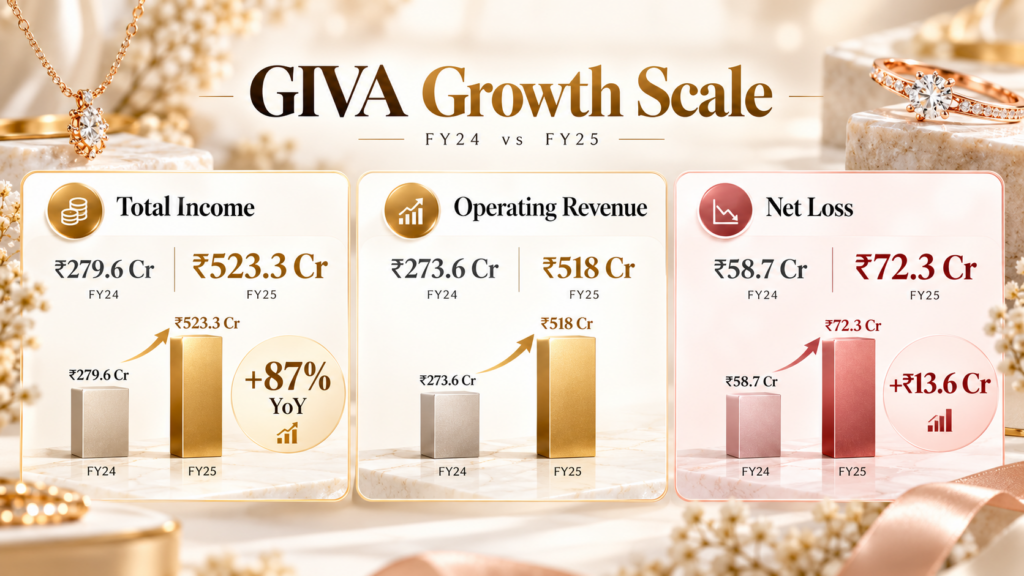
GIVA’s financial growth demonstrates how quickly a digitally native jewellery business can scale.
According to reported FY25 financial data, GIVA generated approximately ₹523.3 crore in total income, compared with about ₹279.6 crore in FY24 — an increase of roughly 87% year over year.
Its operating revenue was reported at approximately ₹518 crore, up from ₹273.6 crore in the previous year.
The growth, however, also highlights an important performance-marketing lesson.
Rapid revenue growth does not automatically mean profitable growth.
GIVA reported a net loss of around ₹72.3 crore in FY25, compared with approximately ₹58.7 crore in FY24.
This makes GIVA particularly relevant as a performance-marketing case study.
The strategic question is not simply:
“Can digital marketing generate more sales?”
It is:
“Can customer acquisition, conversion and repeat purchase grow efficiently enough to support sustainable economics?”
That distinction matters for every D2C brand.
Palmonas Is at a Different Stage of the Growth Curve
Palmonas is significantly smaller by reported FY25 revenue, but its growth trajectory is notable.
Inc42 reports FY25 revenue of approximately ₹10.8 crore, compared with about ₹5.4 crore in the previous year — almost 100% year-over-year growth.
The company has also attracted significant growth capital.
Palmonas raised a $40 million Series B round in March 2026, taking its reported cumulative funding above $52 million.
That funding gives the company more resources to invest in areas such as:
- Brand building
- Customer acquisition
- Technology
- Inventory
- Retail expansion
- Team growth
- Ecommerce infrastructure
Palmonas also says it has expanded its physical retail footprint and highlights a growing pan-India store presence on its own media page.
Digital Commerce Is the Foundation, Not Just a Sales Channel
Both brands illustrate how jewellery companies can now begin online and later expand offline.
GIVA currently promotes an app with 8 million-plus downloads and also lists commerce partners including Amazon, Myntra, Ajio, Flipkart, Nykaa, Shoppers Stop, Trends and quick-commerce platforms.
Palmonas similarly operates a direct ecommerce platform and promotes an app with 400,000-plus downloads on its website.
This means digital commerce is doing more than processing transactions.
It can provide:
- Product discovery
- First-party customer data
- Behavioural signals
- Retargeting audiences
- Conversion data
- Product-level demand insights
- Repeat-purchase opportunities
These signals can then support performance marketing.
Performance Marketing Connects Demand With Revenue
For digital-first jewellery brands, paid media can operate at several stages of the funnel.
Meta can introduce a new collection to someone who was not actively searching for jewellery.
Google can capture someone already searching for:
“silver earrings for women”
or:
“gold plated necklace under ₹3000.”
Retargeting can reconnect with someone who viewed a product but did not purchase.
Shopping campaigns can put specific products, prices and images directly in front of high-intent consumers.
The channels perform different jobs.
The strongest growth model is therefore not simply:
Run more ads.
It is:
Create demand → Capture demand → Convert demand → Retain the customer.
Offline Expansion Changes the Economics Again
Both businesses also show why digital-first does not necessarily mean digital-only.
GIVA has expanded through exclusive outlets and partnerships with retailers such as Shoppers Stop and Reliance Trends. Its current store locator lists locations across numerous Indian cities.
Palmonas has also been expanding into physical retail as the brand scales.
For jewellery, this can be especially valuable.
A physical store helps customers:
- See products in person
- Judge finish and quality
- Try jewellery
- Build trust
- Purchase higher-value products with more confidence
Digital and physical commerce therefore reinforce each other.
AI Discovery Adds the Next Layer
A new discovery channel is now emerging.
Customers can increasingly ask AI tools questions such as:
“What are good demi-fine jewellery brands in India?”
or:
“Suggest everyday jewellery under ₹5,000 that does not look like cheap fashion jewellery.”
This creates a new challenge for both GIVA and Palmonas.
Historically, the objective was to become visible through:
Google + Meta + Marketplaces + Influencers
The emerging objective becomes:
Google + Social + Marketplaces + AI Recommendations
Brands therefore need to think about whether AI systems can correctly understand:
- Their category
- Product materials
- Price positioning
- Customer reviews
- Brand authority
- Product use cases
- Availability
This is where performance marketing begins to meet SEO, AEO, GEO and AI visibility.
GIVA and Palmonas are therefore useful examples not simply because they sell jewellery online.
They show how the modern growth engine is becoming a combination of:
Brand + Paid Acquisition + Ecommerce + Retail + Data + AI Discovery

Why India’s Jewellery Market Is Shifting From Traditional Retail to Digital-First Discovery
Jewellery in India has historically been closely associated with physical retail.
Customers often preferred to:
- Visit trusted jewellers
- Examine products personally
- Discuss purity and pricing
- Compare designs physically
- Buy around weddings or festivals
For high-value gold jewellery, these behaviours remain important.
But another jewellery market has grown alongside the traditional one.
It is driven by:
- Everyday accessories
- Affordable silver
- Gold-plated pieces
- Demi-fine jewellery
- Gifting
- Self-purchase
- Fashion-led collections
These categories are far better suited to digital discovery.
The Customer Often Discovers the Product Before Searching for It
Traditional ecommerce assumes that shoppers know what they want.
Jewellery discovery frequently works differently.
A consumer may see:
- A Reel
- An influencer
- A celebrity look
- An Instagram post
- A wedding video
- A product recommendation
and only then develop purchase intent.
That means the funnel often begins with visual inspiration, not keyword search.
For a jewellery brand, this is extremely important.
A customer cannot search for a design she has never seen.
Social media therefore plays a role in creating demand before search engines capture it.
Younger Buyers Have Changed the Purchase Occasion
The traditional jewellery industry has historically relied heavily on major events.
Modern digital-first brands have expanded the category by presenting jewellery as something customers can buy more frequently.
Instead of:
Wedding → Jewellery Purchase
the occasion may become:
Birthday
Date
Office wear
Holiday
Gift
Self-reward
Everyday styling
Moneycontrol’s recent account of GIVA’s growth notes that one of the company’s founding ideas was to make jewellery more of an everyday accessory, rather than only an investment-led purchase.
That shift has major marketing implications.
A customer who buys jewellery once every several years creates a very different business model from someone who buys several pieces across a year.
Online Research Reduces the Dependence on the Store
Even when the final purchase happens offline, product research increasingly happens online.
A consumer can research:
- Designs
- Prices
- Materials
- Reviews
- Collections
- Offers
- Store locations
before entering a store.
This means the website, Google presence and social profile influence the sale even when ecommerce does not receive the final transaction.
The distinction between:
online sale
and
offline sale
therefore becomes less useful.
The customer sees one brand.
The brand sees multiple channels.
Social Media Has Become a Virtual Jewellery Showcase
Jewellery is naturally visual.
That gives Instagram, short-form video and creator content a strong role in discovery.
A single jewellery piece can be presented through:
- Product close-ups
- Styling videos
- Outfit combinations
- Gifting stories
- Creator recommendations
- Occasion-led Reels
This is fundamentally different from selling an invisible service.
The product itself becomes the creative.
That allows paid social and organic social to work together.
Palmonas even provides a dedicated “Shop Our Instagram” experience, demonstrating how closely social discovery and ecommerce can be connected.
Trust Remains the Central Challenge
Jewellery is highly dependent on trust.
A beautiful Instagram advertisement can generate interest, but before purchasing, customers may still ask:
- Is the brand genuine?
- Will the product look like the image?
- What material is it?
- Will the finish last?
- Can I return it?
- What do other customers say?
- Is the payment secure?
Digital jewellery brands therefore need to sell more than design.
They need to sell confidence.
That is why performance advertising works best when supported by:
Reviews + Strong Product Pages + Clear Policies + Brand Authority + Offline Presence
The ad can generate the click.
Trust generates the transaction.

GIVA and Palmonas: Different Brand Positions, Similar Digital Growth Ambitions
GIVA and Palmonas compete in overlapping jewellery markets, but their brand propositions are different.
Understanding those differences is important before comparing their growth strategies.
GIVA: A Broader Jewellery Platform
GIVA began as a digital-first jewellery brand focused strongly on silver and affordable jewellery.
It has since broadened its portfolio.
Inc42 describes GIVA as offering categories including sterling silver and gold-plated jewellery, while its current website also promotes gold jewellery.
Its current scale also reflects that broader ambition.
FY25 total income was reported at approximately ₹523.3 crore, up roughly 87% from the previous year.
This positions GIVA as the more mature business of the two.
Its challenge is therefore increasingly about:
- Scaling categories
- Improving economics
- Expanding stores
- Increasing lifetime value
- Building repeat behaviour
- Strengthening omnichannel presence
Palmonas: Building Around Demi-Fine Jewellery
Palmonas has built a more specific category story around demi-fine jewellery.
The positioning attempts to occupy the space between:
Low-cost fashion jewellery
and
expensive fine jewellery
This gives the brand a clear marketing narrative.
The consumer is not necessarily looking for jewellery as an investment.
They are looking for something that feels more premium than disposable fashion jewellery while remaining accessible enough for more frequent purchase.
Palmonas currently sells categories including earrings, rings, bracelets, necklaces, pendants and men’s products.
Price Architecture Reflects the Difference
Palmonas’ current site shows many promotional products in roughly the ₹999 to ₹3,000-plus range, although its wider catalogue includes different price points.
GIVA operates across a broader range because it now includes silver, plated jewellery and higher-value gold categories.
The price architecture matters for performance marketing.
Lower-ticket products can potentially:
- Reduce first-purchase resistance
- Work well with gifting
- Support impulse purchases
- Increase creative testing opportunities
Higher-ticket jewellery, however, generally requires:
- More trust
- Stronger remarketing
- More consideration
- Better product education
A single ad strategy therefore cannot serve every jewellery category equally well.
Their Target Customers Overlap but Are Not Identical
Both brands appeal strongly to younger, digitally active customers, but their positioning can create different entry points.
GIVA can attract customers through:
- Silver jewellery
- Gifting
- Gold
- Everyday designs
- Occasion jewellery
Palmonas can focus strongly on consumers interested in:
- Demi-fine positioning
- Fashion-led designs
- Everyday styling
- Affordable premium jewellery
Both businesses benefit from a customer who sees jewellery as a lifestyle purchase rather than only a family investment.
Both Began With Digital Advantages
The digital-first model gives young brands something traditional retailers did not originally have:
Immediate behavioural data.
Every online interaction can reveal:
- Which products attract clicks
- Which products receive views
- Where customers abandon
- Which cities generate orders
- Which creatives drive engagement
- Which categories convert
That information can influence:
- Marketing
- Merchandising
- Product development
- Store expansion
This is one reason digital-first brands can sometimes move quickly.
Both Are Moving Toward Omnichannel Growth
The most interesting similarity is that neither appears satisfied with remaining purely online.
GIVA’s current ecosystem includes physical stores, an ecommerce site, an app and numerous commerce partners.
Palmonas has also been expanding physical stores as it raises growth capital.
The pattern is:
Digital-first
does not mean:
Digital-only.
Instead:
Digital creates demand. Physical retail strengthens trust. Both channels increase customer reach.

From Brand Awareness to Revenue: How the Digital Funnel Has Changed
The modern jewellery purchase rarely follows one straight line.
A customer may discover a brand on Instagram, search for it on Google several days later, view products on the website, leave without buying and finally purchase after seeing another advertisement.
The journey can look like:
Social Discovery → Search → Website → Product View → Retargeting → Purchase → Repeat Purchase
Each step has a different purpose.
Stage 1: Social Discovery
Social media can introduce a product before the consumer has purchase intent.
The customer may see:
- A creator wearing earrings
- A styling Reel
- A gifting advertisement
- A new collection
- A celebrity association
At this stage, the goal is not necessarily immediate conversion.
The brand is creating memory.
Stage 2: Search
Once interest exists, search becomes more important.
The user may Google:
“GIVA reviews”
or:
“Palmonas jewellery”
or:
“best demi-fine jewellery brands.”
Search therefore captures demand that may have been created elsewhere.
This is why attribution can be misleading.
Google may receive the final click even though Instagram created the original interest.
Stage 3: Website Visit
The website then has to convert curiosity into confidence.
Customers may inspect:
- Product images
- Price
- Materials
- Reviews
- Delivery
- Returns
- Offers
This is where marketing efficiency and ecommerce UX meet.
A strong advertisement cannot compensate for a weak product page forever.
Stage 4: Product View
Viewing a product is a valuable intent signal.
Someone who looked at:
₹2,500 earrings
is more valuable for retargeting than someone who watched three seconds of a generic video.
This is why product-level tracking matters.
Stage 5: Retargeting
Jewellery often benefits from reminder advertising.
The consumer may not buy during the first session.
Retargeting can reintroduce:
- The viewed product
- Similar products
- Offers
- Social proof
- New creatives
Dynamic catalogues make this especially powerful because ads can reflect products the user previously explored.
Stage 6: Purchase
The purchase is where the advertising funnel becomes revenue.
But this is not necessarily the end.
Stage 7: Repeat Purchase
Jewellery has strong repeat-purchase possibilities.
The same customer may later buy:
- Earrings
- Rings
- Bracelet
- Gift
- Festive jewellery
This means Customer Lifetime Value can become more important than first-order ROAS.
The strongest performance-marketing model therefore asks:
What is this customer worth over time?
not only:
What did the first order generate?
Performance Marketing as a Growth Engine
Performance marketing is particularly suitable for D2C jewellery because products are visual, measurable and purchasable online.
However, performance marketing should not be understood as simply buying traffic.
A strong system connects:
Audience + Creative + Intent + Product + Landing Page + Measurement
Google Ads: Capturing Existing Demand
Google Ads can capture customers already expressing intent.
Potential campaign types include:
- Search
- Shopping
- Performance Max
- Brand campaigns
- Non-brand campaigns
Someone searching:
“silver earrings under ₹2,000”
is much closer to purchase than someone who simply likes fashion content.
Google is therefore particularly effective in capturing existing demand.
Meta Ads: Creating and Expanding Demand
Meta can work earlier in the funnel.
Consumers may discover jewellery while browsing Instagram or Facebook without actively searching for it.
This allows brands to use:
- Video
- Reels
- Catalogue ads
- Influencer-style creatives
- Lifestyle photography
to introduce products.
Meta therefore often behaves more like a demand-generation engine.
Shopping Campaigns Turn Products Into Ads
Shopping advertising has a natural advantage for jewellery.
The customer can often see:
- Product
- Image
- Price
- Merchant
before visiting the website.
This reduces ambiguity.
Instead of advertising a general brand promise, the retailer advertises the actual product.
Performance Max Connects Multiple Google Surfaces
Performance Max can help ecommerce advertisers distribute product and creative assets across Google’s inventory.
For a jewellery business with a strong product feed, this can help campaigns discover conversion opportunities beyond traditional keyword campaigns.
However, automation does not remove the need for:
- Good feeds
- Strong tracking
- High-quality images
- Correct conversion data
Automation is only as useful as the inputs it receives.
Prospecting Builds the Customer Pool
Performance growth requires new customers.
Prospecting campaigns introduce products to people who have not purchased before.
Typical signals can include:
- Interests
- Behaviour
- Broad targeting
- Lookalike-style modelling
- Platform automation
The key metric should not only be cheap traffic.
It should be:
quality new-customer acquisition.
Retargeting Converts Existing Interest
Retargeting focuses on people who already interacted with the business.
Audiences may include:
- Website visitors
- Product viewers
- Cart abandoners
- Instagram engagers
- Video viewers
- Existing customers
Because intent is higher, retargeting can often convert efficiently.
But it cannot scale forever without new prospecting.
A brand needs both.
Creative Testing Is Part of Media Buying
Modern performance marketing increasingly depends on creative.
Advertisers can test:
- Hook
- Product
- Model
- Background
- Offer
- Format
- Video length
- CTA
The objective is to identify which creative idea produces the strongest commercial response.
Conversion Optimisation Protects Media Efficiency
Suppose two brands each spend ₹1 lakh on advertising.
Both generate 10,000 website visitors.
Brand A converts 1%.
Brand B converts 2%.
Brand A:
100 orders
Brand B:
200 orders
Same traffic.
Twice the orders.
This is why CRO can sometimes be as valuable as buying more traffic.
Performance marketing ends at the conversion, not at the click.
The Role of Meta Ads in Creating Demand, Not Just Capturing It
Jewellery is highly suited to social advertising because customers can understand much of the product visually.
They do not need to read a long explanation to appreciate:
- Design
- Colour
- Styling
- Finish
- Occasion
That makes Meta particularly useful for introducing products before customers actively search for them.
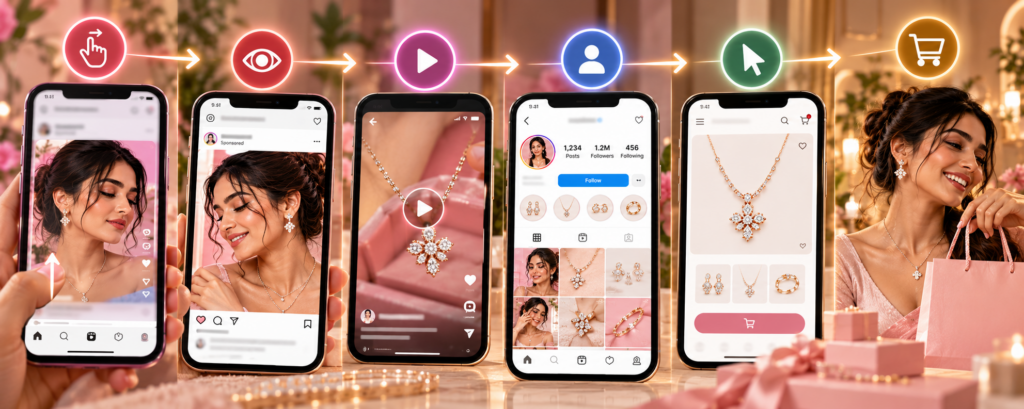
Instagram-First Discovery
For younger shoppers, Instagram can function almost like a digital shopping window.
The journey may begin with:
Scroll → Notice → Watch → Visit Profile → Visit Website → Purchase
This is fundamentally different from Google Search.
The user did not express demand.
The advertisement created it.
Palmonas’ website includes a dedicated Instagram shopping section, reinforcing how closely the brand connects social content with commerce.
Reels Make Jewellery Feel Real
Static images show a product.
Video shows:
- Movement
- Shine
- Scale
- How it looks when worn
- How it works with an outfit
This makes Reels especially useful for jewellery.
A ring can look completely different on a hand than in a catalogue photograph.
Video reduces that gap.
Influencer-Style Creatives Reduce the “Ad” Feeling
Traditional polished ads still have a role.
But creator-style content can feel more native inside social feeds.
Examples include:
- “Three jewellery pieces I wear to work”
- Unboxing
- Styling demonstration
- Gift recommendation
- Outfit transformation
This type of creative introduces the product through a story rather than a sales message.
Palmonas’ public brand profile has also benefited from celebrity involvement and media visibility around Shraddha Kapoor’s association with the company.
UGC Adds Social Proof
User-generated content can reduce purchase hesitation.
Customers can see the product in a less controlled environment.
This can answer subconscious questions:
Does it look good outside the product shoot?
How big is it?
Does it look premium when worn?
That makes UGC both a creative format and a trust mechanism.
Catalogue Ads Connect Behaviour With Product
Catalogue campaigns allow advertisers to promote products dynamically.
Someone who viewed:
a specific necklace
can later see:
that necklace or related designs
inside social advertising.
This makes remarketing more relevant.
Broad Audiences Allow Algorithms to Learn
Modern ad platforms increasingly rely on machine learning to find likely buyers.
This can make broad targeting effective when:
- Conversion tracking is strong
- The creative communicates clearly
- Enough conversion data exists
The advertiser gives the platform room to learn.
Lookalike Audiences Extend First-Party Signals
Customer lists and high-value buyer data can also help platforms model similar audiences.
The principle is:
Use known buyers to find more likely buyers.
The quality of first-party data therefore becomes increasingly important to paid social performance.
How Google Ads Captures High-Intent Jewellery Buyers
Meta can create interest.
Google becomes especially valuable when that interest turns into active search.
Google Ads can capture demand at several levels.
Brand Search
Brand searches may include:
GIVA jewellery
Palmonas jewellery
GIVA rings
These users already know the company.
Brand campaigns help businesses protect and control this high-intent traffic.
They can also support promotions or direct customers toward specific categories.
Non-Brand Search
Non-brand demand is strategically more interesting because the customer has not chosen a company.
Examples:
silver necklace for women
demi-fine jewellery India
gold plated earrings
jewellery gift for girlfriend
Winning these searches helps a brand acquire customers outside its existing awareness base.
Shopping Campaigns Put the Product Into the SERP
Shopping campaigns reduce the distance between search and product.
The user can often see:
Image + Price + Product + Merchant
before clicking.
For a visual category such as jewellery, this can be powerful.
The creative is the inventory.
Performance Max Expands Product Discovery
P-Max can combine product-feed information with creative assets and Google’s automated bidding and targeting.
For retailers with large catalogues, it can help match products to demand at scale.
But feed quality becomes crucial.
Weak titles and missing attributes reduce the quality of the signal.
Category Searches Show Commercial Intent
Searches such as:
silver rings
or:
women’s bracelets
are broad but commercially meaningful.
Brands can use dedicated category landing pages to match this intent.
Product-Level Demand Is Even Stronger
Long-tail queries often reveal more information:
rose gold necklace under ₹2500
minimal silver earrings for office wear
These queries may have lower search volume but stronger buying context.
High-Intent Keywords Are Valuable Because Intent Is Explicit
The central advantage of Google Ads is simple:
The customer tells the advertiser what they want.
Social advertising has to infer intent.
Search advertising receives it directly.
That is why search and social should rarely be analysed as interchangeable channels.

Search Demand vs Social Demand: Why Jewellery Brands Need Both
Performance marketers often debate:
Google or Meta?
For jewellery brands, this is usually the wrong question.
The stronger strategy is understanding what each platform does inside the funnel.
Meta Creates Demand
The user may not be planning to buy jewellery.
Then they see a beautiful pair of earrings.
Interest begins.
Meta can therefore generate:
- Awareness
- Desire
- Product discovery
- Brand familiarity
Google Captures Demand
Several hours or days later, the same user may search:
“GIVA earrings”
or:
“best demi-fine jewellery.”
Google captures the intent that social helped create.
Social Builds Aspiration
Jewellery is emotional and aesthetic.
Consumers often want to imagine:
How will this look on me?
Lifestyle and creator content can answer that question better than a text ad.
Search Helps Close the Decision
Once the shopper is evaluating brands, search becomes useful for:
- Reviews
- Price comparison
- Brand validation
- Product discovery
- Store location
Search can therefore operate closer to the transaction.
Attribution Can Make Search Look Better Than It Really Is
Suppose the journey is:
Instagram Reel
↓
Brand Search
↓
Google Ad
↓
Purchase
Last-click attribution may give Google most of the credit.
But without Instagram, the search may never have happened.
This is why serious performance analysis should consider:
- Assisted conversions
- Branded search growth
- Incrementality
- New customer acquisition
- Total revenue
rather than evaluating every platform in isolation.
The Full-Funnel Model
A simplified jewellery growth funnel looks like:
Meta / Influencers
Create awareness.
↓
Google / Search
Capture intent.
↓
Website
Build trust.
↓
Retargeting
Recover undecided customers.
↓
Purchase
Generate revenue.
↓
CRM / Repeat Marketing
Increase lifetime value.
This is why the strongest digital growth engine is usually multi-channel.
Ecommerce Conversion Is More Than Traffic
Performance marketing becomes expensive when ecommerce conversion is weak.
Driving more visitors to a poor website simply produces more lost opportunities.
For jewellery brands, conversion depends heavily on reducing uncertainty.
Product Pages Are Digital Salespeople
A product page needs to answer:
- What is this?
- What does it look like?
- What material is it?
- What size is it?
- When will it arrive?
- Can I return it?
- Can I trust this company?
If these questions remain unanswered, customers hesitate.
Visual Merchandising Matters More in Jewellery
Customers cannot physically inspect online products.
Images therefore carry more responsibility.
Strong merchandising can include:
- Product close-ups
- Multiple angles
- Jewellery worn by models
- Scale reference
- Video
- Styling combinations
The goal is to reduce the difference between:
screen expectation
and
real-world product.
Reviews Reduce Risk
Reviews provide evidence beyond the brand’s own claims.
They can help customers understand:
- Product appearance
- Quality
- Delivery
- Fit
- Value
This can directly support conversion.
Trust Signals Matter
Trust badges and clear information around:
- Materials
- Authentication
- Secure payments
- Shipping
- Customer support
can help shoppers feel safer.
For a new brand, these elements are particularly important.
Returns Policies Can Influence Purchase Decisions
Jewellery customers may worry about:
- Size
- Style
- Quality
- Gifting
A visible, understandable return or exchange policy can reduce perceived risk.
Payment Options Reduce Checkout Friction
The easier payment becomes, the fewer reasons the customer has to abandon.
Useful options can include:
- Cards
- UPI
- Wallets
- Cash on delivery where offered
Different customers have different payment preferences.
Mobile UX Is Critical
These are digital-first consumer brands.
A significant share of discovery can begin on mobile.
The site therefore needs:
- Simple navigation
- Large images
- Easy filters
- Clear CTA buttons
- Fast checkout
A desktop-first experience can waste mobile advertising spend.
Page Speed Directly Affects Paid Media Efficiency
Every second of unnecessary delay creates another opportunity for the customer to leave.
If advertising drives expensive traffic to slow product pages, ROAS can suffer even when the campaign itself is well optimised.
Product Filters Help Large Catalogues
As assortment grows, navigation becomes harder.
Useful filters can include:
- Price
- Material
- Category
- Colour
- Occasion
- Style
The objective is simple:
Help the customer reach the right product faster.
Conversion Rate Multiplies the Value of Marketing
Imagine the business improves conversion rate from:
1.5% to 2.0%.
That is a 33% relative increase in conversion efficiency.
Without buying a single extra click, the same traffic produces significantly more orders.
This is why conversion optimisation deserves to sit alongside paid media as a growth discipline.
The Importance of Creative Testing in Jewellery Performance Marketing
Jewellery performance marketing has one unusual advantage:
The product itself can generate an enormous number of creative variations.
The same necklace can be advertised through:
- Studio photography
- Model photography
- Creator video
- Gifting message
- Price promotion
- Lifestyle Reel
Each version can attract a different type of customer.
This makes creative testing central to performance growth.
Product-Focused Ads
The simplest creative is the product itself.
These ads work particularly well when:
- The design is visually distinctive
- Price is competitive
- Customer intent is already strong
Product-focused ads remove distraction.
Lifestyle Ads
Lifestyle creative answers:
“How does this jewellery fit into my life?”
A necklace can be shown:
- At work
- At dinner
- With Western wear
- With Indian wear
This shifts the advertisement from product presentation to aspiration.
Occasion-Based Creative
Jewellery naturally connects with occasions.
Campaign themes can include:
- Birthday gifting
- Valentine’s Day
- Raksha Bandhan
- Diwali
- Weddings
- Anniversary
- Mother’s Day
Occasion-based creative creates urgency and context.
Instead of:
“Buy jewellery.”
the message becomes:
“Here is a reason to buy jewellery now.”
Price-Led Creative
Affordable jewellery often performs well when customers understand the value quickly.
Price-led creative can highlight:
- Starting price
- Offer
- Bundle
- Discount
However, brands need to use this carefully.
Too much discount-led communication can weaken premium positioning.
Influencer-Led Creative
Creators can combine:
Attention + Trust + Demonstration
A user sees a familiar person wearing the jewellery rather than seeing a product floating against a white background.
This can make the product feel more real.
UGC Can Improve Authenticity
UGC works because it looks closer to normal social content.
Examples:
- Unboxing
- Review
- Outfit pairing
- “What I ordered vs what arrived”
This format can be especially valuable for customers who are unsure whether product photography reflects reality.
Static and Video Serve Different Jobs
Static creative can communicate:
- Product
- Offer
- Price
very quickly.
Video can communicate:
- Movement
- Shine
- Scale
- Styling
- Story
A mature creative strategy should test both rather than assuming one format always wins.

Creative Fatigue Is a Real Performance Problem
A high-performing ad does not necessarily perform forever.
Repeated exposure can lead to:
- Falling CTR
- Higher CPM
- Lower conversion
- Audience fatigue
That means advertisers need a creative pipeline.
Instead of waiting for performance to collapse, brands can continually test:
New hook
New visual
New model
New product
New offer
New story
Creative Testing Should Be Structured
Randomly creating more ads is not testing.
A useful test changes one major variable at a time.
For example:
Test 1: Product-only vs model
Test 2: Discount hook vs quality hook
Test 3: Static vs Reel
This makes it easier to understand what actually changed performance.
The Larger Lesson
For GIVA, Palmonas and other digital-first jewellery companies, performance marketing is not simply a media-buying function.
It is a connected system:
Creative generates attention.
Media finds the customer.
Product pages create confidence.
Conversion turns traffic into revenue.
Retention increases customer value.
That is what separates a temporary advertising campaign from a scalable digital growth engine.
Influencer Marketing as a Trust and Discovery Layer
For jewellery brands, influencer marketing does more than create awareness.
It can help solve one of the biggest problems in online jewellery shopping:
Trust.
A customer can easily see a necklace or ring in a product image, but that does not always answer questions such as:
- How does it look when worn?
- Does it feel premium?
- Is it suitable for everyday use?
- Does the brand feel credible?
- Would someone I trust actually wear it?
Creators and celebrities can help answer these questions in a more human way.
Creator Credibility Can Reduce Purchase Hesitation
Jewellery is a visual and personal category.
A creator can show the same product in a real-world context:
- At work
- At dinner
- During travel
- With Indian wear
- With Western wear
- As part of everyday styling
This helps the customer imagine the jewellery in her own life.
That is very different from a catalogue photograph.
A strong creator does not simply show the product.
They give the product context.
For example:
“These are the earrings I wear when I want something minimal for work.”
This can feel more believable than:
“Buy our premium earrings today.”
The first message sounds like a recommendation.
The second sounds like advertising.
That difference matters.
Palmonas Has Used Celebrity Association as Part of Its Brand Story
Palmonas has a particularly strong celebrity connection because actor Shraddha Kapoor is positioned by the company as a co-founder, not simply as a campaign face. Palmonas describes its collaboration with her as part of the brand’s wider affordable-luxury and demi-fine positioning.
That creates a deeper association than a short-term endorsement.
For consumers, this can contribute to:
- Recognition
- Brand recall
- Aspirational positioning
- Social credibility
- Media attention
The important marketing lesson is that celebrity involvement works best when there is a logical connection between the person and the brand story.
Celebrity reach can generate attention.
But product relevance still needs to convert that attention into sales.
GIVA Is Also Using Celebrity-Led Brand Building
GIVA has expanded its celebrity strategy as the brand grows.
In May 2026, GIVA announced Kriti Sanon as both brand ambassador and strategic investor, with the relationship extending into brand building and consumer engagement.
Its campaign with Sanon positioned silver jewellery as part of everyday style rather than something reserved only for special occasions.
GIVA has also used Aditya Roy Kapur for its men’s jewellery proposition, showing how celebrity partnerships can help a brand communicate to different customer segments.
The larger strategy is important.
The celebrity is not only generating reach.
They are helping redefine:
Who should wear the product
and
When the product should be worn.
That can be more valuable than a simple endorsement.
Instagram Discovery Can Begin the Entire Funnel
Many jewellery purchases may begin without an active search.
The customer is scrolling Instagram.
She sees:
- A celebrity
- A creator
- A Reel
- An outfit
- A jewellery styling video
She notices the product.
Then she visits the profile.
Later she searches for the brand.
Then she visits the website.
This creates a journey such as:
Influencer Content
↓
Instagram Profile
↓
Brand Search
↓
Product Page
↓
Retargeting
↓
Purchase
The influencer therefore may influence the sale even if the final conversion is later attributed to Google or direct traffic.
Brand Recall Matters Beyond Immediate Clicks
Not every influencer campaign should be judged only by direct conversions.
A customer may see GIVA or Palmonas repeatedly before buying.
Each exposure can build familiarity.
This matters because familiarity reduces perceived risk.
A brand that feels familiar may appear safer than an unknown brand when the customer is finally ready to purchase.
Possible signals of influencer impact can include:
- Branded search growth
- Direct traffic
- Social followers
- Website sessions
- Engagement
- Conversion lift
- New customer acquisition
This is why influencer marketing should connect with performance measurement rather than sit completely outside it.
Social Proof Makes Paid Ads Stronger
Influencer activity also creates assets that can support paid marketing.
A creator video can later become:
- Paid social creative
- Website content
- Product-page social proof
- Retargeting material
This turns influencer marketing into a content engine.
One strong creator collaboration may therefore support both:
Brand Marketing
and
Performance Marketing
The Influencer-to-Performance Funnel
A useful model is:
Creator / Celebrity Exposure
↓
Brand Awareness
↓
Social Engagement
↓
Website Visit
↓
Retargeting Audience
↓
Purchase
↓
Repeat Purchase
The strongest influencer strategies do not stop at reach.
They connect influence with measurable customer behaviour.
CAC, ROAS and Revenue: The Metrics That Actually Matter
Performance marketing becomes dangerous when a business focuses on only one number.
A campaign can have a strong ROAS but still acquire too few new customers.
Revenue can grow while profit falls.
A low CAC may look attractive but produce customers with poor lifetime value.
Jewellery brands therefore need a broader measurement system.
Customer Acquisition Cost — CAC
CAC answers:
How much does it cost to acquire one new customer?
A simplified formula is:
Marketing Spend ÷ New Customers = CAC
For example:
If a brand spends:
₹10,00,000
and acquires:
2,000 new customers
then:
CAC = ₹500
But this number only becomes meaningful when compared with:
- Average order value
- Gross margin
- Repeat purchase
- Customer lifetime value
A ₹500 CAC may be excellent for one brand and unsustainable for another.
Return on Ad Spend — ROAS
ROAS measures how much revenue advertising produces.
Formula:
Revenue Attributed to Ads ÷ Ad Spend = ROAS
Example:
Ad Spend: ₹5 lakh
Attributed Revenue: ₹20 lakh
ROAS:
4x
This means every ₹1 of reported ad spend generated ₹4 in attributed revenue.
ROAS is useful.
But it does not tell the full story.
It does not automatically account for:
- Product cost
- Returns
- Discounts
- Shipping
- Agency fees
- Payment fees
- New vs existing customers
This is why ROAS should be viewed alongside business profitability.
Marketing Efficiency Ratio — MER
MER takes a wider business view.
Instead of asking what revenue an advertising platform claims it generated, MER compares total revenue with total marketing spend.
A simplified formula:
Total Revenue ÷ Total Marketing Spend
This can be particularly useful for omnichannel brands because individual platforms may claim overlapping conversions.
Meta may influence a customer.
Google may receive the final click.
The customer may then buy offline.
MER looks at the business more holistically.
Conversion Rate
Conversion rate measures how effectively traffic becomes sales.
Formula:
Orders ÷ Website Sessions × 100
Suppose:
100,000 visitors produce 1,500 orders.
Conversion rate:
1.5%
If optimisation improves it to 2%:
The same traffic produces:
2,000 orders.
That is a 500-order increase without increasing traffic.
This is why conversion rate has a direct impact on advertising economics.
Average Order Value — AOV
AOV shows the average revenue generated per order.
Formula:
Revenue ÷ Number of Orders
Jewellery brands can increase AOV through:
- Product bundles
- Matching sets
- Cross-selling
- Gifting packages
- Threshold-based offers
A higher AOV can make the same CAC more sustainable.
Repeat Purchase Rate
Repeat purchase rate measures how many customers buy again.
This is especially important for brands trying to move jewellery from an occasional purchase into an everyday fashion category.
A customer may first buy:
Earrings
Then later:
Ring
Then:
Bracelet
Then:
Gift
The economics of the customer improve with each additional transaction.
Contribution Margin
Revenue is not profit.
Contribution margin considers what remains after variable costs.
These can include:
- Product cost
- Packaging
- Shipping
- Payment fees
- Discounts
- Returns
A campaign producing high revenue but very low contribution margin may not be healthy.
For performance marketing teams, this is an important shift:
Optimise for profitable revenue, not simply reported revenue.
Customer Lifetime Value — LTV
LTV asks:
How much value can one customer generate over the entire relationship with the brand?
Suppose a customer:
First order: ₹2,000
Second order: ₹2,500
Third order: ₹3,000
Total revenue from that customer:
₹7,500
A brand with strong repeat behaviour can afford a higher first-purchase CAC than one with almost no repeat purchases.
This is why CAC and LTV should be considered together.
The Better Performance Dashboard
For GIVA, Palmonas or any D2C jewellery brand, the most useful measurement system is not:
ROAS only
It is:
Revenue + CAC + ROAS + MER + Conversion Rate + AOV + Repeat Rate + Contribution Margin + LTV
Together, these numbers answer the real question:
Is growth becoming more valuable as it becomes bigger?
Why Jewellery Brands Cannot Optimise Only for ROAS
ROAS is one of the most popular performance-marketing metrics.
It is also one of the easiest metrics to misunderstand.
A campaign may show a high ROAS because it targets customers who were already likely to buy.
For example:
A brand campaign targeting people searching:
“GIVA jewellery”
may generate excellent ROAS.
But those customers already know GIVA.
If the business spends only on people who already know the brand, customer acquisition eventually slows.
Brand Building Creates Future Demand
Performance marketing captures demand efficiently.
Brand building can create future demand.
Celebrity campaigns, influencers, PR and social content may not always produce immediate purchases.
But they can increase:
- Recognition
- Branded searches
- Direct traffic
- Trust
- Conversion confidence
GIVA’s 2026 Kriti Sanon campaign, for example, was distributed across digital, OTT and retail environments rather than being framed as a purely lower-funnel acquisition campaign.
That demonstrates the difference between:
performance activation
and
brand building.
Both can support growth.
New Customer Acquisition Can Look Less Efficient at First
Retargeting usually performs better than prospecting because it targets warm audiences.
But if a brand optimises only for the highest ROAS, platforms may increasingly spend on:
- Existing customers
- Brand searches
- Website visitors
- Previous engagers
That makes reporting look strong.
But the business may stop expanding its customer base.
A healthy strategy should distinguish:
New Customer ROAS
from
Existing Customer ROAS
where possible.
Repeat Purchases Change First-Order Economics
Suppose:
Customer A costs ₹800 to acquire.
First order revenue:
₹1,500
The first transaction may not look impressive.
But if Customer A later spends another ₹4,000 without requiring expensive reacquisition, the total customer economics improve significantly.
This is why jewellery brands should consider lifetime value.
The first transaction is only one part of the relationship.
Offline Sales Can Hide Digital Marketing Value
For omnichannel brands, performance measurement becomes even more complicated.
Imagine this journey:
Instagram ad
↓
Website visit
↓
Google search
↓
Store locator
↓
Physical-store purchase
The digital campaign influenced the transaction.
But if offline sales are not connected back to marketing data, the ad platform may show no conversion.
This can make digital marketing look less effective than it actually was.
Attribution Is Never Perfect
Modern customer journeys involve many touchpoints.
A shopper may interact with:
- Influencer content
- Organic social
- Meta ad
- Google search
- Physical store
Which channel deserves the conversion?
There is rarely one perfect answer.
That is why brands should combine:
- Platform attribution
- GA4
- CRM
- Incrementality
- Brand-search trends
- Revenue
- Store performance
Instead of expecting one dashboard to explain everything.
Long-Term Growth Requires Both Efficiency and Expansion
Performance marketing has two jobs:
Efficiency
and
Scale
The highest ROAS campaign is not always the campaign that creates the most future value.
Strong growth requires a balance between:
Harvesting existing demand
and
creating new demand.
How Retargeting Turns Browsers Into Buyers
Most jewellery shoppers will not purchase during their first website visit.
They may want to:
- Compare designs
- Check prices
- Ask someone else
- Wait for salary day
- Research reviews
- Think about the purchase
This makes retargeting especially valuable.
Product Viewers
Someone who viewed a specific product has already demonstrated interest.
Instead of showing a generic brand advertisement, retargeting can remind them of:
- The same product
- Similar styles
- The same collection
- Relevant offers
This creates continuity between browsing and advertising.
Cart Abandoners
Cart abandoners have even stronger intent.
They selected a product but did not complete payment.
Possible reasons include:
- Price hesitation
- Delivery questions
- Payment friction
- Distraction
- Comparison shopping
Retargeting can bring them back.
The message may focus on:
- Product reminder
- Trust
- Delivery
- Reviews
- Offer
rather than basic brand awareness.
Social Engagers
Someone who watched Reels, saved content or interacted with Instagram may not have visited the website yet.
These users can form a warmer audience for future campaigns.
The funnel becomes:
Engagement → Website Visit → Product View → Purchase
Video Viewers
Video completion can also indicate interest.
Someone who watched 75% of a jewellery styling video is generally more engaged than someone who scrolled past immediately.
Brands can create follow-up campaigns for these warmer users.
Dynamic Product Ads
Dynamic ads can connect behaviour with catalogue data.
If a customer viewed:
Gold-plated earrings
the system can show:
- Those earrings
- Related earrings
- Similar products
This increases relevance.
Instead of asking the customer to rediscover the product, the advertising brings it back to them.
Email Remarketing
Retargeting does not need to remain inside paid media.
If a user has opted in or becomes a customer, email can support:
- Cart reminders
- New launches
- Restock messages
- Gifting campaigns
- Repeat purchases
This reduces dependence on paid platforms.
SMS and Messaging Remarketing
Where consent and applicable rules allow, brands can also use direct messaging for:
- Order updates
- Offers
- Back-in-stock notices
- Cart recovery
The key is relevance.
Too many messages can damage trust.
Retargeting Should Not Become Overexposure
Repeatedly showing the same jewellery advertisement can create fatigue.
Good retargeting should control:
- Frequency
- Creative variation
- Recency
- Audience exclusions
Existing purchasers should not endlessly receive acquisition ads for something they already bought.
The goal is:
Relevant reminder
not:
constant repetition.
The Role of First-Party Data in Scaling Paid Media
As digital advertising becomes more privacy-conscious, first-party data is becoming increasingly valuable.
First-party data is information a business collects directly from its own customer relationships.
Examples include:
- Email addresses
- Phone numbers
- Purchase history
- CRM records
- Loyalty activity
- Product preferences
- Website conversions
For an ecommerce jewellery brand, this data can improve both marketing and customer retention.
Customer Lists Create Better Audience Signals
A brand can build lists such as:
- All customers
- High-value customers
- Repeat customers
- Gold jewellery buyers
- Silver jewellery buyers
- Recent customers
These audiences can support more relevant campaigns.
For example:
A customer who recently bought earrings may receive recommendations for matching necklaces rather than another pair of identical earrings.
CRM Data Connects Marketing With Customer Value
Advertising platforms mainly see campaign behaviour.
The CRM can reveal what happened after acquisition.
For example:
Customer A:
- First purchase ₹1,500
- Never returned
Customer B:
- First purchase ₹1,500
- Four later purchases worth ₹8,000
If both customers are treated as equal conversions, the advertising system misses valuable information.
CRM data helps the business understand which customers are actually valuable.
Repeat Customer Data Improves Segmentation
Jewellery businesses can use repeat-purchase behaviour to identify stronger customer groups.
For example:
High-value repeat purchasers
can be separated from:
first-time discount buyers.
This supports better retention and acquisition decisions.
Enhanced Conversions Help Improve Google Measurement
Google’s Enhanced Conversions uses hashed first-party information such as customer email or phone data to improve conversion measurement where permitted. Google says this can recover conversions that otherwise might not be measured and provide stronger data for automated bidding.
In 2026, Google also simplified its Enhanced Conversions configuration so user-provided data can be received through website tags, Data Manager and API connections under a unified setting.
For performance marketers, the lesson is straightforward:
Better measurement creates better optimisation signals.
Meta Conversions API Supports Server-Side Measurement
Meta’s Conversions API performs a similar strategic role by allowing businesses to send relevant conversion events from server-side systems rather than depending entirely on browser signals.
For ecommerce brands, this can help improve:
- Measurement
- Event quality
- Audience signals
- Optimisation
The broader objective is not to collect more information unnecessarily.
It is to make measurement more durable using data customers have directly shared with the business.
Google Customer Match Extends First-Party Data Into Advertising
Google’s Customer Match allows advertisers to use their own customer data to reach or re-engage audiences across Google properties including Search, Shopping, Gmail, YouTube and Display.
For jewellery brands, this can support campaigns such as:
- New collection to existing buyers
- High-value buyer reactivation
- Customer exclusions from acquisition campaigns
- Similar audience modelling through automated systems
Privacy Changes Increase the Importance of Consent
First-party data is valuable because it comes directly from the customer relationship.
That does not mean brands can use it without limits.
Businesses still need to follow:
- Consent requirements
- Privacy policies
- Platform policies
- Applicable data-protection rules
The future of performance marketing is likely to depend less on uncontrolled third-party tracking and more on:
Customer consent + First-party relationships + Better measurement infrastructure
Omnichannel Growth: From Website Orders to Physical Stores
Digital-first brands often begin online because ecommerce lowers the barrier to national distribution.
But jewellery has characteristics that make physical stores valuable.
Customers want to:
- Touch the product
- Try it on
- Compare designs
- Evaluate finish
- Ask questions
This explains why digital-first jewellery brands increasingly expand into retail.
Online Discovery Can Lead to Offline Purchase
A customer may discover GIVA or Palmonas online and later buy in a store.
The journey can look like:
↓
Website
↓
Google Search
↓
Store Locator
↓
Physical Store
↓
Purchase
The store therefore does not replace digital.
It completes the digital journey.
GIVA Shows How Far Digital-First Retail Can Expand Offline
GIVA has expanded aggressively into physical retail.
By June 2026, one of its exchange initiatives was available across 350+ exclusive brand outlets, indicating the scale of its physical footprint.
This demonstrates how far the business has moved from a purely digital model.
Physical stores can become:
- Sales channels
- Trust centres
- Customer-service points
- Brand advertising
- Local fulfilment infrastructure
Palmonas Is Following the Same Direction
Palmonas has also been building an offline presence while maintaining its D2C foundation.
This is strategically logical.
Demi-fine jewellery is affordable enough for ecommerce but premium enough that customers may still value trying it before purchasing.
An omnichannel model gives customers both options.
Click-and-Collect Can Connect Online and Offline
A mature omnichannel experience can allow customers to:
- Discover a product online.
- Check local availability.
- Reserve it.
- Visit the store.
- Complete the purchase.
This removes the boundary between ecommerce and retail.
Even where click-and-collect is not available across every location, the concept shows where digital-first retail is moving.
Store Visits Can Be a Marketing Outcome
Digital campaigns do not always need to generate ecommerce transactions.
For local consumers, the objective may be:
Visit Store
Search campaigns can capture queries such as:
“GIVA near me”
or:
“jewellery store near me.”
This turns performance marketing into an omnichannel acquisition channel.
Physical Stores Build Brand Trust
A store sends a psychological signal:
This company exists beyond a website.
For higher-consideration purchases, this can improve trust even among customers who ultimately order online.
The offline network therefore supports ecommerce indirectly.
Why Physical Retail Can Improve Digital Performance
The relationship between ecommerce and physical stores works in both directions.
Digital marketing can send customers to stores.
Stores can also make digital marketing more effective.
Stores Increase Trust
Unknown ecommerce brands face one major problem:
Why should I trust you?
A recognised physical store network can reduce that uncertainty.
Customers know they can:
- Visit
- Ask questions
- Exchange products
- Experience the brand physically
This can make online purchasing feel safer.
Retail Expansion Can Increase Branded Search
When a new store opens in a city, more people may encounter:
- Store signage
- Shopping-mall presence
- Outdoor branding
- Word of mouth
This can increase searches for the brand.
Offline presence can therefore create online demand.
Local Intent Becomes More Valuable
Search behaviour such as:
“GIVA Lucknow”
or:
“Palmonas store near me”
is highly valuable because the customer may be close to purchase.
Brands with physical locations can use:
- Google Business Profiles
- Local SEO
- Location extensions
- Store-specific pages
to capture this intent.
Stores Increase Conversion Confidence
Some customers may visit a store once and purchase online later.
The physical experience answers questions about:
- Quality
- Finish
- Size
- Brand credibility
The customer no longer needs to rely entirely on photography.
This can make future online purchases easier.
More Customer Touchpoints Create More Opportunities
A pure ecommerce business may have:
Website + Email + Social
An omnichannel brand can have:
Website + App + Social + Email + Search + Store
Each new touchpoint creates another opportunity to build the relationship.
The strongest omnichannel brands make these touchpoints feel like one business rather than separate departments.
Digital Commerce Is Becoming a Data Business
Modern ecommerce growth increasingly depends on data.
A jewellery brand is no longer simply selling products online.
Every digital interaction creates signals.
The challenge is turning those signals into better decisions.
Product Feeds Organise the Catalogue
Product feeds contain information such as:
- Title
- Price
- Image
- Availability
- Category
- Product ID
- Variant
These feeds power:
- Shopping ads
- Dynamic ads
- Marketplaces
- Emerging AI shopping systems
Feed quality therefore affects visibility.
Poor data creates poor marketing inputs.
Customer Behaviour Shows What People Actually Want
Website analytics can reveal:
- Most viewed products
- High-exit pages
- Cart additions
- Conversion rates
- Search behaviour
- Device differences
This helps merchandising and marketing teams make better decisions.
For example:
If thousands of users view a collection but very few purchase, the problem might be:
- Price
- Product page
- Trust
- Inventory
- Poor targeting
The data creates the question.
The business still has to find the answer.
Attribution Helps Explain Where Revenue Comes From
Attribution attempts to connect revenue with marketing touchpoints.
Possible channels include:
- Meta
- Influencers
- Organic search
- Direct
- Offline
No model is perfect.
But businesses still need a structured way to understand what influences revenue.
CRM Turns Transactions Into Customer Relationships
Without CRM thinking:
Order #10492 = ₹2,000
With CRM thinking:
Customer #10492 = three orders, ₹8,500 lifetime revenue, silver category preference
The second view is far more valuable.
It supports:
- Segmentation
- Retention
- Personalisation
- LTV analysis
Inventory Data Connects Marketing With Reality
Advertising a product that is almost out of stock may waste demand.
Inventory data can inform:
- Budget allocation
- Promotions
- Product visibility
- Store planning
This becomes even more valuable when AI systems begin recommending products conversationally.
Product Popularity Can Guide Merchandising
A brand can identify:
- Products with high views but low conversion
- Products with low traffic but high conversion
- Best repeat-purchase categories
- Regional demand
These insights can influence future collections.
Demand Forecasting Can Reduce Guesswork
Over time, brands can combine:
- Historical sales
- Seasonality
- Advertising demand
- Search trends
- Inventory
- Customer behaviour
to estimate future demand more accurately.
This does not remove uncertainty.
It reduces blind decision-making.
The bigger lesson is that digital commerce is increasingly built around:
Products + Customers + Data
not just:
Products + Website.
How AI Is Changing Jewellery Product Discovery
Another major change is now arriving.
Consumers can increasingly use AI systems to help decide what to buy.
Instead of searching:
“gold plated necklace”
a customer might ask:
“I need a minimal necklace under ₹3,000 that I can wear to work every day. Which brands should I consider?”
This changes product discovery from keyword matching toward conversational intent.
ChatGPT Can Function as a Product Research Assistant
OpenAI’s current shopping experience allows users to describe what they want, refine requirements, compare products visually and evaluate factors such as price, features and reviews.
For jewellery, the customer might ask:
“Suggest elegant earrings under ₹2,500 for office wear.”
Then:
“Nothing too large.”
Then:
“Show options from Indian brands.”
The conversation becomes part of the shopping journey.
Gemini Is Moving Further Into Shopping
Google has also integrated shopping deeper into Gemini and AI-powered Search.
Google says its Shopping Graph contains more than 50 billion product listings, with more than 2 billion listings refreshed every hour.
That scale gives Google a major structured-commerce foundation for AI shopping.
In India, Google said users can increasingly move from brainstorming to product browsing directly within Gemini.
For brands such as GIVA and Palmonas, this means product feeds and structured information may influence discovery beyond traditional Shopping ads.
AI Overviews Add Another Discovery Surface
Google is also bringing product and commercial discovery into AI-powered Search experiences.
In 2026, Google announced Merchant Center reporting designed to show how products perform across:
- AI Mode
- AI Overviews
- Gemini
including AI shopping share of voice and product-term insights.
This is significant for marketers.
AI visibility is moving from an abstract concept toward something platforms are beginning to measure.
Perplexity Also Blends Research and Commerce
Perplexity’s shopping experience allows users in supported markets to research products conversationally and, for eligible merchants, move directly toward purchase.
That means product discovery is spreading across several AI environments.
Brands may increasingly need visibility beyond one search engine.
Conversational Search Changes the Query
Traditional query:
“best jewellery brands India”
Conversational query:
“I want everyday jewellery that looks premium but costs less than traditional fine jewellery. Which Indian brands should I look at?”
The second request contains:
- Budget positioning
- Style
- Use case
- Market preference
AI systems can use this context to narrow the recommendations.
This creates a major challenge for brands:
Can AI understand where the brand fits?
AI Recommendations Could Become Part of Customer Acquisition
If an AI system recommends:
GIVA
or:
Palmonas
the recommendation may introduce the customer before the brand spends on a direct ad click.
This does not make AI “free advertising.”
It creates a new discovery environment.
The brand still needs:
- Accurate product information
- Strong digital authority
- Reviews
- Merchant data
- Availability
- Clear positioning
The next customer-acquisition funnel may therefore begin:
AI Recommendation → Brand Research → Website → Purchase
rather than:
Google Search → Ad → Website.
From SEO to AEO and GEO: The Next Visibility Layer
For years, digital visibility was dominated by SEO.
Brands asked:
“Where do we rank on Google?”
That question remains important.
But AI-driven discovery adds two more questions:
“Can answer engines understand our information?”
and
“Will generative AI systems mention or recommend our brand?”
This is where SEO, AEO and GEO begin to overlap.
SEO: Search Engine Visibility
SEO focuses on making websites more visible in traditional search results.
For a jewellery brand, SEO might target:
- Silver jewellery
- Women’s rings
- Demi-fine jewellery
- Gold-plated necklaces
- Everyday earrings
Core SEO elements include:
- Technical health
- Keywords
- Content
- Links
- Product pages
- Internal linking
- Structured data
SEO remains essential because traditional search is still a major customer-discovery channel.
Google said in July 2026 that Google and YouTube appear in 93% of Indian consumer journeys for discovering a new brand, product or retailer, highlighting how important search and video discovery remain.
AEO: Answer Engine Optimisation
AEO focuses on making information easy to use when systems answer questions.
Example question:
“What is demi-fine jewellery?”
A strong AEO page should answer this clearly.
It should not force the system to interpret:
- Marketing jargon
- Unclear definitions
- Long promotional introductions
Useful AEO content can include:
- FAQs
- Definitions
- Buying guides
- Product-care answers
- Comparison content
- Clear headings
For Palmonas, for example, explaining exactly what demi-fine means is strategically important.
For GIVA, explaining differences between:
- Sterling silver
- Gold-plated silver
- Gold
- Lab-grown diamond jewellery
can improve product understanding.
GEO: Generative Engine Optimisation
GEO focuses more broadly on visibility inside generative AI systems.
The objective is not only:
“Can this page rank?”
It becomes:
“Does the AI system understand the brand strongly enough to include it in an answer?”
For example:
“Which Indian jewellery brands are good for everyday wear?”
AEO helps answer the category question.
GEO asks whether the brand becomes part of the recommendation.
AI Visibility Is Broader Than Ranking
AI visibility can include:
- Brand mentions
- Recommendations
- Product inclusion
- Citations
- Comparisons
- Category association
A brand may rank well on Google and still appear inconsistently in AI answers.
That creates a new optimisation challenge.
Entity Optimisation Helps Clarify the Brand
AI systems need to understand what an entity represents.
For a jewellery brand, the information should clearly establish:
- Brand name
- Company identity
- Product category
- Materials
- Price positioning
- Founders
- Market
- Store locations
Consistency matters.
If one source describes a company as:
fashion jewellery
another says:
fine jewellery
and another says:
demi-fine jewellery
AI systems may have a more difficult time understanding the exact positioning.
Brand Mentions Build a Wider Information Footprint
A company’s own website is not the only source available to AI systems.
Other useful sources can include:
- News articles
- Industry publications
- Interviews
- Reviews
- Retail listings
- Marketplace pages
This is why PR and authority increasingly connect with AI visibility.
For example, Palmonas’ association with Shraddha Kapoor and GIVA’s Kriti Sanon partnership create coverage outside their own websites.
This builds a broader digital footprint around each brand.
Structured Content Reduces Ambiguity
Content should be organised so both customers and machines can understand it.
Useful structure includes:
Product Name
Material
Price
Use Case
Care Information
Reviews
FAQs
Availability
Structured data and accurate merchant feeds can reinforce this information.
The New Jewellery Visibility Model
Traditional model:
SEO → Google Ranking → Website Visit
Emerging model:
SEO
AEO
GEO
Product Data
Brand Authority
↓
Search Visibility + AI Visibility
↓
Customer Discovery
This does not mean brands should stop doing SEO.
It means SEO is becoming part of a wider visibility strategy.
For jewellery brands such as GIVA and Palmonas, the next competitive question may therefore move from:
“Who ranks higher?”
to:
“Which brand is easiest for search engines, AI systems and customers to understand, trust and recommend?”
That is where traditional digital marketing begins to connect with the next generation of product discovery.
What Makes a Jewellery Brand “AI-Discoverable”
Being visible on Google does not automatically mean a brand will be easy for AI systems to understand.
AI-driven discovery depends on more than ranking.
A jewellery brand needs clear, structured and trustworthy information across the web so that AI systems can correctly understand:
- What the brand sells
- What materials it uses
- Who its products are for
- What price range it operates in
- How its products differ from competitors
- Whether the products are currently available
This creates a new question for brands such as GIVA and Palmonas:
Can AI systems correctly understand the brand before they are expected to recommend it?
Clear Product Descriptions
Product descriptions should do more than sound attractive.
They should explain the product clearly.
For example, instead of writing:
“An elegant piece designed to elevate your style.”
a stronger description might explain:
“A gold-plated sterling silver necklace designed for everyday wear, featuring a lightweight chain and minimal pendant.”
The second description tells both the customer and the AI system:
- Product type
- Material
- Design style
- Intended use
This improves understanding.
Schema Helps Machines Understand the Page
Structured data can help search engines and other systems interpret website information.
For jewellery ecommerce sites, relevant structured information can include:
- Product
- Offer
- Price
- Availability
- Review
- Rating
- Organisation
- Breadcrumb
Schema does not guarantee AI visibility.
But it helps reduce ambiguity around important product information.
Reviews Build External Confidence
Reviews provide information that does not come directly from the brand.
They can help explain:
- Product quality
- Delivery experience
- Packaging
- Comfort
- Durability
- Value
This is useful because AI systems increasingly work with information from several sources.
A product with strong, consistent customer feedback may be easier to evaluate than one with almost no independent signals.
Product Feeds Provide Structured Commerce Data
Product feeds are becoming increasingly important.
OpenAI says merchant product feeds can help ChatGPT understand a catalogue using structured information such as titles, descriptions, images, prices and availability.
For jewellery brands, feeds can provide:
- Product title
- Price
- Availability
- Variant
- Image
- Product ID
- Seller information
This gives AI systems a more reliable commerce layer.
Third-Party Mentions Strengthen the Brand Footprint
A brand’s own website will naturally describe itself positively.
Third-party mentions add another layer.
Useful references may include:
- News publications
- Industry sites
- Retail marketplaces
- Reviews
- Interviews
- Influencer content
- Independent product coverage
These sources help create a wider digital footprint around the brand.
Brand Consistency Reduces Confusion
Brand information should remain consistent across channels.
For example, if Palmonas positions itself as a demi-fine jewellery brand, that category should remain clear across:
- Website
- Social profiles
- Merchant feeds
- Marketplace listings
- PR
- Structured data
Likewise, GIVA’s wider product categories should be clearly organised so AI systems can distinguish its silver, plated, gold and other jewellery lines.
Consistency helps systems build a clearer understanding of the entity.
AI Discoverability Is Built in Layers
A useful model is:
Clear Content
Structured Data
Merchant Feeds
Reviews
External Authority
Consistent Brand Identity
=
Stronger AI Discoverability
This does not guarantee recommendation.
It creates the foundation required for recommendation.
Could AI Recommendations Become a New Acquisition Channel?
For years, digital customer acquisition has been dominated by channels such as:
- Google Ads
- Meta Ads
- Organic search
- Influencers
- Marketplaces
AI may now become another discovery layer.
A customer can increasingly begin a purchase journey by asking:
“Which Indian jewellery brands offer good everyday pieces under ₹5,000?”
The customer may not visit Google Search first.
They may ask an AI assistant.
If the assistant recommends a brand, that recommendation can become the beginning of a new customer journey.
AI Shopping Changes the Starting Point
Traditional acquisition often begins with:
Search keyword
or:
Advertisement impression
AI discovery can begin with:
Customer problem or preference
For example:
“I want jewellery that looks premium but is affordable enough for everyday wear.”
This request may lead AI to identify brands that fit that positioning.
That creates discovery without an exact brand search.
Product Recommendations Can Introduce Unknown Brands
One of the most interesting possibilities is unbranded discovery.
A user does not need to ask:
“Should I buy GIVA?”
They may ask:
“What are good Indian silver jewellery brands?”
If GIVA appears, AI has contributed to acquisition.
Likewise:
“Which demi-fine jewellery brands in India are worth considering?”
could potentially introduce Palmonas.
This means the commercial value of AI visibility may increasingly be measured through category-level recommendations.
Conversational Discovery Is Different From Keyword Discovery
Keyword search:
“silver necklace India”
Conversational discovery:
“I want a minimal silver necklace for office wear under ₹3,000, preferably from an Indian brand.”
The second query contains:
- Price
- Style
- Occasion
- Geography
- Category
AI can interpret several conditions at once.
That makes product discovery more contextual.
Discovery Can Happen Without Traditional Search
The customer may follow this journey:
Ask AI
↓
Receive Brand Recommendation
↓
Research Brand
↓
Visit Website
↓
Purchase
This means AI could influence the customer before Google Search or Meta retargeting enters the journey.
It may therefore become an upper- or mid-funnel acquisition source.
AI-Assisted Commerce Makes the Opportunity Larger
OpenAI’s current shopping experience can show relevant products, imagery and merchant options when it detects shopping intent. Product results are selected based on relevance to the user’s intent and context rather than being the same thing as ads.
OpenAI also supports structured product feeds for approved merchants so product information can stay more accurate and current.
This means AI discovery is beginning to connect with actual commerce infrastructure.
For jewellery brands, that could create a future acquisition path such as:
AI Recommendation
↓
Product Card
↓
Merchant
↓
Purchase
AI is not yet replacing paid acquisition.
But it is becoming another customer-acquisition surface worth monitoring.
Search, Social and AI Are Starting to Converge
Modern customer journeys are increasingly fragmented.
A customer rarely sees one advertisement and immediately buys.
Instead, several platforms may influence the purchase.
A jewellery journey could look like:
Instagram → Google → ChatGPT → Website → Store → Purchase
Each platform performs a different job.
Instagram Creates Inspiration
A consumer sees:
- Reel
- Creator
- Celebrity
- Styling video
Interest begins.
At this stage, the customer may not even know the product category they want.
Google Validates the Brand
Later, the user searches:
“Palmonas reviews”
or:
“GIVA jewellery quality.”
Google becomes a trust and research channel.
The customer is checking whether the brand is credible.
ChatGPT Helps Compare Options
The same customer might then ask:
“How does demi-fine jewellery compare with sterling silver jewellery?”
or:
“Which brand is better for everyday jewellery under ₹4,000?”
AI becomes part of evaluation.
The Website Handles Detailed Product Research
After the brand enters consideration, the customer visits the website.
They inspect:
- Images
- Material
- Price
- Reviews
- Delivery
- Returns
The website remains central to conversion.
Physical Retail Can Close the Purchase
A customer may still decide:
“I want to see it before buying.”
They find the nearest store and complete the transaction offline.
The Customer Journey Is No Longer Linear
The modern funnel therefore looks less like:
Ad → Website → Purchase
and more like:
Social
↓
Search
↓
AI
↓
Website
↓
Store
↓
Purchase
Then perhaps:
Email → Repeat Purchase
This makes attribution increasingly difficult.
It also means brands need visibility across several discovery environments.
The Strategic Lesson
Marketing teams should not ask:
“Which one channel won?”
Instead ask:
“How did the channels work together to move the customer toward purchase?”
That is a more realistic view of modern jewellery commerce.
Product Feeds Could Become More Important in AI Commerce
Product feeds have always been important for Shopping campaigns and marketplaces.
AI commerce may make them even more strategic.
AI systems need accurate, structured and current product information before they can recommend products confidently.
OpenAI says structured feeds help ChatGPT surface products using accurate pricing, availability and seller context.
Product Title
The product title should clearly explain what is being sold.
Weak:
“Aurora Collection 07”
Better:
“Gold-Plated Sterling Silver Minimal Pendant Necklace”
The second title gives much more information.
Price
Price is essential for conversational shopping.
If a user asks:
“under ₹2,500”
the system needs accurate pricing.
Old or incorrect prices can reduce trust.
Availability
AI should ideally avoid recommending unavailable products.
Inventory therefore becomes part of product visibility.
A product that is well optimised but permanently out of stock has little commercial value.
Variants
Jewellery often includes variants such as:
- Size
- Colour
- Finish
- Material
- Stone
Each variation should be clearly represented.
For example:
Ring size is critical.
An AI recommendation is less useful if the product exists but not in the required size.
Images
Jewellery shopping is highly visual.
Images need to clearly represent:
- Actual product
- Scale
- Finish
- Variant
- How it looks when worn
AI shopping interfaces are becoming more visual, which makes image quality strategically important.
Merchant Data
Product discovery also depends on the merchant.
Relevant merchant information can include:
- Seller identity
- Availability
- Pricing
- Returns
- Shipping
OpenAI says merchant selection can consider factors such as availability, price, quality and whether the seller is the maker or primary seller.
Structured Information Reduces Ambiguity
Product feeds turn unstructured ecommerce information into defined fields.
For example:
Brand: GIVA
Category: Necklace
Material: Sterling Silver
Price: ₹2,499
Availability: In Stock
Colour: Silver
This is easier for machines to interpret than a long paragraph of promotional copy.
Product Feeds Are Becoming a Visibility Asset
OpenAI is not the only company moving in this direction.
Google now provides AI performance insights in Merchant Center, including visibility across conversational shopping experiences and product attributes.
This suggests that product-feed optimisation may increasingly affect:
Shopping Ads + Organic Shopping + AI Shopping
Brands should therefore treat feed quality as part of marketing strategy, not just a technical setup.
How GIVA and Palmonas Can Build Stronger AI Visibility
AI visibility should be approached systematically.
Neither GIVA nor Palmonas needs a completely new marketing strategy.
Many of the improvements also strengthen SEO, ecommerce and conversion performance.
Improve Product Data
Every important product should clearly define:
- Product type
- Material
- Style
- Price
- Occasion
- Dimensions
- Variant
- Availability
Avoid vague language where clearer product information is possible.
Build Better FAQs
FAQs should reflect real shopping questions.
For GIVA:
- What is 925 silver?
- Can silver jewellery be worn daily?
- How should gold-plated silver be cared for?
For Palmonas:
- What is demi-fine jewellery?
- How is demi-fine different from fashion jewellery?
- Is demi-fine jewellery suitable for daily wear?
This creates useful conversational content.
Create Comparison Content
Comparison pages can help answer high-intent questions.
Examples:
Demi-Fine vs Fine Jewellery
Sterling Silver vs Gold-Plated Jewellery
GIVA vs Traditional Fine Jewellery
Demi-Fine Jewellery vs Fashion Jewellery
Useful comparisons help AI understand category differences.
Strengthen Entity Signals
Brand information should be consistent across:
- Website
- Merchant feeds
- Google Business Profiles
- Marketplaces
- Press coverage
This strengthens entity clarity.
Invest in Digital PR
External authority matters.
Brands can build credibility through:
- Research
- Interviews
- Product innovation
- Founder stories
- Industry insights
- Consumer trend reports
Digital PR improves both human trust and machine discoverability.
Build More Genuine Reviews
Reviews should be encouraged across appropriate channels.
Strong reviews help establish:
- Product quality
- Service quality
- Reliability
- Customer satisfaction
They also give AI systems more real-world product context.
Monitor AI Visibility
Brands should create prompt sets such as:
“Best demi-fine jewellery brands in India.”
“Best silver jewellery brands for everyday wear.”
“Affordable jewellery brands for office wear.”
Then test them across:
- ChatGPT
- Gemini
- Google AI experiences
- Perplexity
Track:
- Brand appearance
- Competitors
- Recommendation context
- Accuracy
- Sources
AI visibility should become measurable rather than speculative.
Google’s AI performance reporting is already moving in this direction by showing AI share of voice, conversational shopping stages and product attributes.
Competitive Advantage: Brand + Performance + Data + AI
Modern ecommerce advantage is rarely created by one channel.
The strongest jewellery businesses combine several capabilities.
A useful framework is:
Brand Strength
Paid Media
Commerce Infrastructure
First-Party Data
AI Visibility
Each element plays a different role.
Brand Strength Creates Trust
Strong brands convert attention more efficiently.
Customers are more comfortable purchasing when they recognise:
- Name
- Celebrity association
- Reviews
- Store presence
- Reputation
Trust can reduce friction throughout the funnel.
Paid Media Creates Scale
Performance marketing can accelerate acquisition.
Google and Meta allow brands to:
- Reach new audiences
- Capture demand
- Retarget visitors
- Promote products quickly
Paid media provides speed.
Commerce Infrastructure Converts Demand
Advertising is wasted if:
- Site is slow
- Product data is poor
- Checkout fails
- Product is unavailable
Commerce infrastructure turns marketing attention into revenue.
First-Party Data Improves Customer Economics
Customer data helps brands understand:
- Who buys
- What they buy
- Who returns
- Who repeats
- Which customers create the most value
This can improve both acquisition and retention.
AI Visibility Adds the Next Discovery Layer
AI systems increasingly influence research and recommendations.
Brands that are:
- Discoverable
- Understandable
- Trusted
- Well structured
may have stronger opportunities to appear in future AI-driven commerce journeys.
The Competitive Equation
The strongest model therefore becomes:
Brand creates demand.
Performance marketing scales it.
Commerce converts it.
Data improves it.
AI visibility expands future discovery.
That is a more durable advantage than simply spending more on ads.
The Risk of Overdependence on Paid Media
Paid media can scale a D2C brand quickly.
But it also creates risk.
If a business becomes dependent on advertising for almost every sale, growth can become expensive.
Rising CPCs Can Increase CAC
Competition increases advertising costs.
If CPC rises while conversion rate stays the same, CAC increases.
Example:
Previous CPC: ₹10
New CPC: ₹15
The business now needs stronger conversion or better AOV to maintain the same economics.
Creative Fatigue Can Reduce Performance
Even good advertisements stop working eventually.
Repeated exposure may cause:
- Lower CTR
- Higher CPM
- Lower conversion
Brands must constantly develop new creatives.
This adds cost and operational pressure.
Attribution Is Becoming Less Certain
Privacy changes and cross-device behaviour make attribution more complicated.
Platforms may disagree about who generated the conversion.
This makes optimisation harder when the business relies entirely on platform-reported ROAS.
Platform Dependence Creates Strategic Risk
A business heavily dependent on Meta or Google is exposed to:
- Algorithm changes
- Policy changes
- CPM increases
- Tracking changes
- Account problems
No brand should allow one advertising platform to control most of its customer acquisition.
Margin Pressure Can Grow With Scale
More sales do not always mean more profit.
If customer acquisition becomes expensive, discounts increase and returns remain high, revenue can grow while margins weaken.
This is exactly why jewellery companies should monitor:
Contribution Margin
not only:
ROAS.
Organic and Repeat Demand Reduce Paid Dependence
A healthier growth model creates sales from:
- Branded search
- SEO
- Direct traffic
- Repeat buyers
- Referrals
- Stores
These channels reduce the amount of paid media required for every new rupee of revenue.
Why Sustainable Growth Requires More Than Ads
Advertising can accelerate a brand.
It cannot create every part of a sustainable business.
Long-term growth requires multiple demand sources.
SEO Builds Compounding Visibility
Paid traffic stops when spend stops.
Organic search can continue producing traffic over time.
SEO helps brands appear for:
- Product categories
- Buying guides
- Comparison searches
- Brand research
- Informational queries
This creates a more durable acquisition base.
Organic Social Builds Community
Organic content can maintain relationships without paying for every impression.
Useful content may include:
- Styling
- Product care
- Behind-the-scenes
- Customer stories
- New collections
The objective is ongoing brand relevance.
CRM Converts One Customer Into Several Orders
CRM improves the economics of customers already acquired.
A buyer can receive:
- New launch
- Restock
- Birthday
- Gifting
- Category recommendation
Retention is often cheaper than repeatedly reacquiring the same customer.
Loyalty Creates Switching Resistance
A strong loyalty programme can give customers reasons to return.
Possible benefits include:
- Early access
- Exclusive products
- Rewards
- Member offers
The goal is to make repeat purchase easier.
Retention Increases LTV
Every additional purchase improves customer value.
High retention allows the business to spend more confidently on acquisition because each new customer may produce future revenue.
Branded Search Is a Valuable Signal
Growth in branded searches can indicate stronger awareness.
People are no longer searching only:
“silver jewellery”
They are searching:
“GIVA silver jewellery.”
Brand demand reduces dependence on generic keyword competition.
PR Builds Authority
PR can help brands reach customers before they enter the advertising funnel.
It also strengthens:
- Reputation
- Search visibility
- Brand credibility
- AI entity signals
Reviews Build Trust at Scale
Every strong customer review becomes another trust signal.
Reviews can influence:
- Conversion rate
- SEO
- Marketplace performance
- AI product understanding
Sustainable growth therefore depends on an ecosystem, not a single ad platform.
What Smaller D2C Brands Can Learn From GIVA and Palmonas
Smaller brands do not need celebrity investors or hundreds of stores to learn from these businesses.
The principles are more important than the scale.
Build Clear Positioning
Customers should quickly understand:
What do you sell?
Who is it for?
Why is it different?
Palmonas’ demi-fine positioning is a good example of category storytelling.
Clear positioning reduces marketing friction.
Use Performance Marketing Intelligently
Do not start with:
“How much should we spend?”
Start with:
“What economics do we need?”
Understand:
- CAC
- AOV
- Margin
- Conversion
- Repeat purchase
Then scale.
Improve Conversion Before Increasing Spend
A weak website becomes more expensive as ad spend increases.
Improve:
- Product page
- Trust
- Checkout
- Mobile UX
before aggressively scaling traffic.
Track Unit Economics
Every brand should know:
Customer acquisition cost
Gross margin
Contribution margin
Lifetime value
Revenue alone is not enough.
Build Trust Early
Smaller brands need trust even more than established ones.
Build:
- Reviews
- Clear policies
- Strong photography
- Customer support
- Third-party mentions
Prepare for AI Discovery Now
Small brands have an opportunity to build clean product data early.
They can create:
- Structured pages
- Good schema
- Clear FAQs
- Product feeds
- Consistent entity information
This may be easier than fixing a messy catalogue later.
A Practical Growth Framework for D2C Jewellery Brands
A simple way to evaluate jewellery growth is the:
P-D-A-R Framework
The four stages are:
Performance
Digital Commerce
Authority
Recommendability
P — Performance
Ask:
Can paid media acquire customers efficiently?
Track:
- CAC
- ROAS
- MER
- New customer revenue
- Contribution margin
If acquisition is too expensive, the business cannot scale sustainably.
D — Digital Commerce
Ask:
Does the website turn traffic into sales?
Evaluate:
- Conversion rate
- Mobile UX
- Product pages
- Checkout
- Page speed
- Payment options
Traffic without conversion is wasted marketing.
A — Authority
Ask:
Do customers and platforms trust the brand?
Look at:
- Reviews
- PR
- Brand mentions
- Influencers
- Store presence
- Customer sentiment
Authority reduces purchase resistance.
R — Recommendability
Ask:
Can search engines and AI systems confidently surface the brand for relevant needs?
Evaluate:
- Product clarity
- Structured data
- Merchant feeds
- Entity consistency
- AI visibility
- External references
The PDAR Growth Model
The framework works like this:
Performance
Brings customers.
↓
Digital Commerce
Converts customers.
↓
Authority
Builds trust.
↓
Recommendability
Expands future discovery.
Weakness in any one stage can limit growth.
How to Measure Digital + AI Growth Together
Traditional dashboards were built for clicks and conversions.
Modern brands need a wider measurement model.
Revenue
Track:
- Online revenue
- Store revenue
- Total revenue
Revenue remains the ultimate commercial outcome.
CAC
Understand how much each new customer costs.
Track it by:
- Channel
- Campaign
- Category
ROAS
Measure advertising efficiency.
But never view ROAS alone.
MER
Compare total revenue with total marketing spend.
MER gives a wider view of marketing efficiency.
Conversion Rate
Track how efficiently website traffic becomes customers.
AOV
Higher AOV can improve customer economics.
Repeat Purchase Rate
Track how many customers return.
This helps understand retention.
Organic Traffic
Growth in non-paid traffic reduces dependence on advertising.
Branded Search
Increasing branded search can indicate stronger market awareness.
AI Mentions
Track whether the brand appears in relevant AI queries.
For example:
“Best demi-fine jewellery brands India.”
Recommendation Frequency
Create a fixed prompt set.
If the brand appears in:
20 of 50 relevant prompts,
internal recommendation visibility =
40%.
This is not a universal industry metric.
It is a useful internal benchmark.
Google Is Beginning to Formalise AI Shopping Measurement
Google’s AI performance insights now include metrics such as AI share of voice, competitor visibility and product presence for conversational shopping queries.
This shows that AI visibility measurement is moving closer to normal ecommerce analytics.
GIVA vs Palmonas: Where Their Growth Models Differ
GIVA and Palmonas share a digital-first mindset, but their growth models are not identical.
Positioning
GIVA
Broader jewellery platform with strong silver heritage and expanding categories.
Palmonas
More focused demi-fine jewellery positioning.
This gives Palmonas a sharper category narrative while GIVA has a broader commercial scope.
Product Range
GIVA operates across a wider product and price spectrum.
Palmonas remains more closely associated with accessible premium and demi-fine jewellery.
This affects:
- Audience
- Creative
- Search intent
- AOV
- Consideration time
Paid Media
Both brands fit naturally into performance-marketing ecosystems.
However, exact public campaign-level CAC, ROAS and media-spend data are not reliably available.
Therefore, the meaningful comparison is strategic rather than based on invented ad metrics.
GIVA’s larger scale likely requires:
- Broader audience acquisition
- More category segmentation
- Omnichannel measurement
Palmonas can lean more heavily into:
- Category education
- Demi-fine positioning
- Growth-stage acquisition
Influencer Strategy
Palmonas benefits from Shraddha Kapoor’s strong brand association.
GIVA has used celebrities such as Kriti Sanon and other ambassadors to build broad recognition.
Both demonstrate the role of celebrity in jewellery discovery.
Offline Presence
GIVA currently has the stronger physical network and more mature omnichannel footprint.
Palmonas is expanding stores but remains earlier in the offline scaling journey.
Digital Authority
GIVA’s larger scale, age, retail footprint and broader online presence give it a stronger current digital entity footprint.
Palmonas has the advantage of a clear category concept that can be strongly associated with demi-fine jewellery.
AI Visibility
AI visibility is not simply about company size.
A smaller brand can outperform a larger one for specific conversational queries if its positioning and product information are clearer.
For example:
GIVA may be stronger for:
“best silver jewellery brands.”
Palmonas may have a natural opportunity around:
“best demi-fine jewellery brands.”
This is why AI visibility should be evaluated at the query and category level, not only at the brand level.
The Future of Jewellery Growth: From Paid Acquisition to AI-Assisted Discovery
For the last decade, D2C growth has been heavily driven by paid acquisition.
The future appears more diversified.
A possible journey is:
Paid Ads
↓
Search
↓
Social Proof
↓
AI Recommendation
↓
Commerce
Each stage influences the next.
Paid Ads Still Create Scale
Meta and Google will remain important because they can generate traffic quickly.
Search Still Captures Intent
Customers will continue using search engines to:
- Research
- Compare
- Validate brands
Social Proof Creates Confidence
Influencers, reviews and customer content provide reassurance.
AI May Help Narrow the Choice
A shopper may ask:
“Which of these brands is best for everyday wear?”
AI helps reduce the consideration set.
Commerce Completes the Journey
The final purchase may happen through:
- Website
- App
- Marketplace
- Store
The future therefore looks less like one dominant channel and more like a connected discovery ecosystem.
Key Takeaways From the GIVA and Palmonas Case Study
Several important lessons emerge from the comparison.
1. Performance Marketing Can Accelerate Scale
Paid media can help jewellery brands reach new customers quickly.
But it works best when the business understands customer economics.
2. Brand Trust Improves Performance Efficiency
Strong recognition, reviews, celebrity association and physical stores reduce customer hesitation.
That can improve conversion beyond the ad platform itself.
3. Omnichannel Can Strengthen Digital Growth
Physical stores do not necessarily compete with ecommerce.
They can:
- Build trust
- Create local demand
- Increase branded search
- Support higher-consideration purchases
4. First-Party Data Is Becoming More Important
Customer data supports:
- Better measurement
- Retargeting
- Retention
- Personalisation
- Audience modelling
As privacy standards change, direct customer relationships become more valuable.
5. AI Visibility Is Emerging as a New Marketing Layer
Brands now need to think about:
Search visibility
and
AI recommendation visibility.
The question is no longer only:
“Do we rank?”
It is also:
“Do AI systems understand and recommend us?”
6. Product Data Is Becoming Strategic
Product feeds, structured data and accurate inventory increasingly influence:
- Shopping ads
- Organic shopping
- AI shopping
- Marketplace visibility
Product data is becoming a marketing asset.
7. Sustainable Growth Needs Paid and Organic Demand
A brand that relies entirely on paid media remains vulnerable to:
- Rising costs
- Platform changes
- Creative fatigue
Long-term growth requires:
Paid Media + SEO + CRM + PR + Reviews + Retention + AI Visibility
Final Conclusion: Who Will Win the Next Jewellery Customer?
GIVA and Palmonas represent two different stages of the same larger transformation.
Jewellery buying is becoming more digital.
Discovery is becoming more visual.
Customer journeys are becoming more fragmented.
And AI is beginning to influence how people research and compare products.
The next phase of competition will not depend only on which company can buy the most advertising.
It will depend on which company can connect several growth systems together.
Performance Marketing Still Matters
Google and Meta can still drive large-scale customer acquisition.
But paid media needs stronger economics.
Brands must understand:
- CAC
- ROAS
- MER
- LTV
- Contribution margin
Growth without profitability discipline can eventually become difficult to sustain.
Brand Trust Creates Efficiency
Jewellery remains a trust-based category.
Customers need confidence in:
- Product quality
- Brand authenticity
- Delivery
- Returns
- Reviews
Strong trust can make every marketing channel work better.
Digital Commerce Must Convert Attention Into Revenue
Good advertising only creates an opportunity.
The website and commerce experience still need to complete the job.
That requires:
- Strong product pages
- Fast mobile experience
- Good checkout
- Accurate data
- Useful filters
Data Improves Every Decision
First-party data helps brands understand which customers, products and channels generate the most value.
This allows smarter decisions around:
- Marketing
- Inventory
- Retention
- Product development
AI Visibility Adds a New Competitive Layer
The next jewellery customer may not begin with:
“Search Google for jewellery brands.”
They may begin with:
“Which jewellery brand should I buy from?”
If AI increasingly helps answer that question, brands need to become easier for AI systems to:
Find
↓
Understand
↓
Trust
↓
Recommend
That is the new visibility challenge.
The New Growth Equation
The next phase of jewellery growth may therefore depend on:
Performance Marketing
Brand Trust
Digital Commerce
First-Party Data
AI Visibility
rather than any one channel alone.
For GIVA, the challenge is turning large-scale growth into increasingly efficient and profitable customer economics.
For Palmonas, the opportunity is to build on its differentiated demi-fine positioning while scaling acquisition, authority and omnichannel reach.
Both brands show that modern jewellery growth is no longer simply about opening more stores or spending more on advertising.