

NVIDIA is one of the best examples of how a company can become a global brand without relying on traditional consumer advertising. Unlike brands such as Apple, Samsung, or Coca-Cola that invest heavily in television commercials, celebrity endorsements, and mass consumer campaigns, NVIDIA followed a completely different marketing strategy.
Instead of spending billions on traditional advertising, NVIDIA focused on innovation, developer relationships, enterprise partnerships, technical education, and community building. Over time, this strategy transformed the company from a gaming GPU manufacturer into the backbone of the global Artificial Intelligence industry.
Today, NVIDIA powers AI infrastructure for some of the world’s largest technology companies, including Microsoft, Amazon Web Services (AWS), Google Cloud, Oracle Cloud, Meta, and OpenAI. Rather than marketing directly to everyday consumers, NVIDIA positioned itself as the company enabling the future of AI.
The results speak for themselves.
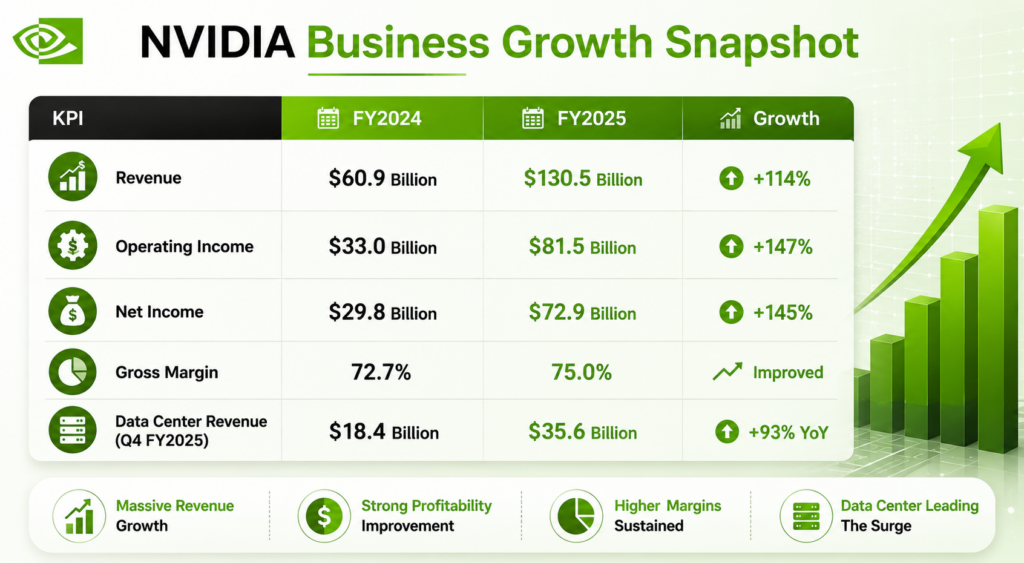
NVIDIA Business Growth Snapshot
| KPI | FY2024 | FY2025 | Growth |
| Revenue | $60.9 Billion | $130.5 Billion | +114% |
| Operating Income | $33.0 Billion | $81.5 Billion | +147% |
| Net Income | $29.8 Billion | $72.9 Billion | +145% |
| Gross Margin | 72.7% | 75.0% | Improved |
| Data Center Revenue (Q4 FY2025) | $18.4 Billion | $35.6 Billion | +93% YoY |
These numbers show that NVIDIA achieved exceptional financial growth while maintaining industry-leading profitability. Much of this success came from enterprise AI demand rather than consumer product marketing.
From a marketing perspective, NVIDIA proves that a strong product ecosystem, technical credibility, and long-term trust can generate demand more effectively than traditional advertising.
The Shift from Gaming Hardware to AI Leadership
When NVIDIA was founded in 1993, its primary focus was developing graphics processing units (GPUs) for gaming and professional graphics. For many years, gamers were the company’s largest customer base.
However, NVIDIA recognized an important opportunity much earlier than most technology companies.
Its GPUs were not only excellent for graphics—they were also highly efficient at performing thousands of parallel calculations simultaneously. This capability made them ideal for artificial intelligence, deep learning, scientific computing, and large-scale data processing.
Instead of marketing itself as just another chip manufacturer, NVIDIA gradually repositioned its brand as the infrastructure provider for the AI revolution.
The launch of CUDA in 2006 was one of the most important strategic decisions in the company’s history. CUDA allowed developers and researchers to use NVIDIA GPUs for complex computing tasks beyond gaming. This created a powerful ecosystem that encouraged developers to continue building on NVIDIA’s platform.
As AI adoption accelerated after breakthroughs in deep learning and generative AI, NVIDIA was already years ahead of competitors because it had invested in both hardware and software.
Today, NVIDIA’s business is no longer driven primarily by gaming.
According to the company’s FY2025 report:
- Compute & Networking generated approximately $116.2 billion in revenue.
- Graphics generated approximately $14.3 billion.
This means nearly 89% of NVIDIA’s revenue came from AI computing, networking, and enterprise infrastructure rather than traditional graphics products.
This strategic transformation demonstrates how strong positioning can redefine an entire brand.
Why This Case Study Matters for Modern Marketers
Many businesses believe that success depends on large advertising budgets. NVIDIA proves that this is not always true.
Instead of focusing on impressions, clicks, and consumer awareness alone, NVIDIA invested in long-term assets that continue generating demand.
These include:
- Developer education
- Open-source support
- AI research
- Enterprise partnerships
- Technical conferences
- Software ecosystems
- Product innovation
This approach created strong word-of-mouth within the technology industry.
Every time a developer built an AI application using CUDA, every time a cloud provider launched NVIDIA-powered AI services, and every time researchers published AI breakthroughs using NVIDIA GPUs, the company received global visibility without traditional advertising.
For digital marketers, this highlights an important lesson:
Sustainable brand authority is often built through value creation, ecosystem development, and community trust—not just paid media.
This marketing philosophy has helped NVIDIA become one of the world’s most influential technology companies.
NVIDIA’s Brand Evolution: From GPU Manufacturer to Global AI Powerhouse
NVIDIA’s brand transformation did not happen overnight. It was the result of consistent strategic decisions made over more than three decades.
Initially recognized for gaming graphics cards, NVIDIA gradually expanded into professional visualization, autonomous vehicles, robotics, cloud computing, healthcare, and artificial intelligence.
Rather than launching unrelated products, every expansion supported the company’s larger vision of accelerated computing.
Today, NVIDIA is widely recognized as the foundation of modern AI infrastructure.
Its GPUs power:
- Large Language Models (LLMs)
- ChatGPT-style AI systems
- Autonomous vehicles
- Robotics
- Medical research
- Scientific simulations
- AI cloud platforms
This evolution changed NVIDIA from a hardware company into one of the world’s most valuable technology brands.
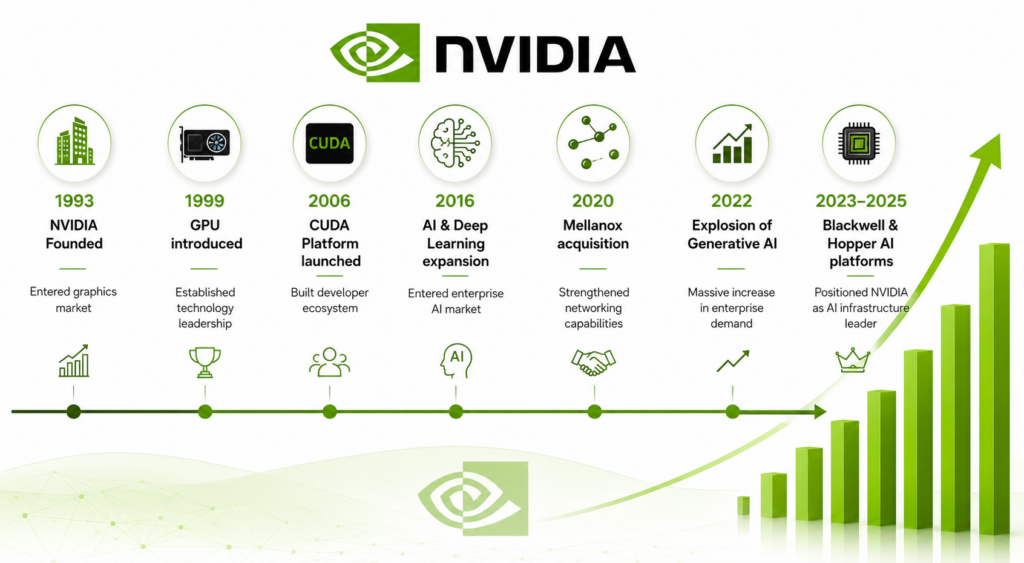
Key Business Milestones That Changed NVIDIA’s Market Position
Several strategic milestones contributed to NVIDIA’s growth:
| Year | Milestone | Marketing Impact |
| 1993 | NVIDIA Founded | Entered graphics market |
| 1999 | GPU introduced | Established technology leadership |
| 2006 | CUDA Platform launched | Built developer ecosystem |
| 2016 | AI & Deep Learning expansion | Entered enterprise AI market |
| 2020 | Mellanox acquisition | Strengthened networking capabilities |
| 2022 | Explosion of Generative AI | Massive increase in enterprise demand |
| 2023–2025 | Blackwell & Hopper AI platforms | Positioned NVIDIA as AI infrastructure leader |
Each milestone strengthened the company’s brand among developers, enterprises, and technology leaders rather than mass consumers.
The Strategic Pivot Toward Artificial Intelligence
Unlike many companies that reacted after ChatGPT became popular, NVIDIA had already spent years preparing for the AI era.
The company invested heavily in:
- AI hardware
- CUDA software
- AI networking
- Enterprise platforms
- Developer education
- Research collaborations
When generative AI demand surged, NVIDIA was already the preferred platform for AI training and inference.
This first-mover advantage enabled extraordinary business growth.
In FY2025:
- Revenue reached $130.5 billion.
- Operating income reached $81.5 billion.
- Net income reached $72.9 billion.
- Gross margin reached 75%.
From a marketing perspective, NVIDIA’s biggest achievement was not simply selling GPUs—it successfully positioned itself as the company powering the future of artificial intelligence.
Why NVIDIA Rarely Relies on Traditional Consumer Advertising
Unlike Apple, Samsung, or Coca-Cola, NVIDIA rarely launches large-scale television campaigns or consumer-focused advertising. This is because its primary customers are not everyday consumers.
Instead, NVIDIA markets to:
- Enterprise CIOs
- AI researchers
- Cloud providers
- Software developers
- Data scientists
- Universities
- Government organizations
- Fortune 500 companies
Its marketing budget is therefore directed toward technical education, ecosystem development, product launches, conferences, and strategic partnerships instead of traditional mass media.
This approach generates highly qualified demand while keeping customer acquisition focused on high-value enterprise opportunities.
The Difference Between B2B Influence and Mass Consumer Marketing
Consumer marketing aims to maximize awareness among millions of people.
Enterprise marketing aims to influence a much smaller group of decision-makers who control billion-dollar technology investments.
NVIDIA understands this distinction. Instead of convincing millions of individuals to purchase a product, NVIDIA focuses on helping enterprise customers solve complex AI challenges.
This includes providing:
- Technical documentation
- AI training resources
- Developer tools
- Software frameworks
- Customer success stories
- Industry-specific AI solutions
As a result, the brand earns credibility through expertise rather than advertising.
Building Demand Without Expensive TV Campaigns
One of NVIDIA’s most effective marketing assets is its annual GPU Technology Conference (GTC).
Rather than spending heavily on television advertising, NVIDIA uses GTC to introduce new technologies, demonstrate AI breakthroughs, and strengthen relationships with developers, enterprise customers, partners, and investors.
Each keynote by CEO Jensen Huang becomes a global technology event, generating extensive coverage across technology media, social platforms, and business publications.
This strategy delivers worldwide visibility while reinforcing NVIDIA’s position as the leader in AI innovation.
Instead of interrupting consumers with advertisements, NVIDIA creates demand by sharing innovations that customers actively want to learn about.
AI Positioning Strategy: Owning the Future of Artificial Intelligence
One of the biggest reasons behind NVIDIA’s extraordinary growth is its positioning strategy. Instead of promoting itself as a graphics card company, NVIDIA repositioned its brand as the company building the infrastructure behind the world’s AI revolution.
Most technology companies market their products by highlighting features such as speed, design, or pricing. NVIDIA took a different approach. The company positioned itself around a much larger idea—accelerated computing and artificial intelligence.
Today, whenever businesses think about training large language models (LLMs), running AI inference, building autonomous vehicles, or developing generative AI applications, NVIDIA is often the first brand that comes to mind. This is the result of years of consistent positioning rather than short-term advertising campaigns.
Rather than asking customers to buy a GPU, NVIDIA communicates a broader value proposition:
“We provide the computing platform that powers the future of AI.”
This positioning allows the company to appeal not only to technology buyers but also to governments, cloud providers, research institutions, startups, and Fortune 500 enterprises.
The financial impact of this positioning is significant. According to NVIDIA’s FY2025 Annual Report:
| AI Business Indicator | FY2025 |
| Total Revenue | $130.5 Billion |
| Compute & Networking Revenue | $116.2 Billion |
| Share of Revenue from AI Infrastructure | Nearly 89% |
| Gross Margin | 75.0% |
These numbers clearly demonstrate that NVIDIA’s identity has shifted from consumer graphics to enterprise AI infrastructure. This transformation has strengthened its brand and enabled sustained business growth. (Source: NVIDIA FY2025 Annual Report)
Becoming the Default Infrastructure for AI Innovation
NVIDIA did not become the AI industry leader by simply manufacturing better chips. The company built an entire ecosystem that enables organizations to develop, deploy, and scale artificial intelligence applications.
Today, NVIDIA’s hardware and software platforms support some of the world’s most advanced AI technologies.
Its solutions are widely used for:
- Large Language Models (LLMs)
- Generative AI applications
- AI-powered healthcare research
- Autonomous driving systems
- Robotics and industrial automation
- Scientific computing
- Digital twins
- Cloud AI infrastructure
Major technology companies including Microsoft Azure, Amazon Web Services (AWS), Google Cloud, Oracle Cloud, Meta, OpenAI, CoreWeave, and Tesla rely on NVIDIA GPUs to train and run AI workloads.
Instead of competing directly with these companies, NVIDIA became the technology platform powering their innovation.
This strategy created an important competitive advantage.
As more organizations adopted NVIDIA’s AI platform, software developers built tools optimized for NVIDIA GPUs. This encouraged additional businesses to choose NVIDIA, creating a strong network effect that made it increasingly difficult for competitors to catch up.
Today, NVIDIA is not just selling hardware—it is selling the foundation on which the AI economy operates.
Creating a Brand Associated With Performance and Trust
Enterprise customers make purchasing decisions differently from everyday consumers.
Before investing millions of dollars in AI infrastructure, organizations evaluate several factors:
- Performance
- Reliability
- Scalability
- Software compatibility
- Technical support
- Long-term roadmap
NVIDIA has consistently built its reputation around these priorities.
Instead of promising the lowest price, the company focuses on delivering the highest computing performance for AI workloads.
Its marketing consistently highlights:
- Faster AI model training
- Improved inference efficiency
- Lower energy consumption per AI task
- Enterprise-grade software support
- Continuous innovation
This messaging has helped NVIDIA become one of the most trusted brands in enterprise AI.
Brand trust is further reinforced through long-term partnerships with universities, research institutions, cloud providers, governments, and Fortune 500 companies.
For marketers, NVIDIA demonstrates that trust is built through consistent product performance and customer success—not advertising frequency.
The B2B Marketing Framework Behind NVIDIA’s Growth
Unlike traditional consumer brands, NVIDIA follows a highly focused B2B marketing model.
Its objective is not to convince millions of consumers to purchase products directly. Instead, the company concentrates on influencing a relatively small number of high-value decision-makers who control enterprise technology investments.
This strategy allows NVIDIA to generate enormous revenue from a comparatively limited customer base.
For example, a single hyperscale cloud provider may invest billions of dollars in AI infrastructure, making enterprise relationships significantly more valuable than mass consumer sales.
As AI adoption accelerated worldwide, NVIDIA’s enterprise-first strategy became one of its strongest competitive advantages.
Targeting Enterprise Decision Makers Instead of Consumers
NVIDIA designs its marketing around the people responsible for large technology investments.
Its primary audience includes:
- Chief Information Officers (CIOs)
- Chief Technology Officers (CTOs)
- AI Researchers
- Machine Learning Engineers
- Cloud Architects
- Enterprise IT Leaders
- Government Technology Departments
- Startup Founders
Instead of running emotional consumer advertisements, NVIDIA provides technical resources that help these audiences solve real business problems.
Examples include:
- AI solution guides
- Technical whitepapers
- Performance benchmarks
- Customer success stories
- Product demonstrations
- Certification programs
- Hands-on workshops
- Developer documentation
This educational marketing approach builds authority before the purchasing decision is made.
According to NVIDIA’s annual reports, Data Center revenue—the business segment primarily serving enterprise customers—reached $115.2 billion in FY2025, accounting for approximately 88% of the company’s total revenue.
Industry-Specific Marketing Across Healthcare, Automotive, Robotics and Cloud
Rather than promoting one generic message, NVIDIA customizes its marketing for different industries.
Each industry faces unique challenges, so NVIDIA develops specialized AI solutions tailored to those needs.
Healthcare
NVIDIA promotes AI applications for:
- Drug discovery
- Medical imaging
- Genomics
- Clinical research
- Digital healthcare
Healthcare organizations view NVIDIA as a technology partner rather than simply a hardware vendor.
Automotive
Automotive companies use NVIDIA platforms for:
- Autonomous driving
- Driver assistance systems
- In-vehicle AI
- Simulation and testing
Companies such as Mercedes-Benz, Volvo Cars, Toyota, Jaguar Land Rover, BYD, and Rivian have announced collaborations involving NVIDIA technologies for next-generation vehicle platforms.
Robotics and Manufacturing
Industrial businesses use NVIDIA technologies for:
- Smart factories
- Warehouse automation
- AI-powered robotics
- Digital twins
- Predictive maintenance
Through NVIDIA Omniverse, manufacturers can simulate entire production environments before deploying physical systems.
Cloud Computing
Cloud providers represent one of NVIDIA’s largest enterprise markets.
Major partners include:
- Microsoft Azure
- Amazon Web Services
- Google Cloud
- Oracle Cloud
- IBM Cloud
These companies offer NVIDIA GPU-powered AI infrastructure to millions of developers worldwide.
By tailoring its messaging to each vertical, NVIDIA increases relevance, improves customer engagement, and strengthens long-term relationships.
Building a Developer Ecosystem That Markets the Brand Automatically
One of NVIDIA’s greatest marketing achievements is creating an ecosystem where customers actively promote the brand.
Most companies depend heavily on advertising to generate awareness.
NVIDIA uses a different strategy.
By investing in developers, software platforms, technical education, and open innovation, the company has built a self-sustaining marketing engine.
Every AI application built using NVIDIA technology becomes an indirect advertisement for the brand.
Every university teaching CUDA introduces future engineers to NVIDIA.
Every cloud provider offering NVIDIA-powered AI services increases the company’s visibility.
Instead of buying attention, NVIDIA earns it through ecosystem growth.
CUDA as a Long-Term Competitive Advantage
Introduced in 2006, CUDA (Compute Unified Device Architecture) is one of NVIDIA’s most valuable strategic assets.
CUDA allows developers to program NVIDIA GPUs for general-purpose computing beyond graphics.
Over the past two decades, CUDA has evolved into one of the world’s largest GPU computing ecosystems.
Today it supports thousands of AI, scientific computing, robotics, simulation, and machine learning applications.
The NVIDIA software ecosystem now includes:
- CUDA
- TensorRT
- cuDNN
- NVIDIA AI Enterprise
- Omniverse
- NVIDIA NIM
- NeMo
- RAPIDS
Because developers have invested years learning CUDA and building applications around it, switching to another hardware platform often requires significant redevelopment effort.
This creates a strong competitive advantage while increasing customer retention.
For marketers, CUDA demonstrates that software ecosystems can become more valuable than advertising campaigns.
How Developers Become NVIDIA’s Biggest Brand Advocates
Traditional marketing often relies on influencers, celebrities, or paid advertisements.
NVIDIA’s most influential advocates are developers, researchers, AI engineers, and enterprise customers.
The company supports this community through:
- NVIDIA Developer Program
- GPU Technology Conference (GTC)
- Free online training
- Certification programs
- Developer forums
- Technical webinars
- University collaborations
- Research grants
- Open-source AI projects
As developers gain success using NVIDIA technologies, they naturally recommend the platform to colleagues, employers, clients, and startups.
This creates a continuous cycle of organic growth.
A startup founder who builds an AI product on NVIDIA often continues using NVIDIA infrastructure as the business scales.
Similarly, researchers who publish AI breakthroughs using NVIDIA GPUs influence universities, enterprises, and governments to adopt the same technology.
This network effect significantly reduces customer acquisition costs while strengthening brand authority.
Marketing Insight: NVIDIA’s developer ecosystem is not just a technical advantage—it is one of the company’s most powerful long-term marketing assets. By investing in education, tools, and community, NVIDIA has transformed developers into trusted advocates who expand the brand’s reach without relying on traditional consumer advertising.
Community-Led Marketing Instead of Paid Promotion
One of NVIDIA’s biggest competitive advantages is that its marketing is driven by its community rather than expensive advertising campaigns. While many technology companies spend heavily on television commercials, celebrity endorsements, and large-scale consumer promotions, NVIDIA has invested in something much more sustainable—a global community of developers, AI researchers, engineers, startups, universities, and enterprise partners.
This community has become one of NVIDIA’s strongest marketing channels.
Instead of interrupting people with advertisements, NVIDIA creates opportunities for professionals to learn, experiment, and innovate using its technologies. Every successful AI project built on NVIDIA’s platform naturally increases awareness and strengthens trust in the brand.
This strategy has created a powerful flywheel:
- Developers build AI applications using NVIDIA.
- They share their work with the community.
- Businesses see successful implementations.
- More organizations adopt NVIDIA.
- The developer ecosystem continues to grow.
Unlike traditional marketing campaigns that stop generating value when advertising budgets end, NVIDIA’s community continues creating new success stories every day.
Today, millions of developers participate in NVIDIA’s ecosystem through developer programs, online learning platforms, GitHub projects, university collaborations, technical conferences, and AI research initiatives. This continuous engagement helps NVIDIA remain highly visible within the global AI industry without relying on mass consumer advertising.
The Power of GTC, Technical Communities and Open Learning
One of NVIDIA’s most successful marketing initiatives is the GPU Technology Conference (GTC).
Rather than organizing a traditional product launch event, GTC has evolved into one of the world’s leading conferences focused on artificial intelligence, accelerated computing, robotics, healthcare, autonomous vehicles, cloud computing, and scientific research.
Every year, thousands of developers, researchers, enterprise executives, startup founders, and technology leaders participate in GTC either in person or online. The event typically features:
- Product announcements
- AI research presentations
- Live demonstrations
- Technical workshops
- Developer training
- Customer success stories
- Industry-specific AI sessions
- Networking opportunities
Instead of simply promoting products, GTC educates the market.
This educational approach generates significantly more trust than traditional advertising because attendees experience NVIDIA’s technology firsthand.
In addition to GTC, NVIDIA continuously supports learning through:
- NVIDIA Deep Learning Institute (DLI)
- Developer documentation
- Free online courses
- AI certifications
- Open-source software
- Community forums
- Research publications
- Technical blogs
By making education freely available, NVIDIA lowers the barrier for developers and enterprises to adopt its technologies.
From a marketing perspective, this creates long-term customer relationships rather than one-time product sales.
Turning Engineers Into Brand Ambassadors
Most consumer brands rely on celebrities or social media influencers to promote their products.
NVIDIA uses a completely different approach.
Its strongest brand ambassadors are engineers, AI researchers, software developers, startup founders, and enterprise architects.
Whenever these professionals successfully build AI applications using NVIDIA technologies, they naturally recommend the platform within their organizations and professional networks.
For example:
- A university professor teaching CUDA introduces hundreds of students to NVIDIA every year.
- An AI startup developing a machine learning application on NVIDIA GPUs encourages future team members to continue using the same platform.
- Enterprise engineers share implementation experiences through conferences, research papers, GitHub repositories, LinkedIn posts, and developer communities.
This creates authentic word-of-mouth marketing that cannot easily be replicated through paid advertising.
The result is a trusted community where recommendations come from technical experts rather than promotional campaigns.
For enterprise buyers, recommendations from experienced engineers often carry far more credibility than advertisements.
Marketing Insight
NVIDIA demonstrates that investing in education and developer success can create a self-sustaining marketing engine where customers become advocates for the brand.
Content Marketing Strategy That Builds Authority Instead of Advertising
Content marketing plays a central role in NVIDIA’s growth strategy.
Unlike companies that focus primarily on promotional content, NVIDIA produces educational and technical resources designed to help developers, researchers, enterprise customers, and business leaders solve real-world challenges.
Rather than asking customers to purchase products immediately, NVIDIA first establishes itself as a trusted source of knowledge.
Its content ecosystem includes:
- Technical blogs
- AI research papers
- Customer case studies
- Product documentation
- Developer tutorials
- Industry reports
- Solution guides
- Benchmark reports
- Videos
- Technical webinars
- Podcasts
- Conference presentations
This content serves two important purposes.
First, it educates potential customers about AI technologies and best practices.
Second, it demonstrates NVIDIA’s expertise, making the company a trusted advisor rather than simply a hardware vendor.
Over time, this educational strategy strengthens both brand authority and customer confidence.
Educational Content That Solves Real Industry Problems
One reason NVIDIA’s content performs so well is that it focuses on solving customer problems instead of promoting product specifications.
Instead of publishing articles such as:
“Why Our GPU Is Better”
NVIDIA creates practical resources explaining topics like:
- How to train large language models faster
- Optimizing AI inference performance
- Deploying enterprise AI securely
- Building digital twins
- Accelerating healthcare research
- Running robotics simulations
- Scaling cloud AI infrastructure
This educational approach helps businesses understand how AI can solve operational challenges before discussing NVIDIA products.
As a result, readers perceive NVIDIA as a technology expert rather than a salesperson.
Many enterprise customers first interact with NVIDIA through educational resources long before making purchasing decisions.
This content-first strategy also improves organic visibility because developers actively search for technical solutions rather than advertisements.
Technical Storytelling That Builds Long-Term Trust
NVIDIA’s storytelling strategy is built around customer success instead of promotional messaging.
Rather than focusing exclusively on its own achievements, NVIDIA frequently highlights how customers are using its technologies to solve meaningful challenges.
Examples include:
- Hospitals improving medical diagnostics through AI.
- Automotive companies developing autonomous driving systems.
- Manufacturers building digital factories.
- Universities accelerating scientific research.
- Cloud providers expanding AI infrastructure.
- Startups launching innovative generative AI applications.
These stories demonstrate measurable business outcomes instead of marketing claims.
Enterprise decision-makers are more likely to trust evidence supported by customer experiences than traditional advertising messages.
By consistently publishing real-world success stories, NVIDIA strengthens credibility across multiple industries.
Strategic Partnerships That Expanded NVIDIA’s Market Influence
Another major factor behind NVIDIA’s rapid growth is its partnership strategy.
Instead of trying to build every solution independently, NVIDIA collaborates with leading technology companies to expand its ecosystem and reach new markets.
These partnerships create mutual value.
Cloud providers receive industry-leading AI infrastructure.
Enterprise customers gain access to scalable AI platforms.
NVIDIA increases product adoption without relying solely on direct sales.
As artificial intelligence becomes increasingly important across industries, these partnerships have significantly expanded NVIDIA’s influence worldwide.
Collaborations With Microsoft, AWS, Google Cloud and Enterprise AI Leaders
Today, NVIDIA works closely with many of the world’s largest technology companies.
Some of its most important strategic partners include:
Microsoft Azure
Microsoft offers NVIDIA-powered GPUs across Azure AI infrastructure, enabling enterprises to train and deploy advanced AI models at scale. Microsoft has also integrated NVIDIA technologies into services supporting enterprise AI workloads.
Amazon Web Services (AWS)
AWS provides multiple NVIDIA GPU instances for machine learning, generative AI, and high-performance computing. This partnership allows startups and enterprises to access NVIDIA’s computing power without investing in their own data centers.
Google Cloud
Google Cloud offers NVIDIA GPUs for AI development, scientific computing, and enterprise machine learning solutions, helping customers accelerate complex workloads.
Oracle Cloud Infrastructure (OCI)
Oracle has expanded its AI cloud offerings using NVIDIA GPUs to support enterprise AI applications and large-scale model training.
Other Enterprise Partners
Beyond cloud providers, NVIDIA collaborates with companies across industries, including:
- ServiceNow
- Accenture
- Dell Technologies
- Hewlett Packard Enterprise (HPE)
- Lenovo
- Siemens
- SAP
- Snowflake
- TSMC
These collaborations increase NVIDIA’s visibility across healthcare, manufacturing, financial services, automotive, telecommunications, and public sector organizations.
Instead of reaching customers through advertising alone, NVIDIA reaches them through trusted technology ecosystems.
Why Ecosystem Marketing Creates Sustainable Growth
Traditional advertising often produces short-term awareness.
Ecosystem marketing creates long-term business growth.
NVIDIA’s strategy demonstrates this clearly.
Every new partner strengthens the overall value of the NVIDIA ecosystem.
For example:
- Cloud providers make NVIDIA technology accessible to millions of developers.
- System integrators help enterprises deploy AI solutions more efficiently.
- Software vendors optimize applications for NVIDIA hardware.
- Universities train future engineers using NVIDIA platforms.
- Startups introduce innovative AI products built on NVIDIA infrastructure.
Each participant adds value to the ecosystem while simultaneously increasing NVIDIA’s market influence.
This network effect makes the company’s competitive position stronger over time.
From a marketing perspective, ecosystem marketing offers several long-term advantages:
| Marketing Benefit | Business Impact |
| Higher Brand Credibility | Trusted through leading enterprise partners |
| Faster Customer Acquisition | Partners introduce new customers |
| Lower Marketing Costs | Organic adoption reduces dependence on paid advertising |
| Increased Customer Retention | Integrated ecosystems make switching more difficult |
| Global Market Expansion | Partners extend NVIDIA’s reach into new regions and industries |
This strategy has contributed to NVIDIA becoming one of the world’s most valuable technology companies, with a market capitalization that surpassed $4 trillion in 2025, reflecting investor confidence in its central role within the AI ecosystem.
Product Launch Marketing: Creating Industry-Wide Anticipation
For most companies, a product launch is a marketing event designed to increase product awareness and drive sales. NVIDIA approaches product launches differently. Instead of treating them as promotional campaigns, the company turns every major launch into an industry event that shapes conversations across the global technology ecosystem.
Rather than relying on paid advertisements, NVIDIA builds anticipation months before a launch through developer updates, research collaborations, technical previews, and keynote announcements. This strategy ensures that customers, investors, media organizations, developers, and enterprise buyers are already paying attention before a new product becomes available.
Each launch is positioned as the next step in AI innovation rather than simply introducing faster hardware. Whether it is the Hopper architecture, Blackwell platform, or next-generation networking solutions, NVIDIA focuses on explaining how these technologies will transform industries such as healthcare, manufacturing, robotics, cloud computing, and scientific research.
This approach creates excitement because customers are buying into a long-term vision instead of just a product.
Unlike traditional consumer marketing that often depends on discounts or emotional advertising, NVIDIA creates demand through technological leadership and future-focused storytelling.
Launch Events That Become Global Technology News
One of NVIDIA’s strongest marketing assets is its ability to transform product launches into global technology events.
Every keynote presentation delivered during major events such as GTC (GPU Technology Conference) is closely followed by:
- Technology journalists
- Enterprise customers
- Cloud providers
- Investors
- AI researchers
- Developers
- Financial analysts
Rather than announcing specifications alone, NVIDIA introduces complete AI platforms, enterprise solutions, software innovations, and future roadmaps.
For example, the launch of the Blackwell AI platform generated worldwide media attention because it addressed growing enterprise demand for generative AI infrastructure. The announcement was covered by leading business and technology publications, significantly expanding NVIDIA’s visibility without relying on large-scale advertising campaigns.
Similarly, every GTC keynote attracts extensive online engagement through live streams, social media discussions, news coverage, YouTube analysis, LinkedIn posts, and developer forums.
This earned media strategy creates enormous visibility while keeping traditional advertising costs relatively low. Instead of paying for attention, NVIDIA earns attention through innovation.
Positioning Innovation Before Product Features
Many companies market products by comparing technical specifications such as processing speed, storage capacity, or battery life.
NVIDIA follows a different strategy.
The company first explains why a new technology matters before discussing what the product can do.
For example, instead of saying a GPU has more processing cores, NVIDIA explains how the technology can:
- Reduce AI training time.
- Improve large language model performance.
- Accelerate scientific discoveries.
- Support autonomous vehicles.
- Enable advanced robotics.
- Reduce enterprise computing costs.
This shifts the conversation from product features to business outcomes.
Enterprise decision-makers are primarily interested in solving problems, improving productivity, and achieving better returns on technology investments. NVIDIA’s messaging reflects these priorities.
Its product launches consistently focus on customer impact rather than technical specifications alone.
This positioning helps enterprise buyers understand the business value of NVIDIA’s innovations before evaluating individual products.
Marketing Insight
Customers rarely remember specifications, but they remember how technology changes their business. NVIDIA markets transformation, not just technology.
AI Thought Leadership as a Competitive Marketing Advantage
One of NVIDIA’s greatest marketing strengths is its ability to lead conversations about artificial intelligence rather than simply participating in them.
Instead of reacting to industry trends, NVIDIA actively helps shape them.
Through research, technical innovation, conferences, partnerships, developer education, and executive leadership, the company has established itself as one of the most influential voices in AI.
This strategy positions NVIDIA as a trusted advisor rather than only a technology supplier.
When businesses begin planning AI initiatives, many first seek insights from NVIDIA’s research, presentations, customer stories, and technical documentation.
This level of authority is difficult to achieve through advertising alone.
Thought leadership has become one of NVIDIA’s most valuable marketing assets because it influences enterprise buying decisions long before customers begin evaluating products.
How CEO Jensen Huang Strengthened the NVIDIA Brand
Every successful technology company has influential leaders, but few executives have become as closely associated with their company’s brand as NVIDIA’s CEO, Jensen Huang.
Over the years, Huang has become one of the most recognized leaders in artificial intelligence and accelerated computing.
Unlike many CEOs who primarily appear during earnings calls or corporate announcements, Jensen Huang regularly communicates directly with developers, researchers, enterprise customers, and technology communities.
His keynote presentations focus less on marketing slogans and more on explaining future technological possibilities.
This approach has strengthened NVIDIA’s credibility because audiences view him as both a business leader and a technology expert.
His presentations typically include:
- AI industry trends
- Product demonstrations
- Future technology roadmaps
- Customer success stories
- Developer opportunities
- Industry collaboration announcements
This educational style has helped build trust among enterprise customers while increasing global media attention around NVIDIA.
Every keynote generates significant discussion across business media, technology publications, LinkedIn, YouTube, and developer communities.
From a branding perspective, Jensen Huang has become an extension of NVIDIA’s identity.
His leadership reinforces the company’s image as an innovative, technically driven organization focused on solving complex global challenges.
Turning Vision Into Market Leadership
Strong brands do more than introduce products—they communicate a clear vision for the future.
NVIDIA consistently positions artificial intelligence as the next major computing revolution and explains how its technologies enable that transformation.
Rather than promoting isolated hardware products, the company presents a connected vision involving:
- AI infrastructure
- Digital twins
- Autonomous systems
- Robotics
- Scientific computing
- Healthcare innovation
- Enterprise AI platforms
- Accelerated computing
This long-term vision influences enterprise customers because organizations prefer investing in partners that demonstrate a clear roadmap for future innovation.
As a result, NVIDIA is often viewed not only as a technology supplier but also as a strategic partner for digital transformation.
The company’s continued investment in AI research, software platforms, networking technologies, and developer ecosystems reinforces this leadership position.
For marketers, NVIDIA demonstrates that thought leadership is most effective when supported by continuous innovation and real-world customer success.
Marketing Insight
Thought leadership is not created through opinions alone. It is earned through consistent innovation, valuable knowledge sharing, and long-term industry impact.
SEO, Organic Visibility and Digital Presence
Although NVIDIA is widely known for its hardware, its digital marketing strategy also plays an important role in maintaining global visibility.
Unlike many technology companies that depend heavily on paid advertising, NVIDIA has built a strong online presence through educational content, developer resources, technical documentation, research publications, and customer success stories.
This content helps the company attract highly qualified audiences who are actively searching for AI-related solutions.
Instead of targeting general consumer searches, NVIDIA focuses on users with strong commercial or technical intent.
Its digital ecosystem includes:
- Official technical blogs
- AI documentation
- Product guides
- Research papers
- Developer tutorials
- Customer case studies
- Training resources
- Webinar recordings
- Conference presentations
Each content type supports a different stage of the enterprise buying journey.
This comprehensive digital strategy helps NVIDIA maintain authority across multiple AI-related topics while continuously attracting developers, engineers, researchers, and enterprise decision-makers.
Content Strategy That Dominates AI Conversations
NVIDIA’s content strategy is designed around education rather than promotion.
Instead of publishing generic marketing articles, the company creates detailed technical resources that answer the questions developers and enterprise customers are already asking.
Its content frequently covers topics such as:
- Generative AI
- Large Language Models
- Machine Learning
- Robotics
- Healthcare AI
- Autonomous Vehicles
- AI Infrastructure
- Digital Twins
- Accelerated Computing
This strategy positions NVIDIA as an authoritative source of knowledge across the AI ecosystem.
Every blog, technical guide, benchmark report, and research paper strengthens the company’s visibility within search engines while also increasing trust among enterprise audiences.
Because the content provides practical value, it continues attracting visitors long after publication.
This evergreen approach generates consistent organic traffic without depending solely on advertising budgets.
For B2B companies, this demonstrates that educational content can become one of the most valuable long-term marketing assets.
How Search Visibility Supports Enterprise Marketing
Enterprise purchasing decisions often begin with research.
Before contacting a sales team, business leaders typically search for:
- AI infrastructure solutions
- Enterprise GPU platforms
- Machine learning deployment
- AI software frameworks
- Industry-specific AI use cases
- Customer success stories
NVIDIA ensures that valuable information is available throughout this research journey.
Its strong organic presence enables potential customers to discover educational resources long before they speak with a sales representative.
This approach delivers several marketing advantages:
| SEO Benefit | Business Impact |
| Higher Organic Visibility | Reaches enterprise buyers during the research phase |
| Educational Content | Builds credibility before the sales conversation |
| Evergreen Resources | Generates long-term traffic without continuous advertising |
| Strong Brand Authority | Positions NVIDIA as a trusted AI knowledge leader |
| Lower Customer Acquisition Cost | Reduces dependence on paid marketing channels |
As AI adoption continues to grow, maintaining strong search visibility has become increasingly important.
By combining SEO, technical education, and high-quality content, NVIDIA has created a digital presence that supports both brand awareness and enterprise demand generation.
What Digital Marketers Can Learn From NVIDIA
NVIDIA’s marketing success proves that long-term brand authority delivers better results than relying only on paid advertising. Instead of constantly chasing short-term sales, NVIDIA has spent decades building trust with developers, researchers, enterprises, gamers, and AI innovators. This approach has transformed the company into one of the world’s most valuable technology brands.
Building Authority Before Running Advertisements
One of NVIDIA’s biggest marketing lessons is that authority should come before aggressive advertising. Rather than spending heavily on traditional marketing campaigns, the company invested in creating products that solved real industry problems while educating its audience.
Some of the key strategies include:
- Publishing in-depth technical blogs and AI research.
- Organizing global events like NVIDIA GTC that attract hundreds of thousands of developers and technology professionals.
- Offering free developer tools, SDKs, and educational resources.
- Building strong relationships with universities, startups, and enterprise customers.
- Encouraging developers to create applications using CUDA, making NVIDIA hardware the preferred choice.
This strategy reduced customer acquisition costs because many customers already trusted the brand before making a purchase.
According to NVIDIA, GTC has grown into one of the world’s largest AI conferences, attracting hundreds of thousands of registered attendees globally through in-person and virtual participation. Instead of being a sales event, GTC serves as an educational platform where customers learn about AI innovations, product launches, and industry trends.
Creating Demand Through Education, Community and Innovation
NVIDIA rarely convinces people to buy through aggressive promotions. Instead, it creates demand by helping people succeed.
Its ecosystem includes:
- AI developers
- Data scientists
- Universities
- Researchers
- Startups
- Enterprise IT teams
- Gaming communities
Every new innovation is supported by tutorials, documentation, webinars, GitHub projects, certifications, and community discussions.
This educational ecosystem creates a network effect. As more developers build with NVIDIA technologies, more businesses adopt NVIDIA-powered solutions, increasing overall demand.
Research consistently shows that B2B buyers complete a significant portion of their purchasing research before contacting a sales team. Companies that publish valuable educational content throughout this journey are more likely to become trusted solution providers.
Future Marketing Trends Inspired by NVIDIA’s Success
The rise of AI is changing digital marketing faster than ever before. NVIDIA’s strategy provides a glimpse into what successful marketing will look like over the next decade.
AI-First Branding Strategies for Modern Businesses
Modern brands are increasingly integrating AI into every stage of the customer journey.
NVIDIA demonstrates that AI branding is not about using AI-generated content everywhere. Instead, it is about positioning the company as the technology leader powering the future.
Businesses can adopt similar principles by:
- Creating AI-powered customer experiences.
- Publishing original industry research.
- Using predictive analytics to improve campaigns.
- Personalizing website experiences.
- Automating customer support with AI assistants.
- Producing educational AI content that solves real customer problems.
According to multiple industry reports, over 80% of organizations worldwide are already using AI in at least one business function, and adoption continues to grow rapidly. Companies that establish authority in AI today are likely to gain a competitive advantage over the coming years.
Why Community and Ecosystems Will Outperform Traditional Advertising
Traditional advertising is becoming more expensive while customer trust continues to decline.
Communities, however, create long-term relationships.
NVIDIA has built one of the strongest technology ecosystems through:
- CUDA developers
- NVIDIA Inception startup program
- NVIDIA Developer Program
- GTC conference
- Academic partnerships
- AI research collaborations
These initiatives encourage continuous engagement instead of one-time transactions.
Studies show that communities significantly improve customer retention, increase referrals, and reduce acquisition costs compared to businesses relying solely on paid advertising.
Future marketing winners will not simply have the biggest advertising budgets.
They will have the strongest communities.
Final Takeaways: The Marketing Blueprint Behind NVIDIA’s Global Success
NVIDIA’s growth did not happen overnight. It is the result of decades of consistent innovation, strategic partnerships, developer-first thinking, and long-term brand building.
From gaming GPUs to becoming a global leader in artificial intelligence infrastructure, the company’s journey demonstrates how trust and innovation can outperform traditional marketing tactics.
Key Lessons for Startups, SaaS Companies and Enterprise Brands
Businesses of every size can learn valuable lessons from NVIDIA’s approach:
- Focus on solving meaningful customer problems.
- Invest in educational content instead of only promotional content.
- Build communities rather than just audiences.
- Develop ecosystems that encourage long-term customer engagement.
- Partner with industry leaders to strengthen credibility.
- Launch products with clear value propositions backed by real-world use cases.
- Continuously innovate while maintaining a consistent brand message.
These strategies help businesses create sustainable growth instead of depending solely on short-term advertising campaigns.
How Businesses Can Apply NVIDIA’s Marketing Principles Today
Whether you are a startup, SaaS company, enterprise business, or digital agency, NVIDIA’s marketing framework can be adapted to your own strategy.
Start by:
- Creating content that genuinely educates your audience.
- Building authority through thought leadership and expertise.
- Investing in communities across LinkedIn, YouTube, GitHub, Reddit, and industry forums.
- Using AI to improve customer experiences instead of replacing human interactions.
- Measuring long-term metrics such as customer lifetime value, brand awareness, engagement, and retention—not just immediate conversions.
NVIDIA’s success shows that sustainable marketing is built on trust, innovation, and continuous value creation. Businesses that combine these principles with data-driven decision-making are better positioned to build loyal customer bases, strengthen brand equity, and achieve long-term growth in an increasingly AI-driven marketplace.
Frequently Asked Questions (FAQ)
1. Why is NVIDIA considered the world’s leading AI brand?
NVIDIA is widely recognized as one of the world’s leading AI brands because it powers many of the technologies behind today’s artificial intelligence revolution. Its GPUs are used by leading AI companies, cloud providers, research institutions, startups, and enterprises to train and deploy advanced AI models. Beyond hardware, NVIDIA has built a complete AI ecosystem that includes software platforms, developer tools, networking solutions, and AI frameworks. This combination of innovation, strong industry partnerships, and continuous investment in research has positioned NVIDIA as a trusted leader in the global AI market.
2. Does NVIDIA spend money on traditional advertising?
Yes, NVIDIA does invest in marketing, but it relies far less on traditional advertising than many technology companies. Instead of focusing heavily on TV commercials or large-scale promotional campaigns, NVIDIA prioritizes product innovation, developer education, technical content, industry events, strategic partnerships, and community engagement. This approach helps the company build long-term trust and brand authority while allowing its products and technology leadership to generate organic demand.
3. What makes NVIDIA’s B2B marketing strategy successful?
NVIDIA’s B2B marketing strategy succeeds because it focuses on delivering value before making a sales pitch. The company educates businesses through research papers, webinars, technical documentation, product demonstrations, and industry conferences. It also works closely with enterprise customers to solve complex business challenges using AI and accelerated computing. By combining educational content, innovation, and customer success stories, NVIDIA has built lasting relationships across multiple industries.
4. How does NVIDIA attract enterprise customers?
NVIDIA attracts enterprise customers by solving real business problems rather than simply promoting products. The company collaborates with cloud providers, healthcare organizations, automotive manufacturers, financial institutions, and technology companies to develop AI-powered solutions. Enterprise buyers are supported with detailed documentation, expert guidance, certified partners, and scalable AI platforms that make adoption easier. This solution-focused approach builds confidence and encourages long-term partnerships.
5. What role does the CUDA ecosystem play in NVIDIA’s marketing?
CUDA is one of NVIDIA’s strongest competitive advantages and an important part of its marketing strategy. It provides developers with a powerful platform for building high-performance applications across AI, machine learning, robotics, scientific computing, and data analytics. As more developers create applications using CUDA, businesses are more likely to choose NVIDIA hardware for compatibility and performance. This creates a strong ecosystem that naturally strengthens customer loyalty and reinforces NVIDIA’s market leadership.
6. How does NVIDIA build trust through developer communities?
NVIDIA invests heavily in developer education and community engagement. Through programs like the NVIDIA Developer Program, technical forums, online documentation, training courses, certifications, GitHub projects, and the annual GTC conference, the company helps developers learn, collaborate, and innovate. By consistently providing valuable resources instead of only promoting products, NVIDIA has built a loyal global developer community that actively supports and recommends its technologies.
7. What can startups learn from NVIDIA’s marketing strategy?
Startups can learn that long-term success comes from building credibility before chasing rapid growth. NVIDIA demonstrates the importance of creating products that solve real customer problems, publishing educational content, listening to user feedback, and building strong communities around a brand. Startups that focus on trust, expertise, and customer value are more likely to generate sustainable growth than those relying only on paid advertising or short-term marketing campaigns.
8. Is NVIDIA’s marketing model suitable for SaaS and AI companies?
Absolutely. Many of NVIDIA’s marketing principles can be successfully applied by SaaS, AI, and technology companies. Creating educational content, establishing thought leadership, building user communities, offering helpful product resources, partnering with industry leaders, and continuously improving customer experiences are strategies that work across businesses of all sizes. While every company has unique goals, focusing on trust, innovation, and long-term customer relationships is a proven foundation for sustainable business growth.