

A few years back, most businesses used AI the way you’d use a helpful intern. Write an email, throw together some blog ideas, knock out a few social captions or images — AI was there to save time on the repetitive stuff.
That’s changed, and it’s changed fast.
AI isn’t just helping marketers make content anymore. It’s starting to help them decide what to do in the first place. The tools available today can look at how customers behave, dig through mountains of marketing data, spot where things are heading, and suggest what to do next — all based on what’s actually happening right now, not guesswork.
That’s the real shift: businesses used to guess what customers wanted. Now they can check.
Marketing teams are leaning on AI to answer questions like:
- Who’s actually likely to buy?
- Which ad deserves more budget?
- When should this campaign go live?
- What should we recommend to this particular customer?
- How do we get more out of what we’re spending?
What used to take hours of digging through reports now takes minutes. That means teams can react to shifting customer behavior and market conditions almost as they happen, instead of finding out weeks later.
This is also changing how companies compete. The ones using AI to guide decisions are spotting opportunities sooner, improving how customers experience their brand, and putting money where it actually works — while companies still relying purely on manual analysis fall a step behind.
McKinsey’s State of AI research points out that companies using AI across several parts of the business are seeing stronger results overall, with marketing and sales among the areas where adoption keeps climbing. Salesforce’s State of Marketing report tells a similar story — marketers are using AI more and more not just to create content, but to personalize experiences, automate engagement, and make faster calls on strategy.
Put together, this paints a clear picture: AI isn’t just another marketing tool anymore. It’s becoming part of how businesses plan, compete, and grow.
Why AI Is Moving Beyond Content Creation
When generative AI first took off, the conversation was mostly about writing — articles, images, videos, social posts. Useful, sure. But businesses are realizing the bigger payoff comes when AI supports the strategy behind marketing, not just the output.
Modern AI platforms can look through millions of customer interactions, find buying patterns, and suggest actions that actually move the needle. Take an email campaign — AI doesn’t just help write it anymore. It can help figure out:
- Who should get the email
- What message will land with them
- The best time to send it
- Which subject line is likely to get opened
- How often to reach out without becoming annoying
That means more personalized campaigns without someone manually combing through spreadsheets of customer data.
AI is also changing how campaigns get planned in the first place. Instead of leaning on gut feeling or “that’s how we’ve always done it,” marketers can compare past campaign performance and see, in hard numbers, what actually delivered a return.
Customer segmentation has gotten smarter too. Rather than splitting people up by age or location alone, AI can group them by what they actually do — shopping habits, browsing history, interests, how often they buy, how engaged they are. That opens the door to offers that actually feel relevant.
Pricing is another place this shows up. Retailers and e-commerce brands are increasingly letting AI watch demand, stock levels, competitor pricing, and seasonal shifts before suggesting a price change — helping them stay competitive without giving away margin.
And then there’s performance optimization. AI keeps an eye on how campaigns are doing and flags where to shift things. If one ad is clearly outperforming another, it can recommend moving budget toward the winner — while the campaign is still live, not after it’s already wrapped up.
Deloitte’s Global Marketing Trends report backs this up, noting that companies are pouring more investment into AI-driven analytics, automation, and predictive tools because they genuinely make marketing run better. A lot of companies now treat AI less like a content machine and more like a strategic partner that helps them actually understand their customers.
How AI Is Making Real-Time Marketing Decisions
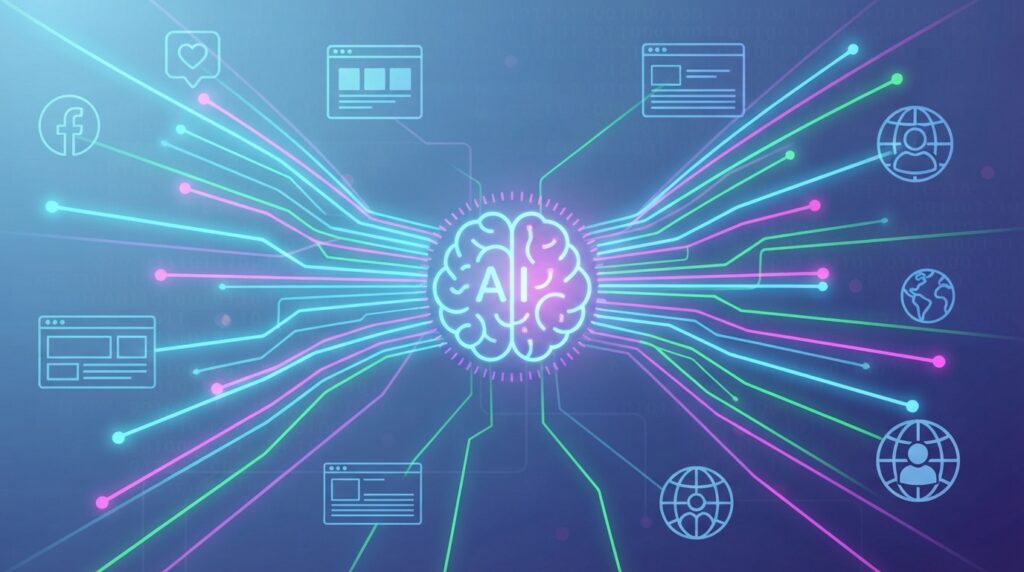
The biggest edge AI brings is speed — it can chew through huge amounts of information almost instantly. Traditional reporting means someone sits down and reviews numbers manually. AI just keeps watching, all the time, and flags what needs attention while the campaign is still running.
Smarter budget allocation. AI can track performance across search ads, social, email, and display all at once, and tell you where your money is actually working. If one channel starts pulling ahead, budget can shift toward it — without waiting for next week’s report.
Continuous ad optimization. Ad platforms now weigh thousands of signals — audience behavior, device, location, browsing habits, engagement — and use that to fine-tune targeting, creative, bids, and campaign goals on an ongoing basis, instead of leaving it to manual tweaks.
Dynamic pricing. Prices can shift based on real-time demand, stock availability, seasonality, and what competitors are charging. Busy season? Prices might nudge up. Slow patch? Expect a promo to pull people back in.
Personalized customer journeys. No two customers behave the same way. AI studies browsing, past purchases, and engagement to shape what each person sees — different homepage recommendations, different blog posts, different landing pages and offers — so it feels tailored rather than generic.
Smarter email automation. Instead of blasting the same email to an entire list, AI can personalize send times, subject lines, product suggestions, and follow-up timing per person — which naturally bumps up opens, clicks, and purchases.
Intelligent product recommendations. By looking at what someone’s bought and browsed before, AI can suggest things they’re actually likely to want. Customers spend less time hunting, and businesses often see bigger average order sizes as a result. Streaming services, online stores, travel sites, and food delivery apps all lean heavily on this.
The Growing Business Impact
Across the board, research from McKinsey, Salesforce, and Deloitte keeps pointing the same direction: companies using AI for analytics, personalization, and campaign optimization are seeing real gains in efficiency, engagement, and overall marketing performance.
But here’s the catch experts keep repeating — the best results still come from pairing AI with experienced marketers. AI is fast and good at spotting patterns, but human creativity, judgment, ethics, and a real feel for the brand are still what build genuine customer relationships. AI’s role is shifting from helping with individual tasks to helping businesses make smarter, faster calls across the board — but it’s not doing that alone.
The Growing Role of Predictive Intelligence
AI used to just tell you what already happened. Now it’s increasingly about what’s about to happen — that’s predictive intelligence, and it’s quickly becoming one of the most useful things AI does in marketing.
Instead of reacting after a customer does something, businesses can now get ahead of it.
Understanding customer behavior. Every website visit, search, email click, app session, and social interaction adds to the picture. AI uses all of that to figure out who’s close to buying, who’s just browsing, and who’s a loyal customer likely to come back soon — so messaging can be tailored instead of one-size-fits-all.
Predicting purchase intent. By tracking browsing patterns, price comparisons, cart activity, and time spent on product pages, AI can spot the signals of someone who’s genuinely close to buying. That’s when a well-timed discount or reminder email actually converts, instead of getting ignored.
Catching churn before it happens. Keeping a customer is usually cheaper than finding a new one. AI watches for warning signs — fewer visits, less email engagement, buying less often, fewer app sessions, rough support interactions — and flags them early enough that a business can step in with an offer or a personal touch before that customer disappears for good.
Better demand forecasting. AI pulls together past sales, seasonal patterns, regional demand, stock levels, economic trends, and current promotions to keep forecasts updated in real time — instead of relying on last year’s numbers and hoping they still hold. That helps avoid both running out of stock and sitting on too much of it.
Finding the best time to launch. Timing can make or break a campaign. AI looks at activity patterns across channels to recommend the best send times for emails, the best days for social posts, and the smartest windows for launches and ads — so businesses reach people when they’re actually paying attention, without spending more to do it.
Salesforce’s research shows marketers increasingly investing in AI-driven analytics and personalization to understand customers better and get more out of campaigns, and McKinsey’s findings echo that AI-powered prediction is improving decisions across marketing, service, and sales alike. Predictive intelligence, in other words, isn’t a nice-to-have anymore — it’s becoming one of the most practical tools businesses have.

Why Businesses Are Trusting AI With Bigger Decisions
As the tech has matured, businesses are letting AI weigh in on decisions that used to sit entirely with experienced marketing teams. That’s not about replacing expertise — it’s about processing complex information faster and catching opportunities that might otherwise slip by.
A few reasons this trust has grown:
Faster decisions. Businesses generate huge amounts of data every single day. Reviewing it by hand can eat up hours or days. AI can chew through millions of data points in minutes, which means decisions get made while they still matter.
Better data analysis. Marketing data is scattered across websites, social platforms, search, email, CRM, and ads. AI pulls it all into one place and surfaces patterns humans would likely miss if they were just staring at clicks and impressions.
Less manual grunt work. Reports, performance reviews, segmentation, spreadsheets — a lot of that used to eat up entire days. Automating it frees marketers up to actually think creatively instead of just compiling numbers.
Sharper campaign accuracy. AI keeps evaluating performance and adjusting recommendations as results come in — which audiences are converting, which ads are landing, which channels are worth the spend — cutting down on wasted budget.
A real competitive edge. Companies that got in early tend to respond faster, personalize better, and spot growth opportunities sooner. As AI becomes more accessible, businesses that wait too long may find it harder to keep up.
Deloitte’s research shows organizations keep increasing their AI investment because of what it does for efficiency, customer understanding, and overall performance — which is exactly why AI has moved from “helpful extra” to “part of the strategy.”
Benefits Brands Are Already Seeing
Higher ROI. AI helps put budget where it actually performs, instead of spreading it evenly and hoping for the best — which usually means stronger returns without spending more overall.
Better conversion rates. Personalized recommendations, targeted ads, and tailored emails simply convert better than generic ones. When the offer actually matches the person, they’re more likely to act on it.
Lower ad costs. Wasted ad spend usually comes down to bad targeting. AI narrows in on the right audience, which cuts down on money spent reaching people who were never going to convert anyway.
Faster optimization. Campaigns used to run their full course before anyone looked at what worked. Now AI flags problems early, so adjustments happen mid-campaign instead of after the fact.
Better customer experience. People expect personalization now — on websites, apps, email, wherever they interact with a brand. AI helps deliver that consistently, and happy customers tend to come back and bring others with them. PwC and Salesforce both continue to flag customer experience as one of the biggest drivers of long-term growth, with AI playing a growing part in making that experience feel personal at scale.
Challenges Companies Still Need to Deal With
AI isn’t a free pass, though. A few things still need real attention:
- Data privacy — customer data has to be collected and used responsibly, with real transparency about how it’s handled.
- Bias — AI learns from historical data, and if that data carries hidden bias, the recommendations will too. Regular checks matter.
- Transparency — a lot of AI systems are genuinely hard to explain. Businesses need to understand how recommendations get made, especially around pricing or targeting.
- Human oversight — AI can process fast, but it can’t replace judgment on things like brand reputation or sensitive customer situations. It should support decisions, not make them unsupervised.
- Regulatory compliance — rules around AI, data, and automated decisions keep evolving, and businesses need to keep up.
- Overdependence on automation — leaning entirely on AI opens the door to bad calls when markets shift unexpectedly or the underlying data is flawed.
The general consensus among people working in this space is that the future isn’t “humans vs. AI.” It’s combining AI’s speed and pattern-spotting with human creativity, ethics, and business sense.
Human Expertise vs. AI Automation: Finding the Balance
AI is moving fast, but it’s still not built to replace marketers outright. The real advantage comes from pairing AI’s speed with human creativity, experience, and judgment.
Strategy still needs a human hand. AI can flag trends and suggest actions, but deciding why a campaign should exist, what the business is actually trying to achieve, and how a brand should position itself — that still comes down to people who understand the market and the company’s goals.
Creativity is still a human thing. AI can draft headlines, copy, and images fast. But what makes a campaign actually land — originality, humor, emotion, cultural nuance — comes from real human imagination. AI’s great for speeding up a first draft; marketers are still the ones who make it feel real.
Storytelling needs a human perspective. Customers connect with brands because of what they stand for, not just what they advertise. AI can organize information, but telling a story that builds trust takes an understanding of culture, emotion, and context that’s still distinctly human.
Relationships are built on trust. Chatbots and recommendation engines speed things up, but people still want empathy and real listening when things get complicated. Many businesses now let AI handle the routine stuff so human teams can focus on the conversations that actually need a person.
Ethics can’t be automated. AI can suggest an action based on data, but it can’t judge whether that action fits a company’s values or legal obligations. Things like privacy, fair advertising, and bias prevention still need human oversight to make sure decisions hold up.
The strongest teams these days aren’t debating “humans or AI” — they’re figuring out how to make both work together, with AI handling the heavy data lifting and people bringing the judgment and creativity.
Industries Leading the AI Marketing Shift
E-commerce — personalized recommendations, dynamic pricing, inventory forecasting, cart recovery, and automated support are already standard for most major online retailers.
Healthcare — used carefully, given strict privacy rules, to personalize patient communication, appointment reminders, and engagement tracking.
Banking and financial services — personalized product recommendations, fraud detection support, and identifying customers who might need extra help or tailored solutions.
Retail — blending AI across physical and online stores for demand forecasting, loyalty programs, personalized promotions, and pricing.
SaaS — lead scoring, onboarding, churn prevention, and renewal predictions, often built directly into the product itself.
Travel and hospitality — personalized flight, hotel, and package recommendations, plus dynamic pricing that adjusts to seasonal demand.
Automotive — personalized vehicle recommendations, predictive maintenance alerts, and smarter lifecycle marketing.
Education — personalized learning paths, enrollment marketing, and course recommendations as online learning keeps growing.
Investment keeps climbing across all of these because the value — better customer experience, better efficiency, better results — keeps showing up in the numbers.
What This Means for Marketers in 2026
Doing well in marketing now isn’t just about writing great copy or building a nice-looking ad. It’s about knowing how to work with AI — interpreting what it tells you and using that to make real decisions.
Get comfortable with AI tools — for research, campaign planning, audience insights, reporting, and personalization. The productivity gains are real once you know how to use them well.
Learn to write good prompts. The quality of what AI gives back depends heavily on how clearly you ask for it. This is quickly becoming a genuine marketing skill, not just a technical one.
Get familiar with marketing automation — email flows, customer journeys, lead nurturing, social scheduling, CRM workflows. Automation keeps communication consistent without eating up your whole week.
Sharpen your analytics skills. AI hands you the insights, but you still need to know what to do with them. People who can combine AI output with real analytical thinking will consistently outperform those just trusting the automation blindly.
Pay attention to first-party data. As third-party cookies fade and privacy rules tighten, data collected directly — through your site, email lists, loyalty programs, apps — is becoming the most valuable asset you have.
Build AI-assisted content workflows, not fully automated ones. A solid process usually looks like: AI does the research and first draft → a person edits, fact-checks, and adds nuance → design polishes the visuals → the team optimizes for SEO and audience engagement before it goes live. That combination is what actually works.
The Future of AI Decision-Making in Marketing
Looking ahead, AI’s role in marketing is only going to grow. What started as a way to automate repetitive tasks is turning into something closer to a genuine decision-support system.
Autonomous marketing systems are starting to manage several tasks at once — monitoring performance, shifting budgets, pausing weak ads, and suggesting new audiences, all with minimal manual input.
AI agents are moving beyond single-task tools. Instead of just answering one prompt, they can research trends, check competitors, draft content, and monitor results — functioning more like a digital assistant across an entire workflow, though human review still matters before big decisions get locked in.
Hyper-personalization is becoming the norm rather than the exception, with AI tailoring content, offers, and communication down to the individual based on behavior and preferences.
Predictive customer journeys will keep getting better at anticipating what a customer needs before they ask — when they’re close to buying, what they’ll look at next, when they might drop off.
Voice commerce is growing as people get more comfortable ordering, comparing, and booking things just by talking to a device.
AI-powered CRM is turning from a simple record-keeping tool into something that actively prioritizes leads, predicts customer value, and flags who’s at risk of leaving.
Real-time optimization keeps shrinking the gap between “campaign underperforming” and “campaign fixed” — from weeks down to hours or less.
Analysts at McKinsey, Deloitte, PwC, and Gartner all expect AI investment to remain a top priority for businesses chasing long-term growth. But the companies that come out ahead will be the ones that pair that investment with real human oversight, not the ones that hand everything over to automation and walk away.
Final Thoughts
AI has come a long way from being a simple content tool. It’s turning into something that actually helps businesses understand customers, predict what’s coming, and make better calls across the board.
But the human side of marketing hasn’t gone anywhere. Strategic thinking, creativity, empathy, ethics, and genuine brand storytelling are still things AI can’t replicate — and they’re still what build real trust with customers.
The future isn’t about replacing marketers with machines. It’s about combining what AI does well — speed, data, pattern recognition — with what people do well: judgment, creativity, and connection. Businesses that get that balance right will be the ones that come out ahead.
FAQs
- What does AI decision-making mean in marketing?
It means using AI to analyze customer and campaign data, spot patterns, and recommend the best next move — who to target, how to spend budget, when to launch, what content is likely to work. It helps marketers make faster, more informed calls instead of relying purely on manual review. - Can AI completely replace digital marketers?
No. AI is great at automating repetitive work — content generation, optimization, segmentation, analysis — but creativity, strategy, emotional intelligence, and ethical judgment still need a person. AI works best as a strong assistant, not a replacement. - How is AI improving advertising performance?
By constantly analyzing campaign data and adjusting in real time — finding the best-performing audiences, optimizing placements and bids, personalizing ads, and recommending budget shifts. That means less wasted spend and better ROI. - Which industries benefit most from AI marketing?
E-commerce, healthcare, banking, retail, SaaS, travel, automotive, and education are all seeing real gains — each using AI a bit differently, from personalized recommendations to demand forecasting to patient engagement. - What skills should marketers learn to work with AI?
A mix of technical and strategic skills: using AI tools well, writing good prompts, understanding automation and data analytics, first-party data strategy, SEO/GEO/AEO, and AI-assisted content workflows — alongside creativity and communication skills that AI still can’t replace. - Is AI marketing suitable for small businesses?
Yes. AI tools have gotten a lot more affordable and accessible, letting smaller businesses automate email, create content, improve support, and optimize ads without needing a big team behind them. - What are the biggest risks of AI-driven marketing?
Data privacy, biased recommendations, poor-quality data leading to bad predictions, lack of transparency, and leaning too heavily on automation without human review. Regular monitoring and oversight go a long way in avoiding these. - How will AI change digital marketing in the next five years?
Expect more real-time optimization, hyper-personalization, predictive analytics, smarter CRM, voice commerce, and AI agents handling multiple tasks at once. The businesses that do this well will still keep human creativity and judgment in the loop rather than removing it entirely.