
Digital marketing is changing faster than ever before. Just a few years ago, businesses mainly focused on Google Search Ads, Facebook Ads, and Instagram promotions to reach customers. Today, artificial intelligence (AI) is transforming how people search for information, discover products, and make buying decisions.
Millions of users now rely on AI assistants like ChatGPT for answers, recommendations, product research, and everyday tasks. Instead of browsing through multiple websites, users are asking one question and receiving detailed, conversational responses within seconds. This shift is creating new opportunities for businesses to connect with potential customers in a more natural and helpful way.
As AI technology continues to evolve, the digital advertising landscape is also entering a new phase. Traditional search advertising is no longer the only option. Conversational AI platforms, smarter automation, and personalized recommendations are beginning to reshape how brands promote their products and services online.
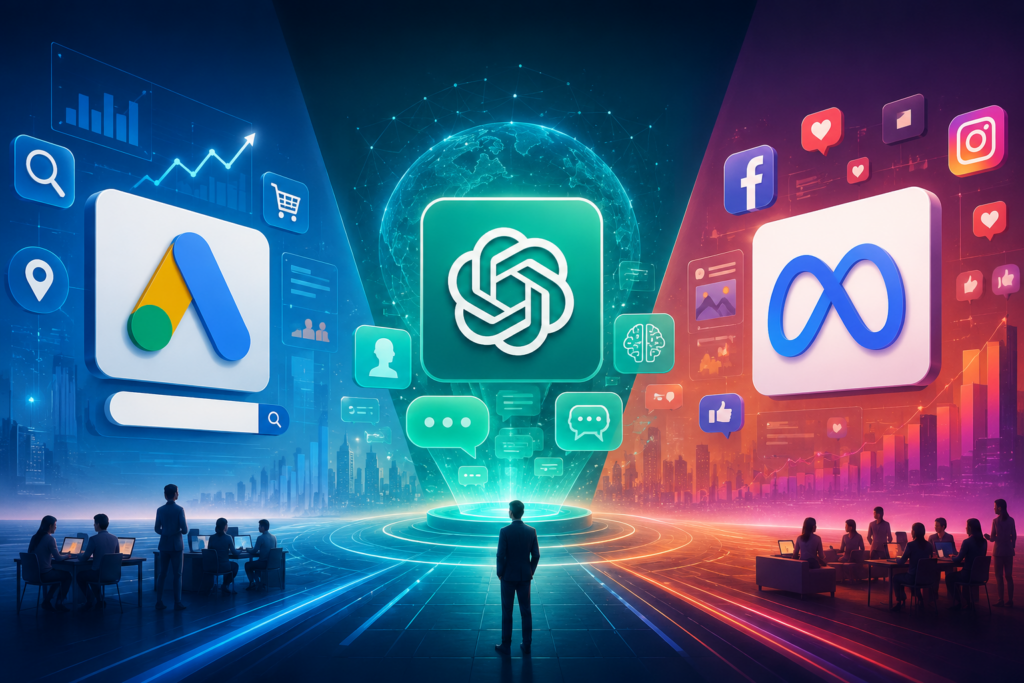
The competition between ChatGPT Ads, Google Ads, and Meta Ads is becoming one of the biggest marketing discussions of 2026. While each platform has its own strengths, they all represent different ways of reaching customers in an AI-driven world.
This article explores how these advertising platforms work, what makes them different, and how businesses can choose the right strategy for their marketing goals.
Why AI Is Changing Digital Advertising Faster Than Ever
Artificial intelligence has become one of the biggest drivers of innovation in digital marketing. Businesses no longer need to rely only on manual campaign management or broad audience targeting. AI can now analyze customer behavior, predict user interests, generate ad creatives, optimize budgets, and improve campaign performance in real time.
Consumers are also changing the way they interact with the internet. Instead of typing short search queries, they are asking complete questions through AI assistants and expecting detailed, personalized answers. This change has created a completely new customer journey.
For example, someone looking for a laptop may no longer search only for “best laptop under $1000.” Instead, they might ask an AI assistant:
“I need a lightweight laptop for video editing and gaming. Which one should I buy?”
This type of conversation gives AI systems a deeper understanding of customer intent. As a result, businesses have new opportunities to reach highly qualified audiences through more relevant recommendations instead of relying only on traditional keyword targeting.
AI is also making advertising more efficient by helping marketers:
- Create ad copy in minutes.
- Generate images and videos using AI tools.
- Automatically adjust campaign budgets.
- Identify high-value customers.
- Improve conversion rates through smarter optimization.
These capabilities are changing not only how advertisements are created but also how marketing decisions are made.
Why Businesses Should Pay Attention in 2026
The digital advertising industry is entering a period of major transformation. Businesses that adapt early to AI-powered marketing are likely to gain a significant competitive advantage.
Today’s customers expect faster answers, personalized recommendations, and seamless online experiences. Companies that continue using outdated marketing strategies may struggle to keep pace with changing consumer behavior.
In 2026, successful businesses are expected to combine multiple advertising platforms instead of depending on just one. Search advertising, social media advertising, and conversational AI each play different roles in the customer journey.
Businesses should pay close attention because AI is helping marketers:
- Reach customers with greater precision.
- Reduce advertising waste.
- Improve campaign performance.
- Deliver more personalized customer experiences.
- Make faster, data-driven marketing decisions.
Rather than replacing traditional advertising, AI is expanding the number of ways businesses can connect with potential customers.
What Are ChatGPT Ads?
ChatGPT Ads represent a new concept in digital advertising that focuses on conversational interactions instead of traditional banner ads or keyword-based search results.
Unlike conventional advertising platforms, conversational advertising aims to introduce products and services naturally while users are actively seeking information. Instead of interrupting the user experience, these advertisements can become part of a helpful conversation.
As conversational AI becomes more common in everyday life, many marketers believe this approach could redefine how businesses communicate with customers online.
Although conversational advertising is still evolving, it reflects a broader shift toward AI-powered customer engagement where relevance and usefulness matter more than simply displaying an advertisement.
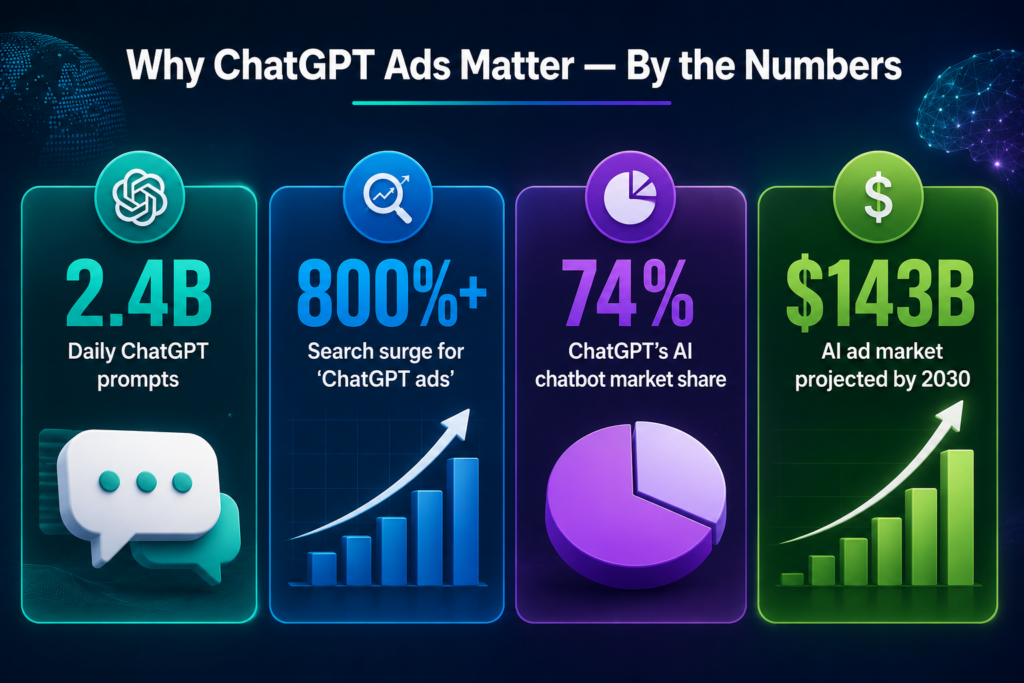
Why ChatGPT Ads Matter — By the Numbers
| 2.4B Daily ChatGPT prompts | 800%+ Search surge for ‘ChatGPT ads’ | 74% ChatGPT’s AI chatbot market share | $143B AI ad market projected by 2030 |
How Did We Get Here? A Quick Timeline
ChatGPT ads didn’t just appear overnight. Here’s a quick timeline of how OpenAI built this platform:
| Date | What Happened |
| Nov 2024 | OpenAI tested sponsored follow-up questions with brands like Whole Foods |
| Jan 16, 2026 | OpenAI officially confirmed ads are coming to ChatGPT for Free & Go users in the US |
| Feb 9, 2026 | ChatGPT ads went live — the biggest shift in digital marketing since Google AdWords |
| Feb 2026 | Personalized ads turned on by default for users with memory enabled |
| Mar 2026 | Early results: no impact on consumer trust, low ad dismissal rates |
| Apr 21, 2026 | Cost-per-click (CPC) bidding introduced alongside existing CPM model |
| Apr 30, 2026 | OpenAI updated its privacy policy to allow sharing certain data with marketing partners |
| May 2026 | Self-serve Ads Manager opened — any business can now run ChatGPT ads |
| May 7, 2026 | Expansion announced: UK, Mexico, Brazil, Japan, South Korea — India next? |
How ChatGPT Ads Work
Unlike traditional search engines that display multiple sponsored links on a results page, conversational advertising focuses on providing useful information during an ongoing discussion.
Imagine a user asking:
“What is the best CRM software for a growing business?”
Instead of showing only a list of links, an AI-powered advertising system could recommend suitable solutions within a detailed response while maintaining transparency about promotional content.
This creates a more interactive experience where advertisements feel like helpful recommendations rather than interruptions.
For businesses, this means marketing becomes more focused on solving customer problems instead of simply attracting clicks.
Where Users May See ChatGPT Ads
As conversational AI continues to develop, advertising opportunities may appear in several user experiences, including:
- Product recommendation conversations.
- Shopping-related questions.
- Business software comparisons.
- Travel planning.
- Educational research.
- Service recommendations.
- AI-assisted buying guides.
Rather than appearing as traditional display banners, these recommendations could become part of a relevant conversation that helps users make informed decisions.
Why OpenAI Is Exploring Conversational Advertising
The rapid growth of AI assistants has changed how people search for information online. Millions of users now rely on conversational AI for research, planning, learning, and product discovery.
As AI platforms continue to expand, conversational advertising is being discussed across the industry as a potential way to connect businesses with users while maintaining a helpful and trustworthy experience.
The main objective is not simply to display more advertisements, but to deliver relevant commercial information when it genuinely matches a user’s question or intent.
If implemented carefully, conversational advertising could create value for both businesses and consumers by making recommendations more useful, contextual, and less intrusive than many traditional online advertisements.
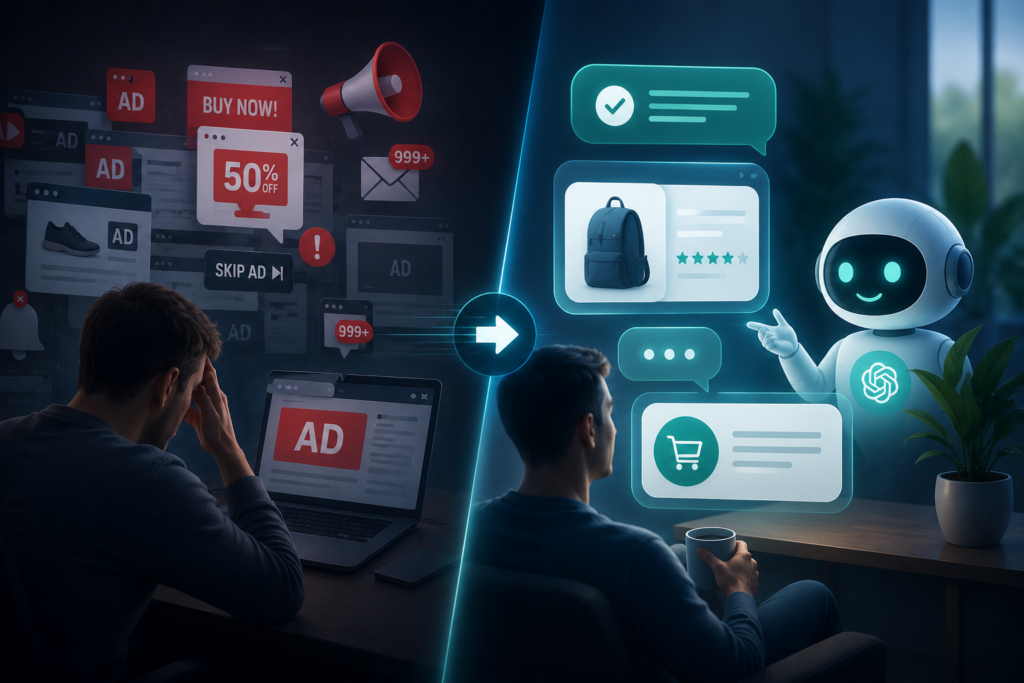
How ChatGPT Ads Are Different from Traditional Ads
Traditional digital advertising usually depends on keywords, audience targeting, or browsing behavior. Users often see advertisements while scrolling through social media or searching for information online.
Conversational advertising follows a different approach.
Instead of showing ads based only on keywords or demographics, it focuses on understanding the complete context of a user’s question.
Some of the key differences include:
- Conversations instead of simple searches.
- Personalized recommendations rather than generic promotions.
- AI understanding user intent instead of matching keywords alone.
- Helpful responses integrated into the user experience.
- Greater emphasis on relevance and trust.
This shift represents one of the biggest changes in digital advertising since the rise of search engine marketing.
Understanding Google Ads in 2026
Google Ads remains one of the world’s largest digital advertising platforms. However, the platform has evolved significantly with the integration of artificial intelligence across nearly every campaign type.
Instead of requiring advertisers to manage every detail manually, Google now uses AI to automate bidding, optimize targeting, generate creative assets, and improve campaign performance.
Businesses can choose from multiple campaign types depending on their goals, making Google Ads suitable for both small local companies and large global brands.
Search Ads
Search Ads continue to be the foundation of Google Advertising.
These ads appear when users actively search for products or services using Google Search.
Because users already have strong purchase intent, Search Ads often deliver high-quality traffic and strong conversion rates.
For example, someone searching for:
“Best digital marketing agency near me”
is much more likely to become a customer than someone casually browsing social media.
This intent-based advertising model remains one of Google’s biggest strengths.
AI Overviews
Google’s AI Overviews are changing how users receive information in search results.
Instead of displaying only a list of website links, Google now provides AI-generated summaries that answer questions directly while referencing multiple trusted sources.
For businesses, this means content quality, authority, and helpfulness have become even more important for maintaining online visibility.
Advertisers are also adapting their strategies as AI-generated answers influence how users discover products and services.
Performance Max
Performance Max is Google’s AI-powered campaign solution that automatically delivers advertisements across multiple Google properties from a single campaign.
Instead of creating separate campaigns for Search, YouTube, Gmail, Maps, and Display, advertisers can use Performance Max to reach customers through Google’s entire ecosystem.
AI continuously analyzes user behavior, adjusts bids, and allocates budget to maximize campaign performance based on business goals.
This automation helps businesses save time while improving efficiency.
Demand Gen Campaigns
Demand Gen Campaigns are designed to help businesses build awareness and generate customer interest before people begin actively searching for products.
These campaigns use visually engaging images, videos, and AI-powered audience targeting across Google’s most popular platforms.
Rather than focusing only on direct sales, Demand Gen helps brands create stronger relationships with potential customers during the early stages of the buying journey.
Shopping Ads
Shopping Ads remain one of the most effective advertising formats for eCommerce businesses.
These ads display product images, prices, store names, customer ratings, and promotional offers directly within Google Search.
By giving shoppers important product information before they click, Shopping Ads often attract highly qualified buyers who are ready to compare products and make purchasing decisions.
For online retailers, Shopping campaigns continue to play a critical role in driving sales and increasing product visibility.
YouTube Ads
YouTube remains one of the most powerful video advertising platforms in the world.
Businesses can reach audiences through skippable ads, non-skippable ads, Shorts, in-feed videos, and connected TV experiences.
With AI-powered audience targeting and campaign optimization, advertisers can deliver relevant video content to users based on their interests, viewing behavior, and purchase intent.
As video consumption continues to grow in 2026, YouTube Ads remain an essential part of a complete digital marketing strategy for brands looking to increase awareness, engagement, and conversions.
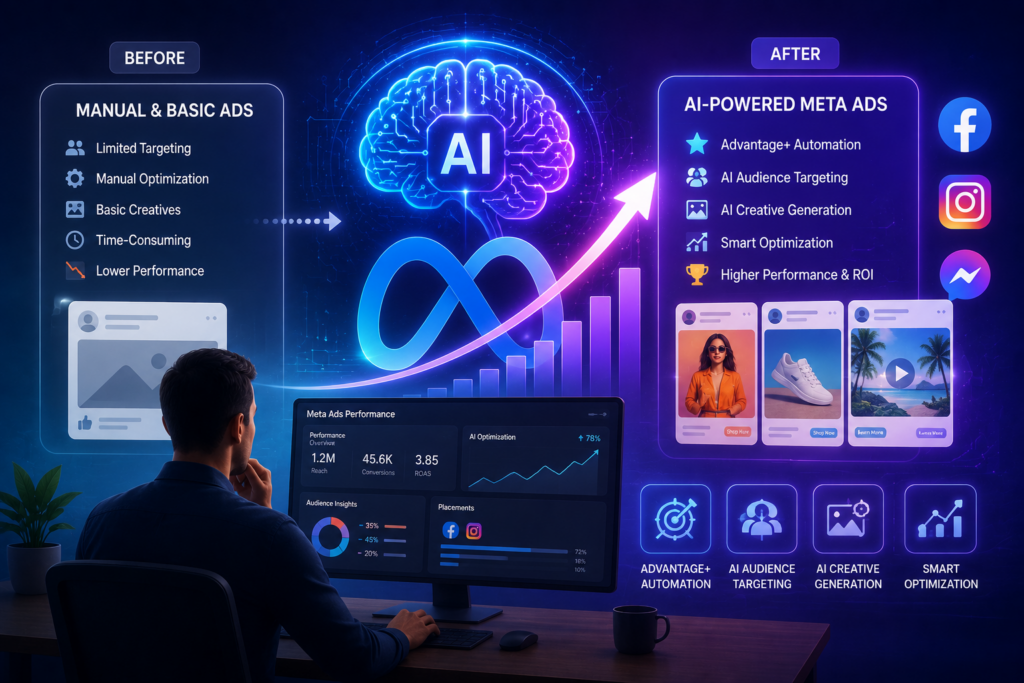
How Meta Ads Have Evolved with AI
Meta has transformed its advertising platform significantly over the last few years. What started as a social media advertising platform has now become an AI-powered marketing ecosystem that helps businesses reach the right audience with less manual effort.
Today, advertisers no longer need to spend hours testing different audiences, writing multiple ad variations, or manually adjusting campaign settings. Meta’s AI handles many of these tasks automatically, allowing businesses to focus more on strategy and creativity.
With Facebook, Instagram, Threads, Advantage+, AI-generated creatives, and advanced audience targeting working together, Meta Ads continue to be one of the most effective platforms for building brand awareness, generating leads, and driving online sales.
Let’s explore how each part of the Meta ecosystem has evolved in 2026.
Facebook remains one of the largest digital advertising platforms, connecting businesses with billions of users worldwide. While younger audiences have shifted toward newer platforms, Facebook still offers excellent opportunities for local businesses, service providers, eCommerce stores, educational institutions, healthcare companies, and B2B brands.
AI has made Facebook advertising much smarter than before.
Instead of relying only on manual audience selection, Facebook’s AI studies user behavior, interests, browsing patterns, and engagement signals to show advertisements to people who are more likely to take action.
Businesses can now spend less time managing campaigns while achieving better results through automated optimization.
For many companies, Facebook continues to be a reliable platform for generating leads, increasing website traffic, and building long-term customer relationships.
Instagram has evolved far beyond a photo-sharing platform. It has become one of the most influential places for product discovery, brand storytelling, and influencer marketing.
People no longer visit Instagram only to connect with friends. They also explore fashion, travel, fitness, food, technology, beauty products, and online shopping.
AI helps businesses identify users who are most likely to engage with visual content. It also recommends the best placement for advertisements across Stories, Reels, Feed, and Explore.
Short-form videos have become one of Instagram’s strongest marketing tools. Businesses using creative Reels and engaging visuals often experience higher engagement compared to traditional image advertisements.
Brands that focus on lifestyle, fashion, beauty, fitness, restaurants, home décor, and consumer products continue to see strong performance on Instagram.
Threads
Threads is becoming an important platform for real-time conversations and community engagement.
Although advertising opportunities are still developing, many marketers believe Threads could become a valuable channel for brands that want to participate in discussions rather than simply display advertisements.
As AI continues to improve content recommendations, businesses may have more opportunities to reach users based on their interests and ongoing conversations.
Brands that build authentic relationships through helpful content and meaningful discussions are likely to benefit as the platform grows.
Advantage+
One of Meta’s biggest AI innovations is Advantage+.
Advantage+ uses artificial intelligence to automate many campaign management tasks that previously required manual work.
Instead of selecting every audience, placement, and budget manually, advertisers can provide their marketing goals while AI continuously optimizes campaign performance.
The system analyzes thousands of data points every second to determine where advertisements should appear, which audience is most likely to convert, and how budgets should be distributed.
This automation helps businesses save time while improving advertising efficiency.
Many advertisers have reported better campaign performance because Advantage+ can react to customer behavior much faster than manual optimization.
AI Creative
Creating advertisements used to take days or even weeks.
Today, AI is helping businesses produce marketing content much faster.
Meta’s AI-powered creative tools can assist advertisers by generating multiple versions of headlines, primary text, image backgrounds, layouts, and creative variations.
Instead of relying on a single advertisement, businesses can test several creative options without significantly increasing production time.
AI also helps optimize creative assets based on user preferences, improving engagement and click-through rates.
Human creativity still plays an essential role, but AI allows marketers to experiment faster and discover what works best.
AI Audience Targeting
Audience targeting has become much more intelligent.
In the past, advertisers manually selected interests, demographics, locations, and behaviors. While these options still exist, AI now handles much of the optimization automatically.
Meta analyzes millions of user interactions to identify people who are most likely to engage with an advertisement.
Rather than relying only on basic audience filters, AI considers purchasing behavior, engagement history, browsing activity, device usage, and many other signals.
This allows businesses to reach highly relevant audiences while reducing wasted advertising spend.
For many marketers, AI audience targeting has become one of the biggest reasons Meta Ads continue to deliver strong results.
ChatGPT Ads vs Google Ads vs Meta Ads: Key Differences
Although all three platforms help businesses reach customers, they are designed for different marketing objectives.
Google Ads focuses on capturing existing demand through search intent.
Meta Ads create demand by helping businesses reach people while they browse social media.
ChatGPT Ads represent a newer conversational approach, where recommendations may become part of an AI-powered discussion rather than a traditional advertisement.
Choosing the right platform depends on your business goals, target audience, marketing budget, and customer journey.
Below is a comparison of the three platforms.
| Feature | ChatGPT Ads | Google Ads | Meta Ads |
| User Intent | Users ask detailed questions and expect personalized answers. | Users actively search for products or services with clear intent. | Users discover products while browsing social media. |
| Audience Targeting | Based on conversation context and user intent. | Based on keywords, search behavior, and AI signals. | Based on interests, behaviors, demographics, and AI learning. |
| Cost | Still developing, pricing models may evolve. | Flexible bidding with options for different budgets. | Suitable for both small and large advertising budgets. |
| AI Automation | Conversational recommendations powered by AI. | AI bidding, campaign optimization, and creative assistance. | AI optimization through Advantage+, audience targeting, and creative tools. |
| Best Business Type | SaaS, B2B, AI companies, consultants, education, finance. | Local businesses, service providers, eCommerce, healthcare, real estate. | Fashion, beauty, restaurants, D2C brands, fitness, lifestyle products. |
| Lead Quality | High-quality leads through detailed conversations. | High purchase intent from active search users. | Strong engagement and interest-based leads. |
| Customer Journey | Research and decision-making stage. | Decision and purchase stage. | Awareness, engagement, and product discovery stage. |
| Conversion Rate | Expected to improve as conversational advertising grows. | Generally strong because users are actively searching. | Depends on creative quality and audience targeting. |
| Brand Awareness | Limited but growing with AI adoption. | Moderate brand visibility through search. | Excellent for building large-scale brand awareness. |
| Return on Investment (ROI) | Potentially high for specialized businesses using conversational marketing. | Consistently strong for businesses targeting search demand. | Excellent for visual brands with engaging creative content. |
Which Platform Should Businesses Choose?
There is no single winner because every platform serves a different purpose.
If customers already know what they need and are searching online, Google Ads remains one of the strongest choices.
If your goal is to introduce products, increase brand awareness, and build customer engagement, Meta Ads continues to perform exceptionally well.
As conversational AI becomes more common, ChatGPT Ads could become a valuable option for businesses that want to educate customers, answer complex questions, and build trust before a purchase decision.
The smartest marketing strategy in 2026 is not choosing one platform over another. Instead, successful businesses are combining all three platforms to reach customers throughout every stage of the buying journey.
How AI Is Changing the Way Businesses Advertise
Artificial intelligence is no longer a future technology. It is becoming an everyday part of digital marketing.
Businesses of all sizes are using AI to save time, improve campaign performance, create better customer experiences, and make smarter marketing decisions.
Instead of replacing marketers, AI is helping them work more efficiently by automating repetitive tasks and providing valuable insights.
Let’s look at some of the biggest ways AI is transforming advertising.
AI-Generated Creatives
Creating marketing content has become much faster with AI.
Businesses can now generate images, videos, headlines, product descriptions, social media posts, and advertising ideas within minutes.
AI speeds up the creative process, allowing marketing teams to test multiple campaign variations without increasing production costs.
While human creativity remains essential, AI helps marketers work faster and explore more ideas.
AI Copywriting
Writing advertising copy used to require multiple rounds of editing and testing.
Today, AI writing tools can generate headlines, product descriptions, email campaigns, landing page content, and advertisement copy in just a few seconds.
Marketers can then refine and personalize the content to match their brand voice.
This combination of AI efficiency and human creativity often leads to better-performing campaigns.
Predictive Targeting
Predictive targeting uses AI to identify customers who are most likely to purchase a product or service.
Instead of targeting broad audiences, AI analyzes customer behavior, browsing history, purchase patterns, engagement signals, and historical campaign data.
This allows businesses to focus their advertising budget on people who have a higher chance of converting. The result is more efficient campaigns and improved return on investment.
Personalized Conversations
Consumers increasingly expect brands to provide personalized experiences.
AI-powered chatbots, virtual assistants, and conversational marketing tools can answer customer questions, recommend products, schedule appointments, and provide support around the clock.
These personalized interactions help businesses build trust while improving customer satisfaction. Instead of delivering the same message to everyone, AI enables businesses to communicate based on each customer’s individual needs.
Smart Bidding
Managing advertising bids manually can be time-consuming and difficult.
AI-powered smart bidding automatically adjusts bids based on factors such as device type, location, browsing behavior, time of day, previous interactions, and conversion probability.
This helps businesses maximize campaign performance without continuously monitoring every keyword or advertisement.
As a result, advertisers can spend their budgets more efficiently while achieving better outcomes.
Automated Campaign Optimization
One of AI’s biggest advantages is its ability to improve campaigns continuously.
Instead of waiting for marketers to analyze reports, AI monitors campaign performance in real time and automatically adjusts bidding strategies, audience targeting, placements, and creative delivery.
This ongoing optimization allows businesses to respond quickly to changing customer behavior and market trends.
For marketers, it means less manual work and more time to focus on strategy, innovation, and long-term business growth.
Artificial intelligence is not replacing digital marketing—it is reshaping how it works. Businesses that combine human creativity with AI-powered tools are better positioned to deliver personalized experiences, improve campaign performance, and stay competitive in the rapidly evolving digital landscape of 2026.
Which Businesses Should Use ChatGPT Ads?
ChatGPT Ads are expected to become one of the most valuable advertising options for businesses that need to educate customers before they make a buying decision. Unlike traditional ads that focus on getting quick clicks, conversational advertising helps brands answer questions, solve problems, and build trust through meaningful interactions.
If your products or services require detailed explanations, expert advice, or personalized recommendations, ChatGPT Ads can become an effective marketing channel as conversational AI continues to grow.
Below are the types of businesses that can benefit the most.
SaaS Companies
Software as a Service (SaaS) businesses often sell products that require customers to understand features, pricing, integrations, and long-term value before making a purchase.
ChatGPT Ads can help explain software solutions through natural conversations instead of forcing users to visit multiple websites.
For example, a business owner searching for the best project management software may receive helpful recommendations based on company size, budget, and business needs.
This creates a more informative buying experience while helping SaaS companies reach highly interested customers.
AI Companies
Businesses offering AI tools, automation software, chatbots, machine learning platforms, or productivity solutions are a natural fit for conversational advertising.
People searching for AI solutions usually ask detailed questions before making a decision.
Instead of showing a simple advertisement, ChatGPT Ads can introduce products within relevant discussions, making recommendations feel more useful and educational.
This allows AI companies to demonstrate value while building trust with potential customers.
B2B Businesses
Business-to-business companies often have longer sales cycles because decision-makers need detailed information before investing.
Products like CRM software, cybersecurity solutions, cloud services, accounting software, HR platforms, and enterprise technology usually require research and comparison.
ChatGPT Ads can help businesses explain complex solutions in a clear and conversational way, making it easier for potential buyers to understand their options.
This approach can generate more qualified leads because users are already looking for detailed answers.
B2C Businesses
Business-to-consumer brands can also benefit from conversational advertising, especially when customers need guidance before purchasing.
Whether someone is looking for the best smartphone, fitness equipment, online course, travel package, or home appliance, AI-powered conversations can provide personalized recommendations based on individual needs.
Instead of displaying generic advertisements, businesses can become part of a helpful buying journey that feels more natural and customer-focused.
Consultants
Marketing consultants, business advisors, legal professionals, financial experts, career coaches, and other consultants depend heavily on trust and expertise.
People usually ask many questions before hiring a consultant.
ChatGPT Ads can help consultants introduce their services by providing useful information while demonstrating their knowledge in a conversational format.
This helps establish credibility before the first consultation even begins.
Education
Educational institutions, universities, online learning platforms, coaching centers, and skill development companies can use conversational advertising to guide students through course selection.
Students often ask questions about eligibility, career opportunities, fees, certifications, and learning outcomes.
ChatGPT Ads can provide relevant recommendations based on these questions, helping educational organizations connect with students who are actively looking for learning opportunities.
Finance
Financial services often involve important decisions that require careful research.
Banks, insurance providers, investment firms, tax consultants, fintech companies, and financial advisors can use conversational advertising to educate potential customers about their services.
Instead of promoting products through traditional advertisements alone, businesses can answer common financial questions and provide useful guidance before introducing suitable solutions.
This educational approach can help build confidence and strengthen customer relationships.
Who Benefits the Most from ChatGPT Ads?
Businesses that rely on education, consultation, personalized recommendations, or detailed product explanations are likely to gain the greatest value from conversational advertising.
Instead of focusing only on generating clicks, ChatGPT Ads have the potential to help businesses build trust, improve customer understanding, and create stronger buying experiences.
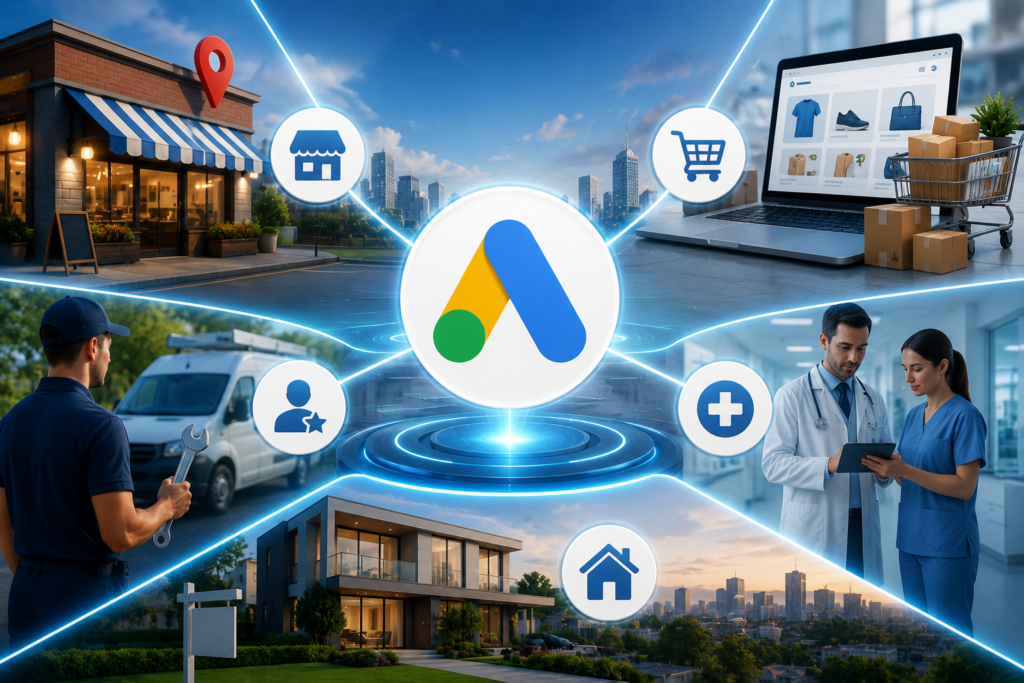
Which Businesses Should Choose Google Ads?
Google Ads continues to be one of the most effective advertising platforms because it reaches users who are actively searching for products or services.
Unlike social media advertising, Google captures customer intent at the moment people are ready to find answers, compare options, or make a purchase.
This makes Google Ads an excellent choice for businesses that want to generate qualified leads, phone calls, website traffic, or online sales.
Let’s look at the industries that benefit the most.
Local Businesses
Local businesses rely heavily on customers searching for nearby products or services.
Whether someone needs a restaurant, electrician, plumber, salon, gym, dentist, repair service, or café, Google Search is often the first place they look.
Google Ads helps local businesses appear at the top of search results when nearby customers are actively looking for their services.
This can increase phone calls, store visits, bookings, and walk-in customers.
Ecommerce Businesses
Online stores benefit greatly from Google Ads because shoppers often search for specific products before making a purchase.
Whether someone wants to buy shoes, electronics, furniture, clothing, kitchen appliances, or beauty products, Google Shopping Ads and Search Ads help businesses reach customers with high purchase intent.
By displaying product images, prices, ratings, and promotional offers directly in search results, eCommerce brands can attract qualified shoppers who are ready to buy.
Service Providers
Businesses that offer professional services can generate consistent leads through Google Ads.
Examples include:
- Digital marketing agencies
- Web development companies
- Interior designers
- Lawyers
- Accountants
- Cleaning services
- Event planners
- Travel agencies
- Home repair professionals
People searching for these services usually have an immediate need, making Google Ads one of the strongest platforms for lead generation.
Healthcare
Healthcare providers benefit from Google Ads because patients frequently search online when they need medical assistance.
Hospitals, clinics, dentists, physiotherapists, diagnostic centers, eye specialists, mental health professionals, and wellness clinics can use Google Ads to connect with patients who are actively seeking healthcare services.
Search advertising helps healthcare organizations increase appointment bookings while reaching patients at the exact moment they need professional support.
Real Estate
The real estate industry depends heavily on online search.
People searching for apartments, villas, commercial properties, rental homes, investment opportunities, or real estate agents often begin their journey on Google.
Google Ads allows real estate businesses to appear when buyers or investors are actively looking for properties in a specific location.
This helps generate high-quality inquiries from users who already have strong purchase intent.
Why Google Ads Still Remains a Powerful Choice
Even as AI continues to reshape digital marketing, Google Ads remains one of the strongest platforms because it connects businesses with customers who are already searching for solutions.
Whether your goal is generating leads, increasing online sales, driving local traffic, or promoting professional services, Google Ads offers a reliable way to reach people at the right moment.
For many businesses, combining Google Ads with AI-powered marketing tools creates a more balanced strategy that captures both existing demand and future customer opportunities.
When Meta Ads Still Deliver the Best Results
Even with the rapid growth of AI-powered marketing and conversational advertising, Meta Ads continue to be one of the strongest platforms for businesses that want to build brand awareness, engage audiences, and influence buying decisions through visual content.
Unlike Google Ads, where people search for a product or service, Meta Ads introduce products to users while they are scrolling through Facebook, Instagram, and other Meta platforms. This creates opportunities to capture attention before customers even realize they need a product.
In 2026, Meta’s AI-powered tools have made advertising smarter than ever. Businesses can automatically find the right audience, optimize campaign performance, and personalize ad delivery based on user behavior.
For brands that rely on storytelling, creativity, and emotional connections, Meta Ads remain an essential part of a successful digital marketing strategy.
Let’s explore the industries where Meta Ads continue to deliver outstanding results.
Fashion Brands
Fashion is one of the biggest success stories on Meta platforms.
People visit Facebook and Instagram every day to discover new clothing styles, seasonal collections, footwear, handbags, jewelry, and accessories. Eye-catching visuals and short videos naturally attract attention, making fashion products highly suitable for social media advertising.
Meta’s AI helps fashion brands show products to users who are most likely to interact with similar styles based on their interests, shopping habits, and previous engagement.
Features such as Instagram Reels, Stories, Carousel Ads, and Collection Ads allow fashion brands to showcase multiple products in creative ways, encouraging users to explore and shop without leaving the platform.
For fashion businesses, Meta Ads are not just about selling products—they help build a recognizable brand that customers remember.
Beauty Brands
The beauty industry continues to thrive on social media.
Consumers enjoy watching makeup tutorials, skincare routines, product reviews, transformation videos, and influencer recommendations before making purchasing decisions.
Meta Ads provide beauty brands with the perfect environment to demonstrate products through engaging visuals and authentic storytelling.
AI also helps advertisers reach users based on their beauty interests, shopping behavior, and online engagement.
Whether promoting cosmetics, skincare, haircare, fragrances, or wellness products, Meta Ads offer beauty businesses an effective way to inspire customers and increase product sales.
Restaurants and Food Businesses
People often discover their next dining experience while scrolling through social media.
Restaurants, cafés, bakeries, cloud kitchens, food delivery brands, and local eateries can use Meta Ads to showcase delicious food photography, behind-the-scenes videos, customer experiences, and limited-time offers.
Visual content plays an important role in influencing food choices.
A well-designed video of a freshly prepared meal or a beautifully presented dessert can quickly attract attention and encourage customers to visit a restaurant or place an online order.
Meta’s location-based targeting also helps food businesses reach nearby customers, making advertising more relevant and cost-effective.
Lifestyle Brands
Lifestyle brands focus on creating emotional connections rather than simply promoting products.
Whether selling travel experiences, home décor, fitness products, furniture, luxury accessories, pet supplies, or wellness services, these businesses benefit from visually engaging campaigns that inspire customers.
Meta Ads provide an excellent platform for storytelling through images, videos, and user-generated content.
Instead of directly selling products, lifestyle brands can build communities around shared interests, values, and aspirations.
This emotional connection often leads to stronger customer loyalty and long-term brand growth.
Direct-to-Consumer (D2C) Brands
Direct-to-consumer businesses have transformed online shopping over the past few years.
Without relying on traditional retail stores, D2C brands sell directly through their websites and social media channels.
Meta Ads have become one of the most effective ways for these brands to reach new customers, introduce products, and encourage repeat purchases.
AI-powered optimization allows D2C companies to identify people who are most likely to purchase while continuously improving campaign performance.
Combined with remarketing campaigns, dynamic product ads, and personalized recommendations, Meta helps D2C businesses build profitable customer acquisition strategies.
Personal Brands
In today’s creator economy, individuals have become brands themselves.
Entrepreneurs, business coaches, fitness trainers, financial advisors, educators, authors, public speakers, YouTubers, influencers, and content creators all use Meta Ads to grow their personal brands.
People often connect with individuals before they connect with companies.
Meta allows creators to share their expertise, success stories, educational content, and personal experiences through engaging posts and videos.
AI-powered targeting ensures that this content reaches audiences who are most likely to follow, engage, and eventually become loyal customers or clients.
For personal brands, Meta Ads are about more than increasing followers—they help build trust, credibility, and long-term relationships.
Why Meta Ads Continue to Deliver Strong Results
Although AI-powered search and conversational advertising are changing digital marketing, Meta Ads remain highly effective because they create demand rather than simply responding to it.
Many customers discover products on social media long before they search for them on Google or ask questions through AI assistants.
Meta’s strength lies in inspiring curiosity, creating emotional connections, and encouraging product discovery through engaging visual content.
For businesses focused on awareness, engagement, community building, and customer loyalty, Meta Ads continue to be one of the most powerful advertising platforms in 2026.
Can Businesses Use All Three Platforms Together?
Absolutely.
In fact, many of the world’s fastest-growing businesses are no longer relying on just one advertising platform. Instead of asking whether ChatGPT Ads, Google Ads, or Meta Ads is better, successful marketers are combining all three to create a complete customer journey.
Every platform plays a different role, and when used together, they create a stronger marketing strategy that reaches customers at every stage of the buying process. This approach is known as Omnichannel Marketing.
What Is Omnichannel Marketing?
Omnichannel marketing is a strategy where businesses connect with customers across multiple platforms while delivering a consistent brand experience.
Instead of treating each advertising platform separately, businesses create a connected journey that guides potential customers from their first interaction all the way to becoming loyal, repeat buyers.
For example, someone may first discover a brand on Instagram, later search for reviews on Google, ask ChatGPT for product recommendations, and finally complete their purchase through the company’s website.
Every touchpoint works together to build trust and increase the chances of conversion.
In today’s AI-driven world, customers rarely make purchasing decisions after seeing a single advertisement. They often research, compare options, read reviews, and seek recommendations before buying.
This is why businesses that combine multiple marketing channels usually achieve better long-term results than those relying on only one platform.
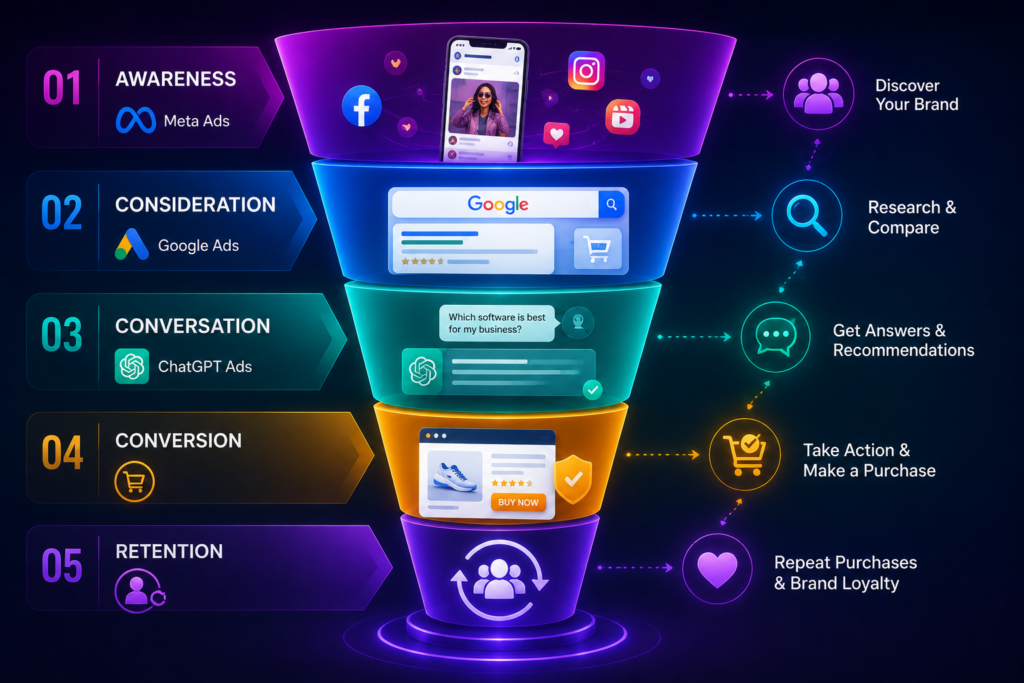
Example Marketing Funnel
A modern digital marketing strategy combines the strengths of ChatGPT Ads, Google Ads, and Meta Ads to guide customers through every stage of the buying journey.
Stage 1 – Awareness
Platform: Meta Ads
The journey often begins with discovery.
People see engaging Facebook posts, Instagram Reels, Stories, or short videos while browsing social media.
At this stage, the goal is not to make an immediate sale. Instead, businesses focus on introducing their brand, capturing attention, and creating curiosity.
Eye-catching visuals, educational videos, and entertaining content help potential customers remember the brand.
Stage 2 – Consideration
Platform: Google Ads
Once customers become interested, they usually start researching.
They search Google to compare products, read reviews, check pricing, and explore different options.
Search Ads and Shopping Ads help businesses appear exactly when customers are actively looking for solutions.
This is where Google captures high-intent users who are seriously considering a purchase.
Stage 3 – Conversation
Platform: ChatGPT Ads
As customers continue researching, they often want detailed answers before making a decision.
They may ask questions like:
- Which software is best for my business?
- Which laptop offers better value?
- Which skincare brand is suitable for sensitive skin?
- Which digital marketing agency has the best expertise?
Conversational AI can provide personalized recommendations, explain product differences, and answer specific questions in a natural way.
Instead of interrupting the customer journey, ChatGPT helps businesses build trust by becoming part of the conversation.
Stage 4 – Conversion
At this stage, customers are ready to take action.
They may click a Google Search Ad, visit the business website, submit an enquiry, book a consultation, or complete an online purchase.
By this point, they have already interacted with the brand across multiple channels, making them more confident in their buying decision.
A seamless website, clear messaging, and a smooth checkout process help convert interested visitors into paying customers.
Stage 5 – Retention
The customer journey does not end after the first sale.
Successful businesses continue engaging customers through email marketing, remarketing campaigns, loyalty programs, educational content, exclusive offers, and helpful customer support.
AI also plays an important role by analyzing customer behavior, recommending relevant products, and personalizing future interactions.
Happy customers are more likely to return, recommend the brand to others, and become long-term advocates.
Expert Opinion: The Future of AI Advertising
Artificial intelligence is no longer just another marketing tool—it is becoming the foundation of modern digital advertising. Over the next few years, AI will continue to influence how businesses reach customers, create campaigns, and measure success.
Marketing is moving away from showing the same advertisement to everyone. Instead, brands are focusing on delivering the right message, to the right person, at the right time. AI makes this possible by understanding customer behavior, learning from data, and helping marketers make better decisions.
As technology continues to improve, several trends are expected to shape the future of AI advertising.
AI Search Will Become More Important
The way people search online is changing.
For many years, users searched with short keywords such as “best running shoes” or “digital marketing agency.” Today, people are asking complete questions through AI-powered search tools and expecting detailed answers instead of just a list of links.
For example, someone may ask:
“Which CRM software is best for a small business with a limited budget?”
Instead of showing hundreds of websites, AI can provide a personalized answer based on the user’s needs.
This means businesses will need to create content that answers real questions, provides useful information, and builds authority. Success in the future will depend on being helpful rather than simply ranking for keywords.
Conversational Ads Will Build More Trust
Traditional advertisements often interrupt the user experience.
Conversational advertising is different because it becomes part of the discussion.
Instead of pushing products aggressively, AI can introduce relevant services or products naturally while helping users solve problems.
For example, if someone asks for the best accounting software for freelancers, an AI assistant may recommend suitable options while explaining their features and benefits.
This creates a smoother and more informative customer experience.
Businesses that focus on providing value before selling are likely to earn greater trust and stronger customer relationships.
Voice Search Will Continue to Grow
More people are using voice assistants on smartphones, smart speakers, and connected devices.
Instead of typing, users now ask questions naturally, just as they would in a normal conversation.
This trend is encouraging businesses to optimize their content for conversational language instead of focusing only on traditional keywords.
Voice search is especially useful for local businesses, restaurants, healthcare providers, travel companies, and service-based businesses where users often need quick answers.
As voice technology becomes smarter, it will become an even more important part of digital marketing.
Personalized Recommendations Will Improve Customer Experience
Consumers expect brands to understand their preferences.
Artificial intelligence makes this possible by analyzing customer behavior, browsing history, purchase patterns, and previous interactions.
Instead of showing the same advertisement to everyone, AI can recommend products and services that match each individual’s interests.
For example, an online shopper interested in fitness products may receive recommendations for sports equipment, workout plans, and healthy lifestyle products instead of unrelated advertisements.
This level of personalization creates a better customer experience while helping businesses improve engagement and conversion rates.
Privacy-First Advertising Will Shape the Future
As digital advertising evolves, protecting user privacy is becoming more important than ever.
Consumers want personalized experiences, but they also expect businesses to handle their data responsibly.
Governments, technology companies, and advertising platforms are introducing stronger privacy standards that give users more control over how their information is collected and used.
For marketers, this means building trust through transparency, ethical data practices, and permission-based marketing.
The businesses that respect customer privacy while delivering valuable experiences will be better positioned for long-term success.
Final Verdict
So, who wins the battle between ChatGPT Ads, Google Ads, and Meta Ads?
The honest answer is that there isn’t a single winner.
Each platform has been designed to solve a different marketing challenge, and each plays an important role in today’s digital landscape.
If your goal is to reach people who are actively searching for products or services, Google Ads remains one of the strongest platforms because it captures customers with high purchase intent.
If you want to increase brand awareness, tell your brand story, build communities, and inspire customers through visual content, Meta Ads continues to be an excellent choice.
If your business depends on educating customers, answering detailed questions, or providing personalized recommendations, ChatGPT Ads represent an exciting opportunity as conversational AI continues to grow.
Rather than competing against each other, these platforms complement one another.
Different Platforms, Different Marketing Goals
A successful marketing strategy is not about choosing one platform and ignoring the others. It is about understanding what each platform does best.
- Choose ChatGPT Ads when your business wants to educate customers, answer complex questions, and build trust through meaningful conversations.
- Choose Google Ads when your priority is capturing existing demand, generating qualified leads, increasing website traffic, or driving immediate sales.
- Choose Meta Ads when your focus is building brand awareness, engaging audiences, creating emotional connections, and showcasing products through creative visual content.
Every customer follows a different buying journey. Some discover brands on social media, others search on Google, and many now ask AI assistants for recommendations before making a purchase.
Businesses that understand this journey can create a stronger and more effective marketing strategy.
The Future Belongs to Businesses That Combine AI and Human Creativity
Artificial intelligence is changing how marketing works, but it is not replacing human creativity.
The most successful businesses in 2026 will be those that combine AI-powered automation with genuine storytelling, helpful content, and strong customer relationships.
Technology can improve targeting, optimize campaigns, and analyze data faster than ever before. However, creativity, trust, authenticity, and customer experience will continue to be the qualities that truly differentiate great brands.
The future of digital advertising is not about replacing marketers with AI. It is about giving marketers smarter tools to create better experiences for their customers.
Businesses that embrace this balance between technology and human creativity will be well prepared for the next generation of digital marketing.