
Summary
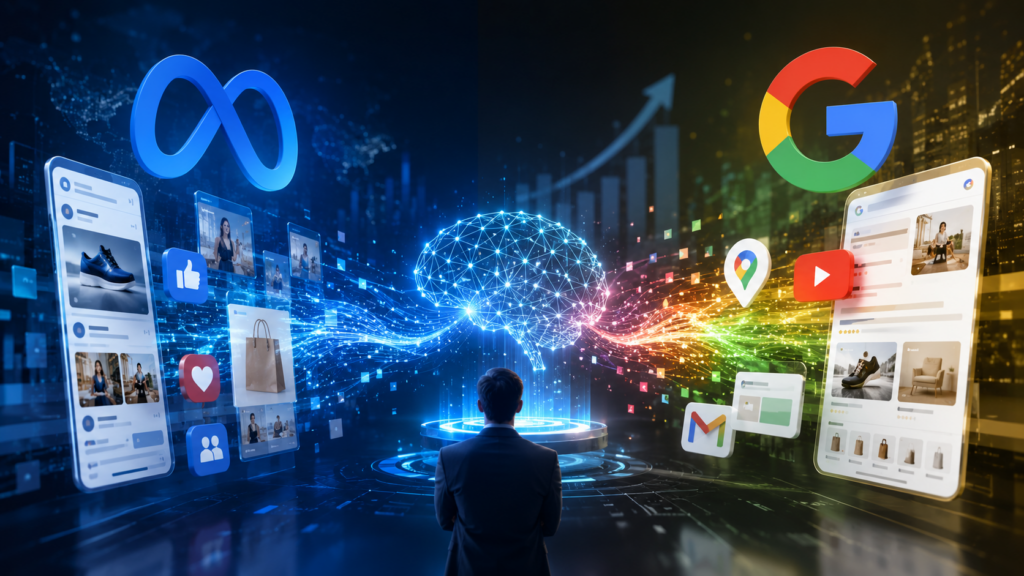
Meta and Google are rapidly moving toward a more AI-driven advertising model, with both platforms giving artificial intelligence a bigger role in campaign targeting, optimisation, creative testing and performance analysis. Google is expanding AI-powered tools such as AI Max and Performance Max, while Meta is using AI to analyse campaigns, improve targeting and automate more advertising tasks. This means advertisers may have less control over individual settings but can potentially manage campaigns faster and at a larger scale. For digital marketers, the focus is increasingly shifting from manual campaign management to providing strong creatives, accurate conversion data and clear business goals that AI can optimise around. The trend shows that AI is becoming a core part of performance marketing, and businesses that learn how to combine AI automation with human strategy are likely to be better prepared for the future of digital advertising.
The digital advertising industry is moving into a new phase as Meta and Google continue to give artificial intelligence a bigger role in campaign creation, targeting, optimisation and measurement. For advertisers, this means platforms are increasingly making decisions that were previously handled manually by marketers.
The shift is not happening overnight. Both companies have been gradually adding AI-powered features, but the latest updates show that automation is becoming a much more important part of how advertising campaigns are managed.
Google Is Pushing AI Deeper Into Google Ads
Google has been making a major push toward AI-powered advertising through AI Max, Performance Max and new agentic tools.
On August 10, Google announced new AI and agentic experiences across Google Ads and Google Analytics. The company says these tools are designed to simplify marketing workflows and help advertisers move faster from campaign planning to business growth.
One of the biggest developments is AI Max for Search campaigns. Google’s AI can help advertisers understand search intent, expand matching beyond traditional keyword targeting and generate assets based on information from the advertiser’s website.
Google is also adding more ways for advertisers to test their campaigns. On August 20, Google announced new AI Max testing and planning tools that will allow advertisers to test different budgets and ROI targets across multiple Search campaigns through an A/B testing approach. The feature is expected to roll out in September.
This is important because marketers are increasingly moving away from managing every individual keyword, bid and creative manually.
Instead, the advertiser provides the business goal, budget, conversion data and other signals, while Google’s systems handle more of the optimisation.
Meta Is Also Giving AI More Control
Meta is following a similar direction with its advertising products.
Meta has been expanding automation through its Advantage+ advertising systems, which use AI to help with audience selection, placements, budget allocation and creative optimisation.
More recently, Meta AI has also gained the ability to analyse advertising account information, provide performance insights and suggest campaign improvements. Reports in August say the system can help advertisers understand campaign performance and automate parts of reporting and optimisation.
Another major change is happening with ad placements.
Meta recently removed an option that allowed some advertisers to exclude individual placements. Instead, its automated systems increasingly decide where ads should appear across Meta’s network.
For advertisers who are used to controlling every placement manually, this represents a significant change.
Why Are Meta and Google Doing This?
The main reason is simple: AI can process a huge amount of data much faster than a human marketer.
Advertising platforms receive signals from searches, clicks, conversions, websites, apps, devices and user behaviour. AI systems can use these signals to predict which people are more likely to take a desired action.
For example, instead of an advertiser manually deciding:
- Which audience to target
- Which placement to use
- Which bid to set
- Which creative to show
- Which search query to match
- How to distribute the budget
AI systems can increasingly make many of these decisions automatically.
The goal is to improve campaign performance while reducing the amount of manual work required from advertisers.
But There Is a Trade-Off: Less Manual Control
The move toward AI advertising also creates an important challenge.
More automation can mean less control.
Advertisers may have fewer options to manually control placements, bids, targeting and other campaign settings.
This means marketers need to become better at providing the right inputs rather than trying to control every individual action.
For example, if an advertiser gives Google or Meta poor conversion data, an unclear campaign objective or weak creative assets, AI may optimise the campaign around the wrong signals.
In other words:
AI can automate a good strategy — but it can also automate a bad strategy very quickly.
This is becoming an important issue as advertising platforms remove or reduce some manual controls. Industry reporting has highlighted the broader trend toward fewer bidding controls and greater platform automation.
Creative Production Is Also Changing
AI is not only being used for targeting and bidding.
It is also changing how advertising creatives are produced.
Google is increasingly connecting AI tools with advertising workflows, while its broader AI creative ecosystem is designed to help businesses create visual and video content more quickly. Google recently highlighted how creative professionals are using its AI-powered Flow tools to develop campaigns.
This could make creative testing much faster.
Instead of creating five different versions of an advertisement manually, marketers may be able to generate multiple variations and allow AI systems to identify which versions perform best.
That could be particularly useful for e-commerce brands, where advertisers often need many combinations of products, images, videos, headlines and offers.
What This Means for Performance Marketers
The role of a performance marketer is likely to change.
In the past, strong campaign management often depended heavily on manual skills such as keyword selection, bid adjustments, audience segmentation and placement management.
Those skills are still useful, but marketers increasingly need to understand:
Data + Creative + Strategy + AI
A marketer who understands how to feed good data into an AI advertising system may have an advantage over someone who simply relies on automatic settings.
Conversion tracking, first-party data, landing-page quality and creative testing are becoming increasingly important because AI systems depend on signals to make their decisions.
What Advertisers Should Do Now
Advertisers do not necessarily need to fight against automation.
Instead, they should learn how to work with it.
A good approach is to:
- Keep conversion tracking accurate.
- Use clear campaign objectives.
- Give platforms enough quality data to learn from.
- Test multiple creative variations.
- Monitor where ads are being delivered.
- Check AI-generated ad copy and assets.
- Watch actual business results, not only platform-reported metrics.
- Continue testing campaigns instead of blindly trusting automation.
For Google Ads users, the latest AI Max tools are particularly important because Google is giving advertisers more ways to test budgets and ROI targets while allowing AI to handle more campaign decisions.
What Happens Next?
The direction is becoming clear.
Google and Meta are moving from advertising platforms where marketers control individual campaign settings toward systems where marketers increasingly define goals and AI handles the execution.
This does not mean human marketers will disappear.
Instead, their role is likely to move higher up the decision-making process.
Marketers will need to focus more on:
- Strategy
- Creative ideas
- Brand positioning
- Customer understanding
- Data quality
- Conversion tracking
- Profitability
- AI supervision
The biggest advantage may go to businesses that can combine strong human strategy with powerful AI automation.
The Bottom Line
The latest changes from Meta and Google show that AI is becoming the operating system behind digital advertising.
Google is expanding AI across Search, campaign planning, bidding and measurement, while Meta is using AI to automate targeting, placements, optimisation and campaign analysis.
For advertisers, the message is clear: the future of performance marketing will not be completely manual. It will be a combination of human strategy and AI-powered execution.