


Quick Summary
Facebook Ads can help property sellers move beyond the limitations of organic reach by putting listings in front of more relevant potential buyers. The blog explains that successful property advertising is not simply about increasing ad spend or using attractive photographs; it requires the right combination of audience targeting, persuasive creative, clear ad copy, retargeting, landing-page experience, follow-up and performance measurement.
The strongest approach considers the complete buyer journey, from generating initial attention and interest to building trust and encouraging qualified enquiries. By combining Facebook and Instagram advertising with retargeting, conversion optimisation, Google Ads and SEO, property businesses can create a more connected marketing system focused on meaningful enquiries rather than impressions and clicks alone.
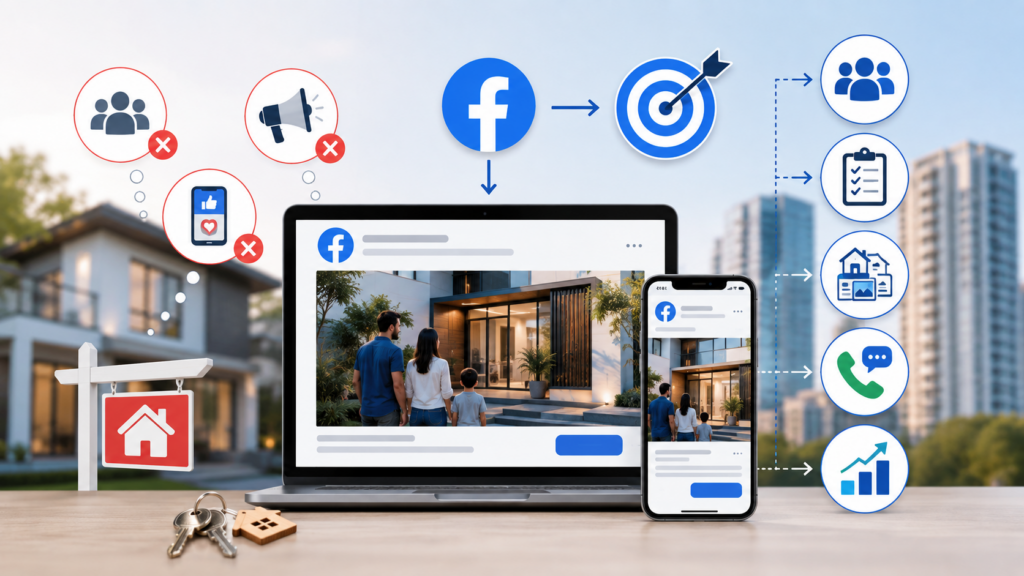
Selling a property can be surprisingly stressful. You can have a beautiful apartment, a well-located commercial space, or a promising investment property, yet still struggle to find the right buyer. I learned this the hard way. Putting a “For Sale” sign outside the property and waiting for calls was no longer enough. Even posting the property on social media organically did not guarantee that the people who actually wanted to buy it would see it.
That was when I started looking at Facebook Ads differently.
Instead of treating Facebook as simply a place to post property photographs, I began seeing it as a platform for reaching specific people who could genuinely be interested in buying. The difference was significant. Rather than waiting for potential buyers to discover my listing, the advertising campaign helped put the property in front of people who matched the type of buyer I was looking for.
The experience also taught me something important: selling properties faster through Facebook is not simply about spending more money on advertising. It is about having the right audience, message, creative, landing experience, follow-up process and measurement working together.
The Problem Was Never Just the Property
At first, I assumed that if a property was attractive and reasonably priced, buyers would naturally come forward. Real estate does not always work that way.
A buyer might never know your property exists. Someone searching for a two-bedroom home may scroll past hundreds of posts every week. Another person may be interested in investing in a particular location but may not actively search for listings every day.
This creates a visibility problem.
The property could be perfectly suitable for someone, but if that person never sees it, there is no opportunity to start a conversation.
Facebook Ads helped solve that part of the problem by allowing the property promotion to move beyond my existing followers. Instead of depending entirely on organic reach, I could use paid advertising to place the property in front of a much larger and more relevant audience.
That shift changed how I thought about property marketing.
Facebook Turned My Property Listing Into a Conversation
A traditional property listing often gives buyers information and then waits.
Facebook advertising feels different because the platform encourages interaction. A potential buyer might see the property photograph, read a short description, watch a video, visit a page or send a message.
That matters because real estate purchases rarely happen after seeing one photograph.
People want to ask questions. They want to know the location, price, floor plan, amenities, parking availability, nearby facilities and whether the property is genuinely worth visiting.
A well-structured Facebook campaign can become the first step in that conversation.
Instead of simply saying, “Property available for sale,” the advertisement can focus on the reason someone might actually want the property. For example, a family-focused home can highlight convenient surroundings and living space, while an investment property can communicate location advantages and commercial potential.
The advertisement becomes less like a classified listing and more like an invitation to learn more.
The Right Audience Made a Bigger Difference Than a Bigger Budget
One of the biggest lessons I learned was that advertising to everyone is not necessarily smart advertising.
If I promote a premium property to people who have no interest in that price range, the campaign can generate plenty of impressions without producing meaningful enquiries. Those numbers might look impressive on a dashboard, but they do not help sell the property.
Audience strategy matters.
Facebook and Instagram advertising can be structured around factors relevant to the campaign, while the overall marketing strategy can be refined based on actual campaign behaviour. The goal is not simply to generate clicks. It is to bring potential buyers into the sales process.
This is where professional paid advertising management becomes valuable.
Complete Gurus, for example, provides Meta Ads management covering Facebook and Instagram, including creative strategy, ad copy, audience segmentation and retargeting. Its approach focuses on building full-funnel campaigns rather than treating every person who sees an advertisement as an immediate buyer.
That distinction is particularly important in real estate because buying decisions usually take time.
A Property Needs More Than a Pretty Photograph
I initially thought the photographs were the most important part of the advertisement.
They are important, but they are only one piece of the puzzle.
A strong property advertisement needs a combination of visual presentation and persuasive information. The first image needs to attract attention, while the accompanying message needs to answer the question that naturally appears in the buyer’s mind: “Why should I care about this property?”
A good creative can show the lifestyle, convenience or opportunity connected to the property instead of simply displaying a room.
Videos can also help potential buyers understand the property before scheduling a visit. A walkthrough can create a stronger sense of space and give prospects a better idea of what they might experience during an actual viewing.
The objective is simple: make the person interested enough to take the next step.

The Ad Copy Changed the Quality of Enquiries
Another unexpected lesson was the difference between generating enquiries and generating useful enquiries.
A vague advertisement may attract curiosity. Someone may click simply because they like the photograph. But curiosity does not always translate into a serious buyer.
Clear copy can help filter the audience.
The advertisement should communicate essential information without overwhelming the reader. Property type, location, key feature, price positioning and a clear next step can give someone enough information to decide whether they want to continue.
This can reduce unnecessary conversations while making genuine enquiries easier to identify.
Professional campaign management also helps here because ad copy can be tested and improved rather than being written once and left unchanged.
Retargeting Kept the Property in Front of Interested Buyers
Real estate buyers rarely make a decision the first time they see a property.
Someone might look at the advertisement during lunch, become interested and then get distracted. Another person may visit the property page but want to discuss it with their partner before making contact.
That does not necessarily mean the person has lost interest.
This is where retargeting becomes powerful.
Instead of treating every visitor as a lost opportunity, retargeting can bring relevant advertising back to people who have already interacted with the campaign or business. The message can be adjusted depending on where the person is in the buying journey.
Someone who has never heard about the property may need awareness. Someone who has already visited the landing page may need more detailed information. Someone who has contacted the business may need a different follow-up altogether.
That is why a full-funnel approach can be more useful than running one advertisement continuously.
The Landing Page Became Just as Important as the Ad
There is another mistake property sellers can easily make: focusing heavily on the advertisement while ignoring what happens after someone clicks.
Imagine seeing an attractive property advertisement and clicking on it, only to arrive at a confusing page with poor photographs, limited information and no obvious way to contact the seller.
The advertising may have done its job, but the opportunity can still disappear.
A good landing experience should continue the story started by the advertisement. The visitor should quickly understand what the property is, where it is, why it may be valuable and how to request additional information or arrange a viewing.
This is where conversion rate optimization becomes relevant.
Complete Gurus positions conversion optimization alongside Google Ads, Meta Ads and SEO as part of its performance marketing approach. The idea is to look beyond the advertisement itself and improve the path between initial interest and conversion.
For property sellers, that means thinking about the entire buyer journey rather than celebrating clicks alone.
I Started Looking at Numbers Differently
Before using paid advertising seriously, I mostly cared about how many people viewed a listing.
That number can be misleading.
A property advertisement receiving thousands of impressions sounds impressive, but impressions alone do not tell me whether the campaign is attracting buyers.
I became more interested in enquiries, cost per lead, conversion rates and the quality of those leads.
This is one of the strongest advantages of digital advertising. Instead of relying entirely on guesswork, campaign performance can be monitored and adjusted.
Complete Gurus highlights weekly performance reporting with metrics such as advertising spend, revenue, ROAS, CPL and conversion data, presented in a straightforward format rather than relying on vanity metrics.
For someone selling property, that type of reporting can make marketing decisions easier because the focus shifts from “How many people saw my ad?” to “Is this campaign actually moving potential buyers closer to a sale?”
Facebook Ads Worked Better When They Were Part of a Bigger Strategy
One of the most important lessons from the experience was that Facebook Ads should not always operate alone.
A buyer may discover a property through Facebook, search for the company on Google, visit the website, compare other properties and then return later.
That means a property business can benefit from having several digital channels supporting one another.
SEO can help people discover the business through organic search. Google Ads can capture people actively searching for properties or related services. Meta Ads can introduce properties to potential buyers and support retargeting. Conversion optimization can improve the experience once visitors arrive on the website.
Complete Gurus offers this broader combination of services, including Google Ads management, Meta Ads management, SEO, AEO and GEO, alongside conversion-focused marketing. It also specifically lists Google Ads for Real Estate among its paid advertising services.
For a property seller, this creates an opportunity to think beyond a single campaign and build a more complete digital sales system.
Why Professional Management Can Save More Than It Costs
It can be tempting to manage Facebook Ads yourself.
The platform makes it easy to create a campaign, select an audience and enter a budget. The difficult part begins afterward.
Which creative should be paused? Which audience is producing stronger enquiries? Is the landing page converting? Is the cost per lead increasing? Should the campaign be adjusted or given more time? Are people clicking but failing to contact the business?
Small decisions can make a significant difference when advertising budgets are involved.
Professional management can bring structure to those decisions. Complete Gurus states that its campaign process covers strategy, campaign build, ongoing optimization and reporting, with dedicated strategy and regular performance reviews.
The value is not simply having someone click buttons inside an advertising platform. It is having someone continuously ask whether the advertising is contributing to a measurable business outcome.
Selling Faster Does Not Mean Selling Carelessly
There is one point worth remembering.
The objective of Facebook advertising should not be to pressure people into buying property simply to close a deal quickly.
A property is a major financial decision. Buyers need accurate information, realistic expectations and enough time to evaluate their options.
The real advantage of better advertising is improved visibility and better connection with suitable prospects.
When the right people discover the right property, conversations can start sooner. When those conversations are supported by useful information and consistent follow-up, the sales process can become more efficient.
That is a much healthier definition of “selling faster.”
The Real Change Was How I Viewed Digital Marketing
Looking back, Facebook Ads did more than increase visibility for my property.
They changed my understanding of how modern property marketing works.
I stopped thinking of advertising as simply paying to display a property. I started thinking about the entire journey: getting attention, creating interest, building trust, encouraging an enquiry, following up and eventually helping the right buyer make a confident decision.
That is why the strongest campaigns are rarely built around one clever advertisement. They are built around a connected strategy.
A property deserves to be marketed to the people most likely to appreciate its value, and the seller deserves to understand whether the money being spent on advertising is producing meaningful results.
Suggested Reading: How Online Marketing Helped Me Get Property Buyer Leads
Conclusion
Selling a property faster is not about putting the same listing in more places and hoping someone responds. It is about reaching the right audience with the right message and giving interested buyers a smooth path from discovery to enquiry.
Facebook Ads can be particularly useful because they allow property marketing to become more targeted, visual and interactive. When combined with compelling creative, thoughtful audience strategy, retargeting, strong landing pages and measurable conversion goals, the platform can become much more than a social media channel.
For property businesses that want to build a stronger digital presence, working with an experienced performance marketing agency can make the process more strategic. Complete Gurus brings together Meta Ads, Google Ads, SEO, conversion rate optimization, AEO and GEO services, with its broader performance marketing approach focused on measurable growth rather than surface-level engagement. Its experience managing paid advertising across industries, including real estate, makes it a relevant option for businesses that want to turn digital visibility into more qualified opportunities and a more efficient sales journey.

Ashutosh Mishra is an AI Visibility & Performance Marketing Expert with 14+ years of experience helping businesses grow through AI Visibility (AEO/GEO), Google Ads, Meta Ads, and SEO. He partners with founders and business leaders to build data-driven growth strategies that increase visibility, improve marketing performance, and help businesses get discovered, trusted, and recommended in the age of AI.