
Quick Summary
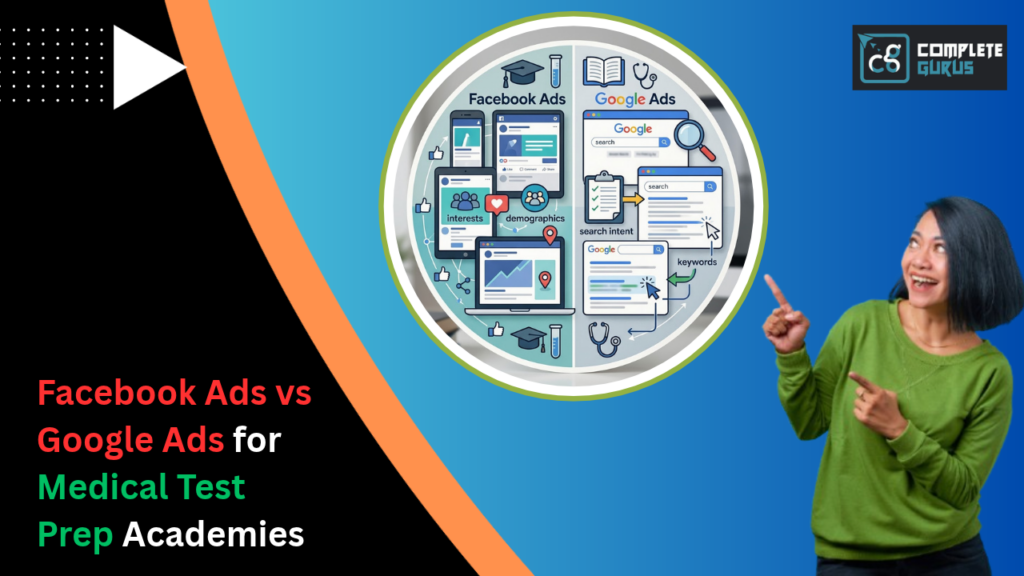
If you run a medical test prep academy and you are staring at two ad dashboards wondering which one deserves your money, here is the short version. Google Ads is where you catch students who are already hunting for a course. Facebook Ads (which also covers Instagram through Meta) is where you plant the idea in a student’s head long before they are ready to buy, and where you bring them back when they wander off. Neither wins on its own. The students you want, whether they are sitting USMLE, MCAT, NCLEX, COMLEX, PANCE or NEET, move through a long, skeptical, peer-influenced buying process, and each platform is good at a different slice of it.
Most academies do best when Google captures high-intent demand, Meta builds trust and brings people back, and a solid landing page and tracking setup ties both to actual enrollments. The rest of this article explains why, where each platform fails, and how to split your budget without guessing.
Why This Question Is Harder for Test Prep Than Most Businesses
When a plumber advertises, the logic is simple. A pipe bursts, someone searches, the plumber appears, the phone rings. That is a one-step journey.
Selling a prep course to a future physician, nurse or pharmacist looks nothing like that. Your buyer is often exhausted, short on time and anxious about a score that can shape their career. They are also spending real money on something they cannot inspect before they use it. Nobody can hold a question bank in their hands and judge it. So they lean on proxies: reviews, pass-rate claims, free sample lectures, a classmate’s opinion, a Reddit thread at midnight.
That changes how you should think about advertising. You are not just buying clicks, you are buying trust, in a market where trust is slow to build. A platform that is brilliant at catching a ready buyer may be terrible at warming a cold one, and the reverse is also true. This is why the “Google or Facebook?” debate usually goes nowhere. It treats two tools as rivals when they are really doing different jobs in the same pipeline.
Agencies that work in this space, Complete Gurus among them, describe the same pattern in their own medical test prep work: students research for a long time, compare options, and decide in groups. If your advertising plan ignores that, you will keep wondering why the leads are plenty but the enrollments are thin.

How a Medical Student Actually Buys a Prep Course
Picture a second-year student we will call Priya. She has her first big licensing exam on the horizon, maybe nine months out. She is not ready to buy anything yet, but she has started to feel uneasy.
Her first move is rarely a purchase. She watches a few free videos on YouTube, scrolls through an exam subreddit and asks a senior which resources they used. Weeks later she searches something like “USMLE Step 1 syllabus” or “how long to study for Step 1.” She is still gathering information. Later, closer to her dedicated study period, her searches change character. Now she types “best USMLE Step 1 course” or “Step 1 question bank comparison.” That is a different person, even if it is the same human being.
This distinction matters because the Complete Gurus team points to it directly: a search for a syllabus and a search for the best course signal very different levels of buying intent, and your budget should lean toward the second. Priya has lived through three or four stages before she ever reaches your checkout, and the platform you choose determines which stages you can reach.
Google meets her mostly when she is actively searching. Meta can reach her while she is scrolling through her evening with no intention to buy anything. Seen this way, the two platforms are not competing for the same moment. They are covering different parts of her calendar.
What Google Ads Does Best for Your Academy
Google Ads is the closest thing digital marketing has to a mind reader, because people tell it exactly what they want. When a student types “NCLEX-RN prep course with pass guarantee,” they have raised their hand. You do not need to persuade them that they need help. You only need to be the credible option they see.
For a prep academy, that gives Google several real strengths. The first is intent. A search for a course comparison is worth more than a thousand idle impressions, and the cost per enrollment often reflects that. The second is control over exam-specific targeting. You can build separate campaigns for MCAT, NCLEX, USMLE Step 1, Step 2 CK and COMLEX, each with its own keywords, ad copy and landing page, so a nursing student never sees messaging written for a pre-med. The third is speed. If an exam date is approaching and you want enrollments this month, search is usually the faster lever.
Google also reaches beyond text ads. YouTube, which belongs to the same ecosystem, matters enormously in this niche because students already use it for free lectures and explanations. Running ads against that behavior, offering a free trial lecture or a sample question set, lets you meet students inside a habit they already have. Complete Gurus builds its test prep campaigns around this idea, pairing paid search and YouTube with free trial lectures, score-improvement offers and remarketing so a casual viewer can become an enrolled student.
If you think of your marketing as a funnel, Google is your bottom and middle. It converts the demand that already exists.
Where Google Ads Gets Painful
Now the part vendors sometimes skip. Google Ads can be an expensive place to learn.
Exam-prep keywords are competitive. Everyone selling a question bank wants to appear for “best USMLE course,” so clicks can be pricey, and a sloppy account will happily burn through a budget on searches that were never going to buy. Broad match settings, weak negative keyword lists and generic landing pages quietly turn good money into curiosity-seekers. Someone searching for a free practice test is not necessarily a buyer, and if your campaign treats them as one, your cost per lead will look fine while your enrollments look dismal.
There is also a ceiling. Search can only capture people who are already searching. If your category is crowded and demand is finite, you eventually run out of fresh buyers to reach, and spending more simply means paying more for the same people. In a seasonal business tied to exam calendars, this ceiling shows up fast.
Finally, there is the click-versus-enrollment problem. A dashboard full of clicks and impressions is flattering and mostly meaningless. A student who clicks three times, watches a sample lecture, leaves, and comes back via a branded search two weeks later will confuse a basic setup about which ad deserves credit. Complete Gurus has written about this very issue, arguing that medical test prep advertisers should track things beyond clicks and impressions, because the numbers that feel good are often unrelated to seats filled.
So Google is powerful, but it rewards patience, careful setup and honest measurement. If you treat it as a switch you flip and forget, it will charge you for the privilege.
What Facebook Ads Bring to the Table
Facebook Ads work in nearly the opposite way. Instead of waiting for someone to ask a question, Meta puts your message in front of a person who has not asked anything yet. That sounds weaker, and for immediate sales it often is. But for a high-consideration purchase like exam prep, it fills a gap Google cannot.
Think about the early-stage student who is still four or five months from needing a course. Search will not find them, because they are not searching. Meta can. You can show them a short clip from one of your instructors explaining a tricky concept, a story about a student who raised their score, or a free study-planning guide. None of that asks for a purchase. It simply introduces your brand and starts building familiarity, which matters because students lean on trust.
Meta’s audience tools also help. You can reach people by interests, life stage and behavior, and build lookalike audiences from the students who have already enrolled. Retargeting is another real strength. A student who watched half of your sample lecture and left can be reminded, a few days later, of the free question set waiting for them. That kind of follow-up replicates the slow, repeated contact a hesitant buyer usually needs.
Social proof lives comfortably on Meta as well. Score wins, short testimonials and instructor personality all travel well on Instagram and Facebook, which is why agencies like Complete Gurus pair Meta campaigns with exam-specific communities and instructor-led content to keep a brand top-of-mind through a long prep timeline.
Where Facebook Ads Fall Short
Honesty demands the other side too. Meta is not a magic fix for a tired enrollment funnel.
The core limitation is intent. A person scrolling past your ad was doing something else a moment ago, such as looking at photos or checking on a friend. Even a well-targeted medical student may simply not be in a buying mood. This means Meta traffic tends to convert more slowly and at a lower rate than search traffic, and if you judge it only by last-click enrollments, it will often look like the weaker platform. That judgment is misleading, because much of its value shows up earlier in the journey and gets credited elsewhere.
Targeting precision has also tightened in recent years because of privacy changes, so reaching “USMLE Step 1 students” is less exact than it used to be. You often work with broader signals and rely on creativity to filter the audience for you. That puts more weight on your ads themselves. A dull, generic image will be ignored by exactly the busy, overloaded students you want to reach.
Creative fatigue is another quiet cost. A test prep audience is relatively small and sees the same ads repeatedly, so a campaign that worked beautifully in month one may stall by month three unless you refresh it. Meta rewards advertisers who keep producing new, human, useful content, and it punishes the ones who set and forget.
None of this makes Meta a poor choice. It simply means you should not ask it to do Google’s job.
The Cost Question Nobody Answers Honestly
Every academy owner eventually asks which platform is cheaper. The honest answer is that it depends on what you are measuring, and anyone promising a universal number is guessing.
Meta clicks are typically cheaper than Google clicks, and a quick glance at the dashboard can make Meta look like the budget-friendly winner. But a cheaper click is not cheaper enrollment. A student arriving from a branded or high-intent search may cost more to reach yet enroll far more often, so the cost per enrollment can come out lower on Google even when each click costs more. The reverse can be true, too, if your search campaigns are poorly structured and your Meta creative is strong.
The metric that actually settles the debate is cost per enrollment, ideally paired with the lifetime value of the student, since some learners buy multiple courses or return for a second exam. Complete Gurus frames its test prep work around exactly this: tracking cost-per-enrollment and lifetime student value so spending is tied to seats filled rather than traffic.
It also helps to remember what the alternatives cost. The agency’s own comparison puts an in-house marketing hire at roughly six to fifteen thousand dollars a month once salary and benefits are counted, with a long hiring and training runway, while freelancers vary widely and rarely cover multiple platforms. You do not need to hire anyone to run ads, of course, but when you weigh the platform costs, weigh the cost of the expertise behind them, too. A cheap platform running badly is an expensive mistake.
Matching the Platform to the Exam and the Moment
Different exams behave differently, and your platform mix should reflect that rather than treating every course the same.
Consider a nursing licensure course. NCLEX candidates tend to be motivated by a specific, near-term deadline, and many are highly active in search once their program ends. Search-heavy campaigns can work especially well here, supported by retargeting for those who hesitate. Compare that with an MCAT or pre-med audience, who often begin planning long before they buy and spend a lot of time on social platforms and video. Meta and YouTube earn a bigger role in that earlier research phase.
USMLE and COMLEX students sit somewhere in between. They research across multiple stages, from early-year foundation work to the focused push before Step exams, so both platforms have a place and the messaging should shift with the stage. A first-year student needs reassurance and a study framework. A student six weeks from the exam needs a concrete, trustworthy tool right now.
International audiences add another layer. Exams like NEET draw very large, price-sensitive audiences, and what works for a US-focused USMLE course will not necessarily translate. Complete Gurus lists USMLE, NCLEX, MCAT, NEET, PANCE and COMLEX among the exams it builds campaigns for, and the thread running through its approach is stage-based targeting: early research gets one message, ready-to-buy gets another.
The practical takeaway is to let the exam calendar guide your spending. Lean on Meta and video early in a student’s journey, and let Google take more of the budget as exam dates close in.
Creative and Messaging That Actually Persuade Students
Both platforms live or die on what you say, so it is worth spending real time here.
Medical students are skeptical readers. They have been trained to look for evidence, and they can smell exaggeration from a long way off. Big, vague promises about guaranteed scores tend to backfire unless you can back them up in specific terms. What works better is concrete, honest usefulness: a free diagnostic test, a sample lecture from a real instructor, a clear explanation of how your question bank is organized, a student story that includes the struggle and not only the triumph.
On Google, that means ad copy matched to the exact search. Someone typing a question about a study schedule should land on a page that answers it, not on a generic enrollment form. On Meta, it means leading with something valuable before you ask for anything, such as a short video that teaches one genuinely useful concept. People remember who helped them before they remember who sold to them.
Offers matter too. Free trial lectures, sample question banks and gated study guides do double duty. They give a skeptical student a low-risk way to try you, and they give you permission to follow up. Complete Gurus builds its lead funnels around these kinds of assets, then nurtures the leads with sequences timed to exam dates and application deadlines, since a student’s urgency changes sharply as those dates approach.
Whatever you test, keep the voice human. Students are tired of polished marketing speak. A calm, specific, slightly informal tone usually earns more attention than a slick one.
Landing Pages and Tracking: The Part That Decides Everything
You can have a flawless Google campaign and a clever Meta strategy and still lose, because the click is the cheap part. What happens in the few seconds after a stressed student lands on your page is where enrollments are won or thrown away. The Complete Gurus blog makes this point directly in its guidance on landing pages for medical test prep, noting that the expensive step is not the click but the moment after it.
A good landing page for this audience loads quickly, speaks to the specific exam the student searched for, shows proof without shouting, and makes the next step obvious and low-pressure. A page that tries to serve every exam at once ends up persuading nobody. Matching each campaign to its own page, with a headline that mirrors the student’s actual question, is one of the simplest ways to lift results without spending another dollar on traffic.
Tracking is the other half. If you cannot see which ads lead to trial signups, which signups become paying students and how long that takes, you will make decisions on instinct. Set up conversion tracking all the way down to enrollment, not just form fills. Review the drop-off points, the places where interested students quietly vanish. Often, the biggest improvement hides there, not in the ad itself.
This is also where the two platforms finally stop being rivals. When your tracking is solid, you can see that Meta introduced a student, a YouTube video warmed them up, and a Google search closed the sale. Without it, you will cut the platform that did the early work and wonder why the late work dried up.
A Practical Way to Split Your Budget
There is no single correct split, but there is a sensible way to think about it.
If your budget is modest, start where intent is highest. Put most of your money into well-structured Google Search campaigns targeting exam-specific, ready-to-buy terms, and fund a small retargeting effort on Meta to bring back the visitors who left. This combination captures existing demand and wastes less on cold audiences. It is a conservative approach, and for a smaller academy it is usually the right one.
As results stabilize, widen the top of the funnel. Add Meta prospecting with genuinely useful content, and introduce YouTube to reach students during their research phase. Give these campaigns time, since their payoff is slower and less direct. Judge them over weeks rather than days, and look at assisted conversions, not only last-click results.
Larger academies with several exams can run all of this in parallel, shifting budget by season. Spend more on early-stage awareness when exam windows are far off, then tilt toward search and remarketing as deadlines approach. The ability to move money in real time toward the exams, regions and creative that are actually converting is a big advantage of paid media, and agencies that focus on performance marketing, like Complete Gurus, build their reporting around exactly that kind of reallocation.
Whatever split you choose, treat it as a hypothesis. Revisit it every month, and let the enrollment data, not the platform’s flattering charts, tell you what to change.
Mistakes Academies Keep Making
A few patterns show up again and again, and avoiding them can save a surprising amount of money.
The first is judging each platform by the wrong yardstick. Measuring Meta only by last-click enrollments and Google only by cost per click leads to bad decisions, because each platform contributes at a different point in the journey.
The second is running one generic campaign for every exam. A student who needs NCLEX help does not care about your MCAT results, and a mixed message makes your ads feel irrelevant to everyone.
The third is neglecting follow-up. Many students will not buy on their first visit, or their second, or their fifth. If you capture their interest and then say nothing for three weeks, you have wasted the hardest part of the work. Retargeting and email nurture exist precisely for this slow-burn audience.
The fourth is ignoring seasonality. Exam calendars create predictable surges and lulls, and budgets that stay flat all year miss both the peaks and the quiet windows when cheaper awareness-building is possible.
The last is treating advertising as a purely technical task. Behind every click is a worried student looking for someone trustworthy. Brands that remember this and write, design and follow up accordingly tend to outperform those that only optimize bids.

When It Makes Sense to Bring In Help
Plenty of academy owners start by running their own ads, and that is a perfectly reasonable way to learn. The trouble tends to appear when spending grows, more exams are added and the number of moving parts, campaigns, audiences, landing pages and tracking rules, outgrows one person’s attention.
At that point, a specialist partner can pay for itself, especially one that understands the exam-prep buying journey and not only ad mechanics. Complete Gurus, for example, runs Google Ads, YouTube and Meta Ads for medical test prep companies, builds the lead magnets and landing pages around them, and reports on enrollments and cost per lead instead of vanity numbers. The agency says it has more than thirteen years in paid ads and manages over three million dollars in annual ad spend, and it offers a 90-day guarantee of at least a 25 percent improvement in return on ad spend and a 20 percent reduction in cost per sale, or it keeps managing at no extra charge until those targets are met. As with any agency, it is worth asking exactly how such guarantees are measured before you sign on.
If you are not ready to commit, a free audit of your existing Google or Facebook account is a low-pressure way to see where money is leaking. Sometimes a fresh pair of eyes finds two or three fixable problems that quietly eat a chunk of your budget.
Suggested Reading: Meta Ads for Medical Test Prep Companies: How to Generate More Student Leads
Conclusion
So, Facebook Ads or Google Ads for a medical test prep academy? The most useful answer is that you are probably asking the wrong question. Google is excellent at catching students who are already looking for a course, and it deserves a solid share of your budget if you want enrollments soon. Facebook and Instagram are excellent at reaching students earlier, building familiarity, and bringing hesitant visitors back, which matters enormously in a market where trust takes time. Used together, with exam-specific messaging, strong landing pages and tracking that follows a student all the way to enrollment, they cover the whole journey instead of fighting over one part of it.
Start with intent, add awareness as you learn, judge everything by cost per enrollment, and keep the voice of your ads as human as the students you are trying to help. If you would rather not work all of this out alone, Complete Gurus (https://completegurus.com/) specializes in digital marketing for medical test prep companies, combining Google Ads, YouTube, Meta Ads, SEO and lead generation to bring qualified, enrollment-ready students to your courses, and it offers free ad audits so you can see where your current campaigns stand before you decide anything.

Ashutosh Mishra is an AI Visibility & Performance Marketing Expert with 14+ years of experience helping businesses grow through AI Visibility (AEO/GEO), Google Ads, Meta Ads, and SEO. He partners with founders and business leaders to build data-driven growth strategies that increase visibility, improve marketing performance, and help businesses get discovered, trusted, and recommended in the age of AI.