
Quick Summary
Picking the wrong objective for a ChatGPT ad campaign is one of the fastest ways to burn a budget on a platform that’s still figuring itself out. If you’re new to ChatGPT Ads, you’re probably staring at objective options and wondering whether you should chase visibility, clicks, or straight-up conversions and honestly, the answer depends on where your business currently stands, not on what worked for your last Google Ads campaign. This blog breaks down how conversational intent changes the way objectives work, how to match your goal to your business stage, and what mistakes to avoid before you spend a single rupee or dollar on a placement inside ChatGPT.
If you’ve been running paid ads for a while, you already know that objective selection isn’t just a dropdown menu you click through without thinking. It’s the single decision that tells the ad platform’s algorithm what “success” looks like for your campaign and if you get it wrong, every dollar after that point works against you instead of for you. Now bring ChatGPT Ads into the picture, a genuinely new advertising surface where people aren’t scrolling and skimming, they’re asking questions and expecting real answers. The old playbook doesn’t transfer cleanly. What worked on Meta or Google Search doesn’t automatically translate to a conversational interface where someone might type “what’s the best budget laptop for video editing” instead of searching “buy laptop online.”
So if you’re a business owner, a marketer, or someone managing paid media and you’re trying to figure out which objective actually fits your ChatGPT ad campaign, this is written for you. Let’s walk through it properly.
Understanding What “Objective” Really Means in ChatGPT Ads
Before you can choose an objective, it helps to understand what you’re actually choosing between. In traditional paid advertising, an “objective” tells the platform what action to optimize toward impressions, clicks, leads, or purchases. ChatGPT Ads work on a similar underlying logic, but the environment around that logic is different in a meaningful way.
When someone opens ChatGPT and types a question, they’re not passively browsing. They’re actively trying to solve something, find a product, compare options, get a recommendation, or understand a service. That means the “objective” you pick isn’t just about what metric gets tracked in your dashboard. It’s about what kind of presence you want your brand to have inside that conversation. Do you want to simply be mentioned when ChatGPT answers a relevant question? Do you want someone to click through to your website? Or do you want the conversation to end with an actual form fill, purchase, or booking?
Each of those goals requires a different creative approach, a different bidding posture, and frankly, a different level of patience. Visibility-focused campaigns build recognition slowly. Traffic-focused campaigns move people along but don’t guarantee action. Conversion-focused campaigns demand the tightest targeting and the most refined messaging because you’re asking someone to act right there in the flow of a conversation, not after three days of retargeting emails.

Why Objective Selection Makes or Breaks Your ChatGPT Ad Campaign
Here’s the part most businesses underestimate: because ChatGPT Ads is still an early, maturing channel, the algorithm has less historical data to learn from compared to a platform like Google Ads that’s had two decades to refine its machine learning models. That means the objective you choose has an outsized effect on how your budget gets spent, because the system is leaning more heavily on the signal you give it upfront.
Pick a conversion objective too early, before you have any data on how your brand performs inside ChatGPT, and you risk the algorithm making expensive guesses about who’s likely to buy. Pick a visibility objective and stick with it too long, and you risk spending money on impressions without ever finding out if those impressions turn into anything real. The sweet spot is different for every business, but the principle holds across the board your objective should match your current stage of data, not your long-term ambition.
This is also why so many businesses get frustrated in the first few weeks of running ChatGPT Ads. They set a conversion goal expecting Google Ads-style performance, only to find costs climbing because the platform simply hasn’t collected enough behavioral data yet to identify your ideal buyer with precision. Understanding this upfront saves you from pulling the plug on a channel that just needed a smarter starting objective.
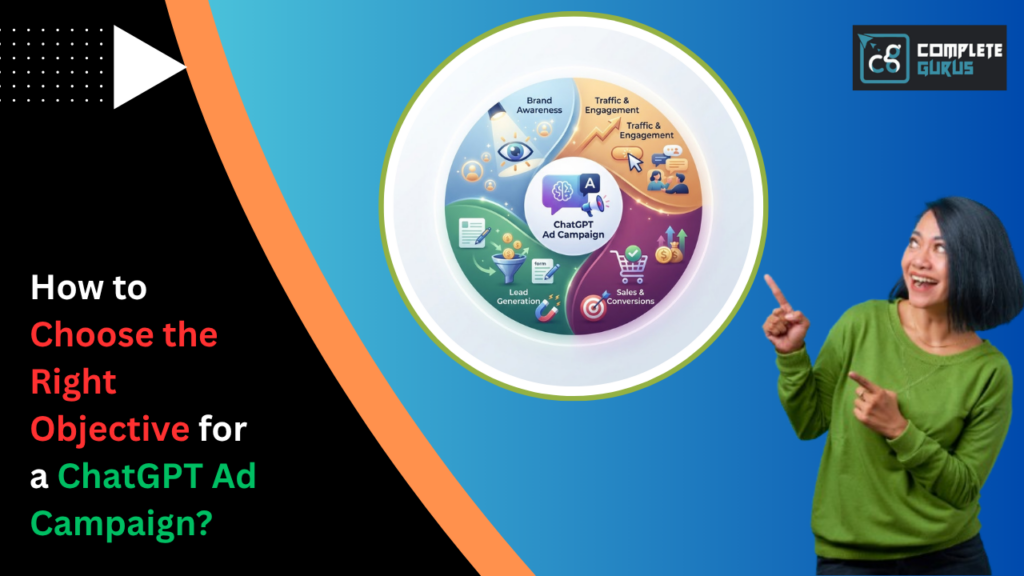
Visibility vs Traffic vs Conversions What’s the Difference
Let’s break these three down in plain terms, because the labels alone don’t tell you much.
A visibility objective is about getting your brand mentioned or surfaced when ChatGPT answers a question relevant to your category. Think of it as digital word-of-mouth at scale you’re not necessarily asking for a click, you’re asking to be part of the answer. This matters more than people initially assume, because a huge chunk of ChatGPT usage right now is research-oriented. Someone asking “what are good running shoes for flat feet” isn’t always ready to buy that same minute, but if your brand shows up as part of that answer, you’ve planted a seed that pays off later, sometimes through a direct search, sometimes through a branded query on Google weeks after.
A traffic objective pushes for the click. This works well when your website or landing page is genuinely built to convert once someone lands on it when the gap between “interested” and “converted” is small and your on-site experience can close it. If your site is slow, cluttered, or doesn’t clearly answer the question that brought the visitor there in the first place, a traffic objective just moves the problem downstream instead of solving it.
A conversion objective is the most demanding of the three because it asks the platform to identify people who are not just interested but ready to act, fill a form, book a call, make a purchase. This objective performs best once you already have some baseline data, whether that’s pixel data from other channels feeding into your account or early campaign history from ChatGPT itself. Jumping straight to conversions with zero signal is a bit like asking a new employee to close high-value deals on day one without any training. It can happen, but it’s not the way to beat your budget.
Matching Your Objective to Your Business Stage
This is where a lot of the confusion clears up once you frame it correctly. Your objective shouldn’t be chosen based on what you want most, everyone wants conversions. It should be chosen based on where your brand currently stands with ChatGPT’s audience.
If your brand has little to no presence in AI search results yet, meaning ChatGPT rarely mentions you when relevant questions come up, starting with a visibility-first approach makes more sense. You’re essentially teaching the platform and its users that your brand belongs in that category conversation before you ask anyone to act on it.
If you already have decent brand recognition and a reasonably optimized website, but you’re not seeing traffic from AI-driven conversations, a traffic objective bridges that gap. It gets people from the chat window to your digital storefront, where your existing conversion mechanisms, email capture, retargeting pixels, on-site offers can take over.
If you’ve already run some campaigns on ChatGPT Ads, or you have strong first-party data from other channels that can inform targeting, a conversion objective becomes viable much sooner. The algorithm has something to learn from, and your creativity has likely already been tested for what resonates.
Businesses that skip straight to conversions without any of this groundwork tend to see inflated costs and inconsistent results not because the channel doesn’t work, but because they asked it to perform a task it wasn’t yet equipped to handle efficiently.
How Conversational Intent Changes the Objective Game
This is the piece that trips up even experienced paid media managers, because it’s genuinely different from anything on Search or Social. On Google, intent is expressed through keywords short, transactional phrases like “buy running shoes online.” On ChatGPT, intent is expressed through full sentences, questions, and follow-ups. Someone might ask “I have flat feet and I’m training for a half marathon, what running shoes should I look at” and that single sentence carries far more context than any keyword ever could.
This richer intent signal changes how you should think about objectives. A visibility objective on ChatGPT isn’t just “be seen” it’s “be the answer that actually addresses the nuance in what they asked.” A conversion objective isn’t just “get the sale” it’s “be specific enough in your ad messaging that it matches the exact scenario the user described, so the jump from question to action feels natural rather than forced.”
This is also why copy-pasting your Meta or Google ad creative into a ChatGPT campaign rarely works well, regardless of which objective you pick. The creative needs to sound like a genuinely useful answer, not an advertisement interrupting a feed. Businesses that treat ChatGPT Ads like just another placement to dump existing creative into tend to underperform no matter which objective they chose, because the mismatch between conversational tone and ad tone breaks the trust that made the user engage with ChatGPT in the first place.
Common Mistakes Businesses Make When Picking a ChatGPT Ads Objective
A few patterns show up again and again with businesses testing this channel for the first time.
The first is chasing the objective that sounds best on a slide deck rather than the one that fits actual campaign data. Conversions sound impressive to report internally, but if the account has no learning history, that objective often underperforms compared to a more patient, staged approach.
The second is switching objectives too frequently. Every time you change the optimization goal, the algorithm resets a portion of what it’s learned and effectively restarts its calibration. Businesses that flip between visibility, traffic, and conversions every week rarely give any single objective enough runway to actually stabilize.
The third is ignoring the difference between what the objective optimizes for and what your business actually needs right now. A SaaS company chasing brand visibility when what it desperately needs is qualified demo bookings is optimizing for the wrong outcome, even if the visibility numbers look great in a report.
The fourth mistake, and maybe the most common one, is setting a conversion objective with a conversion event that’s too rare or too far downstream like optimizing for a final purchase on a high-ticket item when the platform barely has enough volume to learn from. In cases like this, optimizing for a mid-funnel action, like a form submission or an add-to-cart, often produces steadier, more scalable results while the account matures.
Budget Considerations Tied to Each Objective
Objectives and budgets are more tightly linked than people expect, and getting this pairing wrong is another reason campaigns stall out early.
Visibility objectives generally need less budget concentration because the goal is breadth of exposure across relevant conversations, not a tightly targeted push. You can spread a bit wider here without feeling like you’re wasting money, because the return shows up gradually, often influencing branded search and direct traffic weeks later rather than immediately.
Traffic objectives sit in the middle. You need enough budget to generate a meaningful volume of clicks so you can actually evaluate what happens once people land on your site. Too small a budget here just gives you noise instead of a real read on performance.
Conversion objectives are the most budget-sensitive of the three. Because the platform needs enough conversion events to learn patterns, underfunding a conversion campaign often means it never exits the learning phase, and you end up paying premium costs for a small trickle of results that never stabilize. If your budget is limited, it’s often smarter to run a traffic or mid-funnel conversion objective first, gather data, and graduate to a full conversion objective once you have enough volume to support it.
Testing and Adjusting Your Objective Over Time
One thing worth internalizing early is that your objective isn’t a permanent decision, it’s a starting point that should evolve as your data matures. A business that starts with visibility in month one might reasonably shift to traffic in month two once early engagement patterns become clear, and then move to conversions in month three once enough signal exists to support tighter optimization.
The mistake isn’t in changing objectives, it’s changing them without a clear reason or without giving each stage enough time to produce meaningful data. A good rule of thumb is to give any single objective at least a few weeks of consistent spend before deciding whether it’s working, unless something is obviously and immediately broken, like creative that isn’t approved or targeting that’s clearly misaligned with your audience.
It also helps to track more than just the primary metric tied to your objective. If you’re running a visibility campaign, keep an eye on whether branded search volume or direct traffic is ticking upward, even if it’s not something ChatGPT Ads reports on directly. If you’re running a conversion campaign, watch your cost per result closely in the first two to three weeks, because that early window tells you whether the platform is finding the right audience or still guessing.

Industry-Specific Considerations Worth Knowing
Not every business should approach this the same way, and the nature of your industry genuinely changes what objective makes sense first.
A B2C or D2C brand selling a straightforward product often benefits from starting closer to traffic or even conversions, because the decision-making journey for the buyer is shorter and the product itself does a lot of the convincing once someone lands on the page.
A law firm or healthcare business, where trust and credibility matter enormously before someone takes action, usually benefits from a visibility-first approach, since the goal early on is establishing that your firm or practice is a name ChatGPT reliably surfaces when someone asks a relevant question, before ever asking for a click or a form fill.
A real estate or travel business, where the buying journey involves a lot of research and comparison, often does well with a traffic objective that funnels curious researchers toward listings or itineraries, letting the website’s own content and calls to action do the conversion work.
A finance or fintech brand, operating under compliance constraints, typically needs a slower, visibility-led approach simply because messaging has to be reviewed carefully, and rushing into a conversion objective before the creative and targeting are fully vetted can create both performance and compliance headaches.
The point isn’t that any of these rules are absolute. It’s that the “right” objective genuinely depends on how your specific buyers move from curiosity to decision, and that journey looks different across industries.
Suggested Reading: What Should You Choose as Your ChatGPT Ads Campaign Objective?
Conclusion
Choosing the right objective for a ChatGPT ad campaign isn’t about picking the option that sounds most ambitious, it’s about being honest with yourself about where your brand currently stands with this audience and how much data your account actually has to work with. Visibility builds the foundation, traffic tests the bridge between curiosity and action, and conversions ask the platform to do its most demanding job once it has enough to learn from. Rushing straight to the finish line without laying that groundwork is the single biggest reason businesses walk away from this channel disappointed, when the real issue was sequencing, not the platform itself. Treat your objective as a decision you’ll revisit and refine as your data grows, pay attention to how conversational intent reshapes both your targeting and your creativity, and give each stage enough time to actually tell you something before you change course. Get that sequencing right, and ChatGPT Ads stops feeling like a gamble and starts behaving like any other channel you’ve learned to master just with a much more attentive, question-asking audience on the other end.
If all of this feels like a lot to figure out on your own while also running your actual business, that’s exactly the gap Complete Gurus was built to close. Their team works specifically on ChatGPT Ads campaign strategy and placement planning, building objectives, conversational ad creative, and retargeting flows around how people genuinely prompt and search inside ChatGPT rather than recycling a Google or Meta playbook onto a new surface. Whether you need help figuring out whether visibility, traffic, or conversions should come first, or you want a full AI search visibility audit before you spend a single dollar, Complete Gurus brings the early, hands-on testing experience with this format that most agencies simply don’t have yet so your budget goes toward learning what actually works, not toward figuring out the basics on your own dime.

Ashutosh Mishra is an AI Visibility & Performance Marketing Expert with 14+ years of experience helping businesses grow through AI Visibility (AEO/GEO), Google Ads, Meta Ads, and SEO. He partners with founders and business leaders to build data-driven growth strategies that increase visibility, improve marketing performance, and help businesses get discovered, trusted, and recommended in the age of AI.