
Quick Summary:
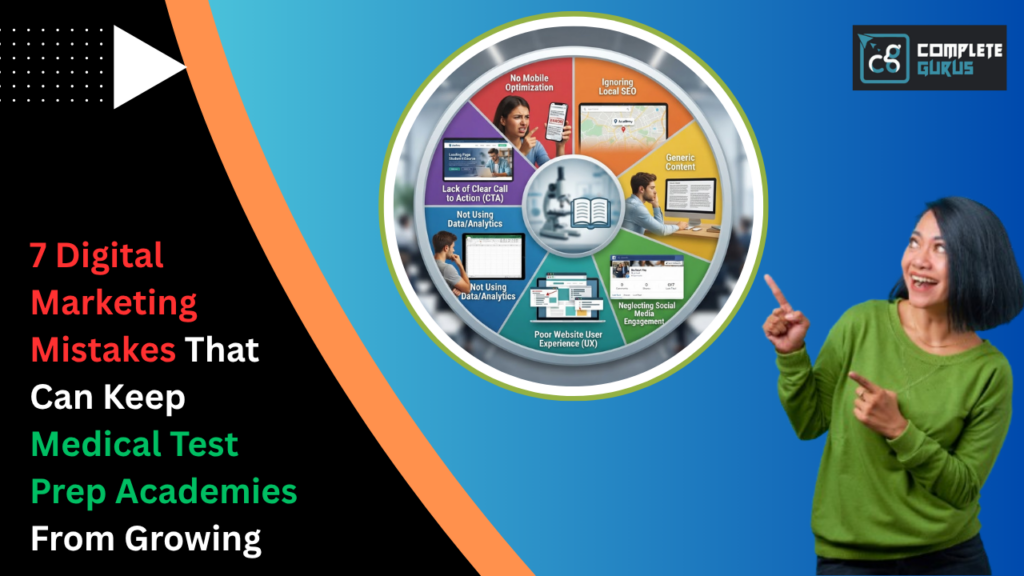
Running a medical test prep academy is a strange kind of business. You’re not just selling a course, you’re selling someone’s shot at becoming a doctor, and that means your marketing carries a weight that a regular coaching center’s marketing simply doesn’t. Yet most medical entrance exam academies, whether they’re prepping students for NEET, USMLE, PLAB, or MCAT, are still marketing themselves like it’s 2014. They’re relying on word-of-mouth, a stale website, and the occasional Instagram post about a “batch starting soon.” Meanwhile, their competitors are quietly eating their lunch online. This article walks through seven digital marketing mistakes that are silently capping the growth of medical test prep academies, why each one hurts more than academy owners realize, and what actually works instead.
If you run a medical test prep academy, or you’re the marketing person trying to convince the founder that the website needs more than a phone number and a Google Map embed, this one’s for you.
Believing Reputation Alone Will Carry the Admissions Numbers
There’s a comforting myth that circulates in the coaching industry, especially among institutes that have been around for ten, fifteen, twenty years. The myth goes something like this: “We’ve built our name over decades. Students find us because their seniors recommend us.” And for a while, that was true. Word-of-mouth used to be the entire marketing department for most medical test prep academies.
Here’s the problem. The student sitting for NEET or preparing for USMIe Step 1 today doesn’t operate the way students did a decade ago. Before they even ask a senior for a recommendation, they’re typing “best NEET coaching near me” into Google, scrolling through Instagram reels of toppers, and checking whether an academy has a YouTube channel with actual teaching content or just a promotional trailer. Word-of-mouth still matters, but it now happens after a digital search, not instead of one.
Academies that lean entirely on legacy reputation tend to have almost no digital footprint that reflects who they actually are today. Their website might still be listing a faculty member who left three years ago. Their Google Business Profile might have four reviews from 2019. When a prospective student compares that against a newer, hungrier competitor with fresh video testimonials, an active blog, and a responsive website, the older academy starts looking outdated even if their teaching quality is superior. Reputation without visibility becomes invisible reputation, and invisible reputation doesn’t convert.
The fix isn’t to abandon what built the brand. It’s to translate that trust into digital proof recorded lectures shared publicly, faculty profiles that are updated and human, and a steady stream of content that shows, rather than tells, why the academy is worth choosing. Reputation earned offline has to be actively rebuilt online, or it quietly expires.

Treating the Website Like a Digital Brochure Instead of a Silent Counselor
Walk through the websites of ten different medical test prep academies and you’ll notice a pattern. Most of them look like a scanned version of a printed pamphlet. There’s a hero banner with a stock photo of a stethoscope, a list of courses, a “contact us” form buried at the bottom, and maybe a slider of faculty photos. That’s it. No real information architecture, no thought given to what a confused, anxious 17-year-old (or their equally anxious parent) actually wants to know before picking up the phone.
Think about what a parent researching a NEET dropper batch is actually trying to figure out. They want to know the batch size, the faculty’s actual teaching credentials, past results broken down by category, the fee structure without having to call and ask, and whether there’s a doubt-clearing system that isn’t just a WhatsApp group that nobody replies to. If a website doesn’t answer these questions clearly and quickly, the visitor leaves. They don’t email. They don’t call. They just close the tab and go check the next academy’s website, because there are dozens of options a search away.
A website for a medical test prep academy needs to function less like a poster and more like the best counselor the institute has, working 24 hours a day. That means clear result pages with verifiable data instead of vague claims like “95% success rate” with no context. It means fast load times, because a slow website on a parent’s mobile data plan is a website that never finishes loading. It means a mobile-first layout, since the overwhelming majority of searches for coaching institutes now happen on phones, often late at night when a student is anxious about their preparation and searching for reassurance.
This is exactly the kind of gap that a proper web development and design partner closes not by adding more sliders and animations, but by rebuilding the site around the actual questions a prospective student is asking. A well-structured, professionally built website converts silently, around the clock, without a single sales call.
Ignoring Local SEO While Chasing Vague National Visibility
There’s a strange obsession among coaching institute owners with ranking for broad, high-volume keywords like “NEET coaching” or “medical entrance exam preparation.” These terms sound impressive to chase, but they’re also brutally competitive, and more importantly, they’re not how most students actually search when they’re close to making a decision.
A student in Kota isn’t typing “best medical coaching in India.” They’re typing “NEET biology faculty in Kota” or “NEET dropper batch fees near me.” A student prepping for PLAB in Manchester is searching “PLAB 1 coaching Manchester reviews,” not “best UK medical exam coaching.” These long-tail, location-specific searches carry far less competition and dramatically higher intent, because the person typing them has already narrowed their decision down to a geography and is close to choosing.
Most medical test prep academies either ignore local SEO entirely or handle it as an afterthought, a Google Business Profile that was set up once and never touched again, no localized landing pages, no city-specific content, and definitely no strategy around collecting and responding to local reviews. This is a massive miss, because local search results, especially the map pack that shows up at the top of Google for “near me” searches, get an outsized share of clicks compared to organic listings further down the page.
Fixing this isn’t complicated, but it does require consistency. It means claiming and fully optimizing the Google Business Profile with accurate categories, photos of the actual campus, and regular updates. It means building separate landing pages for each city or branch the academy operates in, each with unique content rather than duplicated text with the city name swapped out. It means actively asking satisfied students and parents to leave reviews, and then responding to every single one, good or bad, because that responsiveness signals to both Google’s algorithm and human visitors that the academy is active and cares. This is the kind of technical, ongoing work that a dedicated SEO expert handles far better than an in-house team juggling admissions calls and never getting around to it.
Running Social Media Like a Notice Board Instead of a Community
Open the Instagram page of almost any medical test prep academy and you’ll see the same rotation of content: a poster announcing a new batch, a poster wishing students luck for an upcoming exam, a poster congratulating a topper with their photo and rank. It’s not wrong, exactly, but it’s not marketing either. It’s a digital version of the notice board that used to hang outside the academy’s reception.
The problem with notice-board content is that it doesn’t give anyone a reason to follow, engage, or share. It talks to the audience instead of talking to them. A prospective student scrolling Instagram isn’t looking for another poster; they’re looking for something that makes their exam prep feel a little less overwhelming a quick mnemonic for remembering the Krebs cycle, a short video breaking down a tricky physics numerical, a faculty member answering a common doubt on camera, or even a relatable meme about the chaos of NEET biology syllabus. Content like this gets saved, shared, and commented on. Posters get scrolled past.
There’s also a trust dimension here that academies underestimate. Video content featuring actual faculty members teaching, even in short clips, does more to build credibility than any polished testimonial ever could, because it lets a prospective student experience the teaching style before committing money to it. Academies that post consistent educational reels, faculty Q&A sessions, and behind-the-scenes glimpses of classrooms end up building genuine communities rather than passive follower counts. And a community talks about the academy to other people, which is the closest thing to modern word-of-mouth that exists.
This is where a social media marketer who actually understands the coaching and education space earns their keep not by pumping out generic motivational quotes, but by building a content calendar that mixes education, personality, proof, and just enough promotion to stay commercially useful without becoming exhausting to follow.
Spending on Ads Without Building the Funnel Behind Them
This is possibly the most expensive mistake on this list, because it looks like marketing is happening, money is going out the door, impressions are climbing while the actual return stays flat or even negative. Plenty of medical test prep academies eventually get talked into running Google Ads or Meta Ads campaigns, often by a well-meaning but inexperienced freelancer or an in-house employee wearing five hats. The ads go live, they generate clicks, and then… Nothing much happens.
The reason is almost always the same. The ad sends traffic to a generic homepage instead of a dedicated landing page built for that specific campaign. There’s no clear, singular call to action. There’s no lead magnet, like a free diagnostic test or a downloadable study planner, to capture contact details from visitors who aren’t ready to enroll on their first visit. And there’s no retargeting set up to bring back the large percentage of visitors who leave without converting the first time, which, in any industry, is the majority.
Paid advertising without a funnel is like renting a billboard on a highway with no exit ramp anywhere nearby. The traffic exists, but there’s nowhere for it to actually go. A properly built funnel for a medical test prep academy might look like this: an ad promoting a free mock test for a specific exam, leading to a landing page that captures the student’s name, phone number, and target exam date, followed by an automated WhatsApp or email sequence that nurtures that lead with useful content over the following days, eventually leading to a counseling call. Every stage of that funnel needs to be built deliberately, tracked, and optimized based on where people are dropping off.
Academies that skip this groundwork and just “boost posts” or run untracked ads end up concluding that “ads don’t work for us,” when the real issue is that ads were never given a proper destination to send people to. Getting the ad strategy, landing pages, and tracking set up correctly from the start is exactly the kind of specialized work that separates a wasted ad budget from a genuinely profitable one.
Letting Leads Go Cold After the First Inquiry
Here’s a scenario that plays out constantly in the coaching industry. A parent calls in, asks about fees and batch timings, says “we’ll think about it and get back to you,” and hangs up. The front desk staff makes a note, or doesn’t, and that’s often the last interaction that ever happens unless the parent calls back on their own initiative.
Medical entrance exam preparation is a high-stakes, high-anxiety purchase decision. Families are comparing multiple academies, discussing it at home over several days or weeks, and often waiting to see results from a friend’s kid or a relative’s recommendation before committing. A single phone call rarely closes the decision on the spot. That means the businesses that win aren’t necessarily the ones with the best first pitch, they’re the ones who stay present, helpfully and without being pushy, throughout that entire decision-making window.
Most academies have no structured follow-up system at all. There’s no CRM tracking who inquired and when. There’s no automated email or WhatsApp sequence sharing useful content like a free study schedule, an FAQ about the exam pattern, or a short video of a faculty member addressing common concerns. There’s no retargeting ad reminding that parent, two days later while they’re scrolling Instagram, that the academy they inquired about is still there and still worth considering. The lead simply goes cold, and the academy assumes the family “wasn’t serious,” when in reality, nobody gave them a reason to stay engaged.
Setting up even a basic nurture sequence changes this dramatically. It doesn’t need to be aggressive or salesy. It just needs to exist. A gentle, value-first follow-up sequence over one to two weeks, combined with a simple lead-tracking system so no inquiry falls through the cracks, can meaningfully lift conversion rates without spending an extra rupee on new traffic. This is often where a virtual assistant becomes genuinely useful for a growing academy, someone dedicated to managing the CRM, sending timely follow-ups, and making sure warm leads never go unattended simply because the admissions team is buried in daily operations.

Copying Competitor Marketing Instead of Building a Distinct Voice
The last mistake is subtler than the others, but it compounds over time. Many medical test prep academies, especially newer ones trying to establish themselves, look at what a bigger, more established competitor is doing and simply mirror it. Same color scheme, same style of Instagram posts, same kind of “success story” testimonials, sometimes even suspiciously similar taglines. It feels safe, because it’s imitating something that appears to be working.
The trouble is that copying a competitor’s marketing surface without understanding why it works, or without adapting it to a genuinely different value proposition, produces content that feels hollow. Prospective students and parents, especially ones comparing multiple academies side by side, can sense when a brand doesn’t have its own identity. Two academies posting nearly identical toppers-congratulation graphics in the same visual style don’t stand out from each other; they blur together, and the one with the stronger existing reputation usually wins the tie by default.
What actually differentiates a medical test prep academy in a crowded market is a clear point of view about how it teaches and who it teaches best. Maybe it’s an academy that specializes in slow, methodical rebuilding of fundamentals for repeaters who failed the first attempt. Maybe it’s one built around small batch sizes and near one-on-one doubt resolution. Maybe it’s known for its faculty’s clinical experience translating into better conceptual teaching for medical subjects. Whatever that differentiator is, the entire marketing effort, website copy, social content, ad messaging, even the tone of follow-up emails should consistently reinforce it rather than imitate whatever a competitor happened to post that week.
Building that voice takes more strategic thought than copying a template, but it’s also the only path to marketing that compounds instead of blending in. An academy with a distinct, consistently communicated identity becomes memorable in a way that a copycat never can, no matter how polished the imitation looks.
Suggested Reading: How Long Should You Run a ChatGPT Ads Campaign Before Judging Results?
Bringing It All Together
None of these seven mistakes exist in isolation, and that’s actually the encouraging part. A stale website feeds into weak local SEO, which feeds into wasted ad spend, which feeds into cold leads that never get followed up on, and the whole cycle quietly caps how much an otherwise excellent academy can grow, no matter how good its faculty or results actually are. The good news is that the reverse is also true. Fixing even two or three of these starting with the website and local SEO, since they form the foundation everything else sits on tends to create a compounding improvement across the entire funnel.
Medical test prep academies don’t need flashy, expensive marketing to grow. They need a digital presence that actually reflects the quality of teaching happening inside the classroom, systems that don’t let interested families slip away unattended, and a voice that makes the academy unmistakably itself rather than a slightly different version of the competitor down the road. None of that requires guesswork; it requires consistent, competent execution across web development, SEO, social content, paid advertising, and lead follow-up, working together rather than as disconnected, occasional efforts.
For academies that don’t have the in-house bandwidth to handle all of this well, that’s precisely where a team like Complete Gurus fits in. Complete Gurus works as an affordable, full-stack extension of an academy’s team, bringing in experienced web developers to rebuild a slow, outdated website into one that actually converts, SEO experts to fix the local visibility gap so the academy shows up when nearby students are searching, social media marketers who understand how to turn a follower base into an engaged community rather than a passive audience, and virtual assistants who keep the lead follow-up process running so no inquiry goes cold simply because the front desk got busy. Rates start at just three dollars an hour, which makes it realistic for even a mid-sized coaching institute to get access to specialists it couldn’t otherwise justify hiring full-time, and every engagement comes with a dedicated point of contact rather than a rotating cast of freelancers. If any of the seven mistakes above sound familiar, a conversation with the team at Complete Gurus is a reasonable, low-pressure place to start fixing them.

Ashutosh Mishra is an AI Visibility & Performance Marketing Expert with 14+ years of experience helping businesses grow through AI Visibility (AEO/GEO), Google Ads, Meta Ads, and SEO. He partners with founders and business leaders to build data-driven growth strategies that increase visibility, improve marketing performance, and help businesses get discovered, trusted, and recommended in the age of AI.