
Quick Summary
If your Google Ads account shows healthy click numbers, a respectable click-through rate and a monthly bill that keeps climbing while your enrollment sheet barely moves, you are not imagining things. Medical test prep is one of the trickiest categories in paid search. Students preparing for USMLE, NCLEX, MCAT, NEET, PANCE or COMLEX research for weeks. They compare courses, watch free lectures, ask friends and only then commit. Most accounts fail because they are built to collect clicks rather than enrollments. The usual culprits are keywords that attract curious browsers, landing pages that ask for a decision too early, follow-up that goes quiet after the first inquiry, and reporting that celebrates traffic instead of seats being filled. This article walks through each of those leaks in plain language and shows how to fix them, so your spending starts turning into students.
The Uncomfortable Truth Behind a Healthy-Looking Dashboard
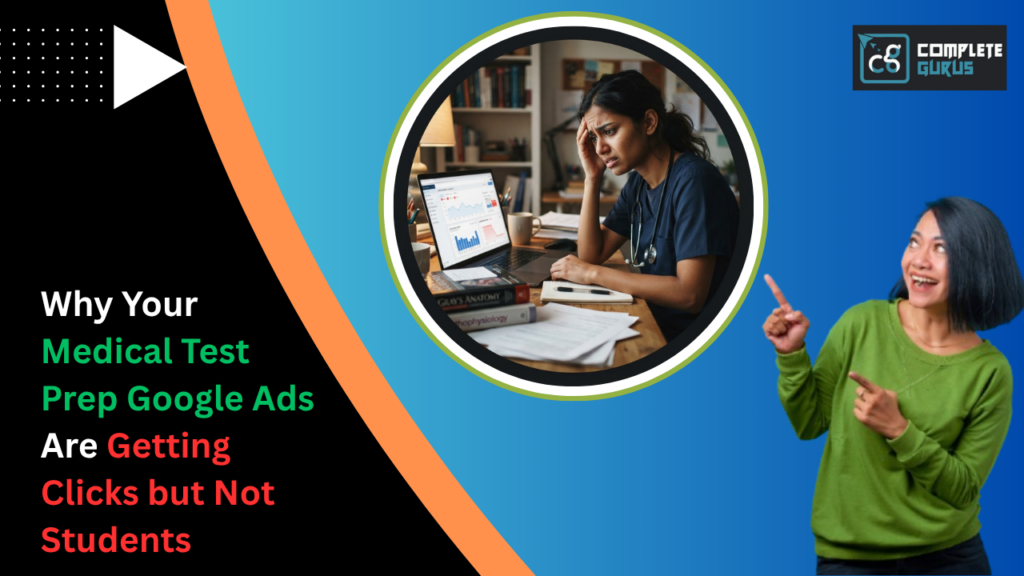
Let’s start with the feeling. You open your ad account on a Monday morning, and the numbers look fine. Impressions are up, clicks are steady, and the click-through rate would make most advertisers smile. Then you open your enrollment sheet, and it tells a different story. A handful of paid students trickled in this month, and none of them can be clearly linked to a specific campaign.
That gap between what the ad platform shows and what your bank account shows is the most common complaint test prep owners bring to a marketing agency. It is frustrating because nothing looks obviously broken. The ads are running, the budget is being spent and the clicks are real people, or at least mostly real people.
The uncomfortable truth is that a click is a very cheap unit of measurement. It tells you someone was curious for about four seconds. It does not tell you whether that person is a first-year medical student with a Step 1 date circled on the calendar, or a high school student idly wondering what USMLE stands for. Google’s system is remarkably good at delivering exactly what you ask for, and if what you asked for was “traffic,” that is what you are getting.
So before changing a single bid, it helps to accept a slightly humbling idea. The problem is rarely that your ads aren’t working. They are working perfectly toward a goal that was never quite the goal you cared about.

Students Do Not Buy a Prep Course the Way They Buy a Pair of Shoes
Picture a student named Aisha, a third-year medical student staring down a licensing exam in about five months. She does not type “USMLE course,” click the first ad and pay. Her journey looks nothing like that.
She starts by asking questions, mostly of herself. How much time do I realistically have? Do I need a full question bank or just a structured schedule? She then asks classmates, lurks in exam communities and reads what other people say about pass rates. She watches free sample lectures, sometimes from three different providers in one evening. She notices which instructors explain things clearly and which ones ramble. She waits for a payday, a scholarship or a family conversation about cost. Somewhere in there, she clicks your ad, maybe twice, maybe on different days from different devices.
This is a long research phase, heavily shaped by peers and very sensitive to price. A course that costs real money and could influence a career is not an impulse buy. Yet most test prep campaigns are built as though it were. They push a “Enroll Now” button in front of someone who is still at the “what even is the difference between these two courses” stage.
When your campaign treats a slow, careful decision like a fast one, you get exactly what you’re seeing. Lots of interest, lots of visits, and very few people ready to pay on the spot. The students are not rejecting you. They simply are not done thinking, and nothing in your funnel is helping them finish.
Your Keywords May Be Attracting Curiosity Instead of Intent
Here is a small experiment worth doing. Open your search terms report and read it slowly, the way you would read a stack of student inquiries. Pay attention to the actual phrases people typed before clicking.
You will probably notice two very different crowds hiding in the same list. One crowd types things like “best USMLE Step 1 course” or “NCLEX prep with pass guarantee.” These are shoppers. They already know they need help and are comparing options. The other crowd types things like “USMLE Step 1 syllabus,” “what is on the MCAT” or “NEET exam pattern.” These are learners collecting information. They might become customers eventually, but today they want a free answer, and they will happily take it from whoever provides it.
Both crowds look identical inside a broad-match keyword strategy. Both generate clicks, and both cost you money. Only one of them is anywhere near a purchase decision.
The fix is not to ignore the information seekers. It is to stop paying premium prices to treat them like buyers. Shopper phrases deserve your strongest ads, your tightest budgets and your most persuasive pages. Information phrases belong in a separate, cheaper bucket where the goal is to earn attention and trust, perhaps through a free study guide or a sample question set, rather than to demand a purchase.
Exam specificity matters too. A student preparing for NCLEX-RN has different fears than one preparing for PANCE, and a MCAT hopeful worries about different things than a NEET aspirant. When one generic ad group tries to speak to all of them, it speaks convincingly to none. Splitting campaigns by exam, and then by prep stage, sounds like extra work. In practice it is often the single change that makes the biggest difference to lead quality.
The Landing Page Is Usually Where the Money Quietly Leaks Out
Imagine you run a small shop and someone walks in after seeing your window display. You greet them, and instead of a conversation, you hand them a contract. That is roughly what many test prep landing pages do.
A student arrives from an ad promising something helpful. What they find is a crowded page with a full-price course table, a countdown timer and a big button asking for payment details. There is nothing in between for a person who is still deciding. No sample lecture, no sense of who the instructors are, no honest answer to the question every student is silently asking: will this actually help me pass?
Students need to feel a little bit of the course before they trust it. A free trial lecture lets them experience the teaching style. A sample question bank lets them judge quality. A short study guide gives them something useful to take away, and that useful thing is also a polite way to collect an email address. That exchange is far more natural than asking for money on a first visit.
Speed and simplicity matter more than people expect, too. A large share of students will open your page on a phone, often between classes or on a hospital shift break. If the page loads slowly, or the form has too many fields, the visit ends quietly and never shows up as a lost sale anywhere in your reports. It just looks like another click that “didn’t convert.”
A good test prep landing page does a few gentle things at once. It matches the promise of the ad, shows real proof such as score improvements or student stories, offers a low-pressure first step, and makes the next action obvious. Notice that none of that is about pushing harder. It is about meeting the student where they actually are.
Trust Is the Real Currency in a Crowded Market
Ask a student why they chose one prep provider over another, and you will rarely hear “because of their ad.” You will hear things like “my friend passed with them,” “the instructor explained it in a way that finally made sense,” or “I watched their free videos and just trusted them.”
Medical test prep is a trust business dressed up as a course business. Students are handing over money and, more importantly, precious study time. They know that picking the wrong course can cost them months. So they look for signals that a provider is credible before they ever fill in a form.
Those signals live mostly outside your ad. They live in the free resources you publish, the score-improvement guides that actually help, the honest breakdown of how a course fits different study styles, and the real stories of people who passed. Instagram posts, YouTube explainers and exam community answers all add to a quiet sense that your brand knows what it’s doing.
When ads run without any of this surrounding trust, they have to do all the heavy lifting alone. They are effectively strangers knocking on a door and asking for a large payment. When ads run alongside a body of helpful content, the same click lands on a brand the student has half-recognized already. That familiarity is worth far more than a clever headline.
This is also why blending paid search with organic work makes such a difference. Someone who first found you through a helpful article on exam strategy, then saw your ad a week later, then watched your sample lecture, arrives at the enrollment page a very different person from a cold click.
Where Interested Students Go to Disappear: The Follow-Up Gap
Suppose your campaigns do their job and a student fills in a form asking for details. What happens next is where many businesses lose the sale without ever realizing it.
Maybe the inquiry lands in a shared inbox and waits two days. Maybe a counselor calls once, gets no answer and moves on to the next lead. Maybe an automated email arrives that reads as though it were sent to everyone on the planet. By the time the student is ready to talk, a competitor has already replied with something personal and helpful.
Because test prep decisions stretch across weeks, one contact is never enough. Students need to be nudged in ways that match their real timeline. An exam date approaching, an application deadline, a scholarship window closing, a new batch starting soon: these are natural, honest reasons to reach out again. A well-designed nurture sequence built around those moments feels like helpful company rather than a sales chase.
The messages should also change depending on where the student is. Someone who just downloaded a syllabus guide needs different follow-up from someone who attended a free demo class yesterday. Treating them the same is like a doctor giving every patient the same prescription regardless of symptoms.
Here is the painful part. When this follow-up is missing, the ad account gets blamed. The campaign shows leads, the leads do not enroll and the conclusion is that “Google Ads doesn’t work for us.” Often the ads delivered exactly what they were supposed to. The handoff after the click is what broke.
Measure Enrollments, Not Applause
If there is one habit that separates struggling test prep advertisers from successful ones, it is what they choose to track. Clicks, impressions and even form fills are pleasant numbers, but they are only stepping stones. The number that actually pays your instructors is the cost of getting one enrolled student.
Many accounts never connect their advertising data to real enrollment outcomes. The ad platform sees a form submission and calls it a conversion. Your admissions team sees a paid student, or doesn’t, three weeks later inside a completely separate system. Nobody joins the two, so nobody knows which campaigns actually produce paying students and which merely produce paperwork.
That blind spot leads to bad decisions. Budget flows toward whichever campaign generates the most inquiries, which may well be the one attracting the least serious visitors. Meanwhile, a smaller campaign quietly sending genuine, enrollment-ready students gets starved because its lead count looks modest.
Fixing this means tracking the full journey from first click to enrollment, and reporting on cost per enrollment, funnel drop-off points and the lifetime value of a student rather than just cost per click. Once that picture is clear, decisions get easier. You can move money toward the exams, regions and creatives that fill seats, and pull it away from the ones that merely look busy.
Honest reporting helps here as well. Dashboards written in plain language, showing spend, leads, enrollments and where prospects stall, keep everyone focused on outcomes instead of vanity metrics.
Timing Your Spend to the Exam Calendar
Test prep has a rhythm that few other industries share. Demand rises and falls with exam dates, registration windows and application deadlines. Yet plenty of accounts run the same flat budget all year, as if a student’s need for a course were constant.
Think about how that plays out. In the weeks when thousands of students are actively choosing a course, your budget may be too thin to compete, and you miss the most valuable clicks of the year. In quiet stretches, the same budget gets spent on people who won’t decide for months, and your cost per student creeps up.
A smarter approach lets spending follow the calendar. Early in a prep cycle, when students are still researching, campaigns can focus on awareness and trust-building content that stays cheap. As decision time approaches, budget and bids shift toward the high-intent shopper searches, remarketing and offers that make committing easier. Near a deadline, urgency messaging that is honest and specific, such as a new batch starting or a discount ending, can help fence-sitters finally decide.
Geography plays into this as well. Different regions have different exam schedules, cost sensitivities and preferred platforms. A campaign that treats every location identically will overspend in some places and underspend in others. Flexible budgets that move toward what is actually converting, week by week, are usually far kinder to your cost per enrollment than a set-it-and-forget-it plan.
YouTube and Meta: The Middle of the Journey You Might Be Ignoring
Search ads catch students who already know what they’re looking for. But a big part of the decision happens earlier, and this is where YouTube and Meta earn their keep.
Students watch a remarkable amount of video before choosing a course. They binge explanations of tough topics, sit through sample lectures and compare how different instructors teach. If your brand is present in those moments with genuinely useful content, you become familiar before the student ever starts comparing prices. Then a remarketing ad, gently reminding them of the free trial they watched, moves them from “just watching” toward “let me try this properly.”
Instagram and exam-specific communities do a similar job in a different flavor. Quick tips, score wins, instructor personality and behind-the-scenes glimpses keep your name in front of students during the long stretch between first curiosity and final decision. None of this replaces search advertising. It supports it, warming up people who will later click a Google ad and feel like they already know you.
The catch is that these channels should not be judged the way search is. A video view rarely produces an instant enrollment, so if you measure it by immediate sales alone, it will look like a waste. Its real contribution shows up later, in higher-quality search clicks, better landing page behavior and shorter decision cycles.

What Fixing This Actually Looks Like in Practice
If you recognize your own situation in this article, the good news is that clicks-without-students is a fixable problem. The fix is usually a series of ordinary, unglamorous improvements rather than one magic trick.
It often begins with a clean look at your search terms and campaign structure, separating shopper intent from curiosity and dividing budgets by exam type and prep stage. Next comes rebuilding the landing experience so that it offers something helpful before asking for money, with free trial lectures, sample question banks or study guides serving as gentle first steps. After that comes tightening what happens once a student raises their hand, so counselors respond quickly and nurture sequences follow the student’s actual exam timeline.
Then comes the part that ties everything together, which is connecting your ad data to enrollment outcomes so that every decision is judged by seats filled rather than sessions counted. Finally, budgets get shifted toward what really works, week by week, instead of staying frozen in whatever plan was drawn up months ago.
None of these steps require a bigger budget. In many cases, the same spend simply starts working harder once it is pointed at the right students and supported by a sensible journey after the click. That is really the heart of it. You do not necessarily need more traffic. You need better-matched traffic and a path that respects how students genuinely make up their minds.
Suggested Reading: How Long Does ChatGPT Take to Review an Advertisement?
Conclusion
Getting clicks but not students is not a sign that your ads are broken, and it is certainly not proof that paid search cannot work for medical test prep. It is a sign that the account is measuring and optimizing for the wrong thing. Students in this space take their time, lean on friends and reviews, and want proof before they part with money. When your keywords, landing pages, follow-up and reporting are all designed around that slow, careful decision, the same budget that once produced empty clicks starts producing enrollments.
If you would like a team that already understands how medical test prep students research, compare and decide, take a look at Complete Gurus at https://completegurus.com/. The agency builds Google Ads, YouTube, Meta Ads, SEO and lead generation campaigns specifically for USMLE, NCLEX, MCAT, NEET, PANCE and COMLEX prep businesses, with a focus on cost per enrollment rather than cost per click. Their team supports everything from exam-specific targeting and free-trial lead funnels to nurture sequences and plain-English weekly reporting, and they offer a free audit so you can see exactly where your current campaigns are leaking students before you commit to anything.

Ashutosh Mishra is an AI Visibility & Performance Marketing Expert with 14+ years of experience helping businesses grow through AI Visibility (AEO/GEO), Google Ads, Meta Ads, and SEO. He partners with founders and business leaders to build data-driven growth strategies that increase visibility, improve marketing performance, and help businesses get discovered, trusted, and recommended in the age of AI.