
Quick Summary
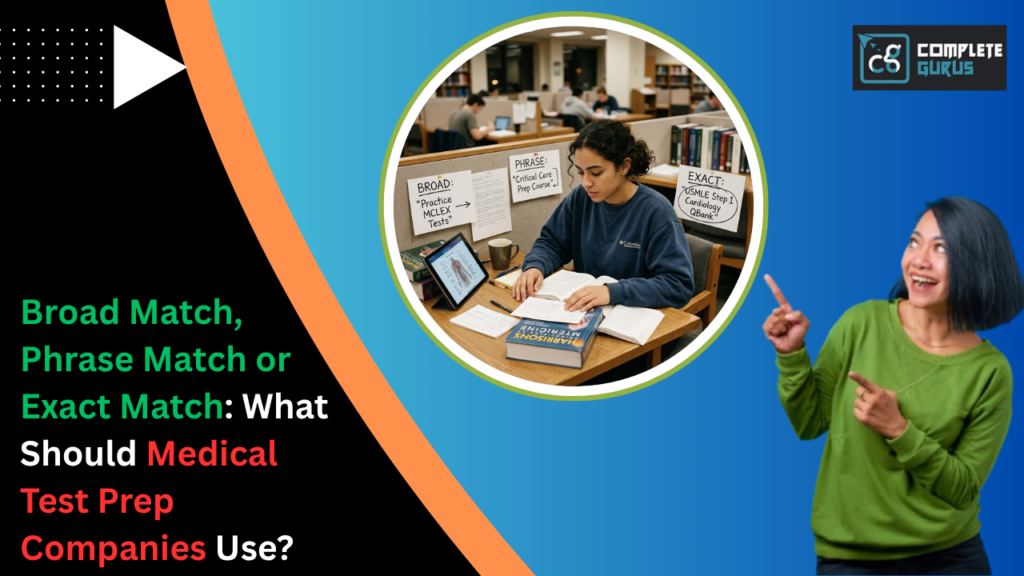
If you run a medical test prep company, the match type you pick decides who sees your ads, and for this audience that choice is expensive to get wrong. A broad match gives you reach and discovery but needs strong guardrails. Phrase match gives you a controlled middle ground and is usually the best home for your core keywords. Exact match gives you precision for high-intent searches like course names and brand terms. For most prep companies, the answer is a layered structure: exact for your proven money terms, phrase for your main exam topics, and carefully fenced broad match with smart bidding for finding new demand. The details below explain how to build that, why it differs for each exam, and what to watch for along the way.
Why This Question Hits Harder for Prep Companies
Picture a student at 11 p.m., three weeks into dedicated study for Step 1, typing a half-formed worry into Google. Maybe it’s “best question bank for weak areas.” Maybe it’s “how many hours should I study per day for USMLE.” Maybe it’s a plain “MCAT prep.” Every one of those searches is a different person with a different level of readiness to buy, and your match type decides which of them your ad appears for.
Prep is an odd market. Your buyers are smart, stressed and short on time. They compare options obsessively and often spend weeks or months deciding. They also search constantly for things that have nothing to do with buying: score conversion tables, registration deadlines, free practice questions, forum threads about test-day nerves. A huge share of exam-related search traffic is informational, and informational clicks cost the same as buying clicks.
That is why match type matters here more than in a category like emergency plumbing, where nearly everyone searching wants to hire someone right now. In test prep, a loose setup can burn through a monthly budget on students who just wanted a free PDF, people studying for a different exam, or professionals who work in medicine and have no plan to sit a test at all. A setup that’s too tight can leave you invisible during the research phase, when students are forming opinions about which brand to trust.
So the real question isn’t which match type is best. It’s which one belongs where in your account, and how you keep each of them honest.

Broad Match: The Wide Net That Needs a Fence
Broad match is Google’s most flexible option and its most misunderstood. Years ago it simply matched your keyword to loosely related queries, and plenty of advertisers got burned by wildly irrelevant traffic. Today it works differently. Google reads the meaning behind your keyword, looks at signals from your landing page and your other keywords, considers what the searcher has done recently, and then decides whether your ad is relevant to that person’s intent.
For a prep company, that can be a genuine advantage. A student searching “how to raise my practice test scores before exam day” never typed the words “question bank,” yet your ad for a question bank could be perfect for them. Broad match can find those conversations, including phrasing you would never think to bid on. It also uncovers language students actually use, which is often messier and more emotional than the neat terms in a marketing brief.
The danger is just as real. A broad keyword like “medical exam prep” may pick up searches about nursing school entrance requirements, dental boards, international licensing pathways you don’t serve, or free resources from universities. If you teach MCAT and someone is hunting for a PCAT guide, a broad match might still show your ad, because Google sees both as pharmacy or health-science admissions content. You pay for the click, and the student leaves in seconds.
Broad matches behave best under three conditions. First, you have conversion tracking you trust, and ideally a meaningful volume of enrollments or trial signups for the system to learn from. Second, you’re using automated bidding that optimizes toward a real business outcome, not just clicks. Third, you’ve built a solid negative keyword list before launch and you review search terms often. Without those three things, a broad match is closer to a gamble than a strategy.
A good way to think about it is as a scouting tool. You use it to discover what you don’t know, then promote the winners into tighter match types where you control them. Treated as a permanent home for your biggest budget, it tends to drift. Treated as a research lab with a leash, it earns its place.
Phrase Match: The Dependable Middle Ground
Phrase match asks Google to show your ad when the search contains the meaning of your keyword, with the words in a sensible order, and allows extra words before or after. You write it in quotation marks. If your keyword is “USMLE Step 1 prep,” a search like “best USMLE Step 1 prep course online” qualifies, and so does “USMLE Step 1 prep schedule for six weeks.”
This is where many prep companies should keep the core of their spending. It filters out a great deal of noise while still giving you room to catch the many ways students phrase the same need. Students almost never search with textbook precision. They add qualifiers like “online,” “cheap,” “for IMGs,” “after failing,” or “with explanations,” and phrase match lets those variations in without letting in completely unrelated topics.
It also suits the way prep buying works. A student rarely goes from first search to checkout in one session. They bounce between comparison pages, reviews, and forum posts. Phrase match keeps your ads visible across that wandering path, because many of those searches contain your core term with a modifier attached. Someone typing “NCLEX-RN practice questions with rationales” is far closer to your offer than a generic “nursing help” browser, and phrase match recognizes the difference.
The tradeoff is that phrase match still accepts some drift. Because Google interprets the meaning, “MCAT prep” in quotes could include “MCAT prep for non-traditional students” (great) and also “MCAT prep free download” (likely a wasted click if you sell paid courses). Negative keywords still matter, just less urgently than with broad.
If you can only afford to master one match type this quarter, make it a phrase. It gives you the best ratio of useful reach to wasted spend for the largest number of prep businesses.
Exact Match: Precision for the People Ready to Buy
Exact match is the tightest option. It shows your ad for searches that match the meaning of your keyword, written in square brackets, including close variations like plurals, reordered words and common misspellings. It won’t wander into broader topics.
For prep companies, exact match belongs on the terms where intent is unmistakable. Think of searches that include your brand name, the specific name of a flagship course, or a very particular offer, like “your company name plus Step 2 CK course” or the exact title of a bootcamp you run. People typing those queries already know you, or at least know precisely what they want, and you should be standing in front of them every time at a sensible price.
Exact match is also a useful protective layer. If competitors bid on your brand name, an exact-match campaign with strong ads helps you keep that high-converting traffic. It’s also a handy place for proven, high-performing search terms you’ve harvested from your broad and phrase campaigns. Once a query has shown it produces enrollments, giving it its own exact-match home lets you set bids and write ad copy specifically for it.
The weakness is volume. Searches for very specific terms are limited by how many people search them. If your whole account is an exact match, you’ll look efficient on paper while slowly starving your pipeline, because you only reach students who already know exactly what to type. Prep is a considered purchase with a long research window, so you can’t build a business only on people who have finished researching.
The exact match is a scalpel, not a net. It’s precise and valuable, but only a piece of the picture.
How the Exam Itself Changes Your Match Type Strategy
One of the biggest mistakes prep companies make is treating “medical exams” as one market. USMLE, MCAT, NCLEX and COMLEX attract different students, different search habits and different competitive landscapes, and your match type mix should reflect that.
The USMLE audience is full of medical students and international graduates who tend to search in very specific languages. They talk about particular steps, particular resources, and particular weaknesses. Because the vocabulary is precise and the search volume per term is fairly modest, phrase match on exam-plus-intent terms usually works well, with exact match reserved for brand and course names. Broad match can be useful here for discovering concerns around study schedules, dedicated study periods or score thresholds, but only with tight negatives to keep out residency application content that isn’t about test prep.
The MCAT audience skews toward undergraduates and career changers who often search more casually and more broadly. They may type short, vague queries early in their journey and long emotional ones later. That gives broad matches more room to discover useful language, particularly with smart bidding. But the audience also includes plenty of people only browsing “pre-med” topics, so your negative keyword list needs to be generous, especially around admissions and application content that isn’t about the exam.
NCLEX searchers are a large, practical group, often searching on phones between shifts or classes. They use direct, task-driven language like “NCLEX practice questions” or “NCLEX study guide.” Search volume is high, competition is stiff, and the line between free resource seekers and paying customers is thin. Phrase match combined with strong exact-match coverage of high-intent terms typically protects the budget here, and broad match deserves a smaller, closely monitored test budget.
COMLEX is the smallest and most specialized pool, with osteopathic students who often search by name and by very particular topics. Volume is low, so it’s easy to over-restrict. Phrase match tends to carry this group, and exact match helps with the narrow set of terms you know. Because audiences this small can’t generate much learning data for automated systems, broad matches here can feel aimless unless you pair it with data from your other campaigns.
Separating these exams into their own campaigns, as Complete Gurus covers in its guidance on Google Ads campaign structure for USMLE, MCAT, NCLEX and COMLEX prep companies, lets you give each audience the match type mix that fits it rather than forcing one blended setup on all four.
Match Types and Smart Bidding Work as a Team
You can’t really choose match types in isolation from your bidding strategy. They interact constantly.
When you use manual bidding, match type is your main control over who sees your ads and what you pay. Broad match with manual bids tends to be wasteful because you have no way of telling the system which loosely related searches deserve more money than others.
When you use automated bidding that targets conversions or a return goal, broad match becomes far more useful, because the algorithm can weigh each auction using signals you’d never see yourself, such as the device, the time of day, and the searcher’s earlier behavior. It can bid aggressively for the student who looks ready to enroll and pull back for the one who looks like a casual browser. This is where broad match sometimes shines for prep companies, finding purchase-ready students through unexpected phrasing.
But automation is only as smart as the signal you feed it. If your conversion tracking counts every free-trial signup or newsletter subscription as equal to a paid enrollment, the system will chase the cheap actions and flood you with low-value leads. Many prep companies discover this the hard way. Before leaning on broad matches with automated bidding, make sure what you’re optimizing toward actually reflects revenue, whether that’s paid enrollments, qualified consultation bookings, or purchases of a specific course tier. Strong tracking is the foundation that lets the looser match types work in your favor.
Exact and phrase match keep working well alongside automation too, since they give the system cleaner, more intent-rich auctions to learn from. Many strong accounts run all three together, each with its own role and its own budget, instead of choosing one.
Negative Keywords: The Quiet Hero of Every Match Type
If match types decide who gets in, negative keywords decide who gets turned away at the door. For prep companies, this list is often the single most valuable asset in the account.
The obvious negatives are the ones tied to free-seekers, such as “free,” “pdf,” “download,” “torrent,” and “cheat sheet,” if those don’t fit your offer. But the more interesting negatives are subtler. Terms related to jobs, salaries, and careers tend to bring in people researching professions, not exams. Searches about unrelated tests, other countries’ licensing systems you don’t support, or very different levels of training can all leak through. And any competitor-specific terms you don’t want to pay for should be handled intentionally.
The way to build a smart list is to let real data teach you. Review your search terms report regularly, especially in the first few weeks of any new broad or phrase campaign. Each irrelevant query is a lesson. Add it as a negative, and over time your account becomes more precise without becoming restrictive.
It’s also worth keeping shared negative lists across campaigns, so lessons from one exam carry over to the others, while still allowing campaign-level exceptions. A word that’s junk for NCLEX could be useful for MCAT, so don’t apply every negative everywhere without thinking.
A Practical Way to Roll This Out
If you’re starting fresh or restructuring, a gradual rollout protects your budget and teaches you what your market really responds to.
Start with an exact match on your brand and flagship course names, plus a small set of proven high-intent terms. This gives you a safe, efficient foundation and a baseline conversion rate. Next, build phrase match campaigns around your core exam topics, grouped tightly so your ads and landing pages speak directly to what each searcher wants. A student looking for a Step 2 CK question bank should land on a page about exactly that, not a general homepage.
Once those two layers are stable and tracking reliably, add broad matches as a controlled experiment. Give it a modest, separate budget, run it with automated bidding that targets a real enrollment goal, and layer your negative list on from day one. Watch the search terms closely for the first few weeks. When a broad match surfaces a query that converts, move it into phrase or exact where you can manage it more precisely. When it surfaces junk, block it.
Review everything on a steady rhythm. Prep demand is seasonal, with surges around exam registration windows, score release periods, and the start of academic terms, so a setup that worked in March may need adjusting by September. Your match type mix isn’t a one-time decision. It’s a living system that should shift with the calendar and with what your data shows.
The landing page deserves attention too. Even perfect match type choices lose value if the page a student reaches feels generic or slow, or makes enrollment confusing. Match types control who arrives, but the page controls whether they stay.

Common Mistakes Worth Avoiding
A few patterns show up again and again in prep company accounts. One is launching a broad match on day one with no negatives and no conversion history, then wondering why the budget vanished on strange searches. Another is the reverse, locking everything into exact matches for safety and then missing the research-phase students who would have become customers later.
Mixing all four exams into a single campaign is another common problem, because it makes it impossible to see which audience is paying off and which is quietly draining money. And many companies set up their ads once and rarely look at search terms again, so wasteful queries pile up unnoticed for months.
There’s also a quieter error, which is chasing cheap clicks. A low cost per click can look wonderful in a report while hiding the fact that none of those clicks turn into enrolled students. The number worth watching is cost per paid enrollment, not cost per visit. Match types that bring in fewer but better-qualified students almost always beat those that bring in lots of curious but uncommitted ones.
Suggested Reading: Which Businesses Should Advertise on ChatGPT?
Conclusion
There’s no single winner among broad, phrase and exact match for medical test prep companies, and anyone who tells you otherwise is probably simplifying. Each one plays a different role. Exact match protects your brand and your most proven, high-intent searches. Phrase match carries most of your day-to-day reach with a good balance of control and flexibility. Broad match, used carefully with solid tracking, smart bidding and strong negative keywords, helps you discover students and phrases you’d never have found by guesswork.
The best-performing accounts tend to use all three on purpose, separate campaigns by exam so each audience gets the treatment it needs, and keep reviewing search terms so the structure improves over time. If you remember one thing, let it be this: match types are about matching your budget to your students’ intent, and that intent changes with the exam, the season, and where each student sits in their decision.
If you’d rather not work all of this out alone, Complete Gurus can help. As a performance marketing agency with more than 13 years of experience in Google Ads and Meta Ads, it runs a dedicated digital marketing service for medical test prep companies, backed by full Google Ads management, professional keyword research, and a free Google Ads audit that shows exactly where your budget is leaking. You can explore everything they offer at https://completegurus.com/ and see how a team that lives and breathes paid search can turn your match type strategy into steady, measurable enrollments.

Ashutosh Mishra is an AI Visibility & Performance Marketing Expert with 14+ years of experience helping businesses grow through AI Visibility (AEO/GEO), Google Ads, Meta Ads, and SEO. He partners with founders and business leaders to build data-driven growth strategies that increase visibility, improve marketing performance, and help businesses get discovered, trusted, and recommended in the age of AI.