
Quick Summary
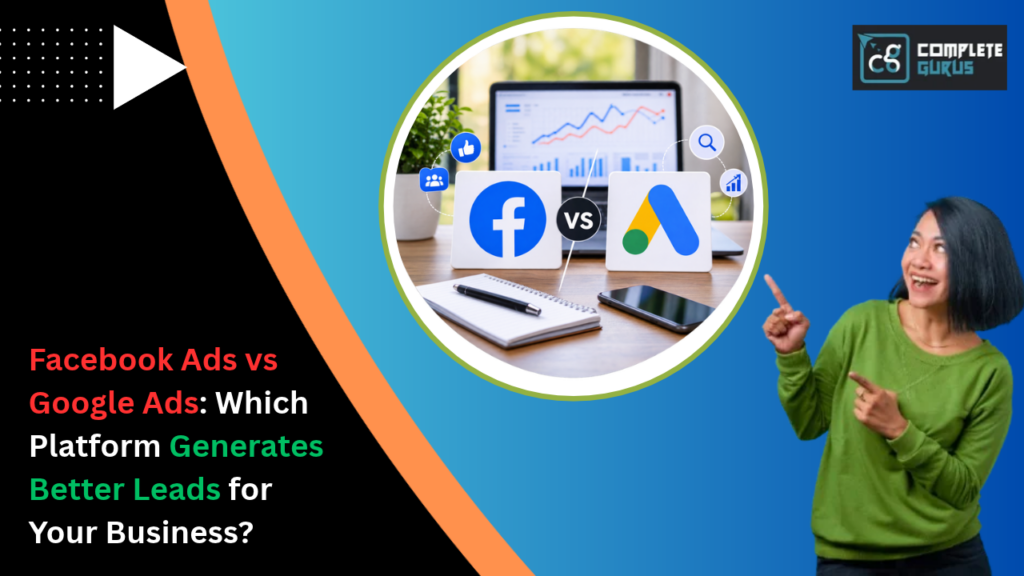
If you want a one-line answer, here it is: Google Ads usually produces leads that are closer to buying, while Facebook Ads usually produces more leads for less money at the start. Neither wins in every situation. Which one is better for you depends on what you sell, how long your customers take to decide, and what you mean by “a good lead.”
Google Ads captures demand that already exists. Someone types a problem into a search box, and your ad appears while they are actively looking. Facebook Ads (and Instagram, since both run through Meta) create demand by putting your offer in front of people who match your ideal customer, even though they weren’t thinking about you a minute earlier. The first approach tends to cost more per lead and converts better. The second tends to cost less per lead and needs more nurturing.
The businesses that get the best results rarely pick a side permanently. They start with the platform that fits their sales cycle, track what happens after the form is filled in, and add the second platform once the first is working. The rest of this article explains how to work out where you fit.
Why This Question Keeps Business Owners Up at Night
Almost everyone who asks this has already spent money on one platform and felt let down. Maybe you ran Facebook ads, got a few dozen enquiries, and found that half of them never answered the phone. Or you tried Google Ads, watched the cost per click climb past what you expected, and wondered if the whole thing was worth it.
Those experiences are real, but they are often misread. A disappointing campaign usually says more about how it was set up than about the platform. A badly structured Google Ads account will burn through budget on searches that were never going to convert. A Facebook campaign with a vague offer will bring in curious scrollers who have no intention of buying. Blaming the platform feels easier than admitting the campaign wasn’t built around the right goal.
It also helps to know that the two platforms are built on completely different ideas. Google is a search engine, so its ads work on intent. Facebook is a social network, so its ads work on interruption and interest. Comparing them directly is a bit like comparing a shop on a busy high street with a billboard on a highway. Both can bring in customers, but they do it in different ways, for different kinds of people, at different moments.
Once you stop asking “which one is better” and start asking “which one matches how my customers actually decide,” the question gets much easier to answer.

How Google Ads Finds Leads: Catching People Mid-Search
Think about the last time you needed something urgently. A plumber for a burst pipe, a lawyer after an accident, a dentist because of a toothache that wouldn’t quit. You probably didn’t browse social media looking for the answer. You picked up your phone and searched.
That moment is what Google Ads is built around. When someone types “emergency dentist near me” or “B2B accounting software for small teams,” they are telling Google exactly what they want. Your ad appears at the very moment the need is on their mind. There is no persuading someone to care, because they already do. You just have to be visible, credible, and easy to contact.
This is why Google leads tend to be warm. People who search with a specific phrase usually have a budget in mind and a timeline to match. A person who clicks your ad for “kitchen remodel contractor in Dallas” is far more likely to request a quote than someone who happened to see a kitchen photo while scrolling.
Google also offers more than one kind of ad. Search campaigns catch people typing queries. Shopping and Performance Max campaigns show products with prices and images, which works well for online stores. Local Services Ads put your business at the top of results for trades and professional services, often with a “Google guaranteed” badge that builds trust quickly. YouTube and Display reach people earlier in their thinking, though they behave more like Facebook than like Search.
The trade-off is cost and competition. Popular keywords in industries like law, insurance, and home services get bid up by many advertisers, so a single click can cost real money. If your offer, landing page, and follow-up process aren’t strong, that cost adds up quickly. Google rewards businesses that are precise. Vague targeting and loose keyword lists leak money.
How Facebook Ads Find Leads: Creating Interest Before It Exists
Facebook Ads work from the opposite direction. Nobody is typing a request. People are catching up with friends, watching short videos, or killing time in a queue. Your ad has to earn attention in a feed full of competing content, and it has to do it in a couple of seconds.
What Meta gives you in return is remarkable targeting. You can reach people by location, age, interests, behaviors, and the audiences it builds from your own customer lists or website visitors. A boutique fitness studio can show a free trial offer to people within a few miles who follow similar interests. A software company can show a demo invitation to people in particular job roles. You are going out to find your customers instead of waiting for them to look for you.
This is especially powerful for products and services people don’t search for until someone shows them a reason to. Few people wake up and search for a specific skincare serum, a unique piece of jewelry, or a new coaching program. They discover those things visually and emotionally, and Meta is excellent at that kind of discovery. The platform also offers instant lead forms that keep people inside the app, which makes it very easy for someone to raise a hand with two taps.
That ease is also the weakness. When submitting a form takes almost no effort, you get a lot of low-commitment sign-ups. Some will be genuine, and some will be people who tapped on impulse and forgot about it by lunchtime. Facebook leads often need faster follow-up, better qualifying questions, and a bit more nurturing before they turn into sales.
Facebook can also build awareness in a way search can’t. A person who sees your brand a few times in their feed may recognize you later when they start searching, and that recognition quietly lifts your results everywhere else.
What a “Lead” Really Means on Each Platform
This is where most comparisons go wrong. They line up cost per lead side by side and declare a winner, as though a lead were a fixed unit like a litre of petrol. It isn’t.
A lead from Google Search is usually someone who looked for you or for your category. They have a problem and are reaching for a solution. They are often comparing a handful of providers, which means you may be competing with others for the same person, but they are in buying mode.
A lead from Facebook is usually someone who responds to an idea. Your ad sparked interest, and they gave you their details. That person may genuinely want what you sell, but they may not be ready yet. They might need a reminder, an email sequence, a call, or a few more exposures to your brand before they commit.
Neither type is better in the abstract. A real estate agent who needs a buyer ready to tour homes this month will lean toward Google. A coaching business that wants to fill a webinar with people curious about a new program may find Facebook delivers more registrants for the money. The important thing is to measure what comes after the lead. How many answered the phone, how many booked, how many paid, and how much revenue came from each?
This is why serious advertisers have shifted their attention from cost per lead toward cost per qualified lead and, ultimately, cost per sale. A platform that gives you cheap leads that never close is more expensive than one that gives you pricier leads that do. If your reporting stops at the form submission, you are only seeing half the picture.
The Cost Question: Cheaper Isn’t the Same as Better
Let’s talk about money, because that’s where the real pressure sits.
In general, Facebook clicks cost less than Google clicks, and cost per lead is often lower too. That’s partly because social platforms have a huge supply of ad space and partly because the audience isn’t actively shopping. Google’s search auctions are competitive precisely because the people on the other end are ready to act.
But a low cost per lead only helps if those leads turn into customers at a reasonable rate. Imagine two campaigns with the same budget. One generates a hundred Facebook leads, and ten of them become customers. The other generates forty Google leads, and fifteen become customers. The Google campaign looks more expensive per lead and cheaper per customer. The reverse can happen too, especially with offers that suit social discovery.
Your own numbers will tell the real story, but a few patterns hold up. High-ticket services with a short, urgent decision window usually favor Google. Impulse-friendly products, visual brands, and offers with an emotional hook usually favor Meta. Businesses with a long sales cycle often use both, with Meta warming people up and Google catching them when they’re ready.
Budget size matters as well. If you can only spend a small amount each month, putting it into one platform and doing it well beats splitting it thin across two. Google’s learning phase needs enough conversions to optimize properly, and so does Meta’s. Spreading too little money across both means neither gets enough data to improve.
It’s also worth being realistic about timing. Neither platform is a switch you flip for instant profit. The first few weeks are about gathering data, testing messages, and trimming waste. Expect the numbers to improve as the system learns, not on day one.
Which Types of Businesses Lean Which Way
Patterns exist, even if they aren’t rules.
Professionals and local service providers tend to do well on Google. Lawyers, dentists, doctors, physiotherapists, HVAC companies, insurance agents, and real estate professionals all benefit from being found at the moment of need. Someone whose air conditioning has just died is not casually scrolling. They are searching, and the business that appears first with a clear phone number often wins the job. Healthcare and legal advertising also come with their own compliance rules, so careful campaign setup matters as much as bidding.
Product-led and lifestyle brands often thrive on Meta. Fashion, jewelry, beauty, home decor, and pet products are all visual and emotional purchases. A striking image or short video can stop a thumb mid-scroll and plant a desire the person didn’t know they had. For online stores, Meta’s dynamic product ads can also follow visitors who looked at an item and didn’t buy, nudging them back with a reminder of exactly what they viewed.
Online stores in particular often use both. Google Shopping and Performance Max capture shoppers who are already searching for a product, while Meta introduces the brand to new audiences and re-engages visitors. The two platforms play different roles in the same customer journey.
Local businesses sit in an interesting middle. A barber shop or a boutique hotel can use Google to catch “near me” searches and Meta to build neighborhood awareness with photos and offers. Travel agencies, coaching institutes, and test-prep companies often find that Meta works well for seasonal promotions, while Google captures the people who are actively comparing options.
If your business doesn’t fit neatly into one of these groups, that’s normal. Treat the patterns as a starting hypothesis and let your own data confirm or correct it.
When B2B Businesses Need to Think Differently
Selling to other businesses changes the equation. B2B buyers research for longer, involve more people in the decision, and rarely buy on the first visit. A purchase might need approval from several departments, and the person who fills in your form may not be the person who signs the contract.
For these companies, Google Ads is often the backbone. Decision-makers search for specific solutions, such as “inventory management software for manufacturers” or “managed IT services for law firms,” and appearing for those searches puts you directly in front of people with a budget and a problem. The focus should be on quality over volume. A campaign that fills your inbox with students and job seekers is worse than one that brings in fewer but genuinely relevant enquiries.
Meta can still play a valuable role, just a different one. It’s useful for retargeting people who visited your site, promoting gated content like guides and webinars, and staying visible during a long consideration period. Pairing that with LinkedIn for professional targeting gives B2B marketers another way to reach job titles and industries directly.
The common thread is that B2B lead generation should be measured by pipeline, not by form fills. If your sales team spends their week talking to people who were never going to buy, the problem isn’t the sales team. It’s the targeting, the offer, or the qualifying questions on your forms. Tightening those usually improves results faster than increasing the budget.
Why Running Both Often Beats Choosing One
Here’s something that gets lost in the “versus” framing: the two platforms influence each other.
Someone sees your Facebook ad on Monday and ignores it. On Thursday, they search for what you offer and see your Google ad. The click is credited to Google, but Facebook did part of the work. If you turned off Facebook because it “didn’t produce direct leads,” you might notice your Google results quietly weaken a few weeks later. Many businesses have learned this the hard way.
Running both platforms lets them cover each other’s blind spots. Google catches people who are ready now. Meta reaches people who aren’t ready yet and keeps your brand familiar until they are. Retargeting ties it together by following up with people who showed interest on either channel. Over time, your audience data on each platform sharpens the other.
That said, doing both only makes sense when you have the budget and the capacity to manage them properly. Two half-managed campaigns are worse than one excellent campaign. A sensible approach is to begin with the platform that best matches how your customers buy, get it profitable, and then expand. Once your tracking is clean and your follow-up process is solid, adding the second channel becomes a growth move instead of a distraction.
This is also where a clear measurement setup pays off. You need to know which leads came from where, what happened to them, and what revenue they produced. Without that, you’ll end up arguing with your own spreadsheet about which platform deserves the credit.
Mistakes That Make Either Platform Look Bad
Most disappointing campaigns trace back to a handful of avoidable problems.
The first is sending clicks to a weak landing page. You can spend thousands perfecting your targeting, but if the page is slow, confusing, or doesn’t match the promise in the ad, people leave. A landing page should have one clear purpose, a clear offer, and an easy way to respond. This matters on both platforms but especially on mobile, where most clicks now happen.
Another is neglecting follow-up speed. Leads cool quickly. If someone fills in a form and hears nothing for two days, they’ve probably moved on to a competitor. Responding within minutes, not hours, can change your close rate dramatically, and it costs nothing in ad spend.
Then there’s tracking. If conversion tracking is broken or measures the wrong thing, both platforms will optimize toward the wrong goal. Google and Meta both rely on the data you feed them. Tell them a button click is a conversion and they’ll find you more button clickers, whether or not any of them buy.
Broad targeting without negative keywords on Google is another quiet budget drain. Without them, your ads can appear for irrelevant searches that look similar to what you offer. On Meta, the equivalent mistake is using the same creative for months until the audience stops noticing it. Ad fatigue is real, and fresh creativity is one of the most reliable ways to keep costs down.
Finally, many businesses give up too early or change too much too fast. Adjusting a campaign every day stops the algorithms from learning. Patience, paired with regular and deliberate review, usually works better than constant tinkering.
How to Decide What’s Right for Your Business
Start with your customer’s behavior. Do people usually search for what you sell when they need it, or do they have to be introduced to it? If search is natural, begin with Google. If discovery is the main driver, begin with Meta.
Look at your sales cycle next. If customers decide in a day or two, the high intent of Google leads usually justifies the higher cost. If they take weeks or months, Meta’s lower costs and retargeting options give you a way to stay in front of them cheaply the whole time.
Think about your offer too. A free quote, an urgent service, or a clear price comparison suits Google. A visual product, a lifestyle benefit, or an emotional story suits Meta. If your offer can be made compelling in a single image or a fifteen-second video, Meta has a real advantage.
Be honest about your capacity to handle leads. A flood of cheap Facebook leads is only useful if someone can contact them quickly. A smaller trickle of Google leads might fit a small team better.
And before committing a large budget, look at what’s already happening. An audit of your existing campaigns, or of your website and tracking if you haven’t run ads yet, will often reveal wasted spend or missed opportunities that matter more than the platform choice itself. Many businesses discover that the fix is not switching platforms but fixing what’s broken on the one they already use.
Suggested Reading: How to Build a Facebook Retargeting Strategy That Converts Interested Visitors
Conclusion
So, which platform generates better leads? The honest answer is the one that matches how your customers buy. Google Ads tends to deliver ready-to-act prospects who are searching for exactly what you offer, usually at a higher cost per lead and a stronger close rate. Facebook Ads tends to deliver a broader stream of interested people at a lower cost, with more nurturing needed before they convert. Both can be profitable, and both can waste money when they’re set up carelessly.
The smartest move is to stop treating this as a rivalry. Choose the platform that fits your customer’s decision process, measure results all the way to revenue, and expand to the second channel when the first is working. Pay attention to lead quality, follow up quickly, keep your tracking clean, and give campaigns enough time to learn.
If you’d rather not work all of this out through expensive trial and error, Complete Gurus can help. They are a performance marketing agency with more than thirteen years of experience in Google Ads, Meta Ads, SEO, and AI search visibility, managing over three million dollars in annual ad spend for B2B, eCommerce, and D2C brands. You get a dedicated strategist, a tailored growth plan, weekly reporting in plain English, and a 90-day guarantee of at least a 25% improvement in ROAS. They also offer free manual audits of your Google Ads and Facebook Ads accounts, which is a low-pressure way to see where your money is going. Visit https://completegurus.com/ to request an audit or book a strategy call.

Ashutosh Mishra is an AI Visibility & Performance Marketing Expert with 14+ years of experience helping businesses grow through AI Visibility (AEO/GEO), Google Ads, Meta Ads, and SEO. He partners with founders and business leaders to build data-driven growth strategies that increase visibility, improve marketing performance, and help businesses get discovered, trusted, and recommended in the age of AI.