
Quick Summary
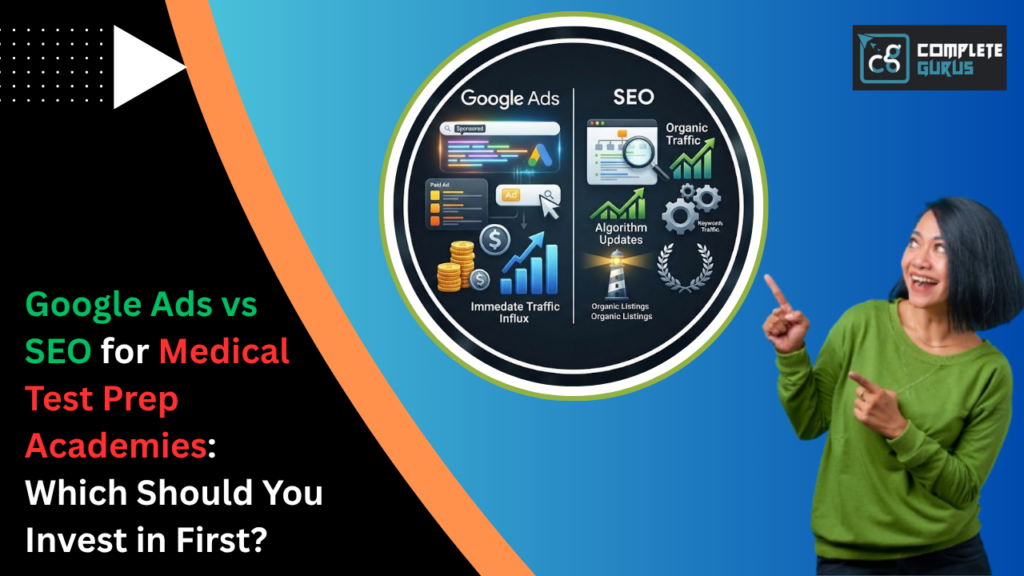
If you run a medical test prep academy, whether it’s NEET coaching, USMLE preparation, MCAT tutoring or nursing entrance training, and you have money for only one marketing channel right now, this is the short version. Google Ads is usually the better first move if you need students enrolled in the next few weeks and your website is ready to receive them. SEO is the better first move if you have a longer runway, a thin ad budget, or a brand that needs to look credible for years to come. Most academies end up needing both, and the order matters less than the timing. Your exam calendar, your cash position and the state of your website decide which channel earns its money first. The rest of this article explains why, in plain language, so you can decide without a marketing degree.
The Question Every Academy Owner Eventually Asks
Sooner or later, usually right after a slow enrollment month, an academy owner sits down and asks, “Should I be paying for ads, or should I be building something that lasts?” It’s a fair question, and a stressful one, because both answers sound reasonable. Ads promise students tomorrow. SEO promises students for years. Neither promise is a lie, and that’s exactly why the decision feels so hard.
The trouble is that most advice on this topic treats every business as the same. A dentist, a jewelry store and a medical entrance academy get handed the same generic playbook. Yet your business has quirks the others don’t. Your customers are often anxious students, or parents who are even more anxious, making a high-stakes decision about a single exam that could shape a whole career. Your buying cycle is tied to fixed dates. Your product is a promise about results, which is the hardest thing in the world to prove before someone has paid.
So instead of declaring a winner, let’s walk through how each channel behaves in your world specifically. By the end, you should be able to look at your own academy, your own calendar and your own bank balance, and know where to put the first rupee or dollar.

What Google Ads Actually Does for a Test Prep Academy
Think of Google Ads as renting attention at the exact moment someone raises their hand. A student types “best NEET coaching for droppers” or “USMLE Step 1 prep course online” into Google, and your academy appears at the top of the page. You pay when they click. That’s the whole mechanism, and its beauty is how quickly it works. A campaign can go live in days, and the first enquiries can arrive within the same week.
For a prep business, this speed matters more than it does for most. Enrollment windows are short. If a batch starts in six weeks and you’re half empty, you can’t wait six months for organic rankings to mature. Paid search lets you switch demand on when you need it and switch it off when the batch is full, which is a kind of control almost no other channel offers.
There’s also a targeting advantage that’s easy to underrate. Search intent in this niche is unusually clear. Someone searching for a specific exam, a specific city or a specific course format has told you almost everything you need to know about what they want. You can build campaigns around those signals, separating the student who is comparing crash courses from the one who is asking about a two-year classroom program. Beyond search ads, formats like YouTube advertising can work well for reaching students who are studying and watching lecture-style videos, though search usually deserves your first attention.
Now the honest downside. Ads are a tap, not a well. The moment you stop paying, the traffic stops. If your landing page is slow, confusing or unconvincing, you’ll pay for clicks that go nowhere, and Google will happily keep charging you. I’ve watched academies burn through a month of budget because the ad said one thing and the page said another. Paid traffic amplifies whatever your website already is, good or bad.
What SEO Actually Does (And Why It Feels So Slow)
SEO is the slow, patient cousin. Instead of renting attention, you’re earning it. You build pages that answer the questions students and parents are already asking, you make sure search engines can read and trust your site, and over time your academy starts showing up in the organic results without a per-click bill.
The word “slow” gets thrown around a lot, so let me be specific about what it means. A new page or a newly optimized site typically needs a few months before it gains real traction, and competitive exam keywords can take longer. That doesn’t mean nothing happens in the meantime. It means the early work is invisible to the naked eye, like laying a foundation, and the payoff arrives later and lasts longer.
What makes SEO special for test prep is how much research students do before they ever enquire. They look up eligibility rules, syllabus changes, registration deadlines, cutoff trends, counseling processes and study strategies. Each of those questions is a doorway. If your academy has published clear, accurate and genuinely helpful content on those topics, you meet the student at the very start of their journey, long before they’re comparing prices. By the time they’re ready to enroll, your name is already familiar and, ideally, trusted.
That’s the quiet superpower of organic search: it builds familiarity without sounding like a sales pitch. It also compounds. A well-written guide on an exam’s registration process can bring visitors year after year, and updating it annually costs a fraction of what it took to create.
The catch is patience and consistency. SEO rewards steady work over bursts of effort, and it punishes sites that are slow, poorly structured or full of thin, copied content. Technical health, on-page relevance, keyword research and quality content all have to pull in the same direction. Skip one and the whole effort loses momentum.
Your Exam Calendar Changes Everything
Here’s where the medical prep world diverges sharply from other industries. Your demand isn’t smooth. It rises and falls with registration windows, result announcements, counseling rounds and the start of new academic cycles. A student who fails or underperforms in one attempt might start looking for a repeater batch within days of results. A first-time aspirant might begin researching a year in advance.
This rhythm should shape your decision more than any generic rule of thumb. If the peak enrollment period is a couple of months away and you have no organic presence, starting with SEO alone means you’ll miss the rush. Ads can capture that seasonal spike while your organic foundation quietly develops in the background. On the other hand, if you’re just coming out of a big season and have several quiet months ahead, that’s the perfect time to invest in content and technical improvements, so your site is stronger when the next wave arrives.
Smart academies think in seasons. During peak windows, paid campaigns do the heavy lifting because the audience is already searching and time is short. During slower stretches, the attention shifts to building content, fixing site issues and earning credibility. Neither channel is competing with the other. They’re taking turns at the front of the stage depending on what the calendar demands.
If you only remember one thing from this section, let it be this: look at your next enrollment date before you look at any marketing budget. The distance between today and that date tells you how much time SEO has to help.
Let’s Talk Money Without the Jargon
Cost is where many owners get stuck, so let’s approach it with some common sense rather than fixed numbers, since prices vary enormously by country, exam and competition.
Google Ads has a variable cost that depends on how many academies are bidding for the same searches. Popular exams in crowded cities can get expensive quickly, because every competitor wants the same students. The good news is that you decide the ceiling. You set a daily budget, watch the results and adjust. The risk is that a poorly structured campaign can waste that budget on irrelevant searches, like people looking for free study material or unrelated courses, if nobody is filtering them out with negative keywords and careful targeting.
SEO has a different cost shape. You pay upfront in time, effort and expertise, with no guarantee of an immediate return, but the cost of each additional visitor drops as your content ages and ranks. Over a long horizon, organic traffic often turns out to be cheaper per enrollment. Over a short horizon, it can feel like paying for nothing.
A useful way to think about it is to ask what one enrolled student is worth to you. If a full-course student brings in a substantial fee, then even a fairly high cost per enquiry can be perfectly healthy, as long as enough enquiries convert into admissions. The number that really matters isn’t the cost per click. It’s the cost per enrolled student, and you can only know that if your tracking is set up properly, which we’ll get to shortly.
One more thing on money: it’s worth being wary of any agency or freelancer who promises guaranteed rankings or guaranteed enrollment numbers without knowing your market. Marketing has too many moving parts for magic promises. Look for partners who talk about clear reporting, defined benchmarks and how they’ll measure success in terms you understand.
Trust Is the Hidden Currency in Medical Prep
Let’s step away from the mechanics for a moment, because there’s something about this industry that spreadsheets miss. Parents and students aren’t buying a product. They’re buying confidence. A family choosing a coaching institute for a medical entrance exam is placing real hope, and often real financial sacrifice, on your shoulders.
That changes how each channel feels to them. An ad is a stranger introducing themselves. It can be persuasive, but it’s also obviously an ad, and people have learned to be a little skeptical of anything labeled as sponsored. An organic result feels different. When your academy appears because a helpful guide answered their question, it carries an implicit endorsement, as though search engines vouched for you. Studies of online behavior consistently suggest that many people trust organic listings more than paid ones, and in a category built on trust, that difference counts.
This doesn’t mean ads can’t build trust. They absolutely can, when the landing page shows real results, transparent faculty details, honest fee information and student stories that feel genuine. But it does mean that leaning only on ads leaves a gap. A student who clicks your ad will very likely open a few other tabs, read reviews, look for your name on other sites and check whether you have a credible online presence. If that presence is thin, the click is wasted.
This is exactly why local visibility matters too. Many students choose academies within reach of their home or hostel, so a strong Google Business Profile, consistent contact details, genuine reviews and location-specific pages can quietly win enquiries that neither ads nor generic SEO would capture. For classroom-based academies especially, local SEO deserves a place in your plans early on.
The Tracking Problem Nobody Warns You About
If there’s one thing that separates academies who grow steadily from those who feel perpetually confused about their marketing, it’s tracking. And this is where the ads-versus-SEO debate often goes wrong, because people compare the two channels using incomplete information.
Consider the typical journey. A student sees your organic article about eligibility, leaves, returns a week later through a Google ad, fills out a form, receives a call from your counselor, attends a demo class and enrolls three weeks after that. Which channel gets the credit? If your tracking stops at the form submission, you’ll never know. Worse, if your counselors don’t record where each lead came from, you’ll credit the wrong source and cut the wrong budget.
The fix isn’t glamorous. It means setting up conversion tracking on the actions that matter, connecting your forms and calls to a system that records lead source, and following each lead through demo classes, follow-ups and final enrollment. When you can see that one channel produces cheaper enquiries but another produces students who actually pay, your decisions become much sharper.
It also protects you against a very common trap: chasing the cheapest leads. Ads can generate a flood of low-quality enquiries from people who were never serious, making your cost per lead look wonderful while your counselors drown in dead-end calls. SEO tends to attract more research-driven visitors, some of whom convert slowly but stay committed. Without tracking, you can’t tell which pattern you’re living in.
Whichever channel you begin with, build the measurement layer at the same time. It’s the difference between guessing and knowing.
A Sensible Order of Operations
So where should you actually begin? Rather than a rigid formula, here’s how I’d talk it through over a cup of tea with an academy owner.
If enrollments are urgent, your batch starts soon, and your website is in decent shape, begin with Google Ads. Keep the campaign tight: a handful of highly relevant searches, a dedicated landing page for each major exam or course, and a simple enquiry path. Let it run, learn which searches produce real students, and use that information later to guide your SEO. Ads are a fast, paid research lab. Every search term that turns into an enrollment tells you which topics deserve long-form organic content.
If your budget is small, your timeline is comfortable, and your competition is intense, lean toward SEO first. Small ad budgets in expensive markets tend to buy a handful of clicks and little learning. Investing the same money in a solid website, useful guides and local optimization builds an asset that keeps working after the money is spent.
If your website is slow, outdated, hard to use on a phone or missing basic trust elements, fix that before you spend on either channel. Sending paid traffic to a weak site is like pouring water into a leaky bucket. Technical SEO work, such as speed, mobile usability and clean structure, helps ads and organic performance alike, so it’s rarely wasted effort.
If you’re launching a brand-new academy with no reputation at all, consider a blended start. A modest ad campaign can bring in your first batch of students and testimonials, while foundational SEO gets underway. Those early students become the social proof your future marketing depends on.
Notice that in every scenario, the real answer isn’t ads or SEO in isolation. It’s what your business needs this quarter, and what it needs next year.
Mistakes I See Academies Repeat
Certain missteps show up again and again, and knowing them in advance can save you months of frustration.
The first is treating every exam as one giant audience. A student preparing for NEET has different questions, fears and timelines than one preparing for USMLE or the MCAT. Lumping them together in a single campaign or a single page dilutes your message and hurts your performance in both ads and organic search. Separate pages and separate campaigns for each exam almost always outperform a catch-all approach.
The second is neglecting what happens after the enquiry. Many academies pour effort into generating leads and then let them sit for a day or two before anyone calls back. In a market where students are comparing several options at once, speed of response can decide who gets the enrollment. Marketing brings people to the door, but your counselors have to open it promptly.
The third is publishing content that reads like a brochure. Students searching for exam guidance want real answers, not slogans. A page that honestly explains eligibility, common pitfalls and preparation timelines does far more than one that repeats how wonderful your faculty is. Helpful beats promotion nearly every time, and it happens to be what search engines increasingly reward.
The fourth is expecting either channel to work without patience and adjustment. Ads need testing and refining. SEO needs time and consistency. Owners who abandon a strategy after three weeks, or after three months, often quit right before it would have started paying off.
The fifth, and perhaps the quietest, is ignoring how search itself is changing. Which brings us to the next point.

How AI Search Is Quietly Rewriting the Rules
Students today don’t only type queries into a search box. They ask conversational questions to AI assistants and read summarized answers at the top of results pages. “Which is the best online course for MCAT prep, and how long should I study?” is the kind of question that now gets an answer composed from several sources rather than a plain list of blue links.
This matters for your decision, because it raises the value of clear, well-structured, trustworthy content. Academies that explain topics plainly, use organized information and demonstrate real expertise stand a better chance of being referenced when these summaries are generated. Paid ads still appear alongside them, but the organic side of the equation is shifting toward answers rather than rankings alone.
None of this makes SEO obsolete. If anything, it rewards the same habits that good SEO always demanded: accuracy, clarity and genuine usefulness. It does suggest, though, that content built purely to grab clicks will age poorly, while content built to help students will keep earning its place. Investing in answer-focused content and clean structured data now is a sensible way to stay visible as search habits keep evolving.
Suggested Reading: What Happens After Submitting a ChatGPT Ad for Review?
Conclusion
So, Google Ads or SEO first? If you need students soon and your site is ready, start with Google Ads and use it to learn what your audience actually searches for. If you have time, a modest budget and a competitive market, start with SEO and build something that keeps paying you back. If your website isn’t in good shape, fix it first, because it’s the foundation under both. And whichever path you take, set up proper tracking from day one, because the channel that looks best on the surface isn’t always the one that fills your batches with committed students.
The academies that grow well rarely pick a side. They use paid campaigns to catch the seasonal rush, organic content to build lasting trust, and honest data to decide how much of each to use. Your own calendar, your cash flow and your goals should write the plan, not a blog post’s generic advice, this one included.
If you’d like a team that already understands this niche, Complete Gurus at https://completegurus.com/ is worth a conversation. They run a dedicated digital marketing service for medical test prep companies and pair it with hands-on Google Ads management, Medical SEO, Local SEO, keyword research, technical SEO and content and blog writing, so you don’t have to choose between channels in isolation. They also publish practical guides on tracking a lead from the first click through to enrollment, and offer free Google Ads and SEO audits that can show you where your current setup is leaking students. It’s a practical way to get an honest picture of where you stand before you commit your budget to either path.

Ashutosh Mishra is an AI Visibility & Performance Marketing Expert with 14+ years of experience helping businesses grow through AI Visibility (AEO/GEO), Google Ads, Meta Ads, and SEO. He partners with founders and business leaders to build data-driven growth strategies that increase visibility, improve marketing performance, and help businesses get discovered, trusted, and recommended in the age of AI.