
Quick Summary
If you have ever looked at your Google Ads dashboard and wondered why the clicks keep coming while the enquiries stay thin, this article is for you. AI has quietly changed how Google Ads works. Bidding, audience discovery, ad creation and budget distribution are now handled by machine learning systems that can process more signals in a second than a person could review in a week. Used well, they bring you more of the people who actually want to talk to you, and they bring them at a lower cost per lead.
Used carelessly, the same tools burn through budget on curious browsers. The difference comes down to how the campaign is set up, what data you feed it, and who is steering. Below, we walk through how these systems actually behave, where they help most, where they need a human hand, and what a realistic path to better leads looks like for a business owner who just wants the phone to ring with the right people on the other end.
Why Lead Generation Feels Harder Than It Used To
Not long ago, running Google Ads was a fairly manual craft. You picked keywords, wrote a few ads, set a bid for each keyword, and checked back every few days to trim what was not working. If you knew your market, that approach was good enough. Then the market got louder.
Today, the same search term might be typed by a first-time researcher, a competitor snooping around, a student writing an assignment, or a buyer with a credit card nearly out. Costs per click have crept up in most industries, and rivals are using automation that reacts to auction conditions in real time. A manual bid set on Monday morning cannot respond to a spike in competition on Monday afternoon. That gap is where many small and mid-sized advertisers quietly lose money.
There is also a human problem underneath. Most business owners do not want more clicks. They want more conversations, more booked consultations, more quote requests from people who are ready to buy. Clicks are a means, and leads are the point. When a campaign is judged on traffic, it drifts toward whatever is cheapest to deliver, which is rarely the most valuable.
This is the real reason AI matters for lead generation. It is not magic, and it is not a replacement for good marketing judgment. It is a way to respond to thousands of tiny signals, such as device, time of day, location, past behavior and search intent, that decide whether a particular person is likely to become a lead. When you point it at the right goal, it gets remarkably good at finding those people. When you point it at the wrong goal, it gets remarkably good at finding the wrong ones.
What “AI-Powered” Really Means Inside Google Ads
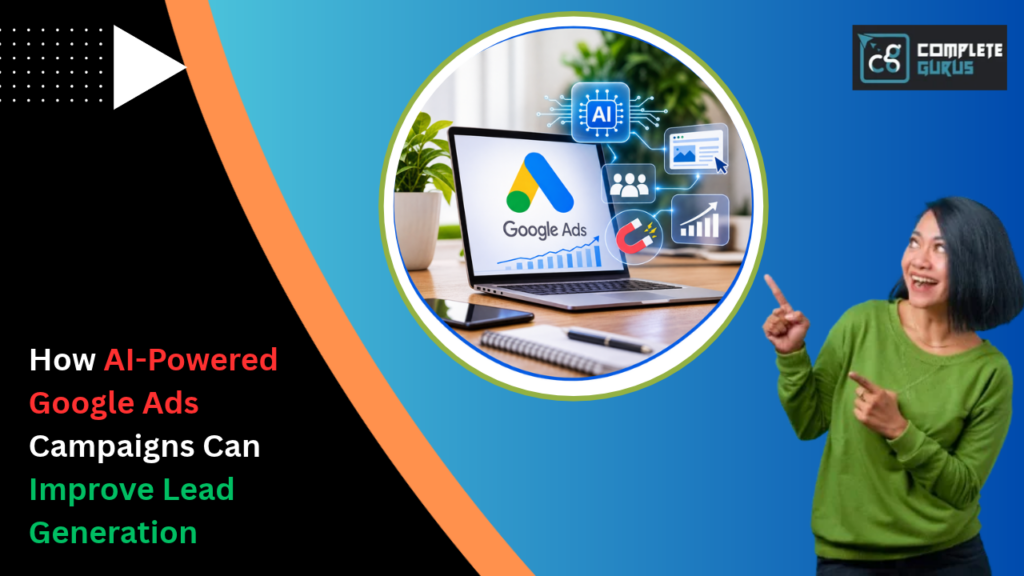
The phrase gets thrown around so casually that it has started to lose meaning, so let’s ground it. Inside Google Ads, AI shows up in several places, and each one affects your leads differently.
The first is bidding. Instead of you setting a fixed amount for a click, the system estimates, for every single auction, how likely that specific person is to convert, and then adjusts the bid up or down accordingly. Someone who has visited your pricing page twice this week and is searching from a high-intent location might get a confident bid. Someone who appears to be casually browsing might get a lower one, or none at all.
The second is creative assembly. Responsive search ads let you supply a pool of headlines and descriptions, and the system tests combinations to learn which message resonates with which kind of searcher. The third is audience modelling, where Google studies the people who have already converted for you and goes looking for lookalikes across its enormous network. The fourth is campaign-level automation, most visibly in Performance Max, which spreads your budget across Search, YouTube, Display, Discover, Gmail and Maps based on where conversions are most likely to appear.
Notice what these have in common. Every one of them learns from outcomes. They improve in proportion to the quality of conversion data they receive. If your account tells Google that a conversion is any page view, the AI will happily deliver page views. If your account tells Google that a conversion is a form submission from a qualified prospect, it will work toward that instead.
This is the single most important idea in the whole topic, and it is worth sitting with for a moment. The AI is not deciding what you want. You are, through the signals you provide. A campaign that improves lead generation is, at its core, a campaign that has been taught clearly what a good lead looks like.
Smart Bidding That Chases Leads Worth Having
Smart Bidding is probably the most direct way AI improves lead volume and efficiency, so it deserves a closer look. Strategies such as target cost per action and maximize conversions replace guesswork with prediction. Rather than treating every click as equal, the system asks a sharper question: given everything known about this searcher right now, what is the chance they become a lead, and what is that worth to this business?
Picture a regional law firm advertising for personal injury enquiries. A search from a mobile phone, late in the evening, using words like “what to do after a car accident,” carries a very different weight from a daytime desktop search for “personal injury law history.” A person could spot that distinction on a good day. The AI spots it thousands of times a day, across every device, location and query variation, and bids accordingly.
The catch is that these systems need room and patience. A bidding model that has only seen a handful of conversions cannot make confident predictions. Switching strategies every week, or slashing budgets whenever a slow day appears, resets the learning and keeps the account stuck in a loop of mediocre results. Advertisers who see the strongest gains tend to be the ones who set a sensible target, give the algorithm enough conversion data, and review performance over weeks rather than hours.
There is also a quality filter worth building in. Rather than counting every form fill equally, a well-run account can pass back information about which leads became sales-qualified or closed deals. Feeding that downstream information into Google Ads shifts the algorithm from chasing cheap leads to chasing leads that turn into revenue. This is a subtle shift on paper, but in practice it often separates an account that generates a lot of noise from one that fills the pipeline with real opportunities.
For B2B companies in particular, where one good lead can be worth many thousands, this is transformative. A cost per lead that looks high on a spreadsheet can be wonderful if those leads close at a healthy rate. Complete Gurus builds its B2B lead generation campaigns around exactly this principle, tracking the cost of a qualified lead rather than celebrating raw volume, because a sales team that speaks to buyers instead of browsers is the whole point.
Performance Max and the Art of Letting Google Find People for You
Performance Max is the campaign type that most clearly shows both the promise and the risk of AI in advertising. You hand over assets, such as headlines, descriptions, images, videos and logos, along with a goal and a budget. Google then decides where and when to show your ads across its entire inventory, from search results to YouTube to Maps.
For lead generation, this can be powerful because it reaches people in places a keyword-only campaign never would. Someone who watched a related video on YouTube yesterday and searched on Google today may be reached at both moments. Performance Max connects those dots without you having to build separate campaigns for each channel.
The risk is that it is a bit of a black box. Because the system optimizes toward whatever you define as a conversion, it can drift toward the easiest wins. If your lead form is short and anyone can fill it in, Performance Max may find large numbers of people willing to do exactly that, whether or not they are serious. Poorly structured campaigns also tend to cannibalize branded search traffic, claiming credit for conversions that would have happened anyway.
So the craft lies in structure. Strong asset groups organized around distinct services or audiences, clear audience signals that point the system toward your best customers, exclusions that keep out irrelevant traffic, and conversion tracking that reflects genuine lead quality all make a visible difference. A dentist advertising implants and a dentist advertising routine cleanings should not share the same asset group, because the intent, the value and the message are different.
This is where specialist industry experience earns its keep. Complete Gurus runs dedicated Google Ads programs for sectors like dentists, doctors, lawyers, real estate, HVAC and insurance, and the reason is practical. A campaign for emergency air conditioning repair behaves nothing like a campaign for luxury jewelry. The signals that matter, the seasonality, the way people search and the value of a single lead are all different, and an AI system trained on the wrong assumptions will optimize confidently in the wrong direction.
Better Ad Copy Without the Guesswork
Ask most advertisers how they write their ads and you will hear some version of “we try something and see.” That works, slowly. AI speeds up the seeing.
Responsive search ads allow up to fifteen headlines and four descriptions, and Google assembles them into thousands of potential combinations, showing each searcher the one most likely to resonate. Over time, the system learns that one audience responds to price and speed, while another responds to credentials and trust. It does this without anyone having to run a formal split test and wait a month for statistical significance.
For lead generation, this matters because the words in an ad do a surprising amount of filtering. An ad that says “free consultation” will attract a different crowd than one that says “book a strategy session with a specialist.” Neither is wrong, but each pulls in a different kind of person. The AI can tell you which combinations produce clicks. A human still has to decide which of those clicks you actually want.
That human judgment shapes the raw material. If you give the system fifteen near-identical headlines, it has nothing meaningful to test. If you give it a spread covering your offer, your proof, your location, your differentiators and a clear call to action, it has room to learn something useful. Strong ads typically speak to a specific problem in the searcher’s own language, mention something concrete like a response time or a guarantee, and make the next step obvious.
There is a temptation to let generative tools write everything and walk away. That tends to produce ads that sound like everyone else’s, and in a crowded auction, sounding like everyone else is expensive. The best results come from blending machine speed with real knowledge of the customer, such as the questions they ask on sales calls, the objections that stall deals and the phrases they use when describing their problem. Those details are what make an ad feel like it was written for one person rather than for a market.
Audience Signals and the Quality-Over-Quantity Problem
Anyone who has run lead generation for a few months knows the frustration of a campaign that produces plenty of enquiries and very few worth answering. Salespeople lose faith in marketing, marketing points at the lead count, and nobody is happy. AI can help here, but only if you steer it toward quality.
Audience signals are one of the best tools for that. By uploading customer lists, defining custom segments based on search behavior, and marking past converters, you give Google a starting picture of your ideal customer. The system uses that picture to find people who resemble them. This is far more efficient than casting a wide net and hoping the right fish swim in.
For B2B companies, the picture gets more interesting. Decision-makers often research quietly across many sessions before reaching out. Pairing Google Ads with LinkedIn campaigns, as Complete Gurus does for B2B clients, lets you reach the same buyer in a professional context after they have encountered you in search. The two channels reinforce each other, and the combined effect is often stronger than either alone.
Remarketing deserves a mention too. Most visitors do not convert on the first visit. AI-driven remarketing identifies who is most likely to return and shows them relevant messages at the right moment, whether that is a reminder about a service they viewed or a nudge toward a free audit. For businesses with longer buying cycles, this steady, patient presence can be the difference between a lead you capture and a lead who quietly picks a competitor.
Then there is the less glamorous side, which is negative keywords and exclusions. AI will expand reach aggressively, and part of the job is trimming what does not belong. Job seekers, students, free-resource hunters and unrelated searches can all sneak into a broad campaign. Regular review of search terms, combined with smart exclusions, keeps the machine focused on people who might actually hire you. Think of it as pruning a garden. The AI grows things quickly, and someone has to decide what stays.
When Local and Niche Businesses Use AI to Win the Phone Call
Much of the conversation about AI in advertising focuses on big eCommerce budgets, but some of the sharpest gains show up in local service businesses. A plumber, an orthodontist or a family law practice does not need a million impressions. It needs a handful of the right calls this week.
Local Services Ads and location-aware campaigns are well suited to this. Google’s systems can detect when a searcher is nearby, on a mobile device, and expressing urgency, and they can prioritize that moment. Call extensions, location assets and call-only formats then make it easy for the person to reach you in one tap. For an HVAC company on the first hot day of summer, that responsiveness is the whole game.
Timing matters enormously here. AI-based bidding can raise bids during the hours when your phones are staffed and ease off when no one is available to answer. It can also learn that Tuesday mornings produce better leads than Saturday nights for your particular business, something an owner might suspect but rarely has time to confirm. These adjustments sound small, yet they accumulate into meaningfully lower costs per lead across a month.
Healthcare and professional services come with extra sensitivity. A medical practice has to balance performance with compliance, tone and trust. Someone searching for a podiatrist or a physical therapist is often in discomfort and wants reassurance as much as information. Ads, landing pages and follow-up all have to reflect that. This is why Complete Gurus maintains focused work for healthcare and medical PPC, covering doctors, dentists, physiotherapists and podiatrists, rather than treating every client as interchangeable.
The same applies to lawyers, real estate agents and insurance agencies, where a lead is not a casual click but a person with a real and often stressful need. AI can find them quickly. What turns them into clients is what happens afterward, which brings us to the part of the funnel many advertisers neglect.
Why Landing Pages and Tracking Decide Whether AI Helps or Hurts
Here is an uncomfortable truth. You can have the most sophisticated bidding in the world and still produce poor leads if the page people land on is slow, confusing or asks too much. AI sends traffic. It cannot persuade a visitor who is staring at a cluttered page with a seven-field form and no clear reason to trust you.
Conversion rate optimization is the quiet partner of every successful AI-driven campaign. A landing page that matches the promise of the ad, loads quickly on a phone, shows proof such as reviews or results, and makes the next step effortless will convert a bigger share of the traffic you are already paying for. Even a modest lift in conversion rate lowers your cost per lead without touching the bid.
Tracking is just as vital, and often the weakest link. If calls are not tracked, if form submissions are counted twice, or if offline outcomes never make it back into the account, the AI is learning from a distorted picture. It will optimize efficiently toward whatever it can see. Clean conversion setup, with distinct values for different lead types and, where possible, imported results from your CRM, gives the algorithm an honest scoreboard.
Consider how a simple change can alter the outcome. Suppose a business counts every contact form as one conversion. A casual question about opening hours and a serious request for a ten-thousand-dollar quote carry the same weight, so the system treats them as equals. Assign higher value to the quote request, and the bidding starts leaning toward the people who submit them. Nothing about the AI changed. Only the definition of success did.
This is also where transparent reporting protects you. You should be able to see spend, leads, cost per lead and, ideally, lead quality in plain language without decoding jargon. Weekly dashboards that show what was spent, what it produced and what changed are not a luxury. They are how you keep a powerful automated system accountable to your business goals instead of its own.
The Human Layer: Why Strategy Still Matters
It would be easy to read all this and conclude that the machines have taken over and the advertiser’s job is to press a button. The opposite is closer to the truth. As the mechanical work gets automated, the strategic work becomes the thing that separates good accounts from average ones.
Someone has to decide which services to push, how to split budget between high-value and high-volume offers, what to do when a competitor changes tactics, and when a promising trend deserves more investment. Someone has to read the search terms report with a skeptical eye, notice when quality drops before the numbers show it, and question whether a metric is telling the truth. AI is excellent at optimizing within a frame. It is not good at questioning whether the frame is right.
Experience shows up in small, practical judgments. Knowing that a sudden surge in cheap conversions is probably spam. Recognizing that a seasonal dip does not mean the campaign is failing. Understanding when to be patient with a learning phase and when to intervene. These calls come from having seen many accounts across many industries, and they are very hard to replicate by following a checklist.
That is why the structure of an agency relationship matters as much as the tools. A dedicated strategist who knows your business, rather than a rotating cast of account managers, builds context over time and spots patterns others would miss. Complete Gurus works this way, assigning a dedicated strategist and holding weekly performance reviews, so the person making decisions about your campaigns genuinely understands what a good lead means for you.
It also helps to be honest about what a campaign can and cannot do. If your offer is weak, your pricing is uncompetitive or your follow-up is slow, no amount of clever bidding will fix it. A good partner will tell you that, even when it is inconvenient. The best advertising relationships are built on that kind of candor, because it keeps everyone focused on the real levers.
What to Expect in the First Ninety Days
If you decide to bring AI-powered campaigns into your lead generation, it helps to know what a sensible timeline looks like, so you can judge progress fairly and avoid panic in the early weeks.
The beginning is mostly about diagnosis and foundations. A thorough audit of the existing account reveals where money is leaking, whether through poor keyword match types, missing negatives, weak tracking or messy structure. Fixing those basics before layering on automation is far more effective than automating a broken setup. Many businesses are surprised by how much waste an honest audit uncovers, and a free Google Ads audit is a low-pressure way to see it for yourself.
Next comes the build. Campaigns are structured around your real services and goals, conversion tracking is cleaned up, assets are prepared and audience signals are loaded. Then launch, followed by a learning period during which the algorithms gather data. This stretch can feel slightly uncomfortable, because results may wobble before they settle. Resisting the urge to change everything at once is one of the most valuable habits an advertiser can develop.
As data accumulates, optimization begins in earnest. Underperforming segments are trimmed, winning messages are expanded, bids and budgets are redistributed, and landing pages are refined. By the third month, a healthy account usually shows a clearer pattern of what produces qualified leads and what does not, and decisions become sharper.
Throughout, you should expect clarity. Complete Gurus, for instance, outlines a tailored roadmap within forty-eight hours of understanding your business, covering campaign structure, keyword strategy, audience targeting, bidding approach and a ninety-day growth forecast. The agency also states a ninety-day guarantee of at least a twenty-five percent improvement in return on ad spend and a twenty percent reduction in cost per sale, and says it will continue managing at no extra charge until those benchmarks are met. Whether or not you work with them, the principle is worth borrowing. Any partner worth hiring should be willing to attach specific expectations and timelines to their work.
Suggested Reading: How to Reduce Cost Per Lead with a Conversion-Focused Meta Ads Strategy
Conclusion
AI has not made Google Ads easier so much as it has changed where the effort goes. The tedious parts, such as nudging bids, testing endless ad variations and scanning for audience patterns, are now handled by systems that do them faster and often better than any person could. What remains is the part that always mattered most: deciding what a good lead is, feeding the system honest data, building pages that earn trust, and keeping a thoughtful human in the loop to steer.
For a business owner, the practical takeaway is simple. Judge your campaigns by the quality and cost of the leads they produce, not by clicks. Make sure your tracking tells the truth. Give the automation time and clean signals. Match your strategy to your industry rather than copying a generic template. And work with people who are willing to be accountable for the results.
If you would like help turning those ideas into steady, qualified enquiries, Complete Gurus is a performance marketing agency with more than thirteen years of experience in Google Ads and Meta Ads, managing over three million dollars in annual ad spend for B2B, eCommerce and D2C brands. From Google Ads management and B2B lead generation to industry-focused programs for healthcare, legal, real estate and home services, plus SEO and AI search visibility, the team handles strategy, launch, optimization and plain-English reporting under one roof. You can start with a free audit and a strategy conversation at https://completegurus.com/.

Ashutosh Mishra is an AI Visibility & Performance Marketing Expert with 14+ years of experience helping businesses grow through AI Visibility (AEO/GEO), Google Ads, Meta Ads, and SEO. He partners with founders and business leaders to build data-driven growth strategies that increase visibility, improve marketing performance, and help businesses get discovered, trusted, and recommended in the age of AI.