
Quick Summary
If you run a neighborhood business and keep hearing that people now ask ChatGPT where to eat, who to call for a leaking pipe, or which dentist is taking new patients, here is the short version. ChatGPT Ads are sponsored placements that appear alongside answers inside the chat. They started as a limited pilot in February 2026 and opened to any U.S. business through a self-serve Ads Manager in May 2026, with no big minimum commitment. For local businesses, that means you can now put your name in front of someone at the moment they are asking for a recommendation, rather than hoping they scroll past you on a feed.
What works is a modest, well-aimed test: a clear offer, a landing page that matches the promise, honest tracking, and a budget you can afford to learn with. What does not work is copying your Facebook ad, pasting it in, and walking away. The rest of this piece walks through how the ads look to your customers, which businesses benefit most, how to set up a first campaign, what to expect with billing, and how to measure results without fooling yourself. Along the way, you will see where an agency like Complete Gurus can take the heavy lifting off your plate.
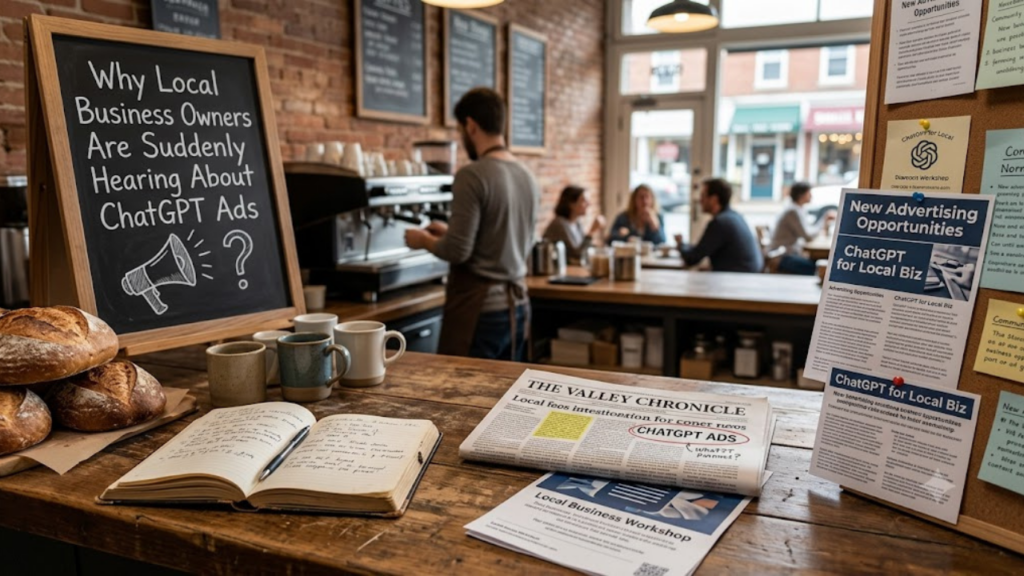
Why Local Business Owners Are Suddenly Hearing About ChatGPT Ads
Not long ago, finding a local service meant typing a few words into a search bar and scanning a page of links. Plenty of people still do that, but a growing number now describe the problem in full sentences to an AI assistant. They say things like, “My furnace is making a banging noise and it’s freezing, who should I call?” The assistant answers in conversation, and that conversation is exactly where advertisers want to be.
OpenAI began testing ads for logged-in Free and Go users in the United States in early 2026. For a few months, the door was open mostly to large brands and agency holding companies, because early access came with steep spending requirements. Then in May the company launched a self-serve Ads Manager, dropped the minimum, and added click-based bidding next to impression-based buying. That one change is why you are suddenly seeing this topic everywhere. A bakery, a dog groomer, or a three-truck plumbing company can now open an account, add a card, and run a campaign without a sales call.
There is a catch worth saying out loud. The platform is still labeled beta, rules and options have changed several times this year, and the advice floating around online can be stale within weeks. So treat what follows as a practical map rather than a promise, and confirm details inside your own account before you commit money.
What a ChatGPT Ad Actually Looks Like to Your Customer
Before you spend anything, it helps to picture the experience from your customer’s chair. Someone opens ChatGPT, asks a question, and gets an answer. Below that answer, a clearly labeled sponsored unit may appear, and that is your ad. It is not a pop-up, it does not hijack the screen, and it does not rewrite what the assistant says. OpenAI has stated that ads do not influence the organic answers, which matters for trust. People are far more forgiving of an ad that sits beside help than one that pretends to be help.
Only some people will ever see it. Ads are shown to logged-in adults in the United States on the Free and Go plans, while paying tiers such as Pro, Business, Enterprise and Edu are not shown ads. That tells you something about your audience: it skews toward everyday consumers rather than corporate subscribers, which suits most local businesses fine. A homeowner with a clogged drain is far more likely to be on a free plan than a company’s research analyst.
The ad itself is compact. You supply a headline, a short description, and a destination, and the platform decides where it fits. Because the unit is small, every word has to earn its place. The best ones read like a helpful nudge, such as a clear service, a clear area, and a clear next step, rather than a slogan. If you imagine your ad as the answer to a question someone just asked, you are already thinking about it the right way.
Which Local Businesses Stand to Gain the Most
Not every business gets equal value from this channel, and pretending otherwise would waste your money. OpenAI’s early rules limited ads to categories it viewed as lower risk, and local services sit comfortably inside that group alongside travel, entertainment, household goods, and digital or educational products. That is good news if you fix furnaces, cut hair, teach music, or cook dinner for a living.
The strongest fits are businesses where the customer arrives with a question and a deadline. Home services are the obvious example, since a person searching for an emergency electrician is not browsing for fun. Restaurants and cafes do well when people ask for somewhere to eat tonight or a spot for a birthday dinner. Fitness studios, wellness centers and salons can catch people who are asking for a plan or a place to start. Real estate agents, travel planners, tutoring centers and coaching institutes also see their customers formulate long, detailed questions, which is precisely what a chat interface invites.
Heavily regulated fields need more care. Healthcare, legal and financial services can still show up in conversations, but the messaging must be compliant, modest and careful, and eligibility rules may be stricter or still evolving. Complete Gurus, for instance, tailors its ChatGPT Ads work by industry, including restaurants, law firms, healthcare, real estate, fitness and retail, and it handles the sensitive wording for the stricter categories. If your business sits in one of those regulated corners, expect to move a bit slower and review your copy twice.
Setting Up Your First Campaign Without Overthinking It
The setup is gentler than most owners fear, but a little preparation saves a lot of frustration. You begin by creating an account at the OpenAI Ads Manager, then completing a billing profile with your business name, address and an email address that someone actually checks. Gather a few small things before you sit down: your landing page, a square logo, and your tax details if you have them. Ten minutes of gathering beats an hour of hunting.
Next comes the part that deserves real thought, which is deciding what you want the ad to do. Some businesses want phone calls, some want form submissions, some want people walking through the door. Pick one primary action and build the whole campaign around it. A campaign trying to do everything usually does nothing well. You then choose how you will buy, either by click or by impression, and set your daily budget and the topics or contexts where you want to appear. Think in terms of questions your customers ask rather than keywords they type. “Who can fix a water heater today” is a very different signal from “water heater repair.”
Your landing page deserves as much attention as the ad. Someone who clicked from a conversation expects continuity, so if the ad promised same-day service, the page should say so immediately, show a phone number, and make booking painless on a phone. A beautiful ad that lands on a slow, confusing page is the fastest way to burn a small budget. If building or fixing that page feels daunting, this is one of the places where outside help earns its keep, since the page often decides whether the click turns into a customer.
Writing Ad Copy That Sounds Like a Neighbor, Not a Billboard
People talk to AI differently from the way they scan a social feed. They are mid-thought, often slightly stressed, and they have just received a thoughtful answer. An ad that shouts feels jarring in that setting. An ad that sounds like the next sensible step feels almost like part of the conversation.
So write the way a helpful local person would speak. Name the thing you do, name where you do it, and give one reason to choose you. A family-run HVAC company might lean on fast response and honest quotes. A yoga studio might lead with a gentle first class for beginners. A tutoring center might talk about small groups and visible progress. What you want to avoid is vague puffery, like “the best service in town,” which means nothing to a person who has never heard of you. Specifics are more believable than superlatives, and believability is the whole game when a stranger is deciding whether to trust you.
It also helps to match tone to the situation. Someone asking about an urgent repair wants calm competence. Someone asking for a weekend brunch spot wants warmth and a hint of appetite. The team at Complete Gurus describes this as writing creatively the way people actually talk to AI rather than the way they scroll a feed, and that framing is useful even if you write everything yourself. Read your draft aloud. If it sounds like something nobody would say to a friend, rewrite it until it does.
Finally, test more than one version. Run two or three variations with different angles, such as speed, price clarity, or reputation, and let real behavior tell you which one resonates. Your opinion of your own copy matters far less than what the people clicking do with it.
Budget, Billing and What to Expect in the First Weeks
Money is where many owners hesitate, so let us be plain about it. Reports from the past few months suggest a daily floor of roughly twenty-five dollars per campaign in the U.S., with click prices cited in a few-dollar range and impression pricing sitting above many social platforms. Treat every one of those as a ballpark. OpenAI does not publish a neat rate card, and your own account will show the real minimums and currency for your market.
Billing works differently from what many people picture. Self-serve accounts generally run on a credit card saved inside Ads Manager, and charges come after your ads have run rather than from a prepaid balance. Your account is assigned a threshold, and once your unpaid spend reaches it, the card is charged and the cycle restarts. That means your costs may arrive in a few larger chunks instead of a smooth daily trickle, so plan around payroll and rent. A temporary authorization hold may also appear when you first add the card, which surprises people with low limits. Keep a card with comfortable headroom, and keep it current, because a failed payment can pause delivery and cost you momentum.
As for timing, think of the first month as tuition. Complete Gurus describes running early ChatGPT campaigns as structured tests, with initial traffic data usually showing up within two to three weeks and clearer patterns emerging around weeks six to eight. That is a sensible expectation for any new channel. Start small, watch how quickly your spend accumulates, learn the rhythm of your charges, and only then think about turning the dial up.
Measuring Whether It Is Working
Clicks feel good, but clicks do not pay the electric bill. The question that matters is how many calls, bookings, form fills or visits came from the ads, and what each one cost you. To answer it, you need tracking in place before you launch, not after.
OpenAI offers conversion measurement tools, including a pixel you add to your site and a server-side option for sending conversion events, and campaign types that steer delivery toward conversions have become available in recent months. Even if all of that sounds technical, the principle is simple: tell the platform what a good outcome looks like, and record when one happens. For a plumber, that might be a tapped phone number. For a salon, a completed booking. For a restaurant, a reservation request or a click for directions.
Do not forget the offline side. Many local customers will see your ad, then simply call, or walk in a week later without ever clicking. Ask every new customer how they found you, and give your staff an easy way to log the answer. A basic habit like that fills in gaps that digital tracking cannot see. Pair it with a dedicated phone number or a specific offer code on the landing page, and you will get a much more honest picture of what the channel is really delivering.
Be patient with the numbers, too. Early data is noisy, and a handful of conversions can mislead you in either direction. Look for trends over several weeks rather than reacting to a single good or bad day.
Pairing ChatGPT Ads With Local SEO and Your Existing Ads
Here is a point that gets lost in the excitement: paid placement inside ChatGPT is only one way your business can appear there. The assistant also pulls in what it knows about local businesses from across the web, and that comes from signals you already control, such as your Google Business Profile, your reviews, your website, and how consistently your name, address and phone number appear across directories. Many specialists argue that for a typical local business, strengthening those foundations and running Google Ads should come before betting heavily on a brand-new channel. That is sound advice.
The smartest approach treats the channels as a team. Local SEO builds the organic reputation that helps AI tools recommend you without a paid placement. Google Ads captures the person typing a quick search. ChatGPT Ads reach the person describing a problem in conversation. And retargeting on Google or Meta can bring back anyone who discovered you through a chat but was not ready to book. Complete Gurus builds exactly this kind of connected setup, with local SEO, Google Ads for industries such as HVAC, dentists and lawyers, Meta Ads, and its AI search work around answer engine and generative engine optimization sitting alongside its ChatGPT Ads service.
An AI search visibility audit is a clever first step here. It looks at how ChatGPT currently describes your business and your competitors, and it reveals gaps in the content and citations that keep you out of its answers. Knowing that before you spend a dollar on ads helps you decide whether your problem is awareness, trust, or simply a messy online presence that needs cleaning up first.
Mistakes Local Businesses Make Early On
Most early missteps are not dramatic. They are small habits that quietly drain a budget. The most common one is launching without any way to measure outcomes, which turns the whole experiment into guesswork. A close second is sending traffic to a generic homepage instead of a page built for the specific promise in the ad, which leaves visitors hunting for what they came for.
Another trap is trying to advertise every service at once. A contractor who lists plumbing, drains, water heaters, remodeling and emergency calls in one campaign dilutes the message and confuses the targeting. Start with the one service that earns you the best margin and the most repeat work, prove it, and expand from there. Owners also tend to judge results too soon, pausing after a few quiet days, or too late, letting a weak campaign run for weeks because they are afraid to touch it.
There is also a quieter risk around billing and compliance. Letting a card expire, mismatching your billing country with your account, or writing claims that a regulated industry should not make can all halt your campaigns at the worst moment. Finally, resist the urge to copy your competitor. If they are testing something, you are seeing the middle of their experiment, not the result. Run your own small tests, keep notes, and trust your own numbers over anyone else’s bravado.
When It Makes Sense to Bring in Help
Plenty of small owners can run a modest campaign themselves, and the self-serve design is meant to allow that. But there is a point where your time is better spent running your business than studying a beta dashboard that changes every few weeks. If you are managing a tight budget, juggling several locations, or operating in a regulated field where wording matters, a specialist can save you real money by avoiding the expensive trial and error.
What should you look for? Someone who builds around conversational intent rather than recycling a search or social playbook, who ties reporting to calls, leads and sales rather than vague impressions, and who is honest about what is still unproven in a young channel. Complete Gurus describes its ChatGPT Ads work in just those terms: campaign strategy and placement planning, conversational ad creative, brand and product visibility setup, an AI search visibility audit, cross-channel retargeting, and structured testing with transparent reporting. The agency also talks about onboarding in a handful of business days and weekly dashboards, and it runs a free audit that gives you a low-pressure look at where you stand before you commit to anything.
Whichever route you choose, keep ownership of your own ad account and billing. Your card, your account, your data. An agency should work inside that arrangement as an invited partner rather than holding everything on your behalf, and any good one will say so without being asked.
Suggested Reading: Medical Test Prep Google Ads: What to Track Beyond Clicks and Impressions
Conclusion
ChatGPT Ads give local businesses something genuinely new: a way to appear at the exact moment a neighbor describes a problem and asks for a recommendation. The door is open to small businesses now, the entry cost is manageable, and the categories most local owners work in are among those currently permitted. At the same time, the platform is young, the rules keep shifting, and the smartest operators treat it as one piece of a bigger picture rather than a silver bullet.
So begin modestly. Pick one service, write one honest offer, build one matching landing page, set up tracking before you spend, and give the test a few weeks to teach you something. Keep your local SEO, your reviews and your Google presence healthy, because those feed the same AI assistants that now shape how people choose. Learn from what happens, adjust, and scale only what proves itself.
If you would rather have experienced people handle the strategy, creative, setup and reporting, Complete Gurus can guide you from the first audit through ongoing optimization, connecting ChatGPT Ads with local SEO, Google Ads and Meta Ads so every dollar works together. Visit https://completegurus.com/ to explore their services and request a free audit to see where your business stands today.

Ashutosh Mishra is an AI Visibility & Performance Marketing Expert with 14+ years of experience helping businesses grow through AI Visibility (AEO/GEO), Google Ads, Meta Ads, and SEO. He partners with founders and business leaders to build data-driven growth strategies that increase visibility, improve marketing performance, and help businesses get discovered, trusted, and recommended in the age of AI.