
Quick Summary
Google Ads can help mobile apps overcome the visibility challenge that often follows launch by putting them in front of relevant potential users rather than waiting for organic discovery. The blog explains how effective app advertising goes beyond simply generating clicks or downloads: audience targeting, ad messaging, keyword research, bidding, conversion tracking and continuous testing all play a role in attracting users who are more likely to install and actually engage with the app.
The key lesson is to treat Google Ads as an ongoing optimisation process rather than a one-time campaign. By testing different messages and audiences, monitoring acquisition costs, improving the app-store listing and connecting paid advertising with ASO, SEO and other channels, app owners can focus on acquiring valuable users rather than chasing download numbers alone.
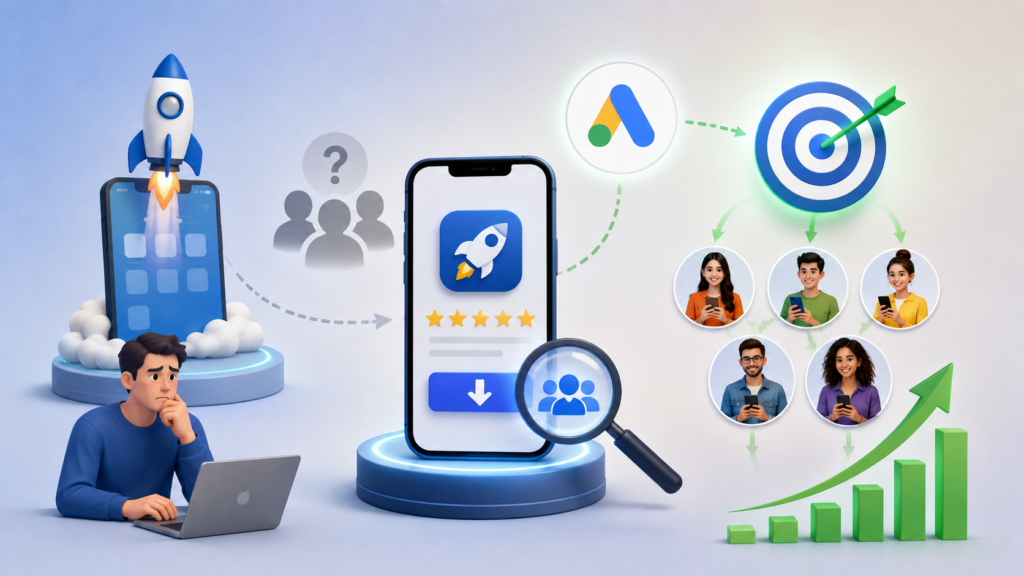
Launching a mobile app can feel like the hardest part of building a digital business. You spend months thinking about the idea, working with developers, testing features, fixing bugs, improving the interface, and finally publishing the app. Then comes the moment you have been waiting for: people can download it.
But there is often an uncomfortable silence after launch.
The app is live, the product is ready, and yet the download numbers are nowhere near where you expected them to be.
That was the problem I faced. I initially believed that having a useful app would naturally bring users. It did not. There were countless other apps competing for attention, and simply being available on an app store was not enough. I needed a way to put the app in front of people who were actually interested in what it offered.
That was when I started looking seriously at Google Ads.
Instead of waiting for users to discover my app organically, paid advertising gave me a way to reach potential users much faster. More importantly, it allowed me to learn who was responding to the app, which messages worked, and where my advertising budget was actually producing results.
The experience changed the way I looked at app marketing. Google Ads was not simply a tool for buying downloads. When managed properly, it became a way to connect the right audience with the right app at the right moment.
The Real Problem Was Not the App
Before running advertising, I made the mistake many app owners make. I assumed low downloads meant something was wrong with the application itself.
Sometimes that is true. But sometimes the real problem is visibility.
Think about having an excellent shop in a busy city but no sign outside. The products may be fantastic, the prices may be competitive, and the customer experience may be excellent. Yet people cannot buy from you if they do not know the shop exists.
Apps face the same problem.
The mobile marketplace is crowded, and users have countless choices. Even a well-designed application can disappear among competitors if its visibility is poor. Organic discovery can take time, particularly for a new app without an established audience, reviews, backlinks, brand recognition, or search presence.
Google Ads helped solve the visibility problem.
Instead of hoping someone would stumble across my app, I could actively introduce it to people who were already searching for relevant solutions or showing interest in related products and services.
That distinction made a huge difference.
Google Ads Put My App in Front of the Right People
Getting thousands of impressions sounds impressive until you realize that impressions do not automatically create downloads.
What I actually needed were relevant users.
A person who has no interest in my app is unlikely to install it simply because they see an advertisement. The more valuable audience consists of people who have a reason to care about the application.
This is where targeting becomes important.
Google Ads allows app promotion campaigns to be structured around audiences, interests, search behavior, and other signals. The objective is not simply to expose an app to as many people as possible. It is to increase the likelihood that the people seeing the promotion will take the next step.
That changed the way I thought about advertising.
Instead of asking, “How many people saw my ad?” I started asking better questions.
Did the right people see it? Did they click? Did they install? Did they actually use the app afterward? Was the cost of acquiring those users reasonable?
Those questions are far more useful when the goal is sustainable growth.
The First Campaign Was a Learning Exercise
I initially thought launching a Google Ads campaign would be straightforward. Create an advertisement, choose an audience, set a budget, and wait for downloads.
In reality, successful app advertising requires considerably more attention.
Campaign structure matters. Creative messaging matters. Targeting matters. Bidding matters. Tracking matters. Even small changes can affect performance.
A campaign can generate plenty of clicks while producing disappointing installations. Another campaign may generate fewer clicks but attract users who are much more likely to install and engage.
That is why I stopped treating the first campaign as a final solution.
It became a learning process.
The data showed me which messages attracted attention and which ones failed. It helped reveal what potential users responded to and where the advertising journey needed improvement.
That mindset is especially valuable for businesses that are new to paid advertising. You do not necessarily discover the perfect campaign on day one. You build toward it through testing and optimization.
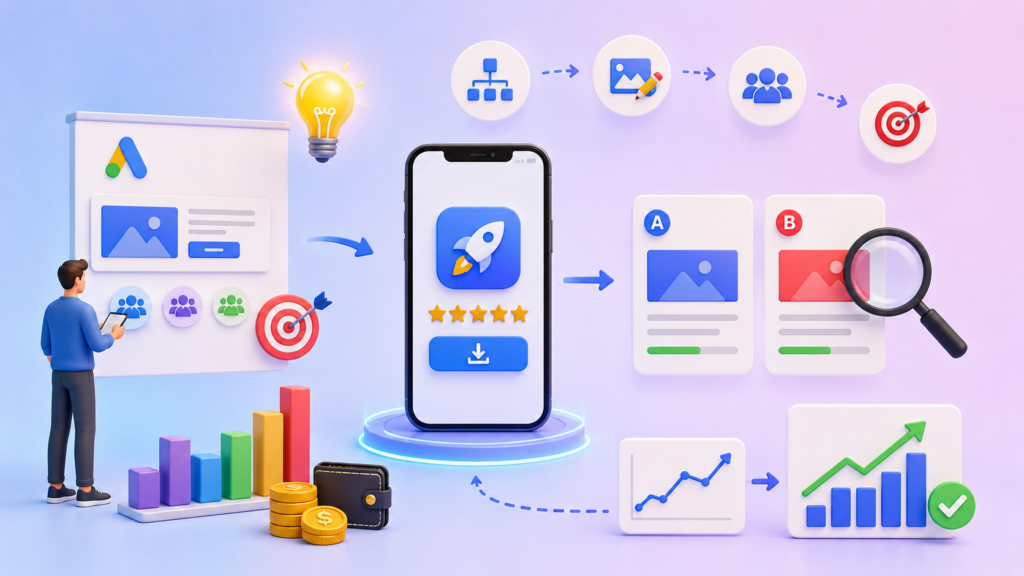
Better Ad Copy Made a Noticeable Difference
One of the easiest mistakes to make with app advertising is talking too much about the product and too little about the user’s problem.
Users do not necessarily care that an app has twenty features. They want to know what the application can do for them.
So instead of creating generic messages, the advertising needs to communicate a clear benefit.
If an app saves time, say that. If it simplifies a complicated process, make that obvious. If it provides personalized experiences, explain why that matters. If it solves a frustrating problem, the advertisement should speak directly to that frustration.
Complete Gurus’ mobile app Google Ads service specifically includes ad copy creation and testing, with the aim of identifying messaging that can better encourage installs and conversions.
That approach is important because there is rarely one perfect message for every potential user.
Testing different versions can reveal which value proposition actually connects with the market.
Keyword Research Helped Me Understand User Intent
Another lesson I learned was that keywords are more than advertising terms.
They provide clues about what people want.
When someone searches for something related to the problem my app solves, there is already an element of intent behind that search. Understanding those searches can help shape advertising messages and the broader marketing strategy.
Good keyword research can reveal the language customers naturally use instead of the terminology a business assumes they use.
That difference can be surprisingly important.
Complete Gurus includes keyword research as part of its mobile app Google Ads services, using relevant search terms to help campaigns reach potential users looking for comparable solutions.
For an app owner, this can provide more than a list of keywords. It can offer a better understanding of customer behavior.
Tracking Downloads Changed Everything
Before advertising, I was mostly looking at download numbers.
After advertising, I began looking at the journey behind those numbers.
How many people saw the promotion? How many interacted with it? How many installed the app? What did each acquisition cost? Which campaigns generated stronger results?
That information transformed advertising from guesswork into something measurable.
Performance tracking is one of the areas Complete Gurus highlights in its mobile app advertising service. Campaign reporting can include impressions, clicks, conversions, and cost-per-acquisition data.
For someone investing real money into advertising, this matters enormously.
If you cannot understand where your budget is going, it becomes difficult to decide what to increase, what to reduce, and what to stop.
Lowering the Cost of Each Download Matters
More downloads are useful, but downloads alone do not determine whether an advertising campaign is successful.
Imagine spending a large amount of money to generate downloads that never turn into active users. On paper, the campaign may look successful because the install count increased. In reality, the business may be losing money.
That is why cost efficiency became one of my biggest concerns.
The goal was not simply to buy more installations. It was to acquire users at a cost that made sense for the business.
Bid management plays an important role here. Complete Gurus describes ongoing bid optimization based on factors such as keyword performance, audience engagement, and competitive activity.
This kind of continuous management is important because advertising conditions do not remain static.
Competition changes. User behavior changes. Some audiences become more expensive. Some advertisements become less effective.
A campaign that worked well last month may need adjustments today.
Google Ads Works Better When Your App Store Listing Is Ready
There is another part of the journey that app owners sometimes overlook.
Getting someone to the app store is only half the battle.
The listing needs to convince that person to download.
If the screenshots are weak, the description is unclear, the value proposition is confusing, or the overall presentation looks unfinished, paid traffic can be wasted.
This is why Google Ads and App Store Optimization should not be treated as completely separate activities.
Complete Gurus also works around ASO, and its resources highlight how optimizing an app’s store presence can support stronger visibility and installation performance.
The idea is simple: advertising can bring attention to the app, while a stronger store listing can help turn that attention into action.
When both sides work together, the marketing journey becomes much more efficient.
Testing Became More Important Than Guessing
One of the biggest changes in my approach was learning to test instead of assuming.
I could have spent weeks debating which headline sounded better. But data could answer the question much faster.
Different messages can be tested. Different audiences can be compared. Bidding approaches can be adjusted. Campaign performance can be reviewed and refined.
Complete Gurus emphasizes A/B testing and data-driven decisions within its mobile app advertising approach.
This is particularly valuable for app businesses because customer preferences are not always obvious from inside the company.
The team building the app may love a particular feature. Customers might care about something completely different.
Advertising data can help close that gap.
The Bigger Opportunity Was Beyond Downloads
Once the campaign started producing more visibility, I realized that app marketing should not stop at installation.
A download is an important milestone, but it is not necessarily the final business outcome.
For some apps, the real goal may be a subscription. For others, it could be a purchase, booking, appointment, lead, account registration, or recurring engagement.
That means the advertising strategy should ultimately connect with the business model.
Complete Gurus approaches digital marketing as a broader performance-focused discipline rather than treating advertising as an isolated activity. Its services include Google Ads, Meta Ads, SEO, AEO, GEO, and third-party marketplace management.
For a growing business, this broader perspective can be useful because customers rarely follow a perfectly straight path.
Someone might discover an app through an advertisement, search for the brand later, visit the website, compare alternatives, and finally install the application.
A strong digital strategy needs to understand that journey.
Why Professional Campaign Management Can Make a Difference
Running Google Ads yourself is possible. But managing campaigns effectively while also running an app business can become difficult.
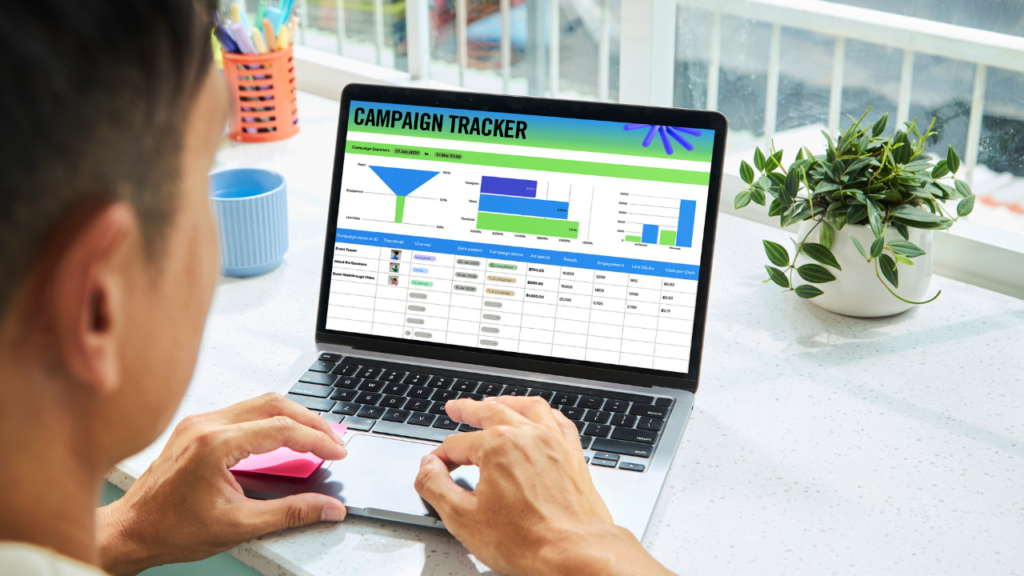
There are dashboards to monitor, targeting decisions to make, creative variations to test, bids to adjust, conversion data to interpret, and market changes to follow.
Then there is the bigger question: what should happen next?
This is where specialist expertise can become valuable.
Complete Gurus states that it manages campaigns end-to-end, from strategy and campaign building through optimization and reporting. The company also says it manages more than $3 million in annual ad spend and has more than 13 years of Google Ads and Meta Ads experience.
For an app owner who wants to concentrate on product development and customer experience, having experienced professionals handle the advertising side can reduce the burden of constant campaign management.
Google Ads Did Not Replace Organic Growth
Another important lesson was that paid advertising should not be viewed as a replacement for organic marketing.
Paid campaigns can provide speed.
Organic strategies can provide lasting visibility.
ASO can improve an app’s ability to attract users through app-store discovery. SEO can strengthen the broader online presence. Content can answer customer questions and build trust. Meta Ads can support awareness and retargeting.
These channels can complement each other.
The strongest app growth strategy is therefore not necessarily about choosing one marketing channel and ignoring everything else. It is about understanding what each channel does well and using them together intelligently.
What I Would Do Differently If I Started Again
If I were launching the app again, I would think about marketing much earlier.
I would define the ideal customer before spending money. I would make sure conversion tracking was properly planned. I would improve the app store listing before sending significant paid traffic to it. I would create multiple advertising messages instead of relying on one idea.
Most importantly, I would not judge the campaign based on downloads alone.
I would look at the quality and value of the users being acquired.
That shift from chasing numbers to measuring meaningful outcomes is probably the most important lesson I took away from the experience.
Suggested Reading: How Facebook Ads Helped Me Sell Properties Faster
Conclusion
Getting an app downloaded faster is not simply a matter of putting an advertisement in front of as many people as possible. It is about creating a connection between a real customer need and a product that can solve it.
Google Ads gave my app something organic discovery could not provide immediately: speed, measurable visibility, and the ability to reach relevant audiences while the app was still building its presence.
But the advertising itself was only one part of the process. Strong messaging, audience targeting, keyword research, bid optimization, performance tracking, testing, and app-store optimization all contributed to making the journey more effective.
For app owners struggling with low downloads, the bigger question should not be, “How can I get more clicks?” It should be, “How can I attract the right users and give them a reason to stay?”
That is where performance marketing becomes much more than advertising.
If you are looking for professional support to promote your mobile app, optimize Google Ads campaigns, improve acquisition efficiency, or connect paid advertising with a broader digital growth strategy, Complete Gurus offers services across Google Ads, Meta Ads, SEO, AEO, GEO, and other performance marketing solutions. Its mobile app advertising service covers campaign setup, ad copy testing, keyword research, bid management, performance tracking, and adaptive optimization, giving businesses a structured approach to growing visibility and attracting more valuable users.

Ashutosh Mishra is an AI Visibility & Performance Marketing Expert with 14+ years of experience helping businesses grow through AI Visibility (AEO/GEO), Google Ads, Meta Ads, and SEO. He partners with founders and business leaders to build data-driven growth strategies that increase visibility, improve marketing performance, and help businesses get discovered, trusted, and recommended in the age of AI.