
Quick Summary
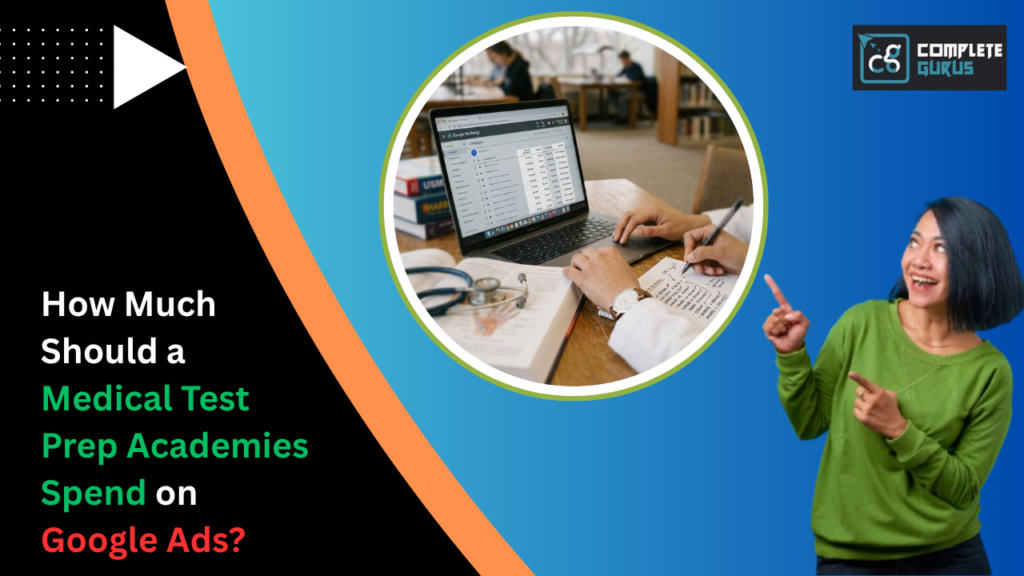
If you run a medical test prep academy and you are wondering how much to put into Google Ads, here is the short version. There is no magic monthly number. The right budget comes from working backwards: what one enrolled student is worth to you, how many students you want to add, and how many leads it takes to get each one. Most small academies start somewhere between fifteen hundred and three thousand dollars a month in ad spend. Mid-sized programs often land between four and ten thousand. Larger multi-exam brands can justify well beyond that. Those are ballpark figures, not promises, because cost per click, competition and course price all move the answer.
What matters more than the headline number is how the money is used. Spending weeks before registration deadlines, tight keyword targeting, landing pages that speak to anxious students, and tracking that follows a lead all the way to enrollment will stretch a small budget much further than a big, unfocused one. The rest of this article walks through how to think about all of it, in plain language.
Why This Question Is Harder Than It Looks
Most owners ask about the budget the way they would ask about rent: what is the going rate? Advertising does not work like that. Two academies can spend the same five thousand dollars in the same month and get completely different outcomes, because one sells a premium, high-touch course and the other sells a low-priced question bank, or because one has a landing page that converts and the other sends people to a homepage that tries to say everything at once.
Medical test prep also has quirks that generic advice ignores. Your audience is stressed, methodical and comparing three or four providers at once. They search in bursts around exam dates, score releases and application cycles. A student preparing for the USMLE, the MCAT, NEET or a nursing licensure exam is making a decision that feels tied to their career, so they read carefully and hesitate. That means your clicks are often expensive, your sales cycle is longer than in most consumer categories, and a lot of your budget is quietly spent on people who are still just browsing.
So before you ask what to spend, it helps to accept that the question really has three parts: what you can afford to spend per student, what the market will charge you per click, and how well your funnel turns clicks into paying students. Get those three right and the monthly budget more or less falls out on its own.

Start With Your Numbers, Not Google’s Suggestions
Google will happily suggest a daily budget. It is usually higher than you need to start, and it says nothing about your economics. The better starting point is a plain look at what a student is worth to your business.
Take your average course fee and subtract the real cost of delivering it: instructor time, platform costs, materials, support staff. What is left is your gross profit per student. If a student pays twelve hundred dollars and it costs you around four hundred and eighty to serve them, you are working with about seven hundred and twenty dollars of gross profit. That is the pool from which every advertising dollar has to be paid.
Next, decide what share of that profit you are willing to hand over to win the student. Many academies are comfortable spending a third or so of first-course profit on acquisition, especially if students often buy a second package, a retake course or a refresher. If your students tend to come back, you can be more generous. If it is a one-time purchase, be stricter. In this example, a third of seven hundred and twenty is about two hundred and forty dollars, and that becomes your target cost per enrolled student.
This is the number that anchors everything else. Once you know it, you stop asking whether a hundred dollars a day is too much or too little, and start asking whether the campaign is producing students at or below your target. That shift alone saves most academies from both overspending and underspending.
A Worked Example Using Real-World Logic
Let me walk through how this plays out with numbers that resemble what many academies see. They are illustrative, so swap on your own.
Suppose your target cost per enrolled student is two hundred and forty dollars. Suppose about eight out of every hundred qualified leads eventually enroll, which is a reasonable expectation when the sales process involves a call, a demo class or a free diagnostic test. That means you need roughly twelve to thirteen leads for each enrollment, and your cost per lead cannot exceed about nineteen or twenty dollars if you want to hit your target.
Now look at the ad side. If your average click costs three and a half dollars, which is not unusual for competitive medical exam keywords, and your landing page turns ten percent of visitors into leads, each lead costs you thirty-five dollars. That is well above your ceiling, and you would lose money on every student even though the campaign looks busy and the click numbers seem healthy.
You have three levers. You can lower the cost per click by tightening keywords and improving relevance. You can raise the landing page conversion rate from ten percent to fifteen or eighteen. Or you can raise the lead-to-enrollment rate through better follow-up. Improving all three modestly often beats trying to fix one dramatically. If clicks fall to three dollars, the page converts at fifteen percent, and follow-up lifts enrollment to ten percent, your cost per lead drops to twenty dollars and your cost per student to two hundred. Same market, same course, very different economics.
Once the funnel works on paper, the budget becomes a growth decision. If you want twenty new students a month at two hundred and forty dollars each, you need around forty-eight hundred dollars in ad spend, and it is sensible to add fifteen or twenty percent on top for testing new keywords and messages.
What Typical Budget Ranges Look Like
With those principles in place, ranges become useful, as long as you treat them as starting points rather than rules.
A newer or single-exam academy, perhaps preparing students for one licensing test in one region, can often get meaningful data from fifteen hundred to three thousand dollars a month. That is enough to run a tight search campaign on your most valuable keywords, learn which messages attract real students, and collect a few dozen leads to judge quality. Going lower than this often produces so little data that you cannot tell whether the campaign is failing or simply has not had a chance.
An established academy with several courses, or one competing in a crowded market such as USMLE Step preparation or MCAT tutoring, usually needs somewhere between four and ten thousand dollars a month. At this level you can run separate campaigns for each exam, add a remarketing layer for people who visited but did not enroll, and test different offers such as free diagnostic tests, trial classes or scholarship windows.
Larger brands with a national or international reach, multiple exams and a proper admissions team can rationally invest well beyond ten thousand a month, provided the numbers behind each campaign hold up. At that scale the question stops being what to spend and becomes where the next dollar earns the most.
One general rule of thumb many education businesses use is to keep total marketing at roughly a tenth of revenue, give or take, with paid search taking a chunk of that depending on how much you rely on organic traffic, referrals and partnerships. If your academy brings in four hundred thousand dollars a year, spending several thousand a month on search is not reckless; it is inside a fairly ordinary range. If you are spending half your revenue on ads, something is off, either in your pricing, your funnel or your targeting.
The Exam Calendar Should Shape Your Spending
Here is where medical test prep differs sharply from most industries. Your demand is not flat. It rises and falls with registration windows, exam dates, score release dates and admission cycles, and a smart budget follows that rhythm instead of dividing the annual amount by twelve.
Think about a student preparing for a spring exam. Search interest usually starts building months earlier as people begin researching providers, spikes when registration opens, stays high through the intensive study period, and then falls sharply after the test. Students who have just finished are unlikely to buy a prep course, though they might be interested in retake support once results arrive.
This suggests holding back during quiet weeks and pushing hard when interest peaks. Many academies keep a baseline budget year-round to stay visible and gather data, then increase it by fifty percent or even double in the weeks around key deadlines. Just as important is planning for the reverse: when a score release causes a wave of students who did not pass, retake-focused campaigns can be some of the most efficient you will ever run, because those people know exactly what they need.
If you run programs for several exams, stagger your budget across them. A NEET campaign and a USMLE campaign will not peak at the same time, and giving each its own budget and calendar prevents one from starving the other. It also means that when you review results, you are comparing like with like rather than blending a busy season with a slow one and getting an average that describes nothing.
Where the Money Should Actually Go
A budget only works if it is pointed at the right searches. This is where a lot of academies waste money without noticing, particularly when they let Google’s broad suggestions run unchecked.
Consider the difference between someone searching for a general term like USMLE and someone searching for an online USMLE Step 1 prep course with live classes. The first person might be a student in their first year, a parent, a researcher or someone curious about the exam. The second person is ready to compare providers and probably has a budget in mind. The second search costs more per click but is far more likely to become a student, and it deserves the bulk of your early budget.
Negative keywords matter just as much. Adding terms like free, pdf, jobs, salary, syllabus or previous year papers as exclusions keeps you from paying for people who want to study for nothing or who are not in a buying frame of mind. Some academies discover that a surprising share of their first month’s spend went to searches like these, simply because nobody had blocked them.
Location and language deserve attention too. If you teach online to students in specific countries, restrict your targeting to those places and consider setting different bids by region, because cost per click and enrollment value can differ enormously. A student in one market may be willing to pay a premium course fee while another expects a much lower price point, and treating them identically means you will overpay in one place and underbid in another.
Automated formats such as Performance Max can be useful once you have solid conversion data, but they are a poor first move for a small budget. They need volume to learn, and without it they can drift toward cheap, low-quality conversions. Starting with well-structured search campaigns and layering automation later gives you far more control.
Why Good Budgets Still Leak at the Landing Page
You can spend the right amount, on the right keywords, in the right season, and still lose money if the page a student lands on does not do its job. Landing pages are the most underrated part of the whole equation, and they directly change what your budget needs to be.
Picture the student clicking your ad. They are probably comparing you against several other providers in adjacent tabs. They want to know quickly whether you cover their exam, whether your instructors are credible, what results past students have seen, how classes are delivered and what it will cost. If the page makes them hunt for these answers, they leave. If it answers them within a few seconds and offers a simple next step, such as booking a free diagnostic test or a demo session, they stay.
Small improvements here have an outsized effect. Raising a page conversion rate from ten percent to fifteen is equivalent to cutting your cost per click by a third, without touching the ad account at all. Clear proof, such as score improvements, student stories and transparent course details, helps enormously in a category where trust is everything. A short form and a visible phone or chat option also help, because many prospective students have specific questions before they commit.
Speed and mobile experience matter as well. A large share of students browse and even submit inquiries on their phones, often late at night after a long study session. A page that loads slowly on mobile quietly burns through your budget in a way no report will flag unless you look for it.
Following a Lead From First Click to Enrollment
Here is a mistake that costs academies more than almost any other: judging campaigns by leads instead of by enrolled students. A form submission is not revenue. It is a name and a phone number, and the gap between that and a paid enrollment is where budgets are won or lost.
Imagine two campaigns. One produces a hundred leads at fifteen dollars each. Another produces sixty leads at twenty-five dollars each. On a dashboard, the first looks better. But if the first attracts casual browsers who never answer the phone and the second attracts serious students who book calls and enroll, the second campaign is the one paying for your growth. You will only know this if you connect your ad data to what happens after the lead arrives.
That means recording the source of every inquiry, tracking whether the lead was contacted, whether they attended a demo, whether they enrolled and how much they paid. Even a simple spreadsheet, kept honestly, can reveal which keywords, exams and messages produce students and which just produce noise. More advanced setups pass enrollment data back into Google Ads so the system learns to find more people like your real students rather than more people who fill in forms.
Speed of response is part of this too. Students who inquire and hear nothing for two days often enroll with whoever called first. If your budget generates leads that your team cannot follow up on quickly, the fix is not more ad spend; it is a faster process. Fixing that can lift your enrollment rate and lower your effective cost per student without spending an extra dollar.
Budgeting for Management, Testing and the Learning Phase
When people think about ad budgets they often forget two things: the cost of running the campaigns and the cost of learning. Both are real, and both affect what you should set aside.
If you manage the account yourself, your cost is your time, and time spent tinkering with bids is time not spent teaching or supporting students. If you hire an agency or a specialist, the fee usually sits on top of the ad spend. That fee can seem large next to a small budget, so it is worth asking what you get for it: a build tailored to your exam categories, regular optimization, clear reporting and someone who will tell you honestly when something is not working. A cheap, hands-off setup that wastes a third of your spend costs more than a well-run one, no matter what the invoice says.
The learning phase is the other hidden cost. In the first four to eight weeks, you are paying to discover what works: which keywords convert, which ads resonate, which pages hold attention. Expect some of that spend to produce little or nothing, and plan for it. Academies that panic after two weeks and pull the plug usually never see the benefit, because they leave before the data becomes useful. It is far better to commit to a defined test period with a fixed amount, review honestly at the end, and then decide whether to scale, adjust or stop.
Build a small testing reserve into your monthly figure, perhaps ten to twenty percent, and use it deliberately. Try a new exam category, a different offer, a fresh landing page. Treat it as research and you will make better choices with the rest of your money.

Knowing When to Scale Up and When to Pull Back
Once campaigns are running, the budget question does not go away; it simply changes shape. The sensible answer is to let performance guide you rather than hope or fear.
If your cost per enrolled student is comfortably under target and your campaigns are not running out of eligible searches, that is a green light to increase spend gradually. Bumping budgets by around twenty percent at a time, rather than doubling overnight, gives the system room to adjust and gives you time to notice if quality slips. Watch whether your cost per student stays steady as volume grows, because it often creeps up when you exhaust the best keywords and start reaching for weaker ones.
If costs are above target, resist the urge to cut everything at once. Look first at where the problem sits. Is the click cost too high? Is the landing page underperforming? Is your team slow to follow up? Sometimes the answer is to reduce spending on one weak campaign while protecting a strong one, rather than a blanket cut that starves the good along with the bad.
Also keep an eye on competitors and seasonality. If a large provider suddenly bids aggressively on your core terms, your costs will rise even if nothing on your side has changed. In those moments, shifting effort to more specific keywords, stronger offers or remarketing to people who already know you can protect your margins better than simply spending more.
Suggested Reading: How Long Does ChatGPT Ads Approval Take?
Conclusion
So, how much should a medical test prep academy spend on Google Ads? The honest answer is enough to reach your target number of new students at a cost per enrollment you can afford, and not a dollar more until the numbers justify it. For many smaller academies that means starting in the low thousands per month; for larger ones, considerably more. But the figure matters far less than the thinking behind it. Know what a student is worth, work backwards to an allowable cost per lead, follow the exam calendar, aim at high-intent searches, build pages that reassure nervous students, and track results all the way to enrollment. Do those things and even a modest budget can perform like a much larger one.
If you would rather not work all of this out alone, Complete Gurus is a performance marketing agency with over thirteen years of experience in Google Ads, Meta Ads, SEO and AI search visibility, and it offers dedicated digital marketing for medical test prep companies. The team builds a tailored growth roadmap, reports weekly on spend, leads and return in plain English, and backs its work with a 90-day performance guarantee. You can start with a free Google Ads audit to see where your current budget may be leaking, and then explore related services such as Medical SEO, landing page design and paid campaign management to bring more qualified students through your doors. Visit https://completegurus.com/ to book a strategy call and get a clear view of what your academy should be spending and where.

Ashutosh Mishra is an AI Visibility & Performance Marketing Expert with 14+ years of experience helping businesses grow through AI Visibility (AEO/GEO), Google Ads, Meta Ads, and SEO. He partners with founders and business leaders to build data-driven growth strategies that increase visibility, improve marketing performance, and help businesses get discovered, trusted, and recommended in the age of AI.