
Quick Summary
This blog explains how a travel business can use digital marketing to move beyond a local customer base and generate valuable international leads. It highlights how Instagram, Facebook and Meta Ads can help travel businesses showcase destinations, target specific audiences and turn inspiration into enquiries, while useful travel content builds trust and positions the business as an expert.
The article also emphasizes that social media works best as part of a connected digital customer journey. SEO, Google Ads, content marketing, website optimisation, analytics and email follow-up can work together to attract the right audiences, build confidence and convert international enquiries into customers.
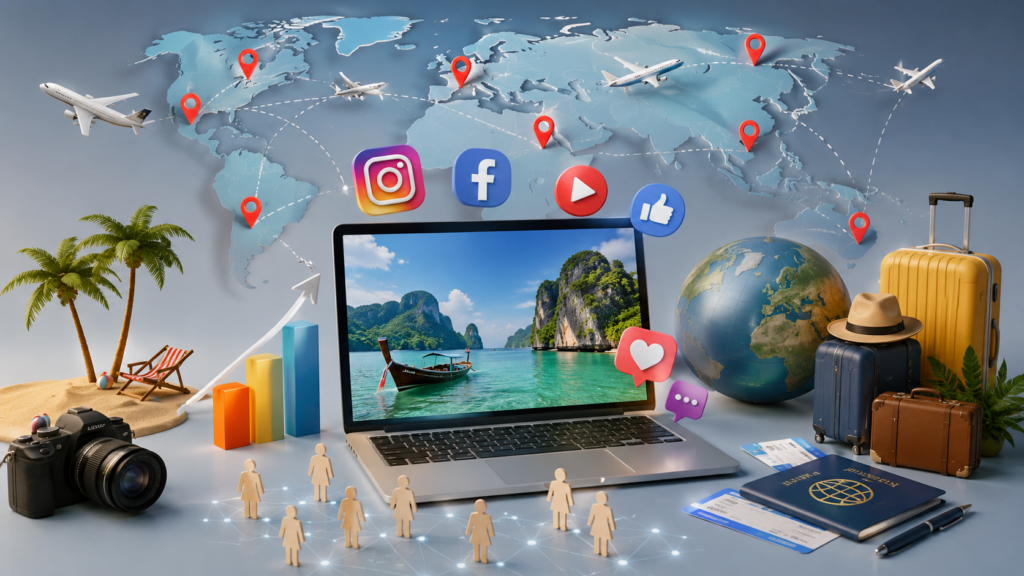 Running a travel business used to feel like a very local game. You built relationships in your city, relied on referrals, spoke with customers over the phone, and hoped someone would recommend your services to a friend planning a holiday. That approach can still work, but the travel industry has changed dramatically. Today, someone sitting thousands of miles away can discover your travel business while scrolling through Instagram, watching a Facebook video, or searching online for ideas for their next trip.
That change completely shifted the way I looked at marketing my travel business.
I initially thought social media was mainly useful for showing beautiful destinations and keeping existing customers engaged. What I eventually realised was far more valuable: social media could become a bridge between my travel business and people in countries I had never marketed to before.
International leads did not appear simply because I created a business page. They came when the right content, audience targeting, advertising, website experience and follow-up process started working together.
The Moment I Realised My Local Audience Was Too Small
When you run a travel business, it is easy to think about customers geographically. You may focus on people living in your city or nearby areas because those are the people you traditionally interact with.
But travel itself has no such boundary.
A person in the United States might be planning a trip to India. Someone in the United Kingdom could be searching for a family holiday in Dubai. A traveller from Australia might be interested in a customised Europe itinerary. These potential customers may never walk into your office, but that does not mean they are inaccessible.
Social media changed that equation.
Instead of waiting for international customers to find my business, I could put my travel services in front of people who were already showing interest in destinations, experiences and travel planning.
That was the real opportunity.
Beautiful Travel Content Was Only the Beginning
Travel is naturally visual. Destinations, hotels, beaches, mountains, cultural experiences and local food can all make compelling social media content.
But attractive pictures alone do not necessarily generate enquiries.
I learned that people need a reason to stop scrolling and then a reason to trust the business behind the post. A photograph of a destination might create interest, but useful content can create intent.
For example, instead of simply posting a picture of Paris, a travel business can discuss the best time to visit, explain how many days a first-time visitor should consider, compare neighbourhoods, discuss family-friendly experiences or explain what a particular budget can realistically cover.
That type of content answers questions before a customer even asks them.
It also makes the business look like a travel expert rather than just another company selling holiday packages.
Instagram Helped Turn Inspiration Into Enquiries
Instagram became particularly valuable because travel and visual storytelling naturally fit together.
A well-optimised profile can communicate what a business offers within seconds. Reels can demonstrate destinations and experiences. Stories can answer quick questions, share customer experiences and create a sense of activity around the brand.
But there is an important difference between having an Instagram presence and actually using Instagram as a marketing channel.
A strong strategy needs consistent content, an understanding of the intended audience, profile optimisation and advertising when appropriate. Complete Gurus, for example, offers Instagram marketing that includes account management, content strategy, hashtag research and Instagram advertising designed around specific audiences.
For a travel business trying to reach international customers, that distinction matters. The objective is not simply to collect followers. The objective is to attract people who could eventually become paying customers.
Facebook Ads Made International Targeting More Practical
Organic social media can introduce your business to new people, but paid advertising can accelerate that discovery.
This was one of the biggest changes in my approach.
Instead of creating one generic advertisement and showing it to everyone, I could think about different audiences. People interested in luxury travel could receive different messaging from budget-conscious travellers. Families could see family-focused packages, while couples might respond better to honeymoon or romantic getaway content.
Location also became important.
If I wanted enquiries from a particular country, I could build campaigns around that market rather than spending money trying to reach everyone. The creative, wording and offer could then be adapted to the people I was trying to reach.
Complete Gurus positions Meta Ads, including Facebook and Instagram campaigns, as part of its performance marketing services, with campaign management focused on targeting, optimisation and measurable business outcomes.
That performance-focused approach is important because international advertising can become expensive very quickly if targeting is based on assumptions instead of actual data.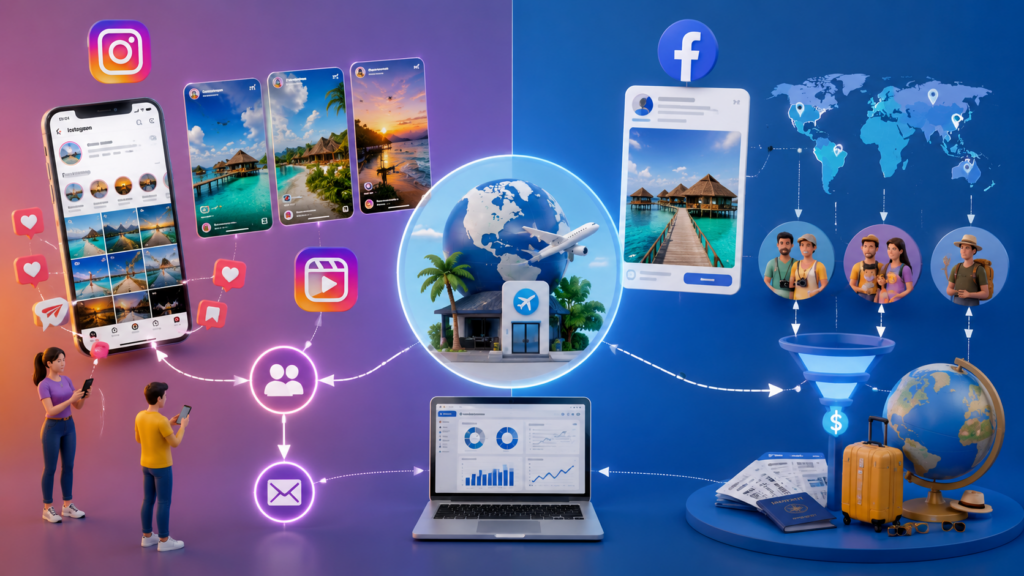
I Stopped Treating Every Lead the Same
One of the biggest lessons from international marketing was that a lead is not automatically a good lead.
Someone might click on a travel advertisement because they like the destination photo. Another person might submit an enquiry because they are seriously planning a holiday within the next two months.
Those two people should not necessarily receive the same follow-up.
Audience research and targeting can help identify who is more likely to become a genuine customer. Social media marketing becomes considerably more powerful when you understand the people behind the clicks.
Complete Gurus highlights audience research and targeting as part of its social media marketing services, alongside content creation, campaign management and data analytics.
For a travel business, this can mean understanding whether an audience is primarily interested in luxury holidays, family travel, adventure experiences, business travel, destination weddings or customised itineraries.
The better the understanding, the more relevant the message can become.
Social Media Was Not Working Alone
Another important realisation was that social media should not operate inside a marketing bubble.
A potential customer might first discover a travel company on Instagram, visit its website later through Google, read a blog post, check reviews and finally contact the business through email or a form.
The customer journey can involve several channels.
That is why combining social media with SEO and paid search can make the overall strategy stronger. Someone who discovers a travel destination through social media may later search for travel agencies offering that destination. If your business appears during that search as well, the customer sees your brand again.
Repeated exposure can make an unfamiliar business feel more credible.
Complete Gurus provides a broader digital marketing mix that includes SEO, Google Ads, Meta Ads, social media marketing, email marketing and AI-search optimisation services such as AEO and GEO.
For businesses looking beyond their home market, this wider approach can be particularly useful because customers rarely follow a perfectly predictable path from advertisement to purchase.
The Website Became Part of the Sales Process
Social media may bring someone to your business, but what happens next matters just as much.
Imagine an international traveller sees an advertisement for a customised India tour. They click through but land on a confusing website with outdated information, unclear packages and no obvious way to enquire.
The advertisement did its job. The website lost the opportunity.
That taught me that lead generation is not just about getting clicks. It is about creating a smooth journey from curiosity to confidence.
The website needs clear information, compelling service pages, strong calls to action, trustworthy messaging and an easy enquiry process. It should answer the questions an international customer is likely to have before they decide to start a conversation.
This is where SEO, content marketing and conversion-focused digital strategy become valuable alongside social media.
Content Built Trust Before the First Conversation
International customers have an additional reason to hesitate: distance.
If someone is booking a trip through a company in another country, they may wonder whether the business is reliable, whether communication will be easy and whether the service will match what was promised.
Content can reduce some of that uncertainty.
Helpful destination guides, itinerary explanations, travel tips, customer stories and behind-the-scenes content can demonstrate knowledge and personality. Instead of repeatedly saying, “Book with us,” the business can show customers why it understands travel.
That difference makes marketing feel less like advertising and more like guidance.
And when someone is planning an expensive holiday, guidance can be much more persuasive than a discount.

Data Told Me What My Audience Actually Wanted
Perhaps the most useful part of digital marketing was discovering that assumptions are often wrong.
I might believe that one destination would generate the most interest, only to discover that another destination produces better enquiries. A particular advertisement might receive many clicks but very few serious leads. Another campaign might receive fewer clicks but generate customers with much stronger buying intent.
Without analytics, both campaigns can look similar at first glance.
With proper reporting, the difference becomes visible.
Complete Gurus emphasises data analytics, reporting and performance tracking as part of its social media marketing approach, allowing campaigns to be adjusted based on what the data shows rather than relying purely on guesswork.
For a travel business, this can mean understanding which markets, messages, destinations and campaigns are actually contributing to business growth.
International Leads Need Better Follow-Up
Getting an enquiry is exciting, but it is not the end of the marketing journey.
An international customer may need more information before making a decision. They may have questions about itineraries, accommodation, transportation, pricing, dates or customisation.
This is where follow-up becomes extremely important.
Email marketing can help keep interested prospects connected with the business instead of allowing an enquiry to disappear after one conversation. Useful destination information, personalised recommendations and timely updates can keep the brand relevant while the customer makes a decision.
Social media may create the first interaction, but email, website content and direct communication can help move that relationship towards a booking.
What Changed Most Was the Way I Thought About Marketing
The biggest transformation was not simply getting enquiries from other countries.
It was understanding that my travel business was no longer restricted by its physical location.
Social media allowed the business to tell stories to people who had never heard of us. Paid advertising allowed us to reach carefully selected audiences. SEO helped us appear when people actively searched. Content helped establish credibility. Analytics showed which efforts deserved more investment.
Together, these channels created something much more powerful than a collection of social media posts.
They created a digital customer journey.
Suggested Reading: Digital Marketing Strategy for Travel Agencies That Actually Works
Conclusion: Your Next Customer Could Be Anywhere
If you run a travel business and feel that your customer base is limited to your local market, social media can open a much larger door. But international lead generation does not happen simply by posting attractive destination photographs every day. It requires strategy, audience understanding, relevant content, targeted advertising, strong landing experiences and consistent follow-up.
The opportunity is especially attractive for travel businesses because people naturally use digital platforms to discover destinations, research experiences and dream about future journeys. Your job is to meet them at the right moment with useful information and a reason to trust your brand.
If you want to turn social media attention into a more structured lead-generation system, Complete Gurus can help bring the different pieces together. Its services span social media marketing, Instagram marketing, Meta Ads, Google Ads, SEO, email marketing, audience targeting, analytics, AEO and GEO, giving businesses the opportunity to build a broader performance marketing strategy rather than depending on one channel alone. For a travel business looking to move from local visibility toward international customers, that kind of connected digital strategy can be the difference between simply being seen online and actually generating valuable business conversations.

Ashutosh Mishra is an AI Visibility & Performance Marketing Expert with 14+ years of experience helping businesses grow through AI Visibility (AEO/GEO), Google Ads, Meta Ads, and SEO. He partners with founders and business leaders to build data-driven growth strategies that increase visibility, improve marketing performance, and help businesses get discovered, trusted, and recommended in the age of AI.