

Quick Summary
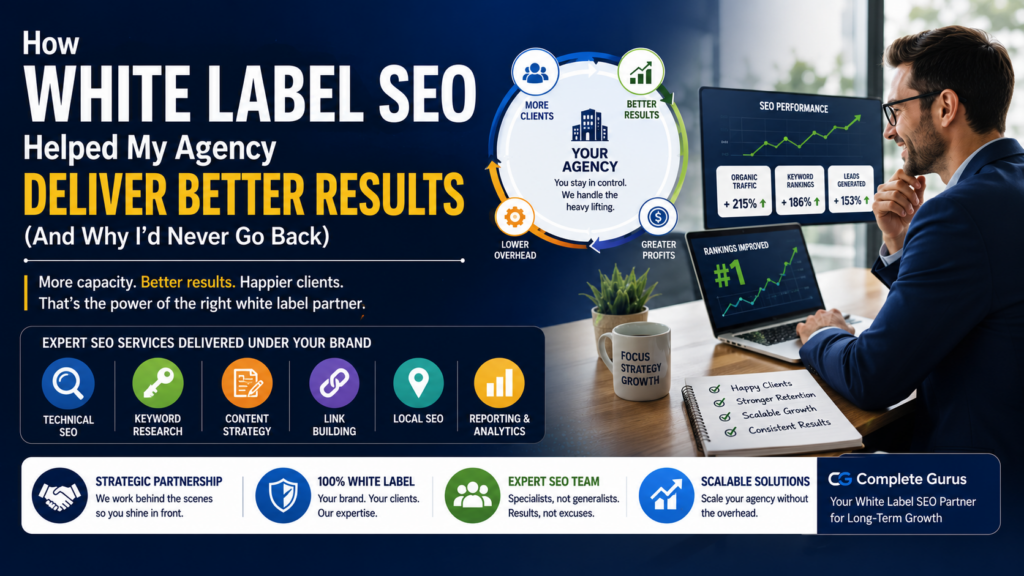
Growing a digital marketing agency doesn’t always require hiring more employees. For many US agencies, partnering with a trusted white label SEO provider is the fastest way to scale operations, improve search rankings, increase client satisfaction, and boost profitability.
Instead of building an expensive in-house SEO department, agencies can leverage experienced specialists to handle keyword research, technical SEO, content optimization, link building, local SEO, and performance reporting—all while maintaining complete ownership of their client relationships.
At Complete Gurus, we help agencies expand their capabilities with white-label SEO, custom website development, PPC management, and digital marketing services that deliver measurable business growth under your brand.
Key Takeaways
✔ White-label SEO helps agencies scale without increasing payroll.
✔ Clients receive enterprise-level SEO under your agency’s brand.
✔ Agencies improve delivery speed, quality, and client retention.
✔ White label partnerships reduce operational costs while increasing profit margins.
✔ Complete Gurus provides comprehensive white label SEO and digital marketing solutions for agencies throughout the United States.
Featured Snippet Answer
What Is White Label SEO?
White label SEO is a partnership where an experienced SEO company performs search engine optimization services on behalf of another agency. The agency sells these services under its own brand while maintaining full ownership of the client relationship.
This allows agencies to offer technical SEO, keyword research, on-page optimization, content marketing, local SEO, link building, SEO audits, and reporting without hiring a large internal SEO team.
Why More Agencies Are Turning to White Label SEO
Running a successful digital marketing agency has never been more demanding.
Clients no longer expect agencies to simply build websites or improve keyword rankings. They expect measurable business growth backed by sophisticated digital strategies that combine search engine optimization, paid advertising, content marketing, website development, conversion optimization, analytics, and ongoing technical support.
For many agencies, keeping up with these expectations has become increasingly difficult.
The SEO landscape evolves continuously. Google’s algorithm updates, AI-powered search experiences, evolving user behavior, Core Web Vitals, structured data, local search optimization, and content quality standards require constant attention.
Meanwhile, agencies must continue acquiring clients, managing relationships, overseeing projects, and delivering measurable results.
Eventually, nearly every growing agency reaches the same crossroads:
Do we continue hiring internally, or do we find a smarter way to scale?
For many successful agencies across the United States, the answer is white-label SEO.
Instead of investing months recruiting experienced SEO specialists, agencies partner with trusted providers that deliver expert execution behind the scenes while allowing the agency to remain the face of the relationship.
The result is faster growth, stronger client outcomes, improved efficiency, and significantly lower operational overhead.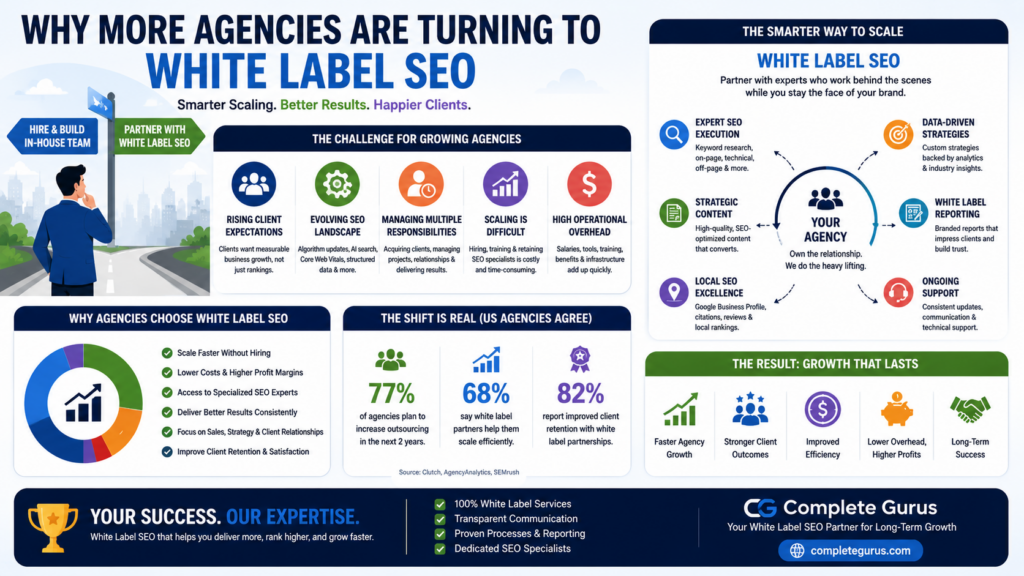
My Agency’s Turning Point
Every agency owner remembers the moment growth stopped feeling exciting and started feeling overwhelming.
For us, that moment arrived after onboarding several large clients within a short period.
On paper, everything looked perfect.
Revenue was increasing.
Our sales pipeline was healthy.
Client demand continued growing.
From the outside, it appeared that our agency had reached an exciting new stage.
Behind the scenes, however, the reality looked very different.
Projects were piling up faster than our team could comfortably manage.
Technical SEO audits became rushed.
Keyword research wasn’t as comprehensive as it should have been.
Content production slowed because our writers were balancing too many campaigns simultaneously.
Monthly reporting shifted from proactive strategic insights to reactive updates designed simply to meet deadlines.
Although clients weren’t immediately unhappy, subtle warning signs began appearing.
Questions became more detailed.
Expectations continued increasing.
Email responses required greater urgency.
Internally, everyone was working harder than ever.
Yet despite those efforts, maintaining consistent quality across every campaign became increasingly challenging.
That’s when I realized something every agency owner eventually learns:
Working harder isn’t always the answer.
Working smarter is.
Why Hiring More Employees Wasn’t the Best Solution
Like many agency owners, my first instinct was simple:
Hire more people.
At first glance, expanding an internal SEO department seems like the logical solution.
Unfortunately, reality is far more complicated.
Recruiting experienced SEO professionals is expensive.
Training new employees requires months before they become fully productive.
Software subscriptions continue growing.
Management responsibilities increase.
Processes become more complicated.
Communication becomes slower.
Even after making those investments, there’s no guarantee new hires will immediately deliver the level of expertise your clients expect.
Meanwhile, client expectations don’t pause while you’re recruiting.
Projects continue arriving.
Deadlines continue approaching.
Competitors continue improving.
I needed a solution that allowed us to expand capacity immediately without compromising quality.
That’s exactly what white label SEO provided.
Understanding White Label SEO
Initially, I had reservations.
Like many agency owners, I worried about losing control over our service quality.
Would another company truly understand our standards?
Would clients notice the difference?
Could outside specialists represent our agency professionally?
Those concerns disappeared once I understood what professional white label SEO actually involves.
White label SEO isn’t outsourcing in the traditional sense.
It’s a strategic partnership.
Your agency remains responsible for:
- Client relationships
- Strategy discussions
- Pricing
- Communication
- Account management
- Brand reputation
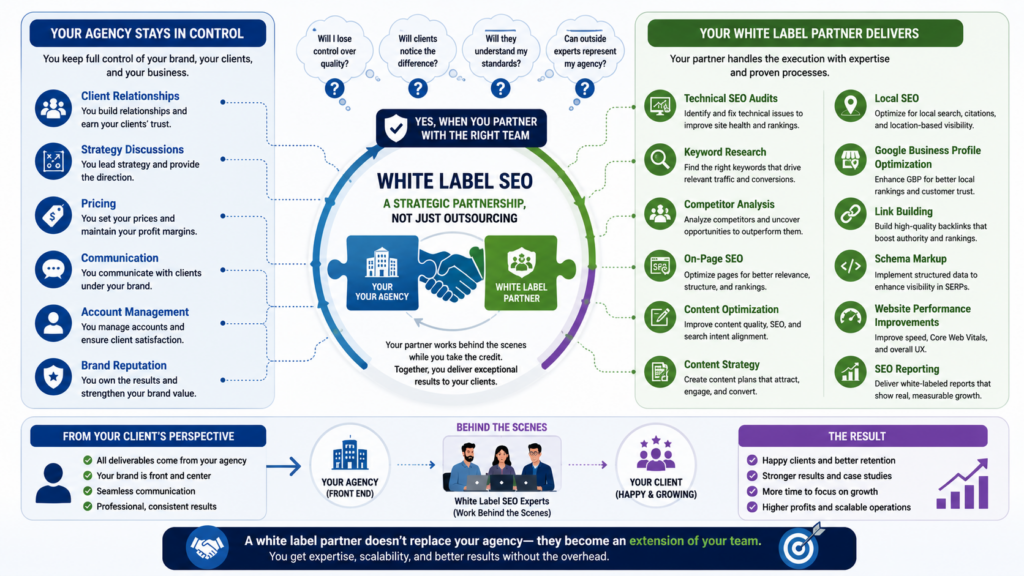
Meanwhile, your white label partner focuses on executing specialized SEO work, including:
- Technical SEO audits
- Keyword research
- Competitor analysis
- On-page SEO
- Content optimization
- Content strategy
- Local SEO
- Google Business Profile optimization
- Link building
- Schema markup
- Website performance improvements
- SEO reporting
From the client’s perspective, every deliverable comes directly from your agency.
Behind the scenes, experienced SEO professionals ensure every campaign meets modern search engine standards.
Rather than replacing your agency, a white label partner becomes an extension of your team.
Choosing the Right White Label SEO Partner
Not every white label provider delivers the same level of expertise.
Some focus primarily on completing tasks.
The best partners focus on achieving business outcomes.
That distinction matters.
An experienced white label SEO provider understands that higher rankings alone aren’t enough.
Clients ultimately care about:
- More qualified website traffic
- Better lead generation
- Increased conversions
- Higher revenue
- Sustainable long-term growth
When evaluating potential partners, I looked beyond pricing.
Instead, I focused on capabilities such as:
Proven SEO Expertise
A reliable partner should demonstrate expertise in:
- Technical SEO
- Local SEO
- Enterprise SEO
- Ecommerce SEO
- Content strategy
- Link acquisition
- Website optimization
Transparent Communication
The best white label providers function as part of your internal team, delivering clear updates, actionable insights, and proactive recommendations.
Scalable Processes
As agencies grow, fulfillment partners must scale alongside them without sacrificing quality or consistency.
Strategic Thinking
Modern SEO extends far beyond keywords.
Today’s successful campaigns combine:
- Search intent optimization
- User experience
- EEAT principles
- Structured data
- AI search optimization
- Content clusters
- Conversion optimization
Complete Gurus stood out because their approach reflected this broader strategic mindset.
Rather than treating SEO as a checklist, they viewed it as an integrated growth system connecting technical optimization, content quality, authority building, user experience, and measurable business outcomes.
That aligned perfectly with our vision.
The Immediate Impact
The improvements weren’t dramatic overnight.
They were something even better.
Consistent.
Every campaign became more organized.
Technical audits became significantly more detailed.
Keyword research evolved from simple search volume analysis into comprehensive topic clustering aligned with search intent.
Content strategies became driven by data rather than assumptions.
Every recommendation supported measurable business goals instead of vanity metrics.
For the first time in months, our agency wasn’t reacting to client demands.
We were leading them.
And that shift changed everything.

Aniket Mishra is a Digital Marketing Specialist with 5+ years of experience in helping businesses grow through data-driven strategies. He specializes in SEO, Meta Ads, Google Ads, AI Marketing, YouTube Growth, Answer Engine Optimization (AEO), Generative Engine Optimization (GEO), Performance Marketing, and Online Reputation Management (ORM) Passionate about AI and digital innovation, he focuses on improving online visibility, generating quality leads, and building strong digital brands through result-driven marketing.