

Summary
Google Ads has started rolling out an AI feature called Video Ads Dubbing inside Asset Studio, and it can translate and dub your existing video ads into 33 languages and locales. This means advertisers don’t have to produce a brand new video for every market, which can save a lot of time and money, especially for small and mid-sized businesses. The feature is available to select advertisers for now. Google has shared strong numbers like an 86% higher click-through rate and a 75% lower cost per click, but these are promotional results and not a guarantee for every account. Advertisers should still review the translation, pronunciation, and cultural fit before going live, and test the dubbed videos against their original ones to see if they really perform better.
September 19, 2026
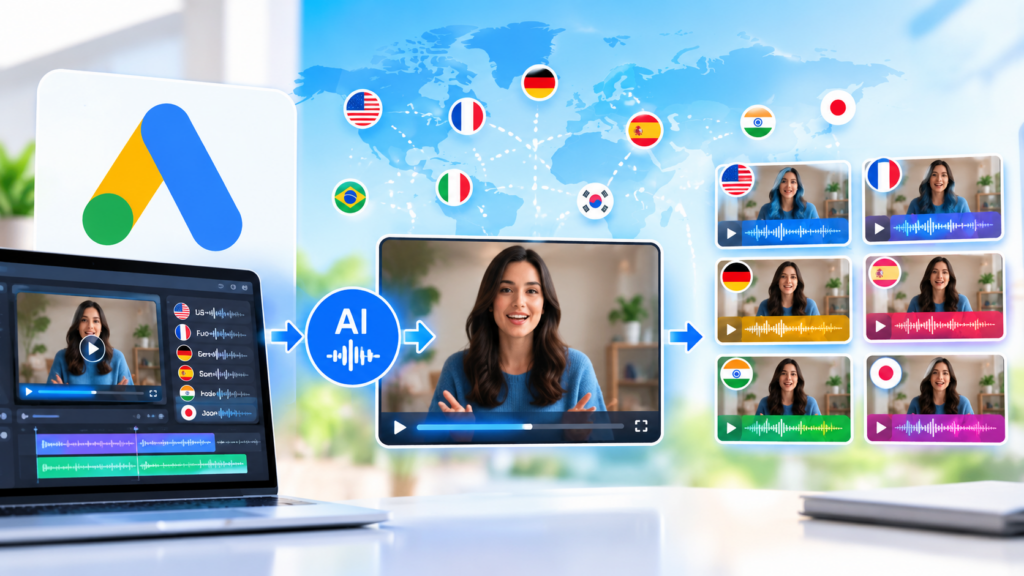
Google Ads just made it a lot easier to take your video ads to other countries. It has started rolling out a new AI feature called Video Ads Dubbing inside Asset Studio.
The idea is simple. You upload a video you already have, and Google’s AI translates and dubs it into another language. According to the latest reports, the tool supports 33 languages and locales. So you don’t have to shoot a brand new video for every market.
So, What Exactly Is Video Ads Dubbing?
It’s an AI tool that lives inside Asset Studio in Google Ads. You take one of your existing videos, pick a language, and get a dubbed version for that market.
Say you’re a US company running an English video ad. With this feature, you could make versions for people who speak other supported languages, without starting from scratch.
This is great news for businesses that want international customers but don’t have the budget to produce a separate video for every country.
One thing to note: Google is rolling this out to select advertisers for now. So you may not see it in your account yet, and availability can be different from one account or market to another.
Why This Matters
Making localised video ads has always been a slow job. Normally you’d have to:
- Translate the script
- Hire voice artists
- Record the voiceovers
- Edit the video
- Sync the new audio with the video
- Review the final version
- Repeat all of this for every market
AI dubbing cuts down a lot of these steps. You start with a video you already have, and the AI does the heavy lifting.
That said, you still can’t skip the human check. You’ll want to go through the translation, the pronunciation, the cultural context, and the overall quality before the ad goes live.
Google Is Adding More AI to Asset Studio
Dubbing is part of a bigger plan. Google wants Asset Studio to become a full AI creative workspace inside Google Ads.
It already helps advertisers create and edit images, text, and videos. It can generate assets using your brief, your brand guidelines, and other inputs. Google has also added AI video creation tools that let advertisers build video assets for campaigns across its ad platforms.
The direction is clear. Google wants you to make your creatives inside Google Ads, without jumping between different tools.
A Big Time-Saver for International Campaigns
The biggest benefit here is time. If you want to run a campaign in a new language, you don’t need to begin from zero. Your existing video becomes the starting point.
For small and mid-sized businesses, this can be a real help, because professional video production for every market gets expensive fast.
Bigger brands can benefit too. They can localise and test creatives across many markets much faster than before.
Will It Improve Your Ad Performance?
Not automatically, no.
Google has shared some impressive numbers linked to this technology, like an 86% increase in click-through rate and a 75% drop in cost per click. But these are Google’s own promotional results. Don’t expect the same results in your account.
Ad performance depends on a lot of things:
- Audience targeting
- Your offer and pricing
- Video quality
- The creative message
- Landing page experience
- Campaign objective
- Competition
- The market itself
- Language and cultural fit
So don’t just assume dubbed videos will do better. Test them against your current creatives and let the data decide.
What It Means for PPC Teams
PPC teams usually spend their time on targeting, bidding, budgets, conversion tracking, and creative testing. But when you run campaigns in several countries, localising creatives becomes a headache.
This is where AI dubbing can help. You can take one winning video concept, make a few language versions, and test them with different audiences. You get to try international campaigns without paying for a new production every time.
Don’t Skip the Human Review
AI can speed things up, but please don’t publish auto-generated videos without checking them first.
A word-for-word translation doesn’t always carry the same meaning in another language. Some phrases, jokes, calls to action, or cultural references need to be adapted, not just translated.
Here’s what to check before going live:
- Voice quality
- Pronunciation
- Translation accuracy
- Brand terminology
- Calls to action
- Cultural context
- Audio timing and sync
This matters even more in regulated industries like healthcare and finance, where ad claims must be accurate.
What This Means for Digital Marketers
This update shows how AI is becoming part of everyday advertising work. It’s no longer just about writing ad copy or brainstorming ideas. Marketers now get AI tools to produce, adapt, and localise complete ad assets.
That could free up teams to spend less time on repetitive production work and more time on strategy, testing, and optimisation. It also makes multilingual advertising possible for businesses that never had the budget for it.
The Bigger Picture
Google’s update is part of a larger shift across the ad industry. Platforms are using AI for:
- Creative generation
- Video production
- Audience targeting
- Bidding
- Campaign optimisation
- Asset testing
- Content localisation
- Performance analysis
Google is pulling many of these into its own ecosystem, and Asset Studio is a big part of that. Advertisers can now create and change assets without depending fully on separate creative software.
What Should Advertisers Do Next?
If you already have access to Video Ads Dubbing, start small. Pick a video that has performed well for you, make a localised version, and compare it with the original.
Keep an eye on these metrics:
- Click-through rate
- Cost per click
- Conversion rate
- Cost per conversion
- Video engagement
- Conversion value
- Return on ad spend
Don’t aim to just make more language versions. Aim to find out whether the localised video actually gets better results for that audience.
Final Thoughts
Google Ads’ Video Ads Dubbing could make multilingual video advertising much faster and easier. With 33 languages and locales supported, select advertisers can now create localised versions of their existing videos without going through the full traditional production process.
It’s one more step toward an AI-driven ad workflow, where creative production, localisation, and campaign management all happen in one place.
But treat AI as a tool for producing and scaling your work, not as a replacement for strategy. You still need to review the final video, understand your audience, and test whether each version really works.
As Google keeps adding AI features to Ads and Asset Studio, video localisation is going to become a much bigger part of performance marketing.