
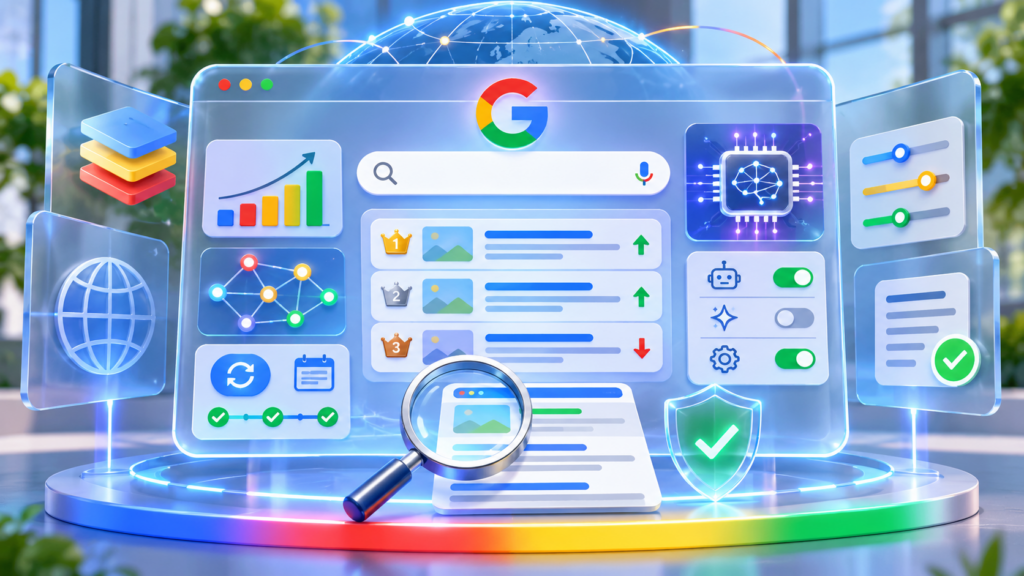
Google has launched a new Search Ranking Transparency Hub to help website owners, publishers, and SEO professionals better understand how its search ranking systems work. Announced on November 24, 2026, the new resource brings together information about algorithm updates, ranking principles, official notifications, and feedback options. Google has also published additional guidance explaining how website content is used in AI-powered search experiences.
Google is taking a new step toward making its search ranking processes easier to understand with the introduction of a dedicated Search Ranking Transparency Hub.
The new hub is available through Google Search Central and is designed to provide clear information about how Google ranks websites, announces important algorithm changes, and collects feedback from website owners.
For many years, businesses and SEO professionals have faced challenges understanding why their website rankings change after Google releases an algorithm update.
Sometimes, a website may experience a sudden decline in organic traffic without an immediately clear explanation.
Google’s latest development aims to improve access to official information and give website owners a better understanding of the search ranking process.
The company has also introduced new documentation about AI-generated search results, source attribution, and website content controls.
These changes arrive as artificial intelligence continues to influence how people discover information through Google Search.
For digital marketers, SEO agencies, content publishers, and online businesses, the announcement provides new resources for monitoring search updates and understanding Google’s approach to ranking transparency.
What Is Google’s New Search Ranking Transparency Hub?
Google’s Search Ranking Transparency Hub is a central resource that explains how the company organizes and ranks information in search results.
The platform brings several important types of information into one location.
These include Google’s ranking principles, official algorithm update announcements, guidance on upcoming changes, and options for submitting feedback about search ranking issues.
Previously, website owners often needed to visit different Google documentation pages to understand these topics.
The new hub makes the information easier to find by organizing it within a dedicated section of Google Search Central.
For example, an SEO professional investigating a decline in website traffic can use the hub to review confirmed ranking updates, learn about Google’s ranking approach, and find relevant troubleshooting resources.
The hub also connects users with the Google Search Status Dashboard, where important algorithm update information is published.
However, the new resource does not provide access to Google’s complete ranking algorithms or reveal the exact formula used to rank individual websites.
Its purpose is to improve transparency around ranking processes, official changes, and available support resources.
Google Explains Three Important Principles Behind Search Rankings
Alongside the new hub, Google published documentation explaining three core principles that guide its ranking systems.
These principles apply to traditional search results and newer search experiences that use artificial intelligence.
Users Come First
Google says its primary objective is to help people find useful and reliable information.
Its ranking systems are designed to prioritize content that meets the needs of searchers.
For example, someone searching for information about buying a new home should receive relevant, accurate, and helpful results.
Websites that provide meaningful answers and useful information may be better positioned to serve those needs.
This reinforces Google’s long-standing emphasis on people-first content.
Consistent Standards Across Search Results
Google explains that different types of search results are evaluated using a common goal: usefulness to the searcher.
These results can include ordinary website links, videos, images, maps, AI Overviews, and other search features.
The company says its ranking systems are not designed to favor particular websites because of their commercial relationships.
It also states that businesses cannot purchase higher rankings in organic search results.
This distinction is important because paid advertising and organic search rankings operate through different systems.
Testing Before Introducing Changes
Google says it carefully evaluates changes to its search systems before introducing them.
The company uses testing, performance measurements, and quality assessments to determine whether an update improves the search experience.
Search quality raters also help evaluate the usefulness of results.
However, individual quality raters do not directly decide the ranking positions of specific websites.
These evaluations help Google assess its broader systems.
Google Will Provide More Information About Important Algorithm Updates
One of the most important changes involves how Google communicates major search ranking updates.
Website owners have often questioned why some algorithm changes are announced while others are introduced without significant advance notice.
The new guidance explains when Google intends to provide notifications about upcoming changes.
Google says it may issue advance notices for important updates that could create widespread ranking changes.
These include major core algorithm updates and actionable policy changes.
For example, if Google introduces a new requirement that affects how websites should structure or present their content, it may notify website owners beforehand.
Similarly, significant ranking updates may receive advance announcements so businesses have more information about upcoming changes.
However, Google has not promised to announce every small algorithm adjustment.
The company regularly makes changes to its search systems, and not all updates require website owners to take action.
The new transparency guidance focuses on changes with broader consequences.
Google Preannounces Its December 2026 Core Update
The launch of the transparency hub comes alongside an important development in Google’s algorithm update communication.
On November 24, 2026, Google preannounced a core update planned for December.
This was an example of the company’s new approach to providing earlier information about significant ranking changes.
The upcoming update is expected to improve how Google understands and ranks content for longer and more complex search queries.
It also relates to improvements in personalized search experiences for users who have enabled personalization.
However, the December 2026 core update had not started rolling out at the time of the announcement.
Google did not provide an exact release date.
Website owners should therefore avoid assuming that ranking movements occurring before the rollout are necessarily caused by the upcoming update.
The announcement provides information about the intended direction of Google’s improvements rather than a complete explanation of how individual websites will be affected.
For SEO professionals, early notification may make it easier to plan monitoring and reporting activities.
Google Introduces a More Structured Ranking Feedback Process
Google has also published new guidance explaining how website owners can submit feedback about ranking changes.
The system is designed to help Google understand possible problems caused by significant algorithm updates.
Verified website owners can submit feedback through Google Search Console when relevant ranking changes or policy updates are announced.
Google recommends including detailed information about the issue.
This may include affected website URLs, search queries, countries, languages, and changes in website performance.
For example, a publisher may notice that its original article has lost visibility while a website copying the same content appears more prominently.
The publisher can provide relevant examples and explain why the search results may not be useful.
Google also recommends identifying the relevant update using a specific hashtag.
For example, feedback about the November 2026 core update can reference #NovemberCoreUpdate2026.
This makes it easier to connect reports with particular updates.
However, submitting feedback does not mean Google will manually restore a website’s ranking.
The company explains that its engineering teams review feedback collectively to identify larger problems affecting search quality.
The process is intended to improve the overall search system rather than provide individual ranking guarantees.
How Website Owners Can Track Confirmed Google Updates
The new Search Ranking Transparency Hub directs website owners to several official information sources.
One of the most important is the Google Search Status Dashboard.
This dashboard provides information about confirmed ranking updates, including when major updates begin and when their rollouts are completed.
Website owners can also use the Google Search Central Blog to follow important announcements.
Google’s documentation updates page provides additional information about changes to official SEO guidance.
For businesses managing several websites, these resources can help distinguish actual algorithm announcements from speculation.
For example, SEO monitoring tools may report unusual ranking fluctuations on a particular day.
However, those fluctuations do not automatically mean Google has launched a new core update.
By checking Google’s official records, marketers can confirm whether a significant update has been announced.
This can help reduce unnecessary website changes based on unverified industry discussions.
Google also provides RSS and Atom feeds that can help website owners follow new announcements.
Google Publishes New Guidance on AI Search Content Controls
Alongside the ranking hub, Google released additional documentation about how website content may be used in generative AI systems.
This is especially relevant as Google continues expanding AI Overviews, AI Mode, and other AI-powered search experiences.
Many website owners want to understand how their published information is used by artificial intelligence.
Some publishers are concerned about AI systems generating answers from their content without users visiting the original websites.
Google’s new documentation explains different controls that website owners can use to manage how their content is handled.
One of these is Google-Extended.
Google-Extended is a control that allows publishers to manage certain uses of their content for training and grounding Google’s generative AI models and related systems, according to the scope described in Google’s documentation.
Google has clarified that using Google-Extended does not automatically remove a website from Google Search results.
It is also not used as a traditional Google Search ranking signal.
Importantly, website owners should understand that AI model training and the use of content to support responses in Google Search are different activities.
The available controls do not necessarily apply in exactly the same way to every Google AI product.
Google’s additional documentation aims to explain those differences more clearly.
Google Explains How Websites Are Selected for AI Overviews and AI Mode
Another important part of Google’s new documentation concerns attribution and citations in AI-powered search features.
AI Overviews and AI Mode can display generated responses that include links to supporting websites.
For publishers and SEO professionals, an important question is how Google decides which websites appear as sources.
Google’s documentation explains that its AI search systems aim to select relevant and useful information that helps answer the user’s question.
The selection process is connected to Google’s broader goal of providing helpful search results.
However, appearing in traditional organic search results does not guarantee that a website will be cited in an AI-generated answer.
Similarly, a page does not automatically receive an AI citation simply because it uses structured data or answers a question in a particular format.
Google’s AI-powered search systems may evaluate multiple sources when preparing a response.
The information selected can depend on the search query, available sources, and the usefulness of the material.
For businesses investing in Answer Engine Optimization and Generative Engine Optimization, this provides an important reminder.
Useful, accurate, accessible, and original content remains essential.
But no single optimization method can guarantee a website’s inclusion in AI-generated search results.
What Does This Update Mean for SEO Professionals?
The new transparency hub could make several everyday SEO activities easier to manage.
The first benefit is access to more organized information about Google ranking updates.
SEO professionals can refer to official documentation when explaining algorithm changes to clients.
This may help reduce confusion when rankings fluctuate.
The second benefit is a clearer process for reporting possible search quality problems.
Website owners can now follow documented steps when submitting feedback about significant ranking changes.
The third benefit is improved information about Google’s overall ranking principles.
This may help SEO teams focus on creating useful content and maintaining technically accessible websites.
However, the announcement does not introduce a new SEO ranking factor.
Google has not stated that using the transparency hub will improve website rankings.
It is an information and feedback resource rather than a search optimization tool.
SEO agencies should use it alongside existing tools such as Google Search Console, website crawlers, performance reporting systems, and technical SEO audits.
How Businesses Should Respond to Sudden Ranking and Traffic Changes
A sudden decline in Google Search traffic can create concern for any business.
However, making immediate changes without understanding the problem may not be the best approach.
Google recommends waiting until a major update has completed before evaluating its effects.
Its new guidance advises website owners to review at least one additional week of post-rollout data when assessing ranking changes.
This helps reduce the risk of making decisions based on temporary fluctuations during an active rollout.
For example, suppose an ecommerce website experiences a 20% decline in organic clicks during a core update.
The business should first determine whether the decline affects the entire website or only certain pages.
It should also compare search queries, countries, devices, and landing pages.
Google Search Console can help identify where performance changed.
The website owner should then investigate possible technical problems, content quality issues, seasonal demand changes, or other relevant factors.
Not every traffic decline is caused by an algorithm update.
Website errors, broken redirects, indexing problems, and changing customer behavior can also affect organic performance.
The transparency hub can provide useful context, but a complete SEO investigation still requires reviewing the website’s own data.
Why This Development Matters for AEO and GEO
Answer Engine Optimization and Generative Engine Optimization have become increasingly discussed areas of digital marketing.
These approaches focus on making content useful and discoverable in systems that generate answers or recommendations using artificial intelligence.
Google’s new ranking principles provide additional context for understanding how AI-powered search fits into the broader search ecosystem.
The company emphasizes that its systems are designed to prioritize helpful information across different search formats.
This suggests that businesses should avoid treating AI search visibility as a completely separate activity from ordinary SEO.
For example, a website publishing technical guides should ensure that the information is original, accurate, clearly organized, and accessible to search engines.
It may also benefit from providing examples, relevant supporting information, and clear explanations of important concepts.
These practices can support ordinary search visibility while making information more useful to readers and AI-powered discovery systems.
However, AEO and GEO strategies should be assessed through realistic business outcomes.
AI mentions, citations, organic clicks, qualified leads, and actual customer conversions can all provide useful information.
A high AI visibility score alone does not guarantee business growth.
New Transparency Measures Come Amid Greater Regulatory Attention
The launch of the ranking transparency hub also comes during increased regulatory attention toward major search platforms.
In the United Kingdom, the Competition and Markets Authority has introduced requirements concerning fairness and transparency in Google Search.
These measures address issues such as how ranking systems operate, how significant changes are communicated, and how affected businesses can raise concerns.
Google’s new documentation acknowledges UK-specific requirements for advance notice when certain significant ranking changes may affect users in that market.
The wider issue is important because search engines can have a major influence on how people discover businesses, products, and information.
For many companies, Google Search remains an important source of website visitors and potential customers.
Changes to ranking systems can therefore have commercial consequences.
Greater transparency may help businesses better understand the environment in which their websites compete.
However, transparency does not mean Google will disclose every detail of its ranking technology.
The company continues to protect information about its systems while explaining their broader principles and processes.
Will Google’s New Transparency Hub Improve Website Rankings?
The new hub does not directly change how individual websites rank in Google Search.
It provides information about ranking systems rather than introducing a new ranking factor.
For this reason, businesses should not expect their rankings to improve simply because they follow or use the hub.
Its main value is helping website owners make better-informed decisions.
For example, a business experiencing a traffic decline can check whether a confirmed algorithm update occurred during the relevant period.
It can then examine performance data and review Google’s official guidance before deciding what changes are needed.
The resource can also help agencies explain the difference between confirmed updates and unverified ranking fluctuations.
This may support more effective SEO planning and communication.
However, improving search performance still depends on factors such as content relevance, website accessibility, useful information, competition, and customer search behavior.
The new documentation offers guidance, not guaranteed ranking improvements.
How Digital Marketing Agencies Can Use the New Hub
Digital marketing agencies can incorporate Google’s new transparency resources into their existing SEO reporting processes.
One useful approach is to review the Google Search Status Dashboard during regular website performance checks.
Agencies can compare confirmed algorithm update dates with changes in client traffic and rankings.
They can also use the official ranking principles when explaining Google’s approach to search quality.
For example, if a client’s website loses visibility after a core update, the agency can examine whether the decline affects specific types of content or search queries.
Instead of immediately rewriting every page, the team can identify the most important problems and prioritize appropriate improvements.
The feedback documentation may also help agencies prepare detailed reports about possible systemic ranking issues.
For clients interested in AI search optimization, Google’s new content control and attribution resources provide additional background.
These documents can help clarify the differences between traditional SEO, AI search visibility, and AI model content usage.
The result could be a more structured approach to SEO management, client communication, and technical investigation.
What Comes Next for Google Search Transparency?
Google’s latest announcement indicates that the company is placing more emphasis on explaining its search ranking processes.
The Search Ranking Transparency Hub introduces a central location for official guidance, while the new documentation provides additional information about algorithm notifications and website owner feedback.
The company’s decision to preannounce the December 2026 core update also demonstrates a more proactive approach to communicating certain major changes.
Meanwhile, the new AI documentation reflects growing questions about how generative AI systems use information from websites.
As Google continues developing AI Overviews, AI Mode, and other search experiences, website owners are likely to pay increasing attention to attribution, content controls, and visibility measurement.
However, Google has not announced that every future algorithm update will receive advance notification.
It has also not introduced a system that guarantees individual website owners can appeal ordinary ranking changes and obtain manual ranking adjustments.
The new resources are designed to improve understanding and feedback rather than provide direct control over search positions.
For SEO professionals, the most useful response is to follow official announcements, monitor performance carefully, and continue focusing on website quality.
Conclusion
Google’s launch of the Search Ranking Transparency Hub on November 24, 2026, represents an important development for website owners, publishers, and SEO professionals.
The new resource brings together official information about Google’s ranking principles, important algorithm updates, advance notifications, and feedback processes.
At the same time, Google has expanded its documentation explaining how website content is used in generative AI systems and how sources are selected for AI-powered search responses.
These developments could help businesses better understand Google’s approach to ranking changes and AI search.
However, the update does not introduce a new ranking algorithm, provide access to Google’s complete ranking formula, or guarantee higher positions in search results.
For digital marketers, the main opportunity is to make better decisions using accurate information.
Monitoring confirmed Google updates, understanding search performance, maintaining strong technical SEO, and publishing genuinely useful content will remain important.
As artificial intelligence continues changing how people search for information, clear communication between search platforms and website owners is becoming increasingly valuable.