




Is ChatGPT Ads Available for Small Businesses?
Quick Summary Short answer: yes. ChatGPT Ads are opening up to businesses of all sizes, small ones included though it still depends on where you're located and whether you have access to OpenAI's Ads
Travelers no longer only browse listicles and scroll through search results — they ask ChatGPT to plan a five-day itinerary, ask Perplexity to compare hotels, and read AI Overviews before ever visiting a booking site. Complete Gurus helps travel and tourism businesses become the answer AI tools give when someone is planning a trip.
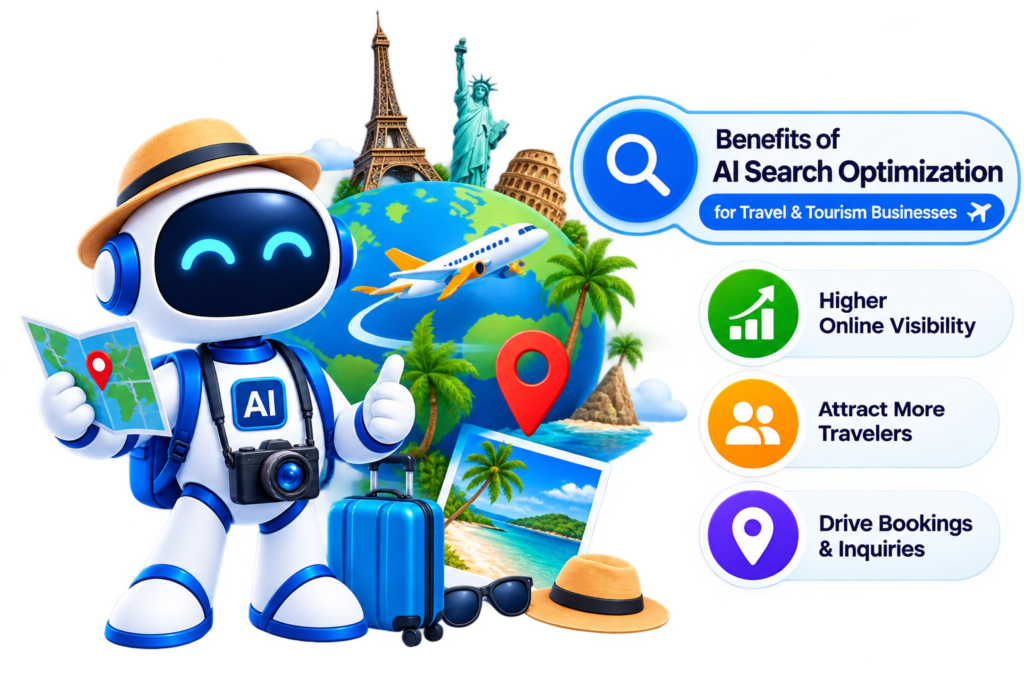
Trip planning is research-heavy, comparison-driven, and increasingly conversational, which makes AI Search Optimization especially relevant for travel and tourism businesses.
When someone asks an AI tool to help plan a trip, they often receive a direct, structured answer naming specific hotels, tours, or attractions. If your business isn't part of that answer, you don't just rank lower in a search — you may not enter the traveler's consideration at all.
Traditional search gets someone to a listing, where they then decide whether to trust it. An AI-generated itinerary or recommendation already carries an implied endorsement before the traveler ever reads a review or compares prices directly.
Questions like "what's a good area to stay in for first-time visitors" or "is this tour suitable for kids" are exactly the kind of natural-language, back-and-forth queries AI tools are built to handle, and this behavior is becoming a standard part of how people plan travel.
Because AI Search Optimization is still new for most travel businesses, those that build strong AI visibility now can establish a meaningful edge before more competitors and destinations catch on to the shift.
AI Search Optimization for travel and tourism businesses comes with challenges that are distinct from other industries and still evolving as the technology matures.
traditional search engines with more established, publicly discussed ranking signals, AI models' citation behavior for travel recommendations and itineraries is less transparent, making optimization more experimental.
Travel businesses often list on multiple OTAs, their own website, and various directories, and inconsistent pricing, availability, or descriptions across these sources can create confusion that reduces accurate citation by AI models.
AI tools often weigh review volume, recency, and sentiment heavily when forming travel recommendations, meaning a business's own website content alone is rarely enough to secure strong AI visibility.
AI tools often weigh review volume, provider credentials, and third-party validation heavily when forming healthcare-related recommendations, meaning a practice's own website content alone is rarely enough to secure strong AI visibility.
AI models favor content that directly and clearly answers a specific question, rather than dense clinical language that requires interpretation. We restructure and create content to directly address the natural-language questions patients ask, such as "what causes," "when should I see a doctor for," or "what's the difference between," while maintaining medical accuracy and appropriate clarity.
Schema markup and structured data help AI systems accurately understand product details, pricing, availability, reviews, and brand information. We implement and maintain structured data across product pages and key content to improve machine readability and reduce the risk of misinterpretation.
AI models often synthesize information from multiple sources. We audit how your property or business is described across your own site, OTA listings, review platforms, and travel directories, correcting inconsistencies in pricing, amenities, or descriptions that could confuse AI-driven summarization.
Because AI models weigh review volume, recency, and sentiment heavily, we focus on strengthening your review presence and encouraging fresh, detailed reviews that give AI tools clear signals about what your restaurant does well and for which occasions it's a strong fit.
Much AI-driven dining discovery happens through occasion-based or comparison questions. We develop content that clearly and accurately positions your restaurant for relevant use cases, such as date nights, business lunches, family gatherings, or specific cuisine preferences.
Since AI queries are often phrased conversationally, we build FAQ-style and conversational content that mirrors how real customers ask questions, improving the likelihood that AI tools surface accurate, relevant answers sourced from your content.
We track how and when your brand appears across major AI search tools for relevant category and comparison queries, providing visibility into a channel that traditional analytics tools don't measure directly.
Because AI search behavior and citation logic continue to evolve, we treat AI Search Optimization as an ongoing process, adjusting content, structured data, and trust-building strategy as we observe how AI tools respond over time.
Get a free consultation and learn how we optimise every channel for growth
Complete Gurus builds AI Search Optimization programs designed around how AI tools discover and reference law firms and legal information
We start by researching how your brand currently appears (or doesn't appear) across major AI search tools for relevant product, category, and comparison queries, along with an audit of your existing content and structured data.
We review how your brand, products, and details are represented across your website, marketplaces, and third-party sources, identifying inconsistencies and trust-signal gaps that could be limiting AI citation.
We build a content plan focused on answer-oriented, conversational content and comparison positioning, alongside a structured data implementation plan to improve machine readability.
We support strategies to strengthen reviews, comparison mentions, and earned media presence that contribute to how AI models evaluate your brand's trustworthiness.
AI Search Optimization, sometimes called generative engine optimization, is the practice of structuring a travel business's content, data, and trust signals so that AI tools like ChatGPT, Perplexity, Gemini, and Google AI Overviews are more likely to accurately reference, cite, or recommend the business when travelers ask relevant trip-planning questions.
Traditional SEO and OTA optimization focus on ranking well in search results or booking platform listings so travelers find and click through. AI Search Optimization focuses on being cited or recommended directly within AI-generated itineraries and answers, which relies on different signals, including content clarity, information consistency, and review strength.
We monitor how frequently and accurately a business appears in AI-generated responses to relevant destination, comparison, and itinerary queries across major AI tools. This is a newer and less standardized form of measurement than traditional search or OTA analytics, and we're transparent about the current limitations in tracking this channel.
Timelines vary depending on a business's current review volume, online presence, and how AI tools currently source information about the destination or category. Because this is an evolving field, results often build gradually as content, structured data, and trust signals are strengthened over time.
Yes. AI Search Optimization complements rather than replaces OTA listings and traditional SEO. Many of the same foundational elements, like accurate information and strong reviews, support all three, and travelers still use booking platforms and search engines alongside AI tools for research.
Optimization focuses on the AI tools most relevant to trip planning, including ChatGPT, Perplexity, Google AI Overviews, and Gemini, with strategy adjusted for differences in how each platform sources and weighs travel information.
Smaller businesses can improve their AI visibility, particularly for specific niches, traveler types, or destination-level searches, though major OTAs and large, well-reviewed brands often have a natural advantage. A focused strategy on specific positioning and strong review signals can help independent businesses compete more effectively.
Ongoing work is strongly recommended. AI search tools, their citation behavior, and traveler planning patterns are all still evolving, and maintaining strong AI visibility requires continued monitoring, content updates, and trust-building rather than a single initial setup.
Quick Summary Short answer: yes. ChatGPT Ads are opening up to businesses of all sizes, small ones included though it still depends on where you're located and whether you have access to OpenAI's Ads
Quick Summary ChatGPT Ads are a real opportunity, but "having a business" isn't the same as "being eligible to advertise." OpenAI wants advertisers who operate in approved markets, sell permitted pro
Quick Summary ChatGPT Ads work nothing like Google Ads. Instead of bidding on keywords, you're showing up inside actual conversations people are having with ChatGPT while they research, compare, or d
18 Aug
Netflix’s rise from a DVD-by-mail service to the world’s biggest streaming platform comes down to one thing: it never treated…
Read More
03 Aug
Summary This case study explores how Zomato and Swiggy grew from food-ordering apps into two of India’s largest digital convenience…
Read More
18 Jul
NVIDIA is one of the best examples of how a company can become a global brand without relying on traditional…
Read More