
Quick Summary
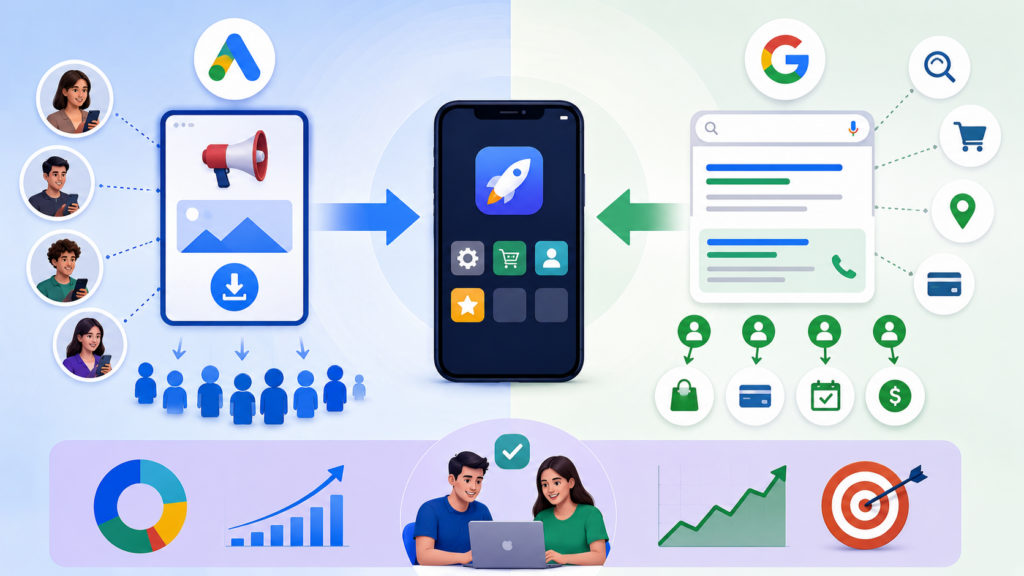
App Install Campaigns and standard Google Ads serve different roles in the customer journey. App campaigns are designed to drive downloads and can work especially well when the app is central to ordering, booking, subscribing or repeat usage. Standard Google Ads, particularly Search, can be stronger when users already have clear intent and are actively looking for a product, service or solution.
The key is not to judge performance by cheap installs or clicks alone. Businesses should measure registration, purchases, enquiries, bookings, repeat usage, revenue, ROAS and customer value. The better campaign is ultimately the one that produces stronger downstream business results and profitable customers.
For a business with a mobile app, getting people to download it can feel deceptively simple. You create an advertisement, put some budget behind it, and wait for installs. Yet anyone who has actually managed paid advertising knows that an install is only the beginning. The real question is whether those users open the app, register, make a purchase, book a service, or return later.
That is where the comparison between App Install Campaigns and Standard Google Ads becomes important. Both can bring valuable users, but they approach the customer journey differently. One is designed around getting your app into more hands, while the other can capture people actively searching for a product, service, solution, or brand.
For someone deciding where to put their advertising budget, the answer is not simply that one campaign type is always better. The stronger option depends on the business model, audience intent, conversion event, app experience, budget, and what happens after the click or installation.
Complete Gurus approaches Google Ads from a performance perspective, focusing on measurable business outcomes rather than surface-level advertising numbers. Its services cover Google Search, Shopping, Performance Max, mobile app advertising, Meta Ads, SEO, AEO, GEO, and marketplace marketing, giving businesses the opportunity to connect paid campaigns with a broader growth strategy.
What Makes App Install Campaigns Different?
App Install Campaigns are built around a very specific objective: encouraging potential users to download a mobile application. Instead of asking someone to visit a website and complete an action there, the campaign is designed to move that person toward installing the app.
That distinction matters because the advertising journey becomes shorter. Someone sees an ad, interacts with it, reaches the app store or installation flow, and potentially becomes an app user.
For an app-based business, this can be incredibly useful. A food delivery company, fitness platform, shopping app, booking service, financial application, or entertainment platform may need a large base of users before it can generate meaningful revenue.
But there is an important catch.
A cheap install does not automatically mean a profitable customer.
Suppose one campaign produces thousands of installations at a low cost. That sounds impressive until you discover that most users uninstall the app within a few days or never complete registration. Another campaign might generate fewer installations at a higher cost but produce users who make purchases repeatedly.
The second campaign may actually be the better performer.
This is why app advertising needs to move beyond install volume and examine what users do after installation.
Why Standard Google Ads Can Still Be Powerful
Standard Google Ads, particularly Search campaigns, work differently because they can reach people when they are actively looking for something.
Imagine someone searching for “best meal delivery app,” “online doctor consultation,” “book hotel near me,” or “accounting software for small business.” That search already tells you something about their intent.
They are not simply browsing.
They have a problem, requirement, or interest and are looking for a solution.
That makes standard Google Search particularly attractive for businesses where customer intent plays a major role. Instead of trying to convince a completely unfamiliar audience to install an app, you can place your offer in front of someone who has already expressed interest through a search.
Complete Gurus manages Google Search alongside Shopping, Performance Max, Display, and Local Services campaigns, with campaign structures designed around business objectives such as CPA, ROAS, leads, and revenue.
For many businesses, that broader control can make standard Google Ads more valuable than chasing installations alone.
App Installs Are Not the Same as Customer Acquisition
This is probably the biggest mistake businesses make when comparing these campaigns.
An installation is an event.
A customer is a relationship.
The difference can completely change how you evaluate performance.
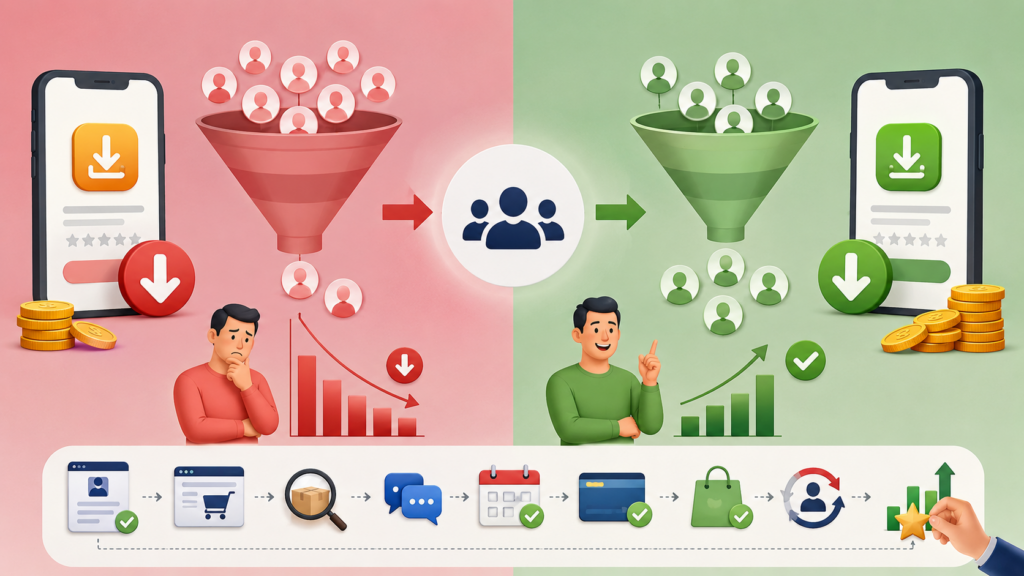
If you spend ₹50 to acquire an install, it may initially look successful. But if only a small percentage of those users become paying customers, your real acquisition cost is much higher.
Now imagine another campaign where the average install costs ₹100, but those users are much more likely to purchase. Suddenly, the apparently expensive campaign may deliver better economics.
For this reason, businesses should look beyond install cost and monitor events such as registration, product views, enquiries, subscriptions, bookings, purchases, repeat purchases, and customer lifetime value.
The campaign that produces the strongest downstream business result is the one worth scaling.
When App Install Campaigns Can Work Better
App campaigns can be particularly effective when the app itself is central to the customer experience.
If customers need the app to place orders, manage subscriptions, make bookings, access loyalty benefits, or use a service regularly, increasing the number of quality app users can create long-term value.
Consider a grocery delivery application. A new customer may install the app today, place an order tomorrow, and then use it every week. In that situation, the initial installation has the potential to become the first step in a much longer customer relationship.
App campaigns can also make sense when your business already has strong brand recognition and the main challenge is increasing adoption.
However, the app needs to provide a convincing reason to install. If the website already offers everything a customer needs and the app adds little value, advertising heavily for installations may produce weak retention.
When Standard Google Ads Can Work Better
Standard Google Ads often have an advantage when the customer is already searching for a solution.
Think about a person looking for an emergency plumber, a dental clinic, a software provider, a legal service, or a particular product. They may not care whether the company has an app. They care about solving their immediate need.
In those situations, forcing the customer through an app installation can add unnecessary friction.
A well-structured Search campaign can instead send the person directly to a landing page, product page, enquiry form, booking page, or phone call.
For B2B businesses, this distinction becomes even more important. A decision-maker searching for enterprise software may be far more valuable as a qualified lead than as an app installation.
Complete Gurus specifically positions its B2B paid advertising around qualified leads and pipeline quality rather than simply generating large volumes of leads.
The Real Winner Depends on Your Conversion Journey
There is no universal winner between the two.
The better campaign is the one that fits the way your customers actually buy.
If the journey looks like ad → app install → registration → purchase → repeat purchase, an app-focused campaign can be a strong choice.
If the journey looks more like Google search → landing page → enquiry → sales call → customer, standard Search Ads may make considerably more sense.
Trying to use the same measurement framework for both can lead to bad decisions.
A business might pause its Search campaign because the cost per click is higher than the cost per install from an app campaign. But that comparison is meaningless if the Search campaign generates significantly more revenue per customer.
The advertising metric should always connect back to the business objective.
Creative Quality Can Change the Outcome
Campaign type gets a lot of attention, but creative quality can quietly determine whether the campaign succeeds.
For app advertising, the message needs to communicate why someone should download the application. A generic “Download Now” message may not be enough.
What does the user get?
Is there a faster booking experience? Exclusive pricing? Easier ordering? Loyalty rewards? Personalised recommendations? Better access to services?
The advertisement needs to answer that question quickly.
Standard Search Ads require a different approach. Here, relevance and messaging need to closely match what the person searched for. Someone looking for a specific service should immediately understand what the advertiser offers and why it is worth considering.
This is where campaign structure, keyword research, ad copy, landing pages, targeting, and ongoing testing work together.
Complete Gurus’ mobile app Google Ads service includes campaign setup and optimisation, ad copy creation and testing, keyword research, and bid management. Its approach is designed around reaching relevant mobile audiences and improving performance rather than simply launching advertisements and leaving them untouched.
Landing Pages Still Matter in an App-First Strategy
It is tempting to believe that an app campaign means your website no longer matters.
That is rarely true.
Before installing an app, a potential customer may still research the company, compare alternatives, read reviews, check pricing, or visit the website. The quality of that broader experience can influence whether the person trusts the brand enough to install.
Standard Google Ads make this even more obvious.
You can have an excellent advertisement, but if the landing page loads slowly, feels confusing, lacks relevant information, or does not match the promise made in the ad, the campaign can lose potential customers.
Paid advertising cannot permanently compensate for a poor post-click experience.
Measurement Should Start With Revenue, Not Vanity Metrics
One of the biggest advantages of performance marketing is that businesses can make decisions using actual data.
Instead of asking only, “How many people clicked?” or “How many people installed the app?”, a better question is, “What did those users ultimately contribute to the business?”
That could mean revenue, qualified leads, purchases, bookings, subscriptions, or another meaningful conversion.
Complete Gurus highlights performance reporting around metrics such as spend, revenue, ROAS, CPL, and conversion data, giving businesses a clearer picture of whether advertising is producing commercially useful results.
This approach becomes especially important when comparing two campaign types with different objectives.
A campaign generating 5,000 installs cannot automatically be considered better than one generating 500 qualified enquiries.
The business outcome decides the winner.

What Businesses Should Test Before Choosing One
Rather than committing an entire advertising budget to one approach immediately, businesses can learn more by testing campaigns against clearly defined conversion goals.
An app business could compare installation volume, registration rate, first purchase rate, cost per paying user, and customer value.
A service business could compare clicks, calls, enquiries, qualified leads, booked appointments, and eventual sales.
The important part is consistency. Both campaigns should be evaluated using a measurement framework that connects advertising activity to commercial results.
This also gives you a much better understanding of your customers. Sometimes the data reveals something unexpected. Perhaps people install the app easily but rarely purchase. Maybe Search users cost more initially but convert at a much higher rate. Or perhaps app users become extremely valuable after their first transaction.
Those insights are more useful than simply declaring one campaign the winner.
How Complete Gurus Can Help Build the Right Google Ads Strategy
Choosing between App Install Campaigns and standard Google Ads is only one part of the larger performance marketing picture.
A business may need Google Search for high-intent customers, Shopping for product discovery, Performance Max for broader automated reach, Meta Ads for prospecting and remarketing, and SEO for sustainable organic visibility.
Complete Gurus provides these services as part of a broader digital marketing offering. Its Google Ads work includes Search, Shopping, Performance Max, Display, Local Services Ads, and mobile app campaigns, while its wider services include Meta Ads, SEO, AEO, GEO, B2B lead generation, eCommerce marketing, and marketplace support.
For eCommerce businesses, its Google Ads offering also covers Shopping campaigns, Performance Max, product-feed optimisation, remarketing, and RLSA, with strategies built around product margins and revenue goals.
That broader view can be valuable because customers rarely move through a perfectly straight advertising funnel. Someone may discover your brand through one channel, search for it later, visit your website, install your app, and finally become a customer after several interactions.
Suggested Reading: How Google Ads Helped My App Get More Downloads Faster
The Better Strategy Is the One That Understands Your Customer
So, App Install Campaigns vs Standard Google Ads what worked better?
The honest answer is that neither wins automatically.
App Install Campaigns can be highly effective when the application is central to the customer journey and when installations lead to meaningful engagement, purchases, or repeat usage. Standard Google Ads can be stronger when customers actively search for a product or service and are ready to take action without installing an app.
The smartest approach is not to chase the cheapest install or the lowest click cost. It is to understand what a valuable customer looks like, track the journey from advertisement to revenue, and then invest more heavily in the campaign that consistently produces profitable outcomes.
For businesses that want help making that decision rather than guessing with their advertising budget, Complete Gurus offers performance-focused Google Ads and digital marketing services built around measurable growth. Its approach combines campaign strategy, optimisation, reporting, Google Ads management, Meta Ads, SEO, AEO, GEO, eCommerce marketing, and mobile app advertising so businesses can build a marketing system around actual customer behaviour not simply collect clicks and installations.

Ashutosh Mishra is an AI Visibility & Performance Marketing Expert with 14+ years of experience helping businesses grow through AI Visibility (AEO/GEO), Google Ads, Meta Ads, and SEO. He partners with founders and business leaders to build data-driven growth strategies that increase visibility, improve marketing performance, and help businesses get discovered, trusted, and recommended in the age of AI.