
Quick Summary
The blog explains how a more strategic approach to YouTube SEO helped transform channel growth from inconsistent views into steady progress towards 10K subscribers. Rather than relying on content quality alone, the strategy focused on matching videos with real search intent through stronger titles, descriptions, keywords and metadata, while improving thumbnails, CTR, watch time, audience retention and engagement.
The key lesson is that YouTube SEO is not about manipulating the algorithm. It is about helping YouTube understand your content while giving viewers a compelling reason to discover, click and continue watching it. Combining keyword research, analytics, audience-focused content and consistent optimisation can create sustainable visibility and subscriber growth over time.
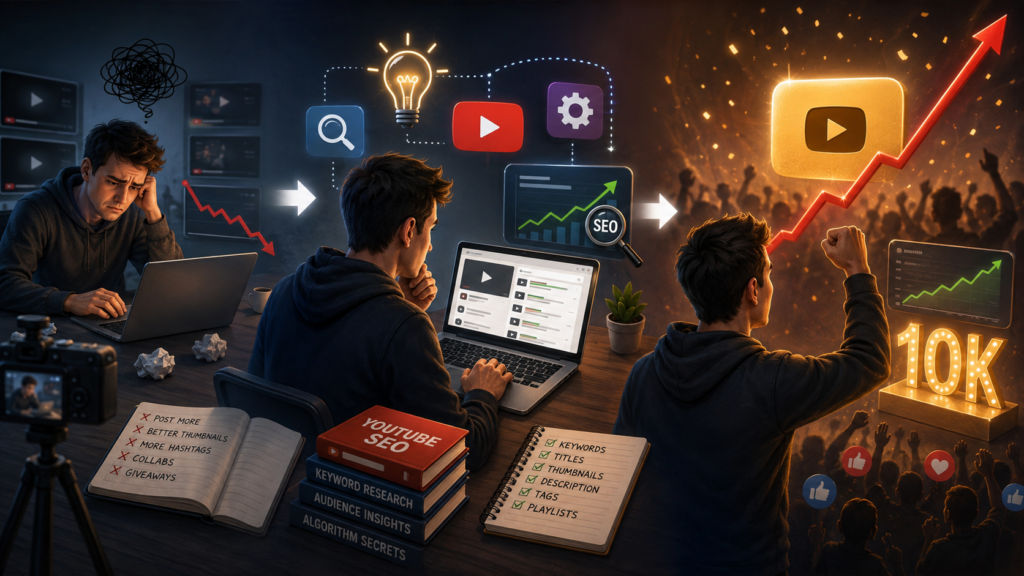
I still remember the night I hit 10 000 subscribers on my YouTube channel. It wasn’t a random viral moment. It wasn’t some overnight fame. In fact, it was the result of a long, often frustrating journey where I tried everything from posting more videos to redesigning my thumbnails a dozen times. But nothing truly moved the needle until I discovered the power of YouTube SEO and the difference it made was nothing short of transformational.
Before that night, I had felt stuck in a cycle of frustration. My content was solid. I cared about every idea I posted. But something wasn’t clicking. Views trickled in, but they never turned into loyal subscribers. I began questioning whether my passion project could ever grow beyond my immediate circle of friends and family. That all changed when I finally embraced SEO with intent not as a mysterious buzzword, but as a real strategy that connected my content with the people who were actually searching for it.
What I learned along the way was far richer than “keywords go here” advice. It was a deep dive into how YouTube’s algorithm truly works, how audiences discover videos every day, and how small tweaks in the right places can unlock visibility that feels almost unfair. And when I combined that hands-on learning with support from experts who live and breathe YouTube SEO, the results started to accelerate.
Let me take you through my journey not as a case study of luck, but as a story of strategy, persistence, and the right guidance so you can see how YouTube SEO might help your channel reach 10K subscribers faster too. This is the story of how I turned a passion project into a channel people actually found and followed with intention.
Understanding Why Most Channels Don’t Grow
At the beginning, I thought content quality alone would drive growth. If I uploaded good videos, surely viewers would come, right? That’s the hope most of us start with. But in reality, YouTube is a search engine and recommendation engine first. Without optimization, your content sits quietly and waits to be discovered which usually means it might never be.
The problem isn’t passion or creativity. It’s visibility. So many creators pour their hearts into content that never gets the exposure it deserves because they underestimate how YouTube finds and serves videos to people. YouTube isn’t just a platform where content sits, it’s a living ecosystem where discoverability matters.
I remember watching other creators with similar content to mine suddenly blow up with subscribers. It wasn’t that their videos were inherently better. It was that their videos were findable; they were optimized for search, suggested traffic, and viewer retention. And that made all the difference.
Most creators focus on viewpoints that feel intuitive, great thumbnails, cool intros, posting schedules but overlook the deep science of SEO that truly connects content with intent.
That’s where my journey took a turn. Instead of creating videos only for the few who already found me, I started creating for the audience who was actively searching for the answers, entertainment, or insights embedded in my videos. That shift from “posting content” to “creating discoverable content” was the first domino that changed everything.
What YouTube SEO Really Means
When I first heard “YouTube SEO,” I thought it was some mystical optimization that only technical experts could do. In reality, it’s a practical set of actions that helps your videos show up in search results and recommended feeds.
Most people associate SEO with websites and Google search. But YouTube, owned by Google, also uses complex ranking systems only here, keywords, metadata, watch time, engagement signals, and viewer behavior play critical roles. It’s not just about stuffing keywords; it’s about shaping your video so YouTube understands what it’s about and when to suggest it.
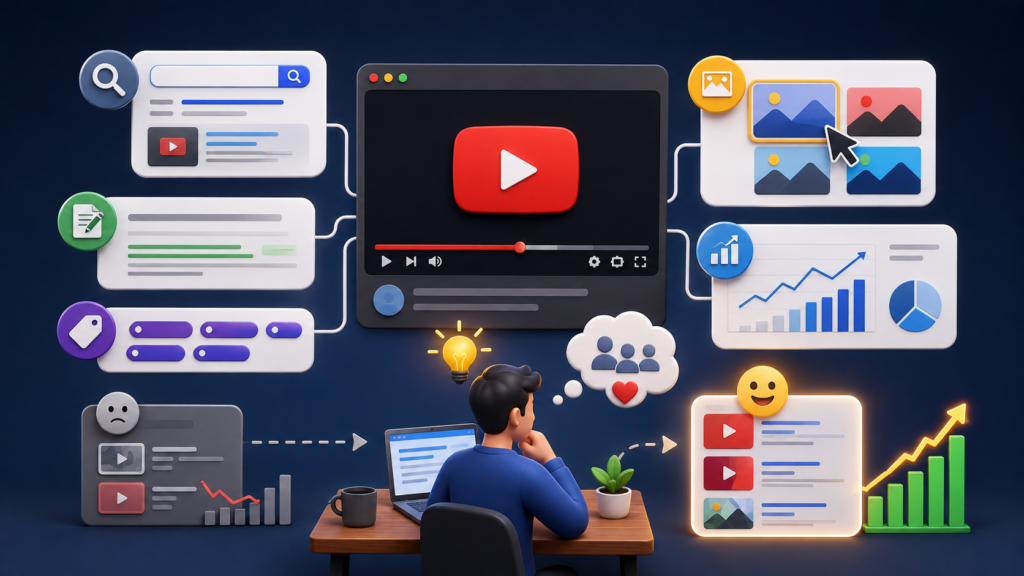
I learned that the key elements of YouTube SEO include:
Drafting titles that match what people
are actually searching for.
Writing descriptions that explain the
content in natural language while including relevant phrases.
Selecting tags that reinforce theme and
context so YouTube can categorize your video.
Optimizing thumbnails so they signal value
to both humans and algorithms.
Tracking analytics watch time, CTR, impression
rate to fine‑tune future videos.
Before I refined my approach to these fundamentals, I was posting videos that only my subscribers could find easily. I didn’t understand how to connect those videos with the search intent of a broader audience. Once I focused on these elements, suddenly my channel began to show up in suggested lists, search results, and “related videos” more often. This led to steady growth, instead of random spikes once in a while.
This shift was the most human part of the SEO journey: it made me think like my viewers. I began to anticipate what they would search for, how they’d describe their problem or curiosity, and how my video could answer that. SEO became not just a technical task it became a creative challenge in matching my content with real human needs.
The First Breakthrough: Improved Titles and Descriptions
The moment I saw a real effect from SEO was surprisingly simple: I changed the way I wrote titles and descriptions. Previously, I would write titles like “My Thoughts on X” or “Video About Y.” Those titles were fine for people who already knew me, but they didn’t match the phrases most viewers were searching for.
When I learned what people were typing into YouTube, searched the actual phrases, questions, and keywords and adjusted my titles to speak that language, views started to climb in a way that felt almost instantaneous.
Instead of generic titles, my videos began to sound like answers to specific questions:
“How To Solve X Problem Fast” instead of
“Here’s My Opinion on X.”
“Beginner’s Guide to Y in 2025” instead of
“New Video About Y.”
These weren’t clickbait, they were honest, search-aligned titles that helped both people and the algorithm understand what my video was about. And when people could find my videos in search results, they watched more.
Descriptions mattered too. Early on, I treated the description as an afterthought to a couple of sentences with links. But over time I learned to use the description to naturally weave in a useful context. Including relevant phrases, explaining what the video covers, and describing how the content helps viewers made my videos more discoverable and gave YouTube more cues for matching search queries.
This was the first real breakthrough that made me think differently: YouTube SEO isn’t about tricking the system, it’s about communication. You are telling YouTube who should see your video and why they should watch it.
How YouTube Analytics Became My Compass
Once my titles and descriptions improved, the next shift came when I started looking deeper into YouTube analytics, not just views and likes, but behavioral metrics like CTR (click‑through rate), watch time, and audience retention.
Seeing real numbers transformed my approach entirely. Before that, I was guessing what worked and what didn’t. After analytics entered the picture, I was learning from what viewers actually did.
Analytics showed me which videos had strong engagement, which topics resonated longer, and which parts of a video caused people to drop off. By optimizing future content based on this data, I consistently produced videos that were more aligned with what my audience wanted, instead of what I assumed they wanted.
CTR and impressions became especially critical. YouTube shows your thumbnails and titles to people but it’s CTR that tells YouTube if people clicked because it looked promising. And when watch time was higher, YouTube began recommending my videos more frequently to users watching similar content.
This created a positive feedback loop: better SEO led to higher visibility, analytics helped refine content, and refined content improved engagement which, in turn, triggered even more favorable recommendations from YouTube’s algorithm.
It was a kind of growth I had only dreamed about when I had fewer than 1000 subscribers. But once the mechanism clicked, I could measure what worked and do more of it. That insight shifted my progress from slow and haphazard to predictable and steady.
Why Thumbnails and Engagement Signals Matter
SEO doesn’t live in isolation. In fact, titles and descriptions only work if people actually click your video. That’s where thumbnails come in acting as the first emotional signal a viewer sees.
I used to slap random screenshots as thumbnails. After studying the data, I realized people were ignoring them. My thumbnails lacked clarity, emotion, and relevance.
Great thumbnails don’t just look pretty, they promise a benefit: a snapshot of value that the viewer immediately understands. Whether it’s a bold expression, contrasting colors, or readable text that teases what’s inside, thumbnails became one of the biggest levers in my channel’s growth.
Combined with optimized titles, thumbnails increased my CTR dramatically. And high CTR sends a strong signal to YouTube that your video deserves attention which leads to more visibility in search results and suggestions.
But it wasn’t just about design. Engagement signals such as likes, comments, shares, and watch time all started to become central to my SEO strategy. I began actively asking viewers to engage not in a begging way, but in ways that invited responses:
“What do you want next?”
“Tell me if this helped you in the comments.”
“Share this with someone who might benefit.”
These small prompts encouraged participation and built a sense of community, which is another strong signal that tells YouTube your content is worth promoting. SEO isn’t just keywords, it’s about creating meaningful interactions that signal value to the algorithm.

Content Strategy and Keyword Mastery
If you really want YouTube SEO to work for you, you have to think of your content strategy as a dialogue between search intent and value delivery. I learned to plan my videos not only around topics I cared about, but around what people were searching for and how they searched for it.
This meant spending time on keyword research discovering what phrases were trending in my niche and which search terms had meaningful demand. I began to use tools and expert support to identify high‑traffic keywords, and then tailor my video concepts to fit those terms without sacrificing authenticity. That balance was key.
Keyword mastery doesn’t mean stuffing your title with phrases that don’t feel natural. Instead, it means speaking the language your audience uses when they are searching. When I aligned my video topics with actual search trends, I started to appear in places where viewers were already looking for answers.
Not only did this approach increase views, it attracted the right kind of subscribers, people interested in what I consistently offered, rather than casual visitors who clicked once and left. The growth became sustainable because it was rooted in real demand.
Consistency and Long‑Term Growth
SEO and growth don’t happen overnight. When I first learned about SEO best practices, I expected a sudden spike. Instead, what I got was momentum that built over time. Each video I optimized added incremental value to my channel as a whole.
Consistency mattered more than perfection. Posting regularly and optimizing every upload signaled to YouTube that my channel was active, dependable, and worth recommending. That consistency, combined with SEO, produced compounding growth that eventually pushed me past the 10 K mark.
It didn’t feel like luck. It felt like progress you can measure and reproduce.
How Expert Guidance Accelerated My Growth
While I learned many aspects of YouTube SEO on my own, what truly accelerated my growth was partnering with experts who had done this many times before. YouTube SEO isn’t a static checklist it evolves as the algorithm changes and as viewer behaviors shift. Having experienced support meant I could adapt faster and avoid mistakes that would have cost time and traction.
Complete Gurus’ team brings deep understanding of YouTube’s algorithm and trends to the table, helping with keyword research, video metadata optimization, thumbnail design, analytics interpretation, and more. This combined expertise helped me navigate the complex landscape of SEO in a structured and effective way, turning points of confusion into clarity.
Rather than guessing what might help, I had data‑informed strategies implemented that guided my channel toward better visibility, engagement, and ultimately, more subscribers.
Suggested Reading: Why Magento SEO Is a Game-Changer for eCommerce Stores
Conclusion
Reaching 10 000 subscribers wasn’t about luck. It was about understanding how YouTube connects viewers with content, learning how to make my videos findable, and consistently improving every aspect of my channel’s presence. YouTube SEO transformed my channel from something quiet and unseen into a destination where people found value and chose to subscribe.
If you’re serious about growing your channel, the lesson I learned is this: YouTube SEO isn’t optional, it’s foundational. It’s not about tricks or shortcuts. It’s about understanding your audience, speaking their language, and giving YouTube the clues it needs to show your videos to the right people at the right time.
And that’s exactly why partnering with experienced YouTube SEO professionals can make such a lasting difference. If you want support that accelerates your channel’s growth through strategic optimization, storytelling, and technical insights, check out https://completegurus.com/ where expert guidance meets real results.

Ashutosh Mishra is an AI Visibility & Performance Marketing Expert with 14+ years of experience helping businesses grow through AI Visibility (AEO/GEO), Google Ads, Meta Ads, and SEO. He partners with founders and business leaders to build data-driven growth strategies that increase visibility, improve marketing performance, and help businesses get discovered, trusted, and recommended in the age of AI.