
Quick Summary
This article recounts a developer’s frustration after launching a Play Store app that had a clean interface and positive early feedback, yet remained buried in search results with almost no downloads. The turning point came from realizing that Google Play doesn’t automatically surface new apps — ranking depends on signals like keyword relevance, metadata, engagement, and reviews. The author walks through the fixes that reversed the trend: researching how users actually search (rather than relying on brand-focused language), rewriting the title and description to blend keywords with readability, redesigning screenshots and the icon around storytelling and benefits, prompting for reviews at the right moments, improving retention and onboarding, and studying competitor listings to spot gaps rather than copy them.
The piece concludes that the app’s poor ranking was never about product quality but about discoverability, and that ASO is what bridged that gap — gradually turning stagnant installs into steady organic growth. It closes with a promotional nod to “Complete Gurus,” an agency offering professional ASO services (keyword research, listing optimization, visuals, and review management) for businesses wanting to accelerate this process.
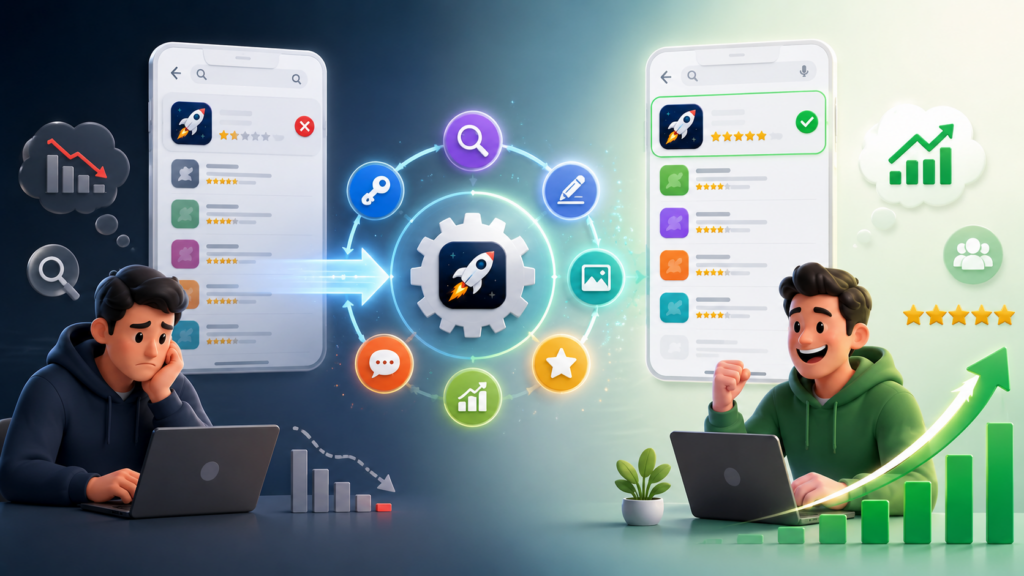 Launching a mobile application often feels like the finish line. After months of development, testing, debugging, and polishing every screen, you finally hit the “Publish” button on the Play Store. You imagine downloads climbing, reviews pouring in, and users discovering the product you worked so hard to build. But for many developers and businesses, reality hits differently.
That moment when you search for your own app in the Play Store and it barely appears, sometimes not even within the first hundred results can feel confusing and frustrating. You start asking questions. Is the app not good enough? Did the launch fail? Why are similar apps ranking higher even though they seem less polished?
This experience is surprisingly common. The truth is that publishing an app is only the beginning of the journey. With millions of apps competing for attention in app stores, visibility does not happen automatically. Ranking requires a strategic process known as App Store Optimization, or ASO, which improves how an app appears and performs in store search results.
My own experience with an app that struggled to rank taught me a valuable lesson: success in the Play Store is not just about building a great product, it is about making sure people can actually find it.
What follows is the story of why my app was invisible at first, the mistakes I made without realizing it, and how ASO completely changed its trajectory.
The Harsh Reality After Launching My App
When the app first went live, everything seemed perfect. The interface was clean, the features worked smoothly, and early testers loved it. Friends and colleagues installed it and gave positive feedback. From a product perspective, everything looked promising.
But something strange happened.
Days passed. Then weeks.
Downloads barely moved.
Even when searching for keywords related to the app’s core function, it was nowhere near the top results. Sometimes it appeared far below competitors that looked outdated or poorly designed.
At first, I assumed it just needed time. Maybe the Play Store algorithm needed to “discover” the app.
But that assumption turned out to be wrong.
The Play Store does not automatically promote new apps. Instead, it relies on signals like keywords, metadata relevance, downloads, engagement, reviews, and listing quality to determine rankings.
Without optimization, even a great app can remain invisible.
Understanding the Competition Inside the Play Store
Before diving deeper into optimization, I began researching the environment my app was competing in.
The scale of competition was shocking.
Every category in the Play Store is crowded with alternatives. For nearly every idea, there are dozens or hundreds of similar apps competing for the same audience.
In this environment, visibility depends heavily on search optimization.
Users typically discover apps in three main ways:
Searching keywords in the Play Store.
Browsing category rankings.
Exploring recommendations and related apps.
If an app does not appear in relevant searches, it loses the biggest source of organic downloads.
That realization shifted my entire perspective. The problem was not necessarily the product. The problem was discoverability.
The Biggest Mistake I Made: Ignoring ASO
When I launched the app, I focused entirely on development and functionality.
What I ignored was optimization.
The Play Store listing was written quickly. The title was basic. The description explained features but did not include strategic keywords. Screenshots were uploaded without thinking about conversion psychology.
In short, the listing existed but it was not optimized.
ASO works in a similar way to SEO for websites. It focuses on improving app metadata, keywords, visuals, and user engagement so the app ranks higher in search results and attracts more downloads.
Without ASO, the algorithm has very little information to understand what the app is about or when to show it to users.
Once I realized this, the solution became clear: the app needed optimization.
Discovering the Power of Keyword Research
The first step in fixing the ranking problem was understanding what people were actually searching for.
This seems obvious, but it is often overlooked.
Developers tend to describe their apps in technical or brand-focused language. Users, however, search differently. They use practical terms that describe the problem they want to solve.
For example, instead of searching for the name of an app, users might search phrases like:
Budget tracker
Habit tracker
Fitness planner
Photo editor
Language learning app
If your listing does not include the phrases people search for, the Play Store algorithm struggles to match your app to those searches.
Keyword research reveals which search terms have strong demand and manageable competition. It also helps determine how to structure the title, description, and metadata for better visibility.
Ignoring keyword research is one of the most common ASO mistakes because it prevents apps from appearing in relevant search results.
Once I reworked the keywords strategically, something interesting started happening.
The app began appearing in search results.
Fixing the App Title and Metadata
The title of an app is one of the most powerful ranking factors in the Play Store.
Initially, my title only included the brand name.
While branding is important, the Play Store algorithm relies heavily on descriptive keywords in the title to understand what the app does.
The solution was simple but effective.
Instead of using only a brand name, the title included both the brand and the primary keyword describing the app’s function.
This instantly improved relevance.
The short description was also rewritten to clearly communicate the core benefit of the app using natural keywords.
Small adjustments like these may seem minor, but they dramatically improve how the algorithm interprets the app listing.
Rewriting the Description for Humans and Algorithms
The original description explained the app’s features but lacked structure and keyword relevance.
Optimizing it required balancing two goals.
The text needed to be readable and persuasive for users while also including important keywords for ranking.
The improved version focused on:
Explaining the core problem the app solves.
Highlighting key features clearly.
Including keywords naturally throughout the text.
Encouraging downloads with a clear value proposition.
The first few lines of the description became particularly important because users often see only a preview before expanding the full text.
That opening section now communicated the main benefit instantly.
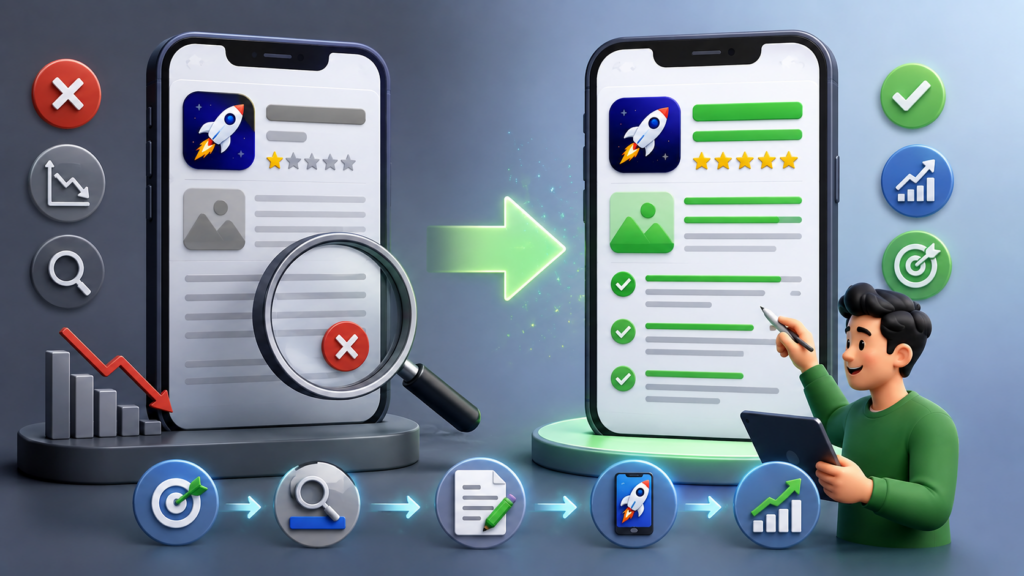
Transforming Visual Assets to Increase Conversions
One of the most overlooked aspects of ASO is visual optimization.
Many users decide whether to install an app based on its icon, screenshots, and preview visuals before reading the description.
Research shows that visuals strongly influence download decisions because they help users quickly understand the app experience.
The original screenshots simply displayed different screens of the app.
They were functional but not persuasive.
The new screenshots focused on storytelling.
Each image communicated a benefit:
Solve a problem
Save time
Improve productivity
Track progress
Simple captions explained what each feature did.
The icon was also redesigned to be more recognizable and visually clean.
These changes improved conversion rates dramatically.
The Role of Ratings and Reviews in Rankings
Another factor affecting app visibility is user feedback.
Apps with higher ratings and consistent reviews tend to rank better because they signal quality and trust to the algorithm.
Early on, the app had only a handful of reviews.
After optimizing the in-app experience and politely prompting users to leave feedback, the review count gradually increased.
Positive reviews improved both credibility and ranking potential.
Responding to user feedback also helped build trust with the audience.
Improving Engagement and Retention
ASO does not end with metadata and visuals.
The Play Store also evaluates how users interact with the app after installing it.
Metrics such as retention, crash rates, and engagement affect ranking signals.
If users install an app but uninstall it quickly, it sends a negative signal.
Improving onboarding, fixing performance issues, and simplifying the user experience can significantly impact long-term visibility.
In many ways, ASO and product design work together.
Better user experience leads to better engagement, which leads to stronger rankings.

Analyzing Competitors to Find Opportunities
One of the most eye-opening parts of the ASO journey was competitor analysis.
By studying top-ranked apps in the same category, patterns started appearing.
Successful apps consistently optimized their:
Titles
Keywords
Screenshots
Descriptions
Brand messaging
They clearly communicated their value to users.
Instead of copying competitors, the goal was to identify gaps.
What features were missing?
What messaging could be clearer?
What benefits could be emphasized more effectively?
This insight helped refine the app’s positioning and differentiate it from others in the category.
The Turning Point: When Downloads Finally Increased
After implementing these ASO improvements, the changes were not immediate but they were noticeable.
Over time, search impressions increased.
Then installs started rising.
The app began appearing for multiple keywords related to its function.
Organic downloads gradually replaced the initial trickle of installs.
What felt like a failing launch slowly turned into a growing user base.
That moment was a powerful reminder that visibility in the Play Store is not random.
It is the result of strategy.
Why ASO Is Essential for Every App
Many developers believe marketing begins after an app is built.
In reality, optimization should start even before launch.
ASO ensures that the app is positioned correctly from day one.
Without it, even excellent products can disappear in the massive catalog of apps competing for attention.
Effective ASO can increase discoverability, downloads, and user engagement by aligning the app listing with how users search and evaluate apps.
In many ways, it is the bridge between a great product and the audience that needs it.
How Professional ASO Experts Accelerate Growth
Learning ASO independently can take time.
Testing keywords, analyzing competitors, optimizing visuals, and monitoring results require both experience and data-driven strategies.
That is why many businesses choose to work with specialized ASO professionals.
Experienced experts understand how Play Store algorithms work, how to identify high-impact keywords, and how to design listings that convert visitors into users.
They also monitor performance continuously and refine strategies based on analytics.
This approach saves time and significantly improves results.
Suggested Reading: How ASO Helped My App Get 5K Downloads in One Month
Conclusion
Looking back, the reason my app failed to rank initially had nothing to do with its functionality.
The real issue was visibility.
Without proper optimization, the Play Store simply did not understand what the app offered or when to show it to potential users.
App Store Optimization changed everything.
By improving keywords, metadata, visuals, reviews, and user experience, the app gradually moved from obscurity to discoverability.
For anyone struggling with low downloads or poor ranking, the lesson is clear.
Building an app is only the first step.
Ensuring people can find it is equally important.
Businesses that want to accelerate this process often work with professional ASO specialists who understand how to navigate the complexities of app store algorithms and user behavior. Companies like Complete Gurus provide dedicated experts who research keywords, optimize listings, improve visuals, manage reviews, and implement conversion strategies designed to increase app visibility and downloads. Their data-driven approach helps apps stand out in competitive marketplaces while driving organic growth and long-term success.
In the end, the difference between an app that succeeds and one that stays invisible often comes down to one critical factor: optimization.

Ashutosh Mishra is an AI Visibility & Performance Marketing Expert with 14+ years of experience helping businesses grow through AI Visibility (AEO/GEO), Google Ads, Meta Ads, and SEO. He partners with founders and business leaders to build data-driven growth strategies that increase visibility, improve marketing performance, and help businesses get discovered, trusted, and recommended in the age of AI.